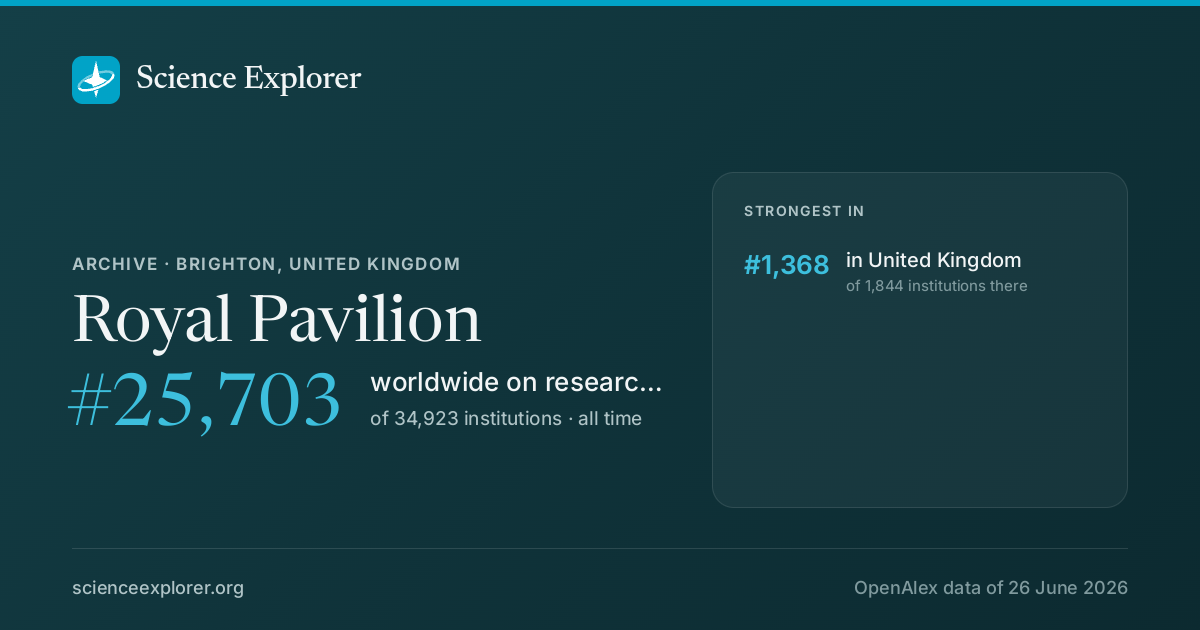
- World rank, all time
- #25,703 of 34,923
- Rank in United Kingdom
- #1,368 of 1,844
- Research works
- 205 ▲ 13% vs 2018-21
- Citations
- 3.2k 15.5 per fractional work
- Top-10% rate
- 5.3% all institutions 10.0%
- vs its own fields
- 0.90× 1.00× is exactly expected
- Open access
- 29% world 40%
- International
- 43% world 18%
Which fields of science does Royal Pavilion work in?
In all years, 51% of research at Royal Pavilion is in Health Sciences, 28% in Social Sciences. Its largest fields are Medicine (43%), Social Sciences (13%), Arts and Humanities (10%). It does 2.1× the world's share of Health Sciences.
Each ring splits the one inside it: the four domains of science, their fields, their subfields. Size is fractional works in all years. Every slice is a page; the interactive view zooms down to single topics and colours each by how much more of it this institution does than the world.
Its 4 domains and 24 fields, with their numbers
- Health Sciences10451.0%
- Medicine8943.2%
- Health Professions136.4%
- Dentistry20.8%
- Nursing10.4%
- Veterinary00.2%
- Social Sciences5828.3%
- Social Sciences2612.6%
- Arts and Humanities2110.3%
- Economics, Econometrics and Finance31.6%
- Psychology31.5%
- Decision Sciences31.3%
- Business, Management and Accounting21.0%
- Physical Sciences2512.4%
- Engineering157.1%
- Computer Science41.9%
- Environmental Science31.6%
- Earth and Planetary Sciences10.6%
- Mathematics10.4%
- Physics and Astronomy10.3%
- Chemistry10.3%
- Materials Science00.1%
- Life Sciences178.3%
Field profile
Location quotient across every field it publishes in: outside the ring is more than an institution of this size would be expected to publish, inside it is less.
Rings at 0.5×, 1× and 2×. Widest outward: Veterinary, 7.8×. Every wedge is a field page.
All 17 fields, with their numbers
- Veterinary7.79×0 works
- Pharmacology, Toxicology and Pharmaceutics4.31×0 works
- Arts and Humanities4.05×2 works
- Mathematics2.52×1 works
- Medicine1.91×7 works
- Social Sciences1.71×4 works
- Immunology and Microbiology0.90×0 works
- Earth and Planetary Sciences0.81×0 works
- Health Professions0.73×0 works
- Computer Science0.68×1 works
- Biochemistry, Genetics and Molecular Biology0.65×1 works
- Engineering0.55×2 works
- Economics, Econometrics and Finance0.40×0 works
- Agricultural and Biological Sciences0.36×0 works
- Decision Sciences0.15×0 works
- Environmental Science0.14×0 works
- Physics and Astronomy0.05×0 works
- Veterinary 7.8×
- Pharmacology, Toxicology and Pharmaceutics 4.3×
- Arts and Humanities 4.0×
- Mathematics 2.5×
- Medicine 1.9×
- Social Sciences 1.7×
- Immunology and Microbiology 0.9×
- Earth and Planetary Sciences 0.8×
- Health Professions 0.7×
- Computer Science 0.7×
- Biochemistry, Genetics and Molecular Biology 0.7×
- Engineering 0.6×
- Economics, Econometrics and Finance 0.4×
- Agricultural and Biological Sciences 0.4×
- Decision Sciences 0.1×
- Environmental Science 0.1×
- Physics and Astronomy 0.1×
Who are the top researchers at Royal Pavilion?
Ranked on the quality score, Henry W. Henfrey, Ernest Philip Alphonse Law and W. M. Myddelton lead among researchers whose main affiliation is Royal Pavilion.
- 1
Henry W. Henfrey
 United Kingdom · #2,446,467 worldwide
2 citations · 46 works
- 2
Ernest Philip Alphonse Law
United Kingdom · #2,694,385 worldwide
40 citations · 28 works
- 3
W. M. Myddelton
United Kingdom · #2,899,022 worldwide
0 citations · 19 works
- 4
D. P. Dalzell
United Kingdom · #3,337,053 worldwide
57 citations · 13 works
- 5
Helen Mears
United Kingdom · #3,421,161 worldwide
28 citations · 29 works
- 6
Nicholas J. Molinari
United Kingdom · #4,695,937 worldwide
7 citations · 18 works
Which keywords describe research at Royal Pavilion?
By fractional works in all years, weighted toward what it does more of than the world: Epidemiology, Identity, Gender, History, Culture, Quality of Life, Public Health and Urban Development.
- Arrhythmias
- PRISMA Statement
- Intangible Heritage
- Adaptive Reuse
- Social Determinants
- Quality Assessment
- Society
- Cultural Sustainability
- Cultural Transfer
- Heart Failure
- Quality Improvement
- Meta-Analysis
- Management
- Cultural Heritage
- Colonialism
- Culture
- Risk Factors
- Globalization
- Quality of Life
- Identity
- Epidemiology
- Public Health
- History
- Gender
- Inflammation
- Sustainability
- Urban Development
- Literature
- Diagnosis
- Primary Care
- Prevention
- Artistic Exchange
- Politics
- Community Participation
- Publication Bias
- Social
- Prenatal Diagnosis
- Diagnostic Accuracy
- Evidence Synthesis
- Regional Growth
Size is fractional works in all years in the topics tagged with each word; colour is the word's share of this institution's work against its share of the world's. The 40 words are chosen for being large and distinctive. Each links to the topic it comes from most.
All 40 words, with their numbers
- Epidemiology15▲ 1.78×56 topics
- Identity8▲ 4.8×22 topics
- Public Health8▲ 2.7×21 topics
- Quality of Life8▲ 2.7×21 topics
- History7▲ 4.5×16 topics
- Globalization7▲ 1.85×19 topics
- Gender7▲ 5.7×16 topics
- Risk Factors6▲ 3.0×16 topics
- Inflammation6▲ 1.22×28 topics
- Culture6▲ 5.7×12 topics
- Sustainability5▲ 1.43×16 topics
- Colonialism5▲ 4.7×12 topics
- Urban Development5▲ 6.8×5 topics
- Cultural Heritage4▲ 5.0×12 topics
- Literature4▲ 4.3×11 topics
- Management4▲ 2.8×15 topics
- Diagnosis4▲ 2.0×19 topics
- Meta-Analysis4▲ 3.7×9 topics
- Primary Care4▲ 4.4×9 topics
- Quality Improvement4▲ 8.9×7 topics
- Prevention4▲ 4.3×9 topics
- Heart Failure3▲ 3.7×8 topics
- Artistic Exchange3▲ 107×1 topic
- Cultural Transfer3▲ 107×1 topic
- Politics3▲ 6.0×8 topics
- Cultural Sustainability3▲ 34×2 topics
- Community Participation3▲ 6.0×4 topics
- Society3▲ 5.9×5 topics
- Publication Bias2▲ 23×3 topics
- Quality Assessment2▲ 6.3×2 topics
- Social2▲ 36×3 topics
- Social Determinants2▲ 6.4×2 topics
- Prenatal Diagnosis2▲ 6.7×6 topics
- Adaptive Reuse2▲ 40×1 topic
- Diagnostic Accuracy2▲ 15×2 topics
- Intangible Heritage2▲ 40×1 topic
- Evidence Synthesis2▲ 46×1 topic
- PRISMA Statement2▲ 46×1 topic
- Regional Growth2▲ 11×2 topics
- Arrhythmias2▲ 7.8×2 topics
Which research topics does Royal Pavilion publish most on?
By volume in 2022-now: Cultural Heritage Management and Preservation, Epistemology, Ethics, and Metaphysics, Torture, Ethics, and Law and Sepsis Diagnosis and Treatment.
Area is fractional works; colour is the subfield each topic belongs to.
- 1 Cultural Heritage Management and Preservation Archeology 1 works
- 2 Epistemology, Ethics, and Metaphysics Philosophy 0 works
- 3 Torture, Ethics, and Law Sociology and Political Science 0 works
- 4 Sepsis Diagnosis and Treatment Epidemiology 0 works
- 5 Diverse Education Studies and Reforms Education 0 works
- 6 Statistical Methods in Epidemiology Statistics and Probability 0 works
- 7 Ethics and Social Impacts of AI Safety Research 0 works
- 8 Education Methods and Practices Education 0 works
- 9 Lung Cancer Treatments and Mutations Pulmonary and Respiratory Medicine 0 works
- 10 Additive Manufacturing and 3D Printing Technologies Automotive Engineering 0 works
How open and international is its research?
Against the world's own shares: the tick on each track. Both are shares of its output, so they sit on one scale and can be read against each other as well as against the world.
World: 40% of research is openly available.
World: 18% is written across borders.
How has Royal Pavilion's research output changed?
Output in 2022-2025 was 13% higher than in 2018-2021.
The same series as a ribbon: one cell per year, darker for more. The line above answers how much; this answers when.
Its share of all research
Growing output can still be a shrinking share: all of science grows. This is Royal Pavilion as a percentage of every work published that year, 0.000036% in 2024.
Fractional works of Royal Pavilion over all fractional works that year. How the balance of science has shifted.
Other research institutions in Brighton
- University of Sussex
- University of Brighton
- University Hospitals Sussex NHS Foundation Trust
- City College Brighton and Hove
- Sussex Community NHS Foundation Trust
- International HIV/AIDS Alliance
- International Centre for Tax and Development
- Kennedy Martin Health Outcomes (United Kingdom)

Share Royal Pavilion's ranking
Badges for a website1Each links back here and updates with every snapshot

Research measures only: rankings here say nothing about teaching, admissions or student experience. Comparable institutions and collaboration partners have tabs of their own, above.
Discussion
Ask a question or share a note about Royal Pavilion. Posts are plain text and can be reported.