Sabancı Üniversitesi
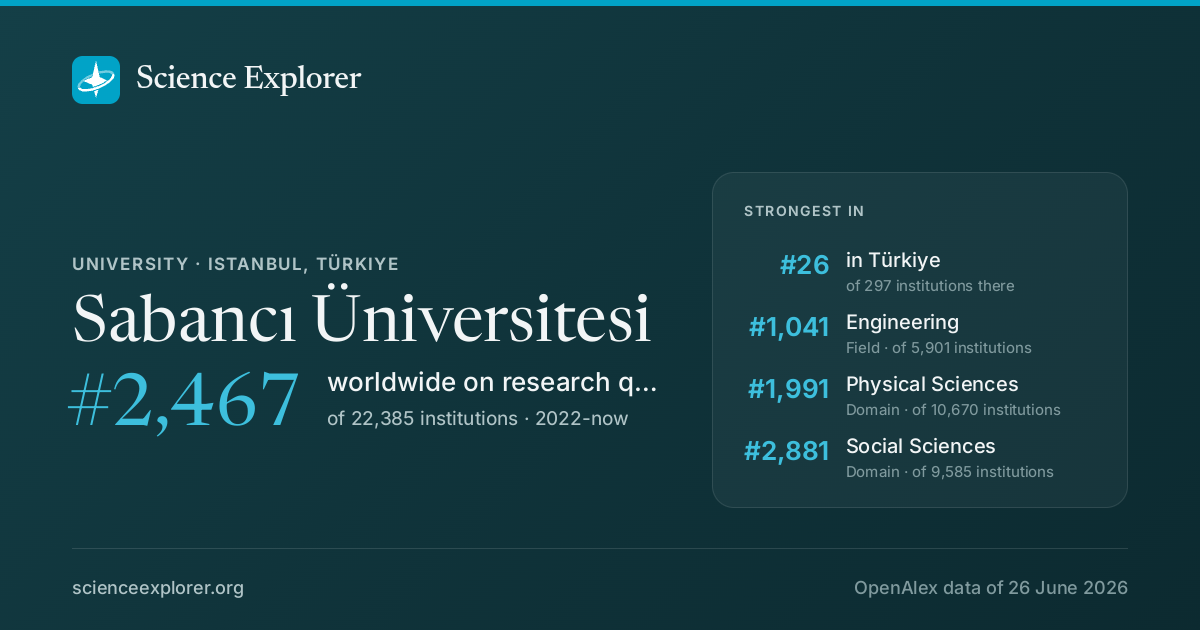
In research, Sabancı Üniversitesi stands highest in Engineering (#1,041 of 5,901 worldwide), Physical Sciences (#1,991 of 10,670 worldwide) and Social Sciences (#2,881 of 9,585 worldwide), 2022-now. Relative to its size it is most specialised in Polymers and Plastics (Polymers and Plastics is 5.1× its share of world research).
- World rank, 2022-now
- #2,467 of 22,385 · #2,324 all time
- Rank in Türkiye
- #26 of 297
- Research works
- 6.4k ▲ 8% vs 2018-21
- Citations
- 136k 21.3 per fractional work
- Top-10% rate
- 12.1% all institutions 10.0%
- vs its own fields
- 0.89× 1.00× is exactly expected
- Open access
- 35% world 40%
- International
- 27% world 18%
What is Sabancı Üniversitesi known for in research?
The fields where it stands highest, 2022-now, ranked among every institution above the floor in each field.
| Field | World rank | Where that sits | Top-10% rate | Works | All time |
|---|---|---|---|---|---|
| EngineeringField | #1,041 of 5,901 | 14.8% | 381 | #1053 | |
| Physical SciencesDomain | #1,991 of 10,670 | 12.2% | 844 | #1774 | |
| Social SciencesDomain | #2,881 of 9,585 | 13.3% | 311 | #2087 | |
| Life SciencesDomain | #2,256 of 6,403 | 12.0% | 124 | #2769 | |
| Materials ScienceField | #964 of 2,276 | 11.0% | 136 | #1491 | |
| Computer ScienceField | #2,069 of 4,417 | 10.1% | 164 | #1108 | |
| Biochemistry, Genetics and Molecular BiologyField | #1,432 of 2,964 | 12.2% | 68 | #2306 | |
| Social SciencesField | #3,074 of 5,988 | 18.1% | 145 | #2134 | |
| Electrical and Electronic EngineeringSubfield | #1,130 of 2,176 | 10.6% | 103 | #1327 | |
| Biomedical EngineeringSubfield | #921 of 1,539 | 11.4% | 72 | #926 |
Each strip is that field's whole ranked pool, with the notch where Sabancı Üniversitesi sits in it, in the colour of the band that rank falls in. The track under the rate is the rate itself: it carries no average mark, because the average differs by field (from about 6% in Dentistry to 21% in Economics).
Which of those standings moved
The same fields on both windows: where it stood over the whole record, and where it stands in 2022-now. The distance is the story, and it is the one thing the two rank columns above cannot show.
- Engineering#1,053 #1,041
- Physical Sciences#1,774 #1,991
- Social Sciences#2,087 #2,881
- Life Sciences#2,769 #2,256
- Materials Science#1,491 #964
- Computer Science#1,108 #2,069
- Biochemistry, Genetics and Molecular Biology#2,306 #1,432
- Social Sciences#2,134 #3,074
- Electrical and Electronic Engineering#1,327 #1,130
- Biomedical Engineering#926 #921
A dot further right is a better standing. Fields it was not ranked in over the whole record are left out.
Which fields of science does Sabancı Üniversitesi work in?
In 2022-now, 63% of research at Sabancı Üniversitesi is in Physical Sciences, 23% in Social Sciences. Its largest fields are Engineering (28%), Computer Science (12%), Social Sciences (11%). It does 1.6× the world's share of Physical Sciences.
Each ring splits the one inside it: the four domains of science, their fields, their subfields. Size is fractional works in 2022-now. Every slice is a page; the interactive view zooms down to single topics and colours each by how much more of it this institution does than the world.
Its 4 domains and 26 fields, with their numbers
- Physical Sciences94763.4%
- Engineering42328.3%
- Computer Science18512.4%
- Materials Science15110.1%
- Mathematics614.1%
- Physics and Astronomy463.1%
- Environmental Science271.8%
- Energy231.6%
- Chemistry211.4%
- Earth and Planetary Sciences60.4%
- Chemical Engineering40.3%
- Social Sciences34723.2%
- Social Sciences16210.9%
- Business, Management and Accounting553.7%
- Psychology493.2%
- Economics, Econometrics and Finance362.4%
- Arts and Humanities261.8%
- Decision Sciences191.3%
- Life Sciences1379.1%
- Health Sciences644.3%
- Medicine503.3%
- Health Professions80.6%
- Nursing30.2%
- Dentistry20.2%
- Veterinary00.0%
What does Sabancı Üniversitesi specialise in?
Where its research is concentrated relative to its size: Polymers and Plastics takes 5.1× the share of its output that it takes of world research.
- Polymers and PlasticsSubfield · 30.9 works5.1×
Location quotient, a volume reading rather than an impact one. It surfaces small, lopsided specialities.
Field profile
Location quotient across every field it publishes in: outside the ring is more than an institution of this size would be expected to publish, inside it is less.
Rings at 0.5×, 1× and 2×. Widest outward: Mathematics, 3.5×. Every wedge is a field page.
All 26 fields, with their numbers
- Mathematics3.45×61 works
- Materials Science2.89×151 works
- Engineering1.89×423 works
- Energy1.71×24 works
- Computer Science1.59×185 works
- Physics and Astronomy1.39×46 works
- Decision Sciences1.30×19 works
- Neuroscience1.15×28 works
- Business, Management and Accounting1.14×55 works
- Economics, Econometrics and Finance1.11×36 works
- Psychology1.07×48 works
- Biochemistry, Genetics and Molecular Biology0.94×75 works
- Chemistry0.90×21 works
- Pharmacology, Toxicology and Pharmaceutics0.87×5 works
- Social Sciences0.86×162 works
- Chemical Engineering0.73×4 works
- Arts and Humanities0.61×26 works
- Nursing0.38×3 works
- Environmental Science0.37×27 works
- Agricultural and Biological Sciences0.36×25 works
- Dentistry0.34×2 works
- Immunology and Microbiology0.25×4 works
- Earth and Planetary Sciences0.24×6 works
- Health Professions0.21×8 works
- Veterinary0.21×0 works
- Medicine0.17×50 works
- Mathematics 3.5×
- Materials Science 2.9×
- Engineering 1.9×
- Energy 1.7×
- Computer Science 1.6×
- Physics and Astronomy 1.4×
- Decision Sciences 1.3×
- Neuroscience 1.1×
- Business, Management and Accounting 1.1×
- Economics, Econometrics and Finance 1.1×
- Psychology 1.1×
- Biochemistry, Genetics and Molecular Biology 0.9×
- Chemistry 0.9×
- Pharmacology, Toxicology and Pharmaceutics 0.9×
- Social Sciences 0.9×
- Chemical Engineering 0.7×
- Arts and Humanities 0.6×
- Nursing 0.4×
- Environmental Science 0.4×
- Agricultural and Biological Sciences 0.4×
- Dentistry 0.3×
- Immunology and Microbiology 0.2×
- Earth and Planetary Sciences 0.2×
- Health Professions 0.2×
- Veterinary 0.2×
- Medicine 0.2×
Who are the top researchers at Sabancı Üniversitesi?
Ranked on the quality score, Milad Ashrafizadeh, Hikmet Budak and İsmail Çakmak lead among researchers whose main affiliation is Sabancı Üniversitesi.
- 1
Milad Ashrafizadeh
 Türkiye · #28,239 worldwide
25k citations · 311 works
- 2
Hikmet Budak
Türkiye · #71,216 worldwide
31k citations · 234 works
- 3
İsmail Çakmak
Türkiye · #85,780 worldwide
39k citations · 372 works
- 4
Onur Varol
Türkiye · #96,718 worldwide
5.3k citations · 105 works
- 5
Senem Aydın‐Düzgit
Türkiye · #184,189 worldwide
1.6k citations · 79 works
- 6
Murat Cokol
Türkiye · #257,714 worldwide
6.8k citations · 72 works
- 7
Erhan Budak
Türkiye · #266,752 worldwide
13k citations · 256 works
- 8
E. Fuat Keyman
Türkiye · #322,163 worldwide
1.7k citations · 77 works
- 9
Bala Anı Akpınar
Türkiye · #361,504 worldwide
6.4k citations · 52 works
- 10
Sabahat Çiğdem Bağci
Türkiye · #414,076 worldwide
1.9k citations · 89 works
Which keywords describe research at Sabancı Üniversitesi?
By fractional works in 2022-now, weighted toward what it does more of than the world: Biomedical Applications, Nanocomposites, Graphene, Tissue Engineering, Nanomaterials, Mechanical Properties, Energy Storage and Polymer Composites.
- Finite Element Method
- Nanofibers
- Surface Roughness
- Hydrogels
- Regenerative Medicine
- Carbon-Based Materials
- Two-Dimensional Materials
- Islam
- Democratization
- Applications
- Composite Materials
- Authoritarianism
- Additive Manufacturing
- Polymer Composites
- Drug Delivery
- Energy Storage
- Tissue Engineering
- Mechanical Properties
- Nanomaterials
- Biomedical Applications
- Deep Learning
- Nanocomposites
- Machine Learning
- Graphene
- Nanoparticles
- Globalization
- Nationalism
- Biosensors
- Neoliberalism
- Metal-Organic Frameworks
- Civil Society
- Cathode Materials
- AKP
- Carbon Nanotubes
- Cryptography
- Electrochemical Capacitors
- Biomaterials
- 3D Printing
- Graphene Oxide
- Tool Wear
Size is fractional works in 2022-now in the topics tagged with each word; colour is the word's share of this institution's work against its share of the world's. The 40 words are chosen for being large and distinctive. Each links to the topic it comes from most.
All 40 words, with their numbers
- Deep Learning61▲ 1.18×63 topics
- Biomedical Applications60▲ 3.4×32 topics
- Nanocomposites51▲ 4.3×20 topics
- Nanomaterials50▲ 3.2×17 topics
- Machine Learning48◆ 0.96×55 topics
- Mechanical Properties47▲ 3.2×27 topics
- Graphene45▲ 4.5×11 topics
- Tissue Engineering43▲ 4.8×13 topics
- Nanoparticles40▲ 2.1×33 topics
- Energy Storage37▲ 3.8×9 topics
- Globalization32◆ 1.10×36 topics
- Drug Delivery31▲ 3.8×15 topics
- Nationalism28▲ 4.2×7 topics
- Polymer Composites28▲ 6.9×7 topics
- Biosensors26▲ 3.5×12 topics
- Additive Manufacturing25▲ 5.5×7 topics
- Neoliberalism24▲ 4.4×10 topics
- Authoritarianism22▲ 17×4 topics
- Metal-Organic Frameworks22▲ 3.5×5 topics
- Composite Materials20▲ 6.4×9 topics
- Civil Society19▲ 12×4 topics
- Applications19▲ 4.7×7 topics
- Cathode Materials19▲ 3.2×3 topics
- Democratization19▲ 19×2 topics
- AKP18▲ 64×1 topic
- Islam18▲ 5.9×1 topic
- Carbon Nanotubes17▲ 3.5×8 topics
- Two-Dimensional Materials17▲ 5.0×4 topics
- Cryptography16▲ 9.2×3 topics
- Carbon-Based Materials15▲ 9.7×1 topic
- Electrochemical Capacitors15▲ 9.7×1 topic
- Regenerative Medicine15▲ 3.9×4 topics
- Biomaterials15▲ 4.1×6 topics
- Hydrogels14▲ 5.0×5 topics
- 3D Printing14▲ 4.3×4 topics
- Surface Roughness14▲ 7.1×4 topics
- Graphene Oxide14▲ 9.7×2 topics
- Nanofibers14▲ 4.6×3 topics
- Tool Wear13▲ 6.6×3 topics
- Finite Element Method12▲ 8.1×3 topics
Which research topics does Sabancı Üniversitesi publish most on?
By volume in 2022-now: Turkey's Politics and Society, Supercapacitor Materials and Fabrication, Advanced Sensor and Energy Harvesting Materials and Additive Manufacturing and 3D Printing Technologies.
Area is fractional works; colour is the subfield each topic belongs to.
- 1 Turkey's Politics and Society Political Science and International Relations 18 works
- 2 Supercapacitor Materials and Fabrication Electronic, Optical and Magnetic Materials 15 works
- 3 Advanced Sensor and Energy Harvesting Materials Biomedical Engineering 11 works
- 4 Additive Manufacturing and 3D Printing Technologies Automotive Engineering 11 works
- 5 Coding theory and cryptography Artificial Intelligence 10 works
- 6 Mechanical Behavior of Composites Mechanics of Materials 9 works
- 7 Advancements in Battery Materials Electrical and Electronic Engineering 8 works
- 8 Graphene and Nanomaterials Applications Biomedical Engineering 8 works
- 9 Vehicle Routing Optimization Methods Industrial and Manufacturing Engineering 8 works
- 10 Advanced machining processes and optimization Mechanical Engineering 8 works
How open and international is its research?
Against the world's own shares: the tick on each track. Both are shares of its output, so they sit on one scale and can be read against each other as well as against the world.
World: 40% of research is openly available.
World: 18% is written across borders.
How has Sabancı Üniversitesi's research output changed?
Output in 2022-2025 was 8% higher than in 2018-2021.
The same series as a ribbon: one cell per year, darker for more. The line above answers how much; this answers when.
Its share of all research
Growing output can still be a shrinking share: all of science grows. This is Sabancı Üniversitesi as a percentage of every work published that year, 0.0056% in 2024.
Fractional works of Sabancı Üniversitesi over all fractional works that year. How the balance of science has shifted.
How much of it reaches the world top 10%
Year by year, against all institutions in the same year.
Of each year's output, the share that reached the world's 10% most cited for its field and year. Peak 15.5% in 2005.
Other research institutions in Istanbul
- Istanbul University
- Istanbul Technical University
- Marmara University
- Sağlık Bilimleri Üniversitesi
- Yıldız Technical University
- Boğaziçi University
- Istanbul University-Cerrahpaşa
- Koç University
Share Sabancı Üniversitesi's ranking
Badges for a website1Each links back here and updates with every snapshot

Research measures only: rankings here say nothing about teaching, admissions or student experience. Comparable institutions and collaboration partners have tabs of their own, above.
Discussion
Ask a question or share a note about Sabancı Üniversitesi. Posts are plain text and can be reported.