Scuola Normale Superiore
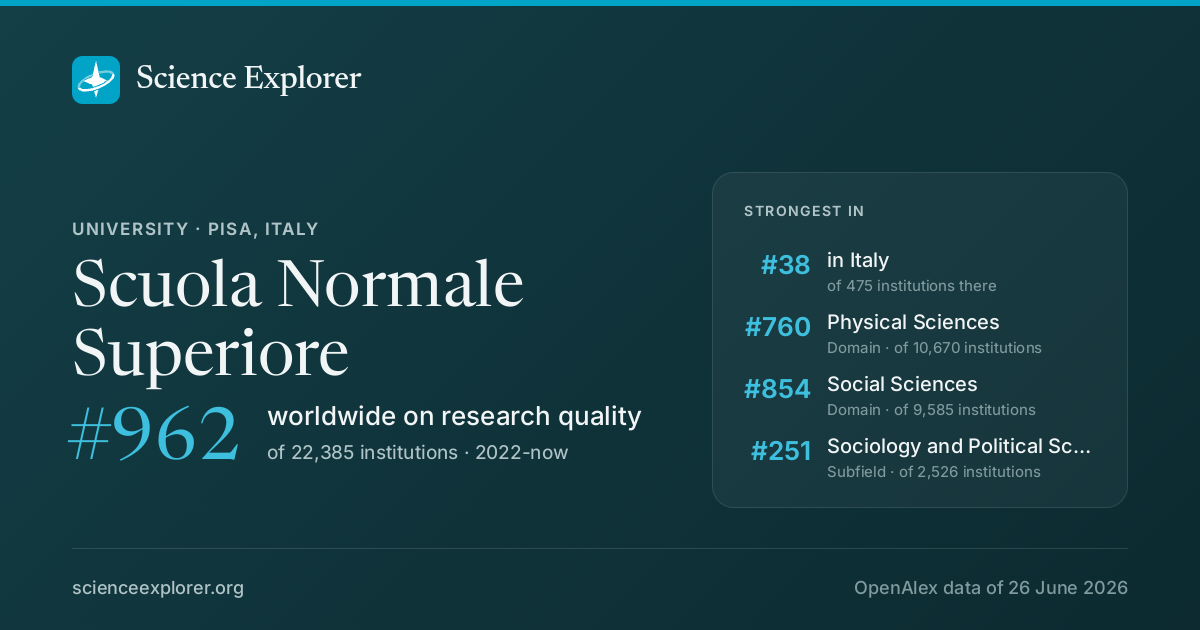
In research, Scuola Normale Superiore stands highest in Physical Sciences (#760 of 10,670 worldwide), Social Sciences (#854 of 9,585 worldwide) and Sociology and Political Science (#251 of 2,526 worldwide), 2022-now. Relative to its size it is most specialised in Geometry and Topology and Mathematical Physics (Geometry and Topology is 12.0× its share of world research).
- World rank, 2022-now
- #962 of 22,385 · #1,373 all time
- Rank in Italy
- #38 of 475
- Research works
- 6.5k ▲ 22% vs 2018-21
- Citations
- 157k 24.2 per fractional work
- Top-10% rate
- 14.8% all institutions 10.0%
- vs its own fields
- 1.46× 1.00× is exactly expected
- Open access
- 53% world 40%
- International
- 28% world 18%
What is Scuola Normale Superiore known for in research?
The fields where it stands highest, 2022-now, ranked among every institution above the floor in each field.
| Field | World rank | Where that sits | Top-10% rate | Works | All time |
|---|---|---|---|---|---|
| Physical SciencesDomain | #760 of 10,670 | 16.5% | 561 | #1127 | |
| Social SciencesDomain | #854 of 9,585 | 14.4% | 554 | #1305 | |
| Sociology and Political ScienceSubfield | #251 of 2,526 | 23.2% | 120 | #642 | |
| Social SciencesField | #620 of 5,988 | 20.7% | 290 | #1142 | |
| MathematicsField | #115 of 1,051 | 18.8% | 102 | #252 | |
| Physics and AstronomyField | #178 of 1,417 | 21.3% | 179 | #340 | |
| Arts and HumanitiesField | #467 of 1,896 | 5.9% | 171 | #709 | |
| Political Science and International RelationsSubfield | #314 of 1,187 | 23.7% | 70 | #675 | |
| Computer ScienceField | #1,250 of 4,417 | 12.3% | 109 | #1411 | |
| Artificial IntelligenceSubfield | #561 of 1,862 | 11.8% | 68 | #883 |
Each strip is that field's whole ranked pool, with the notch where Scuola Normale Superiore sits in it, in the colour of the band that rank falls in. The track under the rate is the rate itself: it carries no average mark, because the average differs by field (from about 6% in Dentistry to 21% in Economics).
Which of those standings moved
The same fields on both windows: where it stood over the whole record, and where it stands in 2022-now. The distance is the story, and it is the one thing the two rank columns above cannot show.
- Physical Sciences#1,127 #760
- Social Sciences#1,305 #854
- Sociology and Political Science#642 #251
- Social Sciences#1,142 #620
- Mathematics#252 #115
- Physics and Astronomy#340 #178
- Arts and Humanities#709 #467
- Political Science and International Relations#675 #314
- Computer Science#1,411 #1,250
- Artificial Intelligence#883 #561
A dot further right is a better standing. Fields it was not ranked in over the whole record are left out.
Which fields of science does Scuola Normale Superiore work in?
In 2022-now, 47% of research at Scuola Normale Superiore is in Physical Sciences, 46% in Social Sciences. Its largest fields are Social Sciences (24%), Physics and Astronomy (15%), Arts and Humanities (14%). It does 1.8× the world's share of Social Sciences.
Each ring splits the one inside it: the four domains of science, their fields, their subfields. Size is fractional works in 2022-now. Every slice is a page; the interactive view zooms down to single topics and colours each by how much more of it this institution does than the world.
Its 4 domains and 25 fields, with their numbers
- Physical Sciences63846.9%
- Physics and Astronomy21115.5%
- Computer Science1208.8%
- Mathematics1158.4%
- Engineering725.3%
- Chemistry564.1%
- Materials Science312.3%
- Environmental Science141.0%
- Earth and Planetary Sciences131.0%
- Chemical Engineering50.4%
- Energy10.1%
- Social Sciences62546.0%
- Social Sciences33124.4%
- Arts and Humanities18813.8%
- Economics, Econometrics and Finance554.0%
- Psychology221.6%
- Business, Management and Accounting181.3%
- Decision Sciences110.8%
- Life Sciences644.7%
- Health Sciences332.5%
- Medicine251.8%
- Health Professions80.6%
- Nursing00.0%
- Dentistry00.0%
What does Scuola Normale Superiore specialise in?
Where its research is concentrated relative to its size: Geometry and Topology takes 12.0× the share of its output that it takes of world research.
- Geometry and TopologySubfield · 26.6 works12×
- Mathematical PhysicsSubfield · 24.8 works12×
Location quotient, a volume reading rather than an impact one. It surfaces small, lopsided specialities.
Field profile
Location quotient across every field it publishes in: outside the ring is more than an institution of this size would be expected to publish, inside it is less.
Rings at 0.5×, 1× and 2×. Widest outward: Mathematics, 7.2×. Every wedge is a field page.
All 25 fields, with their numbers
- Mathematics7.17×115 works
- Physics and Astronomy6.97×211 works
- Arts and Humanities4.79×188 works
- Chemistry2.61×56 works
- Social Sciences1.93×331 works
- Economics, Econometrics and Finance1.88×55 works
- Computer Science1.14×120 works
- Chemical Engineering1.10×5 works
- Decision Sciences0.81×11 works
- Neuroscience0.80×18 works
- Materials Science0.66×31 works
- Earth and Planetary Sciences0.61×13 works
- Psychology0.53×22 works
- Biochemistry, Genetics and Molecular Biology0.49×36 works
- Business, Management and Accounting0.41×18 works
- Pharmacology, Toxicology and Pharmaceutics0.35×2 works
- Engineering0.35×72 works
- Health Professions0.23×8 works
- Environmental Science0.21×14 works
- Agricultural and Biological Sciences0.13×8 works
- Medicine0.09×25 works
- Nursing0.07×0 works
- Energy0.06×1 works
- Immunology and Microbiology0.04×0 works
- Dentistry0.02×0 works
- Mathematics 7.2×
- Physics and Astronomy 7.0×
- Arts and Humanities 4.8×
- Chemistry 2.6×
- Social Sciences 1.9×
- Economics, Econometrics and Finance 1.9×
- Computer Science 1.1×
- Chemical Engineering 1.1×
- Decision Sciences 0.8×
- Neuroscience 0.8×
- Materials Science 0.7×
- Earth and Planetary Sciences 0.6×
- Psychology 0.5×
- Biochemistry, Genetics and Molecular Biology 0.5×
- Business, Management and Accounting 0.4×
- Pharmacology, Toxicology and Pharmaceutics 0.3×
- Engineering 0.3×
- Health Professions 0.2×
- Environmental Science 0.2×
- Agricultural and Biological Sciences 0.1×
- Medicine 0.1×
- Nursing 0.1×
- Energy 0.1×
- Immunology and Microbiology 0.0×
- Dentistry 0.0×
Who are the top researchers at Scuola Normale Superiore?
Ranked on the quality score, Stefano Carniani, Eleonora Parlanti and A. Pallottini lead among researchers whose main affiliation is Scuola Normale Superiore.
- 1
Stefano Carniani
 Italy · #211 worldwide
17k citations · 427 works
- 2
Eleonora Parlanti
Italy · #6,852 worldwide
3.3k citations · 105 works
- 3
A. Pallottini
Italy · #11,315 worldwide
6.5k citations · 200 works
- 4
Laura Sommovigo
Italy · #37,123 worldwide
2.3k citations · 119 works
- 5
Andrea L. P. Pirro
Italy · #42,118 worldwide
3.1k citations · 61 works
- 6
M. Dell’Orso
Italy · #42,181 worldwide
51k citations · 857 works
- 7
Marco Polini
Italy · #42,329 worldwide
29k citations · 361 works
- 8
Andrea Ferrara
Italy · #50,788 worldwide
28k citations · 718 works
- 9
S. Gallerani
Italy · #57,598 worldwide
6.1k citations · 177 works
- 10
Rosario Fazio
Italy · #61,122 worldwide
26k citations · 621 works
Which keywords describe research at Scuola Normale Superiore?
By fractional works in 2022-now, weighted toward what it does more of than the world: Globalization, Nationalism, Religion, Gender, Identity, Black Holes, Late Antiquity and Literature.
- Stellar Populations
- Historiography
- Photosynthesis
- Populism
- Electronic Structure Calculations
- Totalitarianism
- Entanglement
- Europe
- Italy
- Latin America
- Greek Literature
- Memory
- Density Functional Theory
- Hydrogen Bonding
- Cultural Exchange
- Late Antiquity
- Black Holes
- Social Media
- Gender
- Nationalism
- Globalization
- Identity
- Religion
- Literature
- Colonialism
- Dark Matter
- Molecular Dynamics
- Star Formation
- Neoliberalism
- Ancient Rome
- Propaganda
- Cosmology
- Archaeology
- Political Communication
- Fascism
- Vibrational Spectroscopy
- Global Governance
- Right-Wing
- Quantum Coherence
- Galaxies
Size is fractional works in 2022-now in the topics tagged with each word; colour is the word's share of this institution's work against its share of the world's. The 40 words are chosen for being large and distinctive. Each links to the topic it comes from most.
All 40 words, with their numbers
- Globalization96▲ 3.6×73 topics
- Nationalism56▲ 9.2×19 topics
- Identity46▲ 4.7×29 topics
- Gender45▲ 6.1×26 topics
- Religion44▲ 7.0×27 topics
- Social Media41▲ 2.2×19 topics
- Literature36▲ 4.8×28 topics
- Black Holes30▲ 23×3 topics
- Colonialism30▲ 4.7×20 topics
- Late Antiquity30▲ 43×3 topics
- Dark Matter27▲ 17×4 topics
- Cultural Exchange25▲ 14×8 topics
- Molecular Dynamics24▲ 10×6 topics
- Hydrogen Bonding24▲ 21×4 topics
- Star Formation24▲ 31×2 topics
- Density Functional Theory24▲ 17×4 topics
- Neoliberalism24▲ 4.9×17 topics
- Memory23▲ 6.9×9 topics
- Ancient Rome22▲ 50×1 topic
- Greek Literature22▲ 50×1 topic
- Propaganda22▲ 31×3 topics
- Latin America21▲ 8.2×6 topics
- Cosmology21▲ 23×3 topics
- Italy21▲ 62×2 topics
- Archaeology20▲ 12×7 topics
- Europe20▲ 25×2 topics
- Political Communication20▲ 26×2 topics
- Entanglement20▲ 9.6×4 topics
- Fascism19▲ 71×1 topic
- Totalitarianism19▲ 56×1 topic
- Vibrational Spectroscopy19▲ 18×2 topics
- Electronic Structure Calculations19▲ 21×2 topics
- Global Governance18▲ 5.7×13 topics
- Populism18▲ 60×1 topic
- Right-Wing18▲ 60×1 topic
- Photosynthesis18▲ 28×1 topic
- Quantum Coherence18▲ 42×1 topic
- Historiography17▲ 10×9 topics
- Galaxies17▲ 43×1 topic
- Stellar Populations17▲ 43×1 topic
Which research topics does Scuola Normale Superiore publish most on?
By volume in 2022-now: Classical Antiquity Studies, Italian Fascism and Post-war Society, Populism, Right-Wing Movements and Spectroscopy and Quantum Chemical Studies.
Area is fractional works; colour is the subfield each topic belongs to.
- 1 Classical Antiquity Studies Anthropology 22 works
- 2 Italian Fascism and Post-war Society Sociology and Political Science 19 works
- 3 Populism, Right-Wing Movements Political Science and International Relations 18 works
- 4 Spectroscopy and Quantum Chemical Studies Atomic and Molecular Physics, and Optics 18 works
- 5 Galaxies: Formation, Evolution, Phenomena Astronomy and Astrophysics 17 works
- 6 Advanced Chemical Physics Studies Atomic and Molecular Physics, and Optics 16 works
- 7 Geometric Analysis and Curvature Flows Applied Mathematics 13 works
- 8 Nonlinear Partial Differential Equations Applied Mathematics 12 works
- 9 Advanced Mathematical Modeling in Engineering Computational Theory and Mathematics 12 works
- 10 Astronomy and Astrophysical Research Instrumentation 12 works
How open and international is its research?
Against the world's own shares: the tick on each track. Both are shares of its output, so they sit on one scale and can be read against each other as well as against the world.
World: 40% of research is openly available.
World: 18% is written across borders.
How has Scuola Normale Superiore's research output changed?
Output in 2022-2025 was 22% higher than in 2018-2021.
The same series as a ribbon: one cell per year, darker for more. The line above answers how much; this answers when.
Its share of all research
Growing output can still be a shrinking share: all of science grows. This is Scuola Normale Superiore as a percentage of every work published that year, 0.0056% in 2024.
Fractional works of Scuola Normale Superiore over all fractional works that year. How the balance of science has shifted.
How much of it reaches the world top 10%
Year by year, against all institutions in the same year.
Of each year's output, the share that reached the world's 10% most cited for its field and year. Peak 21.7% in 1994.
Other research institutions in Pisa
- University of Pisa
- Scuola Superiore Sant'Anna
- Azienda Ospedaliera Universitaria Pisana
- Fondazione Toscana Gabriele Monasterio
- Ingegneria dei Sistemi (Italy)
- Consorzio Pisa Ricerche
- Fondazione Pisa
- Nextworks (Italy)

Compare Scuola Normale Superiore with
- vs University of Siena
- vs
 Berkeley College
- vs
 Changsha University of Science and Technology
- vs Union Hospital
- vs Yantai University
- vs
 Universidad de Buenos Aires
Share Scuola Normale Superiore's ranking



Research measures only: rankings here say nothing about teaching, admissions or student experience. Comparable institutions and collaboration partners have tabs of their own, above.
Discussion
Ask a question or share a note about Scuola Normale Superiore. Posts are plain text and can be reported.