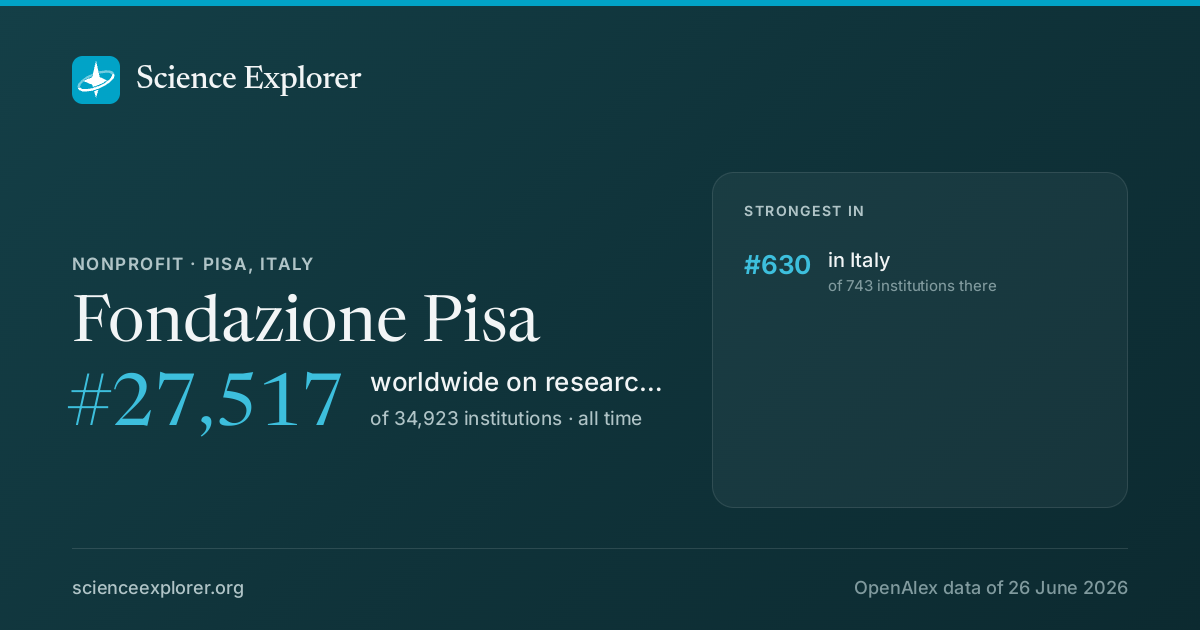
- World rank, all time
- #27,517 of 34,923
- Rank in Italy
- #630 of 743
- Research works
- 135 ▲ 14% vs 2018-21
- Citations
- 6.1k 45.1 per fractional work
- Top-10% rate
- 16.5% all institutions 10.0%
- vs its own fields
- 1.12× 1.00× is exactly expected
- Open access
- 70% world 40%
- International
- 53% world 18%
Which fields of science does Fondazione Pisa work in?
In 2022-now, 47% of research at Fondazione Pisa is in Health Sciences, 39% in Life Sciences. Its largest fields are Medicine (47%), Biochemistry, Genetics and Molecular Biology (31%), Immunology and Microbiology (3%). It does 2.4× the world's share of Life Sciences.
Each ring splits the one inside it: the four domains of science, their fields, their subfields. Size is fractional works in 2022-now. Every slice is a page; the interactive view zooms down to single topics and colours each by how much more of it this institution does than the world.
Its 4 domains and 20 fields, with their numbers
- Health Sciences2947.3%
- Medicine2846.6%
- Dentistry00.3%
- Health Professions00.2%
- Veterinary00.2%
- Life Sciences2438.8%
- Physical Sciences711.4%
- Engineering23.2%
- Chemistry12.3%
- Materials Science11.6%
- Computer Science11.5%
- Environmental Science11.3%
- Mathematics10.9%
- Earth and Planetary Sciences00.5%
- Physics and Astronomy00.0%
- Social Sciences22.5%
Field profile
Location quotient across every field it publishes in: outside the ring is more than an institution of this size would be expected to publish, inside it is less.
Rings at 0.5×, 1× and 2×. Widest outward: Biochemistry, Genetics and Molecular Biology, 5.8×. Every wedge is a field page.
All 20 fields, with their numbers
- Biochemistry, Genetics and Molecular Biology5.79×19 works
- Immunology and Microbiology3.41×2 works
- Medicine2.42×28 works
- Neuroscience1.90×2 works
- Chemistry1.46×1 works
- Veterinary1.34×0 works
- Pharmacology, Toxicology and Pharmaceutics1.25×0 works
- Mathematics0.74×0 works
- Dentistry0.66×0 works
- Materials Science0.45×1 works
- Earth and Planetary Sciences0.35×0 works
- Environmental Science0.27×1 works
- Economics, Econometrics and Finance0.26×0 works
- Engineering0.22×2 works
- Agricultural and Biological Sciences0.20×1 works
- Computer Science0.19×1 works
- Social Sciences0.13×1 works
- Arts and Humanities0.09×0 works
- Health Professions0.07×0 works
- Physics and Astronomy0.02×0 works
- Biochemistry, Genetics and Molecular Biology 5.8×
- Immunology and Microbiology 3.4×
- Medicine 2.4×
- Neuroscience 1.9×
- Chemistry 1.5×
- Veterinary 1.3×
- Pharmacology, Toxicology and Pharmaceutics 1.2×
- Mathematics 0.7×
- Dentistry 0.7×
- Materials Science 0.5×
- Earth and Planetary Sciences 0.3×
- Environmental Science 0.3×
- Economics, Econometrics and Finance 0.3×
- Engineering 0.2×
- Agricultural and Biological Sciences 0.2×
- Computer Science 0.2×
- Social Sciences 0.1×
- Arts and Humanities 0.1×
- Health Professions 0.1×
- Physics and Astronomy 0.0×
Who are the top researchers at Fondazione Pisa?
Ranked on the quality score, Giulia Mantini, Mariangela Morelli and Mahrou Vahabi lead among researchers whose main affiliation is Fondazione Pisa.
- 1
Giulia Mantini
 Italy · #707,709 worldwide
1.3k citations · 70 works
- 2
Mariangela Morelli
Italy · #1,207,148 worldwide
1.7k citations · 85 works
- 3
Mahrou Vahabi
Italy · #1,829,407 worldwide
449 citations · 38 works
- 4
Marialaura Dilillo
Italy · #1,837,688 worldwide
571 citations · 16 works
- 5
Alessandro Gregori
Italy · #1,896,602 worldwide
361 citations · 24 works
- 6
Mjriam Capula
Italy · #2,595,606 worldwide
484 citations · 32 works
- 7
Davide Pellegrini
Italy · #2,619,267 worldwide
510 citations · 27 works
- 8
Chiara Maria Mazzanti
Italy · #3,385,386 worldwide
8.4k citations · 261 works
- 9
Manuel Giacomarra
Italy · #3,430,933 worldwide
25 citations · 17 works
- 10
Prospero Civita
Italy · #3,648,171 worldwide
462 citations · 24 works
Which keywords describe research at Fondazione Pisa?
By fractional works in 2022-now, weighted toward what it does more of than the world: Immunotherapy, Tumor Microenvironment, Cancer, Chemotherapy, Cancer Therapy, Neoadjuvant Therapy, Pancreatic Cancer and Gemcitabine.
- Tumor Suppression
- Reactive Oxygen Species
- Gene Therapy
- Biogenesis
- Warburg Effect
- Oxygen Sensing
- HIF-1
- Angiogenesis
- Tumor Targeting
- Cell Death
- Temozolomide
- Epithelial-Mesenchymal Transition
- Gene Expression
- Biomarkers
- Prognostic Factors
- Surgical Complications
- Gemcitabine
- Inflammation
- Chemotherapy
- Tumor Microenvironment
- Immunotherapy
- Cancer
- Cancer Therapy
- Neoadjuvant Therapy
- Pancreatic Cancer
- Oxidative Stress
- Radiotherapy
- Targeted Therapy
- Molecular Classification
- Glioblastoma
- Cancer Stem Cells
- Tumor Metastasis
- Genomic Instability
- Cancer Genomics
- Mutational Signatures
- Regulation
- Apoptosis
- Drug Delivery
- Metastasis
- Cell Signaling
Size is fractional works in 2022-now in the topics tagged with each word; colour is the word's share of this institution's work against its share of the world's. The 40 words are chosen for being large and distinctive. Each links to the topic it comes from most.
All 40 words, with their numbers
- Immunotherapy9▲ 20×15 topics
- Tumor Microenvironment6▲ 23×8 topics
- Cancer6▲ 6.8×25 topics
- Chemotherapy5▲ 11×8 topics
- Cancer Therapy4▲ 11×14 topics
- Inflammation3▲ 2.6×28 topics
- Neoadjuvant Therapy3▲ 23×4 topics
- Gemcitabine3▲ 70×1 topic
- Pancreatic Cancer3▲ 46×2 topics
- Surgical Complications3▲ 61×1 topic
- Oxidative Stress3▲ 2.9×18 topics
- Prognostic Factors3▲ 10×8 topics
- Radiotherapy3▲ 11×4 topics
- Biomarkers2▲ 5.8×9 topics
- Targeted Therapy2▲ 18×5 topics
- Gene Expression2▲ 6.0×9 topics
- Molecular Classification2▲ 25×2 topics
- Epithelial-Mesenchymal Transition2▲ 37×3 topics
- Glioblastoma2▲ 53×1 topic
- Temozolomide2▲ 53×1 topic
- Cancer Stem Cells2▲ 72×1 topic
- Cell Death2▲ 14×5 topics
- Tumor Metastasis2▲ 57×1 topic
- Tumor Targeting2▲ 17×3 topics
- Genomic Instability2▲ 27×3 topics
- Angiogenesis2▲ 8.2×9 topics
- Cancer Genomics2▲ 38×1 topic
- HIF-12▲ 46×1 topic
- Mutational Signatures2▲ 38×1 topic
- Oxygen Sensing2▲ 25×2 topics
- Regulation2▲ 5.2×5 topics
- Warburg Effect2▲ 46×1 topic
- Apoptosis2▲ 8.3×11 topics
- Biogenesis2▲ 16×3 topics
- Drug Delivery2▲ 4.9×5 topics
- Gene Therapy2▲ 13×4 topics
- Metastasis2▲ 7.0×8 topics
- Reactive Oxygen Species2▲ 6.0×8 topics
- Cell Signaling1▲ 14×6 topics
- Tumor Suppression1▲ 27×4 topics
Which research topics does Fondazione Pisa publish most on?
By volume in 2022-now: Pancreatic and Hepatic Oncology Research, Glioma Diagnosis and Treatment, Cancer Cells and Metastasis and Cancer Genomics and Diagnostics.
Area is fractional works; colour is the subfield each topic belongs to.
- 1 Pancreatic and Hepatic Oncology Research Oncology 3 works
- 2 Glioma Diagnosis and Treatment Genetics 2 works
- 3 Cancer Cells and Metastasis Oncology 2 works
- 4 Cancer Genomics and Diagnostics Cancer Research 2 works
- 5 Cancer, Hypoxia, and Metabolism Cancer Research 2 works
- 6 PARP inhibition in cancer therapy Oncology 1 works
- 7 Extracellular vesicles in disease Molecular Biology 1 works
- 8 Neuroblastoma Research and Treatments Neurology 1 works
- 9 Cancer Research and Treatments Biotechnology 1 works
- 10 Sarcoma Diagnosis and Treatment Pulmonary and Respiratory Medicine 1 works
How open and international is its research?
Against the world's own shares: the tick on each track. Both are shares of its output, so they sit on one scale and can be read against each other as well as against the world.
World: 40% of research is openly available.
World: 18% is written across borders.
How has Fondazione Pisa's research output changed?
Output in 2022-2025 was 14% higher than in 2018-2021.
The same series as a ribbon: one cell per year, darker for more. The line above answers how much; this answers when.
Its share of all research
Growing output can still be a shrinking share: all of science grows. This is Fondazione Pisa as a percentage of every work published that year, 0.00026% in 2024.
Fractional works of Fondazione Pisa over all fractional works that year. How the balance of science has shifted.
Other research institutions in Pisa
- University of Pisa
- Scuola Superiore Sant'Anna
- Scuola Normale Superiore
- Azienda Ospedaliera Universitaria Pisana
- Fondazione Toscana Gabriele Monasterio
- Ingegneria dei Sistemi (Italy)
- Consorzio Pisa Ricerche
- Nextworks (Italy)


Share Fondazione Pisa's ranking
Badges for a website1Each links back here and updates with every snapshot

Research measures only: rankings here say nothing about teaching, admissions or student experience. Comparable institutions and collaboration partners have tabs of their own, above.
Discussion
Ask a question or share a note about Fondazione Pisa. Posts are plain text and can be reported.