Simulations Plus (United States)
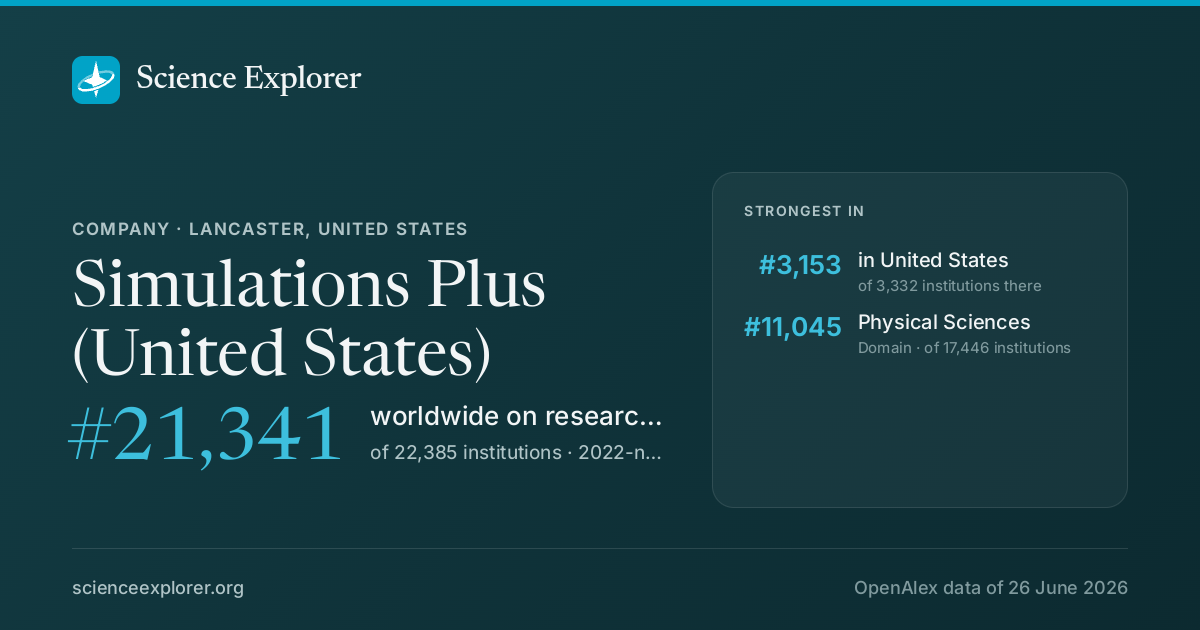
In research, Simulations Plus (United States) stands highest in Physical Sciences (#11,045 of 17,446 worldwide), over all time.
- World rank, 2022-now
- #21,341 of 22,385 · #18,872 all time
- Rank in United States
- #3,153 of 3,332
- Research works
- 267 ▲ 128% vs 2018-21
- Citations
- 14k 53.3 per fractional work
- Top-10% rate
- 9.2% all institutions 10.0%
- vs its own fields
- 0.96× 1.00× is exactly expected
- Open access
- 33% world 40%
- International
- 22% world 18%
What is Simulations Plus (United States) known for in research?
The fields where it stands highest, over all time, ranked among every institution above the floor in each field.
| Field | World rank | Where that sits | Top-10% rate | Works |
|---|---|---|---|---|
| Physical SciencesDomain | #11,045 of 17,446 | 16.9% | 126 |
Each strip is that field's whole ranked pool, with the notch where Simulations Plus (United States) sits in it, in the colour of the band that rank falls in. The track under the rate is the rate itself: it carries no average mark, because the average differs by field (from about 6% in Dentistry to 21% in Economics).
Which fields of science does Simulations Plus (United States) work in?
In 2022-now, 43% of research at Simulations Plus (United States) is in Health Sciences, 26% in Life Sciences. Its largest fields are Medicine (42%), Pharmacology, Toxicology and Pharmaceutics (12%), Biochemistry, Genetics and Molecular Biology (9%). It does 1.8× the world's share of Life Sciences.
Each ring splits the one inside it: the four domains of science, their fields, their subfields. Size is fractional works in 2022-now. Every slice is a page; the interactive view zooms down to single topics and colours each by how much more of it this institution does than the world.
Its 4 domains and 21 fields, with their numbers
- Health Sciences3442.7%
- Medicine3442.4%
- Veterinary00.1%
- Health Professions00.1%
- Life Sciences2126.3%
- Physical Sciences2025.5%
- Computer Science78.7%
- Chemistry78.2%
- Engineering33.6%
- Mathematics22.3%
- Environmental Science11.1%
- Physics and Astronomy00.6%
- Materials Science00.5%
- Energy00.3%
- Social Sciences45.5%
Field profile
Location quotient across every field it publishes in: outside the ring is more than an institution of this size would be expected to publish, inside it is less.
Rings at 0.5×, 1× and 2×. Widest outward: Pharmacology, Toxicology and Pharmaceutics, 34.4×. Every wedge is a field page.
All 21 fields, with their numbers
- Pharmacology, Toxicology and Pharmaceutics34.44×10 works
- Chemistry5.23×7 works
- Immunology and Microbiology3.04×2 works
- Decision Sciences2.46×2 works
- Medicine2.21×34 works
- Mathematics1.98×2 works
- Biochemistry, Genetics and Molecular Biology1.76×8 works
- Computer Science1.12×7 works
- Veterinary0.95×0 works
- Neuroscience0.50×1 works
- Business, Management and Accounting0.41×1 works
- Energy0.38×0 works
- Psychology0.34×1 works
- Physics and Astronomy0.28×0 works
- Engineering0.24×3 works
- Environmental Science0.23×1 works
- Agricultural and Biological Sciences0.20×1 works
- Economics, Econometrics and Finance0.19×0 works
- Materials Science0.15×0 works
- Health Professions0.04×0 works
- Social Sciences0.03×0 works
- Pharmacology, Toxicology and Pharmaceutics 34.4×
- Chemistry 5.2×
- Immunology and Microbiology 3.0×
- Decision Sciences 2.5×
- Medicine 2.2×
- Mathematics 2.0×
- Biochemistry, Genetics and Molecular Biology 1.8×
- Computer Science 1.1×
- Veterinary 0.9×
- Neuroscience 0.5×
- Business, Management and Accounting 0.4×
- Energy 0.4×
- Psychology 0.3×
- Physics and Astronomy 0.3×
- Engineering 0.2×
- Environmental Science 0.2×
- Agricultural and Biological Sciences 0.2×
- Economics, Econometrics and Finance 0.2×
- Materials Science 0.1×
- Health Professions 0.0×
- Social Sciences 0.0×
Who are the top researchers at Simulations Plus (United States)?
Ranked on the quality score, Marvin Waldman, Robert D. Clark and Michael B. Bolger lead among researchers whose main affiliation is Simulations Plus (United States).
- 1
Marvin Waldman
 United States · #595,836 worldwide
5k citations · 49 works
- 2
Robert D. Clark
United States · #1,129,619 worldwide
5k citations · 168 works
- 3
Michael B. Bolger
United States · #1,317,480 worldwide
5.5k citations · 107 works
- 4
Sandra Suarez‐Sharp
United States · #1,608,911 worldwide
900 citations · 29 works
- 5
Viera Lukáčová
United States · #1,704,234 worldwide
1.8k citations · 81 works
- 6
Sébastien Bihorel
United States · #2,227,156 worldwide
435 citations · 25 works
- 7
Michael S. Lawless
United States · #2,535,071 worldwide
668 citations · 41 works
- 8
Denise Morris
United States · #2,691,865 worldwide
419 citations · 20 works
- 9
Robert Fraczkiewicz
United States · #2,873,856 worldwide
1.7k citations · 32 works
- 10
Jörg‐Rüdiger Hill
United States · #2,958,832 worldwide
767 citations · 33 works
Which keywords describe research at Simulations Plus (United States)?
By fractional works in 2022-now, weighted toward what it does more of than the world: Pharmacokinetics, Genetic Variation, Medicinal Chemistry, Cytochrome P450, Pharmacogenetics, Molecular Docking, Drug Target Identification and Virtual Screening.
- Acetaminophen
- Liver Transplantation
- False Discovery Rate
- Adaptive Designs
- Immunogenicity
- Cognitive Function
- Polymeric Materials
- Perfusion Imaging
- Liquid Chromatography
- Monoclonal Antibodies
- Critically Ill Patients
- Treatment
- Multidrug Resistance
- Nuclear Receptors
- Big Data
- Virtual Screening
- Molecular Docking
- Cytochrome P450
- Genetic Variation
- Machine Learning
- Pharmacokinetics
- Oxidative Stress
- Medicinal Chemistry
- Pharmacogenetics
- Drug Target Identification
- Biomarkers
- Metabolic Regulation
- ATP-dependent Transporters
- Antimicrobial Resistance
- Antibiotic Pharmacokinetics
- Mitochondrial Dysfunction
- Chiral Separation
- Magnetic Resonance Imaging
- Antioxidants
- Biopharmaceuticals
- Cyclodextrins
- Solid Dispersions
- Angiogenesis
- Hepatotoxicity
- Spatial Analysis
Size is fractional works in 2022-now in the topics tagged with each word; colour is the word's share of this institution's work against its share of the world's. The 40 words are chosen for being large and distinctive. Each links to the topic it comes from most.
All 40 words, with their numbers
- Pharmacokinetics9▲ 44×2 topics
- Machine Learning7▲ 2.5×7 topics
- Oxidative Stress6▲ 4.4×14 topics
- Genetic Variation6▲ 31×3 topics
- Medicinal Chemistry5▲ 23×2 topics
- Cytochrome P4505▲ 183×1 topic
- Pharmacogenetics5▲ 298×1 topic
- Molecular Docking5▲ 47×2 topics
- Drug Target Identification4▲ 63×1 topic
- Virtual Screening4▲ 63×1 topic
- Biomarkers4▲ 7.6×8 topics
- Big Data4▲ 4.8×5 topics
- Metabolic Regulation4▲ 26×2 topics
- Nuclear Receptors3▲ 46×2 topics
- ATP-dependent Transporters3▲ 163×1 topic
- Multidrug Resistance3▲ 119×1 topic
- Antimicrobial Resistance3▲ 18×2 topics
- Treatment3▲ 2.9×12 topics
- Antibiotic Pharmacokinetics3▲ 110×1 topic
- Critically Ill Patients3▲ 110×1 topic
- Mitochondrial Dysfunction2▲ 10×3 topics
- Monoclonal Antibodies2▲ 34×3 topics
- Chiral Separation2▲ 64×1 topic
- Liquid Chromatography2▲ 44×1 topic
- Magnetic Resonance Imaging2▲ 9.9×1 topic
- Perfusion Imaging2▲ 35×1 topic
- Antioxidants2▲ 5.4×2 topics
- Polymeric Materials2▲ 33×2 topics
- Biopharmaceuticals2▲ 44×3 topics
- Cognitive Function2▲ 12×3 topics
- Cyclodextrins2▲ 107×1 topic
- Immunogenicity2▲ 52×2 topics
- Solid Dispersions2▲ 107×1 topic
- Adaptive Designs2▲ 105×1 topic
- Angiogenesis2▲ 6.5×6 topics
- False Discovery Rate2▲ 105×1 topic
- Hepatotoxicity2▲ 44×2 topics
- Liver Transplantation2▲ 18×2 topics
- Spatial Analysis2▲ 23×2 topics
- Acetaminophen2▲ 70×1 topic
Which research topics does Simulations Plus (United States) publish most on?
By volume in 2022-now: Pharmacogenetics and Drug Metabolism, Computational Drug Discovery Methods, Drug Transport and Resistance Mechanisms and Antibiotics Pharmacokinetics and Efficacy.
Area is fractional works; colour is the subfield each topic belongs to.
- 1 Pharmacogenetics and Drug Metabolism Pharmacology 5 works
- 2 Computational Drug Discovery Methods Computational Theory and Mathematics 4 works
- 3 Drug Transport and Resistance Mechanisms Oncology 3 works
- 4 Antibiotics Pharmacokinetics and Efficacy Pharmacology 3 works
- 5 Analytical Chemistry and Chromatography Spectroscopy 2 works
- 6 Advanced MRI Techniques and Applications Radiology, Nuclear Medicine and Imaging 2 works
- 7 Drug Solubulity and Delivery Systems Pharmaceutical Science 2 works
- 8 Statistical Methods in Clinical Trials Statistics and Probability 2 works
- 9 Drug-Induced Hepatotoxicity and Protection Pharmacology 2 works
- 10 Data Visualization and Analytics Computer Vision and Pattern Recognition 1 works
How open and international is its research?
Against the world's own shares: the tick on each track. Both are shares of its output, so they sit on one scale and can be read against each other as well as against the world.
World: 40% of research is openly available.
World: 18% is written across borders.
How has Simulations Plus (United States)'s research output changed?
Output in 2022-2025 was 128% higher than in 2018-2021.
The same series as a ribbon: one cell per year, darker for more. The line above answers how much; this answers when.
Its share of all research
Growing output can still be a shrinking share: all of science grows. This is Simulations Plus (United States) as a percentage of every work published that year, 0.00038% in 2024.
Fractional works of Simulations Plus (United States) over all fractional works that year. How the balance of science has shifted.
Other research institutions in Lancaster
Share Simulations Plus (United States)'s ranking
Badges for a website1Each links back here and updates with every snapshot

Research measures only: rankings here say nothing about teaching, admissions or student experience. Comparable institutions and collaboration partners have tabs of their own, above.
Discussion
Ask a question or share a note about Simulations Plus (United States). Keep it to the research: no personal attacks, advertising or links. Any reader can report a post, which collapses it for everyone until it is opened.