Science Explorer Back to mapMap
Discussion
Institution · Helsinki · Finland

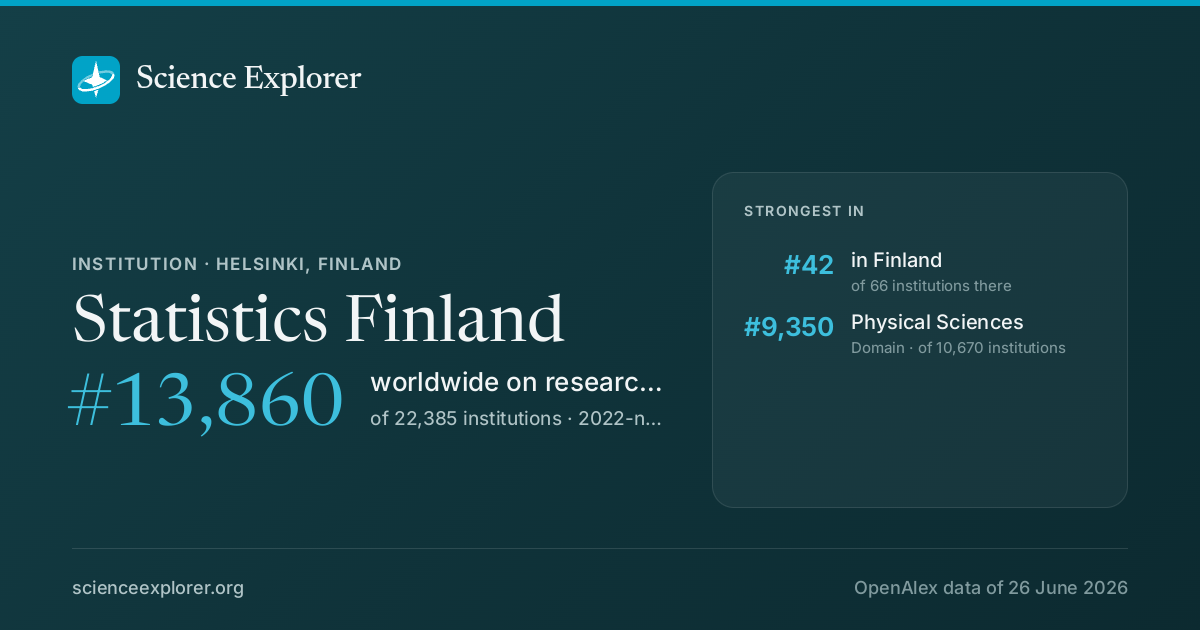
Statistics Finland

In research, Statistics Finland stands highest in Physical Sciences (#9,350 of 10,670 worldwide), 2022-now. Relative to its size it is most specialised in Mathematics (Mathematics is 23.9× its share of world research).

World rank, 2022-now
#13,860
of 22,385 · #6,526 all time
Rank in Finland
#42
of 66
Research works
724
▼ 10% vs 2018-21
Citations
17k
23.3 per fractional work
Top-10% rate
9.4%
all institutions 10.0%
vs its own fields
0.99×
1.00× is exactly expected
Open access
55%
world 40%
International
38%
world 18%

What is Statistics Finland known for in research?

The fields where it stands highest, 2022-now, ranked among every institution above the floor in each field.

FieldWorld rankWhere that sitsTop-10% rateWorksAll time
Physical SciencesDomain #9,350 of 10,670 9.5%78 #7418

Each strip is that field's whole ranked pool, with the notch where Statistics Finland sits in it, in the colour of the band that rank falls in. The track under the rate is the rate itself: it carries no average mark, because the average differs by field (from about 6% in Dentistry to 21% in Economics).

Which fields of science does Statistics Finland work in?

In 2022-now, 64% of research at Statistics Finland is in Physical Sciences, 18% in Social Sciences. Its largest fields are Mathematics (28%), Computer Science (18%), Medicine (10%). It does 1.6× the world's share of Physical Sciences.

Physical Sciences: 84 fractional works · 64.2% of its workMathematics: 37 fractional works · 28.2% of its workApplied Mathematics: 14 fractional works · 10.7% of its workMathematical Physics: 10 fractional works · 7.6% of its workStatistics and Probability: 5 fractional works · 4.1% of its workGeometry and Topology: 3 fractional works · 2.6% of its workNumerical Analysis: 1 fractional works · 1.0% of its workModeling and Simulation: 1 fractional works · 0.8% of its workAlgebra and Number Theory: 1 fractional works · 0.6% of its workDiscrete Mathematics and Combinatorics: 0 fractional works · 0.4% of its workSmaller subfields together: 0 fractional works · 0.3% of its workComputer Science: 24 fractional works · 18.2% of its workComputational Theory and Mathematics: 9 fractional works · 6.6% of its workArtificial Intelligence: 7 fractional works · 5.6% of its workInformation Systems: 3 fractional works · 2.7% of its workSignal Processing: 1 fractional works · 1.0% of its workComputer Networks and Communications: 1 fractional works · 0.8% of its workComputer Science Applications: 1 fractional works · 0.5% of its workComputer Vision and Pattern Recognition: 1 fractional works · 0.4% of its workSoftware: 0 fractional works · 0.3% of its workSmaller subfields together: 0 fractional works · 0.2% of its workEngineering: 11 fractional works · 8.7% of its workComputational Mechanics: 2 fractional works · 1.9% of its workBiomedical Engineering: 2 fractional works · 1.3% of its workMechanics of Materials: 2 fractional works · 1.3% of its workControl and Systems Engineering: 2 fractional works · 1.2% of its workElectrical and Electronic Engineering: 1 fractional works · 1.1% of its workBuilding and Construction: 1 fractional works · 0.6% of its workMechanical Engineering: 1 fractional works · 0.4% of its workAerospace Engineering: 0 fractional works · 0.3% of its workCivil and Structural Engineering: 0 fractional works · 0.3% of its workSmaller subfields together: 0 fractional works · 0.3% of its workPhysics and Astronomy: 5 fractional works · 3.8% of its workAtomic and Molecular Physics, and Optics: 2 fractional works · 1.2% of its workStatistical and Nonlinear Physics: 1 fractional works · 0.9% of its workAstronomy and Astrophysics: 1 fractional works · 0.6% of its workCondensed Matter Physics: 1 fractional works · 0.5% of its workNuclear and High Energy Physics: 0 fractional works · 0.4% of its workRadiation: 0 fractional works · 0.3% of its workEnvironmental Science: 5 fractional works · 3.6% of its workPollution: 1 fractional works · 0.8% of its workEcology: 1 fractional works · 0.7% of its workGlobal and Planetary Change: 1 fractional works · 0.4% of its workEnvironmental Engineering: 1 fractional works · 0.4% of its workNature and Landscape Conservation: 1 fractional works · 0.4% of its workEcological Modeling: 0 fractional works · 0.3% of its workHealth, Toxicology and Mutagenesis: 0 fractional works · 0.3% of its workManagement, Monitoring, Policy and Law: 0 fractional works · 0.2% of its workSmaller subfields together: 0 fractional works · 0.1% of its workEarth and Planetary Sciences: 1 fractional works · 0.7% of its workGeophysics: 0 fractional works · 0.3% of its workAtmospheric Science: 0 fractional works · 0.3% of its workSmaller subfields together: 0 fractional works · 0.1% of its workMaterials Science: 1 fractional works · 0.5% of its workMaterials Chemistry: 0 fractional works · 0.4% of its workSmaller subfields together: 0 fractional works · 0.1% of its workChemistry: 0 fractional works · 0.4% of its workAnalytical Chemistry: 0 fractional works · 0.3% of its workSmaller subfields together: 0 fractional works · 0.1% of its workEnergy: 0 fractional works · 0.2% of its workSocial Sciences: 23 fractional works · 17.8% of its workSocial Sciences: 9 fractional works · 6.8% of its workEducation: 3 fractional works · 2.6% of its workSociology and Political Science: 3 fractional works · 2.0% of its workDemography: 1 fractional works · 0.4% of its workHealth: 0 fractional works · 0.4% of its workPolitical Science and International Relations: 0 fractional works · 0.3% of its workSafety Research: 0 fractional works · 0.3% of its workSmaller subfields together: 1 fractional works · 0.8% of its workEconomics, Econometrics and Finance: 5 fractional works · 3.5% of its workEconomics and Econometrics: 3 fractional works · 1.9% of its workFinance: 1 fractional works · 1.1% of its workGeneral Economics, Econometrics and Finance: 1 fractional works · 0.4% of its workArts and Humanities: 4 fractional works · 3.0% of its workHistory and Philosophy of Science: 1 fractional works · 0.9% of its workHistory: 1 fractional works · 0.5% of its workLanguage and Linguistics: 0 fractional works · 0.4% of its workPhilosophy: 0 fractional works · 0.4% of its workVisual Arts and Performing Arts: 0 fractional works · 0.3% of its workArcheology: 0 fractional works · 0.3% of its workClassics: 0 fractional works · 0.3% of its workSmaller subfields together: 0 fractional works · 0.0% of its workBusiness, Management and Accounting: 2 fractional works · 1.9% of its workStrategy and Management: 1 fractional works · 0.8% of its workManagement of Technology and Innovation: 1 fractional works · 0.4% of its workMarketing: 0 fractional works · 0.3% of its workAccounting: 0 fractional works · 0.2% of its workSmaller subfields together: 0 fractional works · 0.2% of its workPsychology: 2 fractional works · 1.6% of its workExperimental and Cognitive Psychology: 1 fractional works · 0.5% of its workClinical Psychology: 1 fractional works · 0.4% of its workSocial Psychology: 0 fractional works · 0.4% of its workDevelopmental and Educational Psychology: 0 fractional works · 0.3% of its workSmaller subfields together: 0 fractional works · 0.0% of its workDecision Sciences: 1 fractional works · 1.1% of its workManagement Science and Operations Research: 1 fractional works · 0.5% of its workStatistics, Probability and Uncertainty: 1 fractional works · 0.4% of its workSmaller subfields together: 0 fractional works · 0.1% of its workHealth Sciences: 15 fractional works · 11.3% of its workMedicine: 13 fractional works · 9.9% of its workRadiology, Nuclear Medicine and Imaging: 2 fractional works · 1.4% of its workOncology: 1 fractional works · 1.0% of its workPublic Health, Environmental and Occupational Health: 1 fractional works · 0.9% of its workEpidemiology: 1 fractional works · 0.8% of its workPulmonary and Respiratory Medicine: 1 fractional works · 0.7% of its workPhysiology: 1 fractional works · 0.6% of its workPediatrics, Perinatology and Child Health: 1 fractional works · 0.5% of its workPathology and Forensic Medicine: 1 fractional works · 0.5% of its workSurgery: 1 fractional works · 0.4% of its workObstetrics and Gynecology: 1 fractional works · 0.4% of its workOrthopedics and Sports Medicine: 0 fractional works · 0.3% of its workInfectious Diseases: 0 fractional works · 0.3% of its workGenetics: 0 fractional works · 0.3% of its workRehabilitation: 0 fractional works · 0.2% of its workSmaller subfields together: 2 fractional works · 1.5% of its workHealth Professions: 1 fractional works · 0.9% of its workGeneral Health Professions: 1 fractional works · 0.6% of its workSmaller subfields together: 0 fractional works · 0.3% of its workDentistry: 0 fractional works · 0.4% of its workNursing: 0 fractional works · 0.1% of its workVeterinary: 0 fractional works · 0.1% of its workLife Sciences: 9 fractional works · 6.6% of its workBiochemistry, Genetics and Molecular Biology: 5 fractional works · 4.1% of its workGenetics: 3 fractional works · 2.1% of its workMolecular Biology: 2 fractional works · 1.3% of its workCell Biology: 0 fractional works · 0.3% of its workSmaller subfields together: 1 fractional works · 0.5% of its workAgricultural and Biological Sciences: 2 fractional works · 1.2% of its workFood Science: 0 fractional works · 0.4% of its workEcology, Evolution, Behavior and Systematics: 0 fractional works · 0.3% of its workPlant Science: 0 fractional works · 0.2% of its workSmaller subfields together: 0 fractional works · 0.3% of its workNeuroscience: 1 fractional works · 0.7% of its workCognitive Neuroscience: 0 fractional works · 0.4% of its workSmaller subfields together: 0 fractional works · 0.3% of its workImmunology and Microbiology: 1 fractional works · 0.6% of its workImmunology: 1 fractional works · 0.4% of its workSmaller subfields together: 0 fractional works · 0.2% of its workPharmacology, Toxicology and Pharmaceutics: 0 fractional works · 0.0% of its workALL ITS WORKStatisticsFinland130fractional works, 2022-now
Life Sciences7%Physical Sciences64%Health Sciences11%Social Sciences18%

Each ring splits the one inside it: the four domains of science, their fields, their subfields. Size is fractional works in 2022-now. Every slice is a page; the interactive view zooms down to single topics and colours each by how much more of it this institution does than the world.

Its 4 domains and 25 fields, with their numbers
    1. Mathematics3728.2%
    2. Computer Science2418.2%
    3. Engineering118.7%
    4. Physics and Astronomy53.8%
    5. Environmental Science53.6%
    6. Earth and Planetary Sciences10.7%
    7. Materials Science10.5%
    8. Chemistry00.4%
    9. Energy00.2%
    1. Social Sciences96.8%
    2. Economics, Econometrics and Finance53.5%
    3. Arts and Humanities43.0%
    4. Business, Management and Accounting21.9%
    5. Psychology21.6%
    6. Decision Sciences11.1%
    1. Medicine139.9%
    2. Health Professions10.9%
    3. Dentistry00.4%
    4. Nursing00.1%
    5. Veterinary00.1%
    1. Biochemistry, Genetics and Molecular Biology54.1%
    2. Agricultural and Biological Sciences21.2%
    3. Neuroscience10.7%
    4. Immunology and Microbiology10.6%
    5. Pharmacology, Toxicology and Pharmaceutics00.0%
All of science, and how each field's share has moved since 1950: the Science domain explorer

What does Statistics Finland specialise in?

Where its research is concentrated relative to its size: Mathematics takes 23.9× the share of its output that it takes of world research.

  1. MathematicsField · 36.7 works24×
← less than its size predicts1×more →

Location quotient, a volume reading rather than an impact one. It surfaces small, lopsided specialities.

Field profile

Location quotient across every field it publishes in: outside the ring is more than an institution of this size would be expected to publish, inside it is less.

Agricultural and Biological Sciences: 0.26× its world share, 2 worksAgricultural and Bio…Biochemistry, Genetics and Molecular Biology: 0.76× its world share, 5 worksBiochemistry, Geneti…Immunology and Microbiology: 0.60× its world share, 1 worksImmunology and Micro…Neuroscience: 0.42× its world share, 1 worksNeurosciencePharmacology, Toxicology and Pharmaceutics: 0.07× its world share, 0 worksPharmacology, Toxico…Chemistry: 0.22× its world share, 0 worksChemistryComputer Science: 2.34× its world share, 24 worksComputer ScienceEarth and Planetary Sciences: 0.43× its world share, 1 worksEarth and Planetary …Energy: 0.18× its world share, 0 worksEnergyEngineering: 0.58× its world share, 11 worksEngineeringEnvironmental Science: 0.73× its world share, 5 worksEnvironmental ScienceMaterials Science: 0.14× its world share, 1 worksMaterials ScienceMathematics: 23.95× its world share, 37 worksMathematicsPhysics and Astronomy: 1.73× its world share, 5 worksPhysics and AstronomyDentistry: 0.75× its world share, 0 worksDentistryHealth Professions: 0.34× its world share, 1 worksHealth ProfessionsMedicine: 0.51× its world share, 13 worksMedicineNursing: 0.19× its world share, 0 worksNursingVeterinary: 0.63× its world share, 0 worksVeterinaryArts and Humanities: 1.03× its world share, 4 worksArts and HumanitiesBusiness, Management and Accounting: 0.57× its world share, 2 worksBusiness, Management…Decision Sciences: 1.14× its world share, 1 worksDecision SciencesEconomics, Econometrics and Finance: 1.65× its world share, 5 worksEconomics, Econometr…Psychology: 0.52× its world share, 2 worksPsychologySocial Sciences: 0.54× its world share, 9 worksSocial Sciences1×world share
more than its size predictsabout as predictedless

Rings at 0.5×, 1× and 2×. Widest outward: Mathematics, 23.9×. Every wedge is a field page.

All 25 fields, with their numbers
  1. Mathematics23.95×37 works
  2. Computer Science2.34×24 works
  3. Physics and Astronomy1.73×5 works
  4. Economics, Econometrics and Finance1.65×5 works
  5. Decision Sciences1.14×1 works
  6. Arts and Humanities1.03×4 works
  7. Biochemistry, Genetics and Molecular Biology0.76×5 works
  8. Dentistry0.75×0 works
  9. Environmental Science0.73×5 works
  10. Veterinary0.63×0 works
  11. Immunology and Microbiology0.60×1 works
  12. Engineering0.58×11 works
  13. Business, Management and Accounting0.57×2 works
  14. Social Sciences0.54×9 works
  15. Psychology0.52×2 works
  16. Medicine0.51×13 works
  17. Earth and Planetary Sciences0.43×1 works
  18. Neuroscience0.42×1 works
  19. Health Professions0.34×1 works
  20. Agricultural and Biological Sciences0.26×2 works
  21. Chemistry0.22×0 works
  22. Nursing0.19×0 works
  23. Energy0.18×0 works
  24. Materials Science0.14×1 works
  25. Pharmacology, Toxicology and Pharmaceutics0.07×0 works

Who are the top researchers at Statistics Finland?

Ranked on the quality score, Tuija Annika Poussa, Yrjo O. Vartia and Martti Kalke lead among researchers whose main affiliation is Statistics Finland.

  1. 1 Tuija Annika Poussa Finland · #271,916 worldwide 13k citations · 133 works
  2. 2 Yrjo O. Vartia Finland · #1,414,463 worldwide 998 citations · 23 works
  3. 3 Martti Kalke Finland · #3,327,012 worldwide 309 citations · 15 works
  4. 4 Henri Luomaranta Finland · #3,396,807 worldwide 39 citations · 20 works
  5. 5 Petri Hilli Finland · #3,408,675 worldwide 135 citations · 17 works
  6. 6 Minna Piispa Finland · #3,664,317 worldwide 274 citations · 24 works
  7. 7 Satu Nurmi Finland · #3,748,454 worldwide 223 citations · 34 works
  8. 8 Hanna Sutela Finland · #3,767,388 worldwide 403 citations · 24 works
  9. 9 Pirkko Aulin‐Ahmavaara Finland · #3,907,897 worldwide 154 citations · 18 works
  10. 10 Jukka Hoffrén Finland · #3,967,728 worldwide 189 citations · 19 works
All ranked researchers at Statistics Finland

What are the most cited papers from Statistics Finland?

The most cited paper from Statistics Finland is "Mapping genomic loci implicates genes and synaptic biology in schizophrenia" (Vassily Vladimirovich Trubetskoy et al., 2022), with 2,894 citations. Next come "Distribution and intensity of constraint in mammalian genomic sequence" (1,466) and "Probiotics and prevention of atopic disease: 4-year follow-up of a randomised placebo-controlled trial" (1,351).

Most cited papers
#PaperReleasedCitations
1 Mapping genomic loci implicates genes and synaptic biology in schizophrenia Vassily Vladimirovich Trubetskoy et al. · Nature Open access613 authors 8 Apr 2022 2,894
2 Distribution and intensity of constraint in mammalian genomic sequence Gregory M. Cooper, Eric A. Stone, George Asimenos et al. · Genome Research Open access 17 Jun 2005 1,466
3 Probiotics and prevention of atopic disease: 4-year follow-up of a randomised placebo-controlled trial Marko A. Kalliomäki, Seppo Salminen, Tuija Annika Poussa et al. · The Lancet May 2003 1,351
4 Testing linearity against smooth transition autoregressive models Ritva A. Luukkonen, Pentti Saikkonen, Timo Teräsvirta · Biometrika 1988 1,351
5 The Fecal Microbiota of Irritable Bowel Syndrome Patients Differs Significantly From That of Healthy Subjects Anna Kassinen, Lotta Krogius-Kurikka, Harri Mäkivuokko et al. · Gastroenterology Open access 15 Apr 2007 1,006
All 60 most cited papers, with filters and sorting

Which keywords describe research at Statistics Finland?

By fractional works in 2022-now, weighted toward what it does more of than the world: Numerical Methods, Electrical Impedance Tomography, Finite Element, Porous Media, Nonlinear Equations, Heterogeneous, Multiscale Methods and Inverse Problems.

▲ more of its work than of the world's◆ about the world's share▼ less than the world's

Size is fractional works in 2022-now in the topics tagged with each word; colour is the word's share of this institution's work against its share of the world's. The 40 words are chosen for being large and distinctive. Each links to the topic it comes from most.

All 40 words, with their numbers
  1. Machine Learning5▲ 1.22×24 topics
  2. Numerical Methods5▲ 49×3 topics
  3. Electrical Impedance Tomography5▲ 108×2 topics
  4. Finite Element5▲ 84×2 topics
  5. Nonlinear Equations5▲ 28×3 topics
  6. Porous Media5▲ 27×2 topics
  7. Heterogeneous4▲ 97×1 topic
  8. Inverse Problems4▲ 31×4 topics
  9. Multiscale Methods4▲ 97×1 topic
  10. Ill-Posed Problems4▲ 154×1 topic
  11. Regularization Methods4▲ 154×1 topic
  12. Fractional Laplacian4▲ 128×1 topic
  13. Sobolev Spaces4▲ 128×1 topic
  14. Holomorphic Functions3▲ 81×2 topics
  15. Knowledge Representation3▲ 23×3 topics
  16. Calderón–Zygmund Theory2▲ 191×1 topic
  17. Description Logics2▲ 40×2 topics
  18. Fourier Multiplier Theorems2▲ 191×1 topic
  19. Model Checking2▲ 38×3 topics
  20. Weighted Spaces2▲ 77×2 topics
  21. Bayesian Inference2▲ 16×5 topics
  22. Temporal Logic2▲ 48×2 topics
  23. Urban Development2▲ 4.5×3 topics
  24. Composition Operators2▲ 89×1 topic
  25. Toeplitz Operators2▲ 89×1 topic
  26. Modal Logic2▲ 46×2 topics
  27. Sparse Representation2▲ 7.5×3 topics
  28. Feedback Control2▲ 7.8×4 topics
  29. Sensitivity Analysis2▲ 13×3 topics
  30. Answer Set Programming2▲ 81×1 topic
  31. Belief Revision2▲ 81×1 topic
  32. Monte Carlo Simulation2▲ 6.0×4 topics
  33. Real Estate Market2▲ 28×2 topics
  34. Geometric Algebra2▲ 87×1 topic
  35. Principal Component Analysis2▲ 8.7×4 topics
  36. Quaternionic Analysis2▲ 87×1 topic
  37. Boundary Value Problems1▲ 21×2 topics
  38. Housing Supply1▲ 32×1 topic
  39. Mortgage Credit Expansion1▲ 32×1 topic
  40. Population Genetics1▲ 8.0×5 topics

Which research topics does Statistics Finland publish most on?

By volume in 2022-now: Advanced Mathematical Modeling in Engineering, Numerical methods in inverse problems, Nonlinear Partial Differential Equations and Advanced Harmonic Analysis Research.

  1. 1 Advanced Mathematical Modeling in Engineering Computational Theory and Mathematics 4 works
  2. 2 Numerical methods in inverse problems Mathematical Physics 4 works
  3. 3 Nonlinear Partial Differential Equations Applied Mathematics 4 works
  4. 4 Advanced Harmonic Analysis Research Applied Mathematics 2 works
  5. 5 Holomorphic and Operator Theory Applied Mathematics 2 works
  6. 6 Logic, Reasoning, and Knowledge Artificial Intelligence 2 works
  7. 7 Algebraic and Geometric Analysis Applied Mathematics 2 works
  8. 8 Housing Market and Economics Economics and Econometrics 1 works
  9. 9 Geometric Analysis and Curvature Flows Applied Mathematics 1 works
  10. 10 Spectral Theory in Mathematical Physics Mathematical Physics 1 works

How open and international is its research?

Against the world's own shares: the tick on each track. Both are shares of its output, so they sit on one scale and can be read against each other as well as against the world.

openly available54.6%not open45.4%

World: 40% of research is openly available.

with international co-authors38.5%domestic only61.5%

World: 18% is written across borders.

How has Statistics Finland's research output changed?

Output in 2022-2025 was 10% lower than in 2018-2021.

still counting1990200020102020
grewheldshrank

The same series as a ribbon: one cell per year, darker for more. The line above answers how much; this answers when.

Its share of all research

Growing output can still be a shrinking share: all of science grows. This is Statistics Finland as a percentage of every work published that year, 0.00053% in 2024.

still counting0.00050%0.0010%0.0015%Statistics Finland0.00045% in 202519801990200020102020

Fractional works of Statistics Finland over all fractional works that year. How the balance of science has shifted.

How much of it reaches the world top 10%

Year by year, against all institutions in the same year.

still counting10%20%Statistics Finland10.3% in 2025all institutions10.0% in 202520102020

Of each year's output, the share that reached the world's 10% most cited for its field and year. Peak 20.0% in 2020.

Other research institutions in Helsinki

All research institutions in Helsinki

Share Statistics Finland's ranking

Statistics Finland on Science Explorer

A card with Statistics Finland's standing and the fields it leads in, for a post or a slide. A link to this page previews as the same card.

Download the card

1200 × 630 PNG, sized for social posts, drawn from the latest snapshot.

Badges for a website1Each links back here and updates with every snapshot

Research measures only: rankings here say nothing about teaching, admissions or student experience. Comparable institutions and collaboration partners have tabs of their own, above.

Discussion

Ask a question or share a note about Statistics Finland. Posts are plain text and can be reported.