Suncor Energy (Canada)
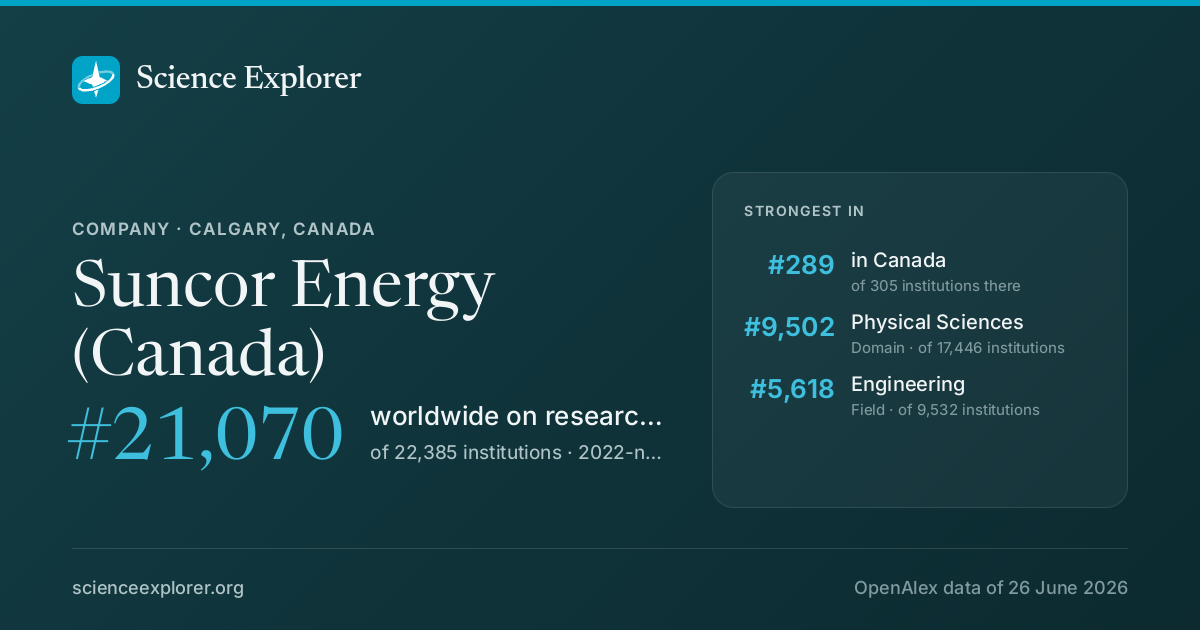
In research, Suncor Energy (Canada) stands highest in Physical Sciences (#9,502 of 17,446 worldwide) and Engineering (#5,618 of 9,532 worldwide), over all time.
- World rank, 2022-now
- #21,070 of 22,385 · #24,651 all time
- Rank in Canada
- #289 of 305
- Research works
- 326 ▲ 38% vs 2018-21
- Citations
- 4k 12.4 per fractional work
- Top-10% rate
- 3.6% all institutions 10.0%
- vs its own fields
- 0.93× 1.00× is exactly expected
- Open access
- 17% world 40%
- International
- 22% world 18%
What is Suncor Energy (Canada) known for in research?
The fields where it stands highest, over all time, ranked among every institution above the floor in each field.
| Field | World rank | Where that sits | Top-10% rate | Works |
|---|---|---|---|---|
| Physical SciencesDomain | #9,502 of 17,446 | 7.4% | 281 | |
| EngineeringField | #5,618 of 9,532 | 7.6% | 182 |
Each strip is that field's whole ranked pool, with the notch where Suncor Energy (Canada) sits in it, in the colour of the band that rank falls in. The track under the rate is the rate itself: it carries no average mark, because the average differs by field (from about 6% in Dentistry to 21% in Economics).
Which fields of science does Suncor Energy (Canada) work in?
In 2022-now, 84% of research at Suncor Energy (Canada) is in Physical Sciences, 7% in Life Sciences. Its largest fields are Engineering (53%), Environmental Science (11%), Materials Science (9%). It does 2.0× the world's share of Physical Sciences.
Each ring splits the one inside it: the four domains of science, their fields, their subfields. Size is fractional works in 2022-now. Every slice is a page; the interactive view zooms down to single topics and colours each by how much more of it this institution does than the world.
Its 4 domains and 21 fields, with their numbers
- Physical Sciences6084.1%
- Engineering3853.0%
- Environmental Science811.3%
- Materials Science79.4%
- Earth and Planetary Sciences33.8%
- Computer Science12.0%
- Chemistry11.9%
- Energy11.5%
- Chemical Engineering00.5%
- Physics and Astronomy00.5%
- Mathematics00.1%
- Life Sciences57.2%
- Health Sciences45.8%
- Medicine34.3%
- Veterinary00.7%
- Health Professions00.7%
- Nursing00.1%
- Social Sciences23.0%
Field profile
Location quotient across every field it publishes in: outside the ring is more than an institution of this size would be expected to publish, inside it is less.
Rings at 0.5×, 1× and 2×. Widest outward: Veterinary, 5.1×. Every wedge is a field page.
All 21 fields, with their numbers
- Veterinary5.14×0 works
- Engineering3.53×38 works
- Materials Science2.69×7 works
- Earth and Planetary Sciences2.45×3 works
- Environmental Science2.27×8 works
- Energy1.65×1 works
- Chemical Engineering1.55×0 works
- Chemistry1.21×1 works
- Agricultural and Biological Sciences1.09×4 works
- Decision Sciences1.06×1 works
- Biochemistry, Genetics and Molecular Biology0.38×1 works
- Computer Science0.26×1 works
- Health Professions0.25×0 works
- Medicine0.22×3 works
- Business, Management and Accounting0.22×0 works
- Economics, Econometrics and Finance0.22×0 works
- Physics and Astronomy0.21×0 works
- Nursing0.19×0 works
- Mathematics0.10×0 works
- Social Sciences0.06×0 works
- Psychology0.02×0 works
- Veterinary 5.1×
- Engineering 3.5×
- Materials Science 2.7×
- Earth and Planetary Sciences 2.5×
- Environmental Science 2.3×
- Energy 1.6×
- Chemical Engineering 1.6×
- Chemistry 1.2×
- Agricultural and Biological Sciences 1.1×
- Decision Sciences 1.1×
- Biochemistry, Genetics and Molecular Biology 0.4×
- Computer Science 0.3×
- Health Professions 0.2×
- Medicine 0.2×
- Business, Management and Accounting 0.2×
- Economics, Econometrics and Finance 0.2×
- Physics and Astronomy 0.2×
- Nursing 0.2×
- Mathematics 0.1×
- Social Sciences 0.1×
- Psychology 0.0×
Who are the top researchers at Suncor Energy (Canada)?
Ranked on the quality score, R.J. Chung, David Pernitsky and C. R. Cutler lead among researchers whose main affiliation is Suncor Energy (Canada).
- 1
R.J. Chung
 Canada · #677,559 worldwide
826 citations · 23 works
- 2
David Pernitsky
Canada · #919,885 worldwide
1.3k citations · 38 works
- 3
C. R. Cutler
Canada · #1,122,457 worldwide
2.4k citations · 15 works
- 4
Christine Daly
Canada · #1,682,857 worldwide
802 citations · 22 works
- 5
P. G. Nix
Canada · #3,131,536 worldwide
173 citations · 17 works
- 6
K.C. Yeung
Canada · #3,299,015 worldwide
109 citations · 15 works
- 7
W. S. James
Canada · #3,734,387 worldwide
29 citations · 16 works
- 8
Bob Mitchell
Canada · #4,364,982 worldwide
20 citations · 16 works
- 9
Michael Fefer
Canada · #4,423,747 worldwide
376 citations · 44 works
- 10
Trent Pehlke
Canada · #4,759,626 worldwide
49 citations · 15 works
Which keywords describe research at Suncor Energy (Canada)?
By fractional works in 2022-now, weighted toward what it does more of than the world: Mechanical Properties, Corrosion, Microstructure, Optimization, Failure Analysis, Fault Diagnosis, Surfactants and Predictive Maintenance.
- CO2 Sequestration
- Sulfate-Reducing Bacteria
- Pore-scale Modeling
- Mudstones
- Rheological Properties
- Gas Permeability
- Wear Resistance
- Pipeline
- Shale Gas Reservoirs
- Fracture Propagation
- Fatigue Fracture
- Hydrogen Embrittlement
- Pitting Corrosion
- Finite Element Analysis
- Artificial Lift Systems
- Surfactants
- Failure Analysis
- Nanoparticles
- Microstructure
- Machine Learning
- Mechanical Properties
- Corrosion
- Optimization
- Environmental Impact
- Fault Diagnosis
- Predictive Maintenance
- Electric Submersible Pumps
- Hydraulic Fracturing
- Data Assimilation
- Ensemble Kalman Filter
- Fracture Mechanisms
- Numerical Simulation
- Well Placement
- Shale Gas
- Reactive Oxygen Species
- Passive Films
- Stainless Steels
- Pore Structure
- Steel
- X-ray Computed Tomography
Size is fractional works in 2022-now in the topics tagged with each word; colour is the word's share of this institution's work against its share of the world's. The 40 words are chosen for being large and distinctive. Each links to the topic it comes from most.
All 40 words, with their numbers
- Mechanical Properties6▲ 9.3×11 topics
- Machine Learning5▲ 2.2×8 topics
- Corrosion4▲ 44×5 topics
- Microstructure4▲ 9.5×6 topics
- Optimization4▲ 11×3 topics
- Nanoparticles3▲ 3.6×7 topics
- Environmental Impact3▲ 2.4×9 topics
- Failure Analysis3▲ 44×2 topics
- Fault Diagnosis3▲ 28×2 topics
- Surfactants3▲ 40×3 topics
- Predictive Maintenance3▲ 53×2 topics
- Artificial Lift Systems3▲ 133×1 topic
- Electric Submersible Pumps3▲ 133×1 topic
- Finite Element Analysis3▲ 16×4 topics
- Hydraulic Fracturing3▲ 34×2 topics
- Pitting Corrosion3▲ 70×2 topics
- Data Assimilation2▲ 20×2 topics
- Hydrogen Embrittlement2▲ 40×2 topics
- Ensemble Kalman Filter2▲ 30×1 topic
- Fatigue Fracture2▲ 263×1 topic
- Fracture Mechanisms2▲ 263×1 topic
- Fracture Propagation2▲ 51×1 topic
- Numerical Simulation2▲ 11×6 topics
- Shale Gas Reservoirs2▲ 51×1 topic
- Well Placement2▲ 68×1 topic
- Pipeline2▲ 29×3 topics
- Shale Gas2▲ 24×2 topics
- Wear Resistance2▲ 77×2 topics
- Reactive Oxygen Species2▲ 6.3×3 topics
- Gas Permeability2▲ 26×2 topics
- Passive Films2▲ 76×1 topic
- Rheological Properties2▲ 14×2 topics
- Stainless Steels2▲ 76×1 topic
- Mudstones2▲ 32×1 topic
- Pore Structure2▲ 19×1 topic
- Pore-scale Modeling2▲ 62×1 topic
- Steel2▲ 56×2 topics
- Sulfate-Reducing Bacteria2▲ 36×2 topics
- X-ray Computed Tomography2▲ 62×1 topic
- CO2 Sequestration2▲ 11×2 topics
Which research topics does Suncor Energy (Canada) publish most on?
By volume in 2022-now: Oil and Gas Production Techniques, Mechanical Failure Analysis and Simulation, Reservoir Engineering and Simulation Methods and Hydraulic Fracturing and Reservoir Analysis.
Area is fractional works; colour is the subfield each topic belongs to.
- 1 Oil and Gas Production Techniques Ocean Engineering 3 works
- 2 Mechanical Failure Analysis and Simulation Mechanical Engineering 2 works
- 3 Reservoir Engineering and Simulation Methods Ocean Engineering 2 works
- 4 Hydraulic Fracturing and Reservoir Analysis Mechanical Engineering 2 works
- 5 Hydrogen embrittlement and corrosion behaviors in metals Metals and Alloys 2 works
- 6 Enhanced Oil Recovery Techniques Ocean Engineering 2 works
- 7 Hydrocarbon exploration and reservoir analysis Mechanics of Materials 2 works
- 8 Metal Alloys Wear and Properties Materials Chemistry 2 works
- 9 Photodynamic Therapy Research Studies Pulmonary and Respiratory Medicine 1 works
- 10 Corrosion Behavior and Inhibition Materials Chemistry 1 works
How open and international is its research?
Against the world's own shares: the tick on each track. Both are shares of its output, so they sit on one scale and can be read against each other as well as against the world.
World: 40% of research is openly available.
World: 18% is written across borders.
How has Suncor Energy (Canada)'s research output changed?
Output in 2022-2025 was 38% higher than in 2018-2021.
The same series as a ribbon: one cell per year, darker for more. The line above answers how much; this answers when.
Its share of all research
Growing output can still be a shrinking share: all of science grows. This is Suncor Energy (Canada) as a percentage of every work published that year, 0.00030% in 2024.
Fractional works of Suncor Energy (Canada) over all fractional works that year. How the balance of science has shifted.
Other research institutions in Calgary
- University of Calgary
- Encana (Canada)
- Mount Royal University
- Schlumberger (Canada)
- Libin Cardiovascular Institute of Alberta
- Petro-Canada
- Institute of Cancer Research
- Nexen (Canada)

Share Suncor Energy (Canada)'s ranking
Badges for a website1Each links back here and updates with every snapshot

Research measures only: rankings here say nothing about teaching, admissions or student experience. Comparable institutions and collaboration partners have tabs of their own, above.
Discussion
Ask a question or share a note about Suncor Energy (Canada). Posts are plain text and can be reported.