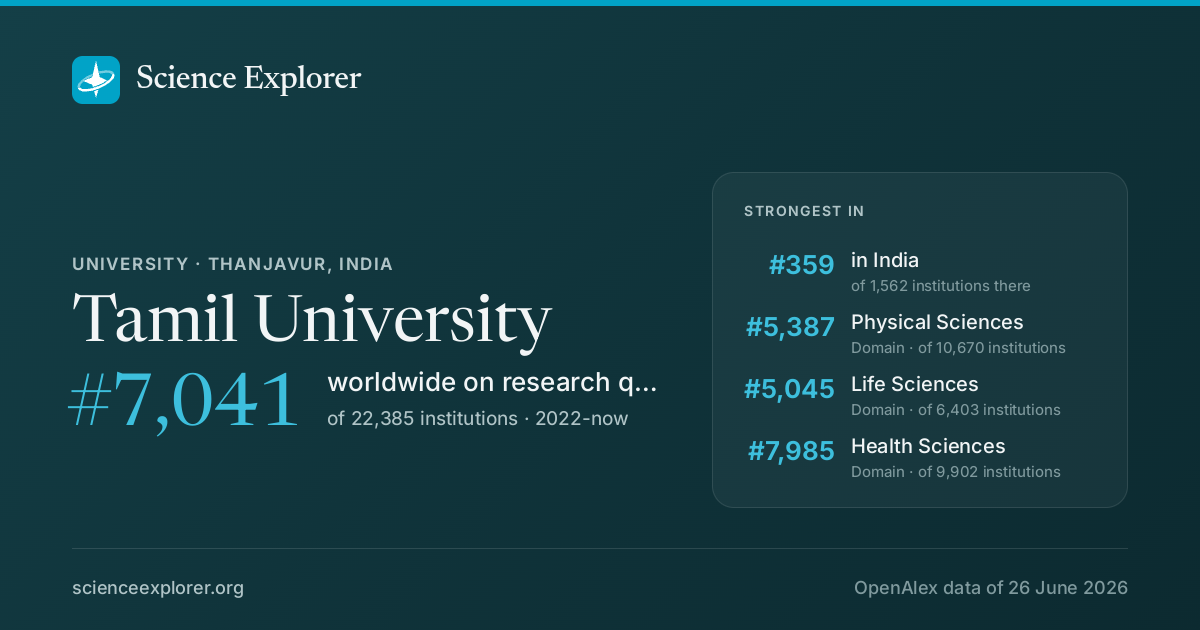
World rank, 2022-now #7,041
of 22,385 · #14,212 all time
Rank in India #359
of 1,562 Research works 1.4k
▲ 32% vs 2018-21
Citations 11k 7.7 per fractional work
Top-10% rate 4.3%
all institutions 10.0%
vs its own fields 0.71×
1.00× is exactly expected
Open access 60%
world 40%
International 12%
world 18%
What is Tamil University known for in research?
The fields where it stands highest, 2022-now, ranked among every institution above the floor in each field.
Field World rank Where that sits Top-10% rate Works All time Domain #5,387 of 10,670 5.4% 162
#10015 Domain #5,045 of 6,403 3.1% 81
#8391 Domain #7,985 of 9,902 1.9% 130
#15821 Field #6,939 of 8,541 1.8% 103
#13676 Domain #8,280 of 9,585 3.2% 113
#13716
Which of those standings moved
#10,015 #5,387 #8,391 #5,045 #15,821 #7,985 #13,676 #6,939 #13,716 #8,280
A dot further right is a better standing. Fields it was not ranked in over the whole record are left out.
Which fields of science does Tamil University work in?
In 2022-now, 34% of research at Tamil University is in Physical Sciences , 26% in Health Sciences . Its largest fields are Medicine (21%), Engineering (10%), Social Sciences (10%). It does 1.3× the world's share of Life Sciences .
Physical Sciences: 189 fractional works · 33.9% of its work Engineering: 54 fractional works · 9.7% of its work Electrical and Electronic Engineering: 19 fractional works · 3.5% of its work Biomedical Engineering: 8 fractional works · 1.4% of its work Mechanical Engineering: 6 fractional works · 1.0% of its work Civil and Structural Engineering: 5 fractional works · 0.8% of its work Aerospace Engineering: 3 fractional works · 0.6% of its work Automotive Engineering: 2 fractional works · 0.4% of its work Building and Construction: 2 fractional works · 0.4% of its work Control and Systems Engineering: 2 fractional works · 0.4% of its work Media Technology: 2 fractional works · 0.4% of its work Computational Mechanics: 1 fractional works · 0.3% of its work Mechanics of Materials: 1 fractional works · 0.2% of its work Smaller subfields together: 2 fractional works · 0.3% of its work Materials Science: 42 fractional works · 7.5% of its work Materials Chemistry: 27 fractional works · 4.8% of its work Polymers and Plastics: 6 fractional works · 1.1% of its work Electronic, Optical and Magnetic Materials: 6 fractional works · 1.1% of its work Biomaterials: 2 fractional works · 0.4% of its work Smaller subfields together: 1 fractional works · 0.2% of its work Computer Science: 38 fractional works · 6.8% of its work Artificial Intelligence: 9 fractional works · 1.6% of its work Computational Theory and Mathematics: 8 fractional works · 1.4% of its work Computer Networks and Communications: 7 fractional works · 1.3% of its work Information Systems: 6 fractional works · 1.1% of its work Computer Vision and Pattern Recognition: 4 fractional works · 0.8% of its work Signal Processing: 2 fractional works · 0.3% of its work Smaller subfields together: 2 fractional works · 0.3% of its work Environmental Science: 20 fractional works · 3.5% of its work Global and Planetary Change: 4 fractional works · 0.8% of its work Water Science and Technology: 3 fractional works · 0.6% of its work Management, Monitoring, Policy and Law: 2 fractional works · 0.4% of its work Pollution: 2 fractional works · 0.3% of its work Industrial and Manufacturing Engineering: 2 fractional works · 0.3% of its work Ecology: 2 fractional works · 0.3% of its work Nature and Landscape Conservation: 2 fractional works · 0.3% of its work Environmental Engineering: 1 fractional works · 0.3% of its work Health, Toxicology and Mutagenesis: 1 fractional works · 0.2% of its work Smaller subfields together: 0 fractional works · 0.1% of its work Physics and Astronomy: 12 fractional works · 2.1% of its work Nuclear and High Energy Physics: 8 fractional works · 1.4% of its work Atomic and Molecular Physics, and Optics: 2 fractional works · 0.3% of its work Statistical and Nonlinear Physics: 1 fractional works · 0.2% of its work Smaller subfields together: 1 fractional works · 0.2% of its work Chemistry: 11 fractional works · 2.0% of its work Organic Chemistry: 5 fractional works · 0.9% of its work Inorganic Chemistry: 4 fractional works · 0.6% of its work Analytical Chemistry: 1 fractional works · 0.2% of its work Smaller subfields together: 2 fractional works · 0.3% of its work Energy: 6 fractional works · 1.1% of its work Renewable Energy, Sustainability and the Environment: 6 fractional works · 1.0% of its work Smaller subfields together: 0 fractional works · 0.1% of its work Mathematics: 3 fractional works · 0.6% of its work Algebra and Number Theory: 1 fractional works · 0.2% of its work Smaller subfields together: 2 fractional works · 0.4% of its work Earth and Planetary Sciences: 2 fractional works · 0.4% of its work Chemical Engineering: 0 fractional works · 0.1% of its work Health Sciences: 145 fractional works · 25.9% of its work Medicine: 117 fractional works · 20.8% of its work Surgery: 21 fractional works · 3.7% of its work Radiology, Nuclear Medicine and Imaging: 8 fractional works · 1.5% of its work Epidemiology: 8 fractional works · 1.5% of its work Pulmonary and Respiratory Medicine: 7 fractional works · 1.2% of its work Public Health, Environmental and Occupational Health: 6 fractional works · 1.0% of its work Infectious Diseases: 6 fractional works · 1.0% of its work Complementary and alternative medicine: 5 fractional works · 0.9% of its work Neurology: 5 fractional works · 0.9% of its work Endocrinology, Diabetes and Metabolism: 5 fractional works · 0.9% of its work Oncology: 5 fractional works · 0.9% of its work Orthopedics and Sports Medicine: 5 fractional works · 0.8% of its work Cardiology and Cardiovascular Medicine: 4 fractional works · 0.7% of its work Pediatrics, Perinatology and Child Health: 3 fractional works · 0.5% of its work Pharmacology: 3 fractional works · 0.5% of its work Dermatology: 3 fractional works · 0.5% of its work Rheumatology: 2 fractional works · 0.4% of its work Hematology: 2 fractional works · 0.4% of its work Physiology: 2 fractional works · 0.4% of its work Pathology and Forensic Medicine: 2 fractional works · 0.3% of its work Obstetrics and Gynecology: 2 fractional works · 0.3% of its work Ophthalmology: 2 fractional works · 0.3% of its work Psychiatry and Mental health: 1 fractional works · 0.3% of its work Emergency Medicine: 1 fractional works · 0.2% of its work Urology: 1 fractional works · 0.2% of its work Smaller subfields together: 8 fractional works · 1.4% of its work Health Professions: 20 fractional works · 3.5% of its work General Health Professions: 14 fractional works · 2.5% of its work Physical Therapy, Sports Therapy and Rehabilitation: 1 fractional works · 0.2% of its work Speech and Hearing: 1 fractional works · 0.2% of its work Smaller subfields together: 3 fractional works · 0.6% of its work Nursing: 6 fractional works · 1.0% of its work Nutrition and Dietetics: 6 fractional works · 1.0% of its work Veterinary: 2 fractional works · 0.3% of its work Small Animals: 2 fractional works · 0.3% of its work Dentistry: 1 fractional works · 0.3% of its work Social Sciences: 130 fractional works · 23.3% of its work Social Sciences: 54 fractional works · 9.6% of its work Political Science and International Relations: 15 fractional works · 2.7% of its work Education: 12 fractional works · 2.2% of its work Sociology and Political Science: 12 fractional works · 2.1% of its work Anthropology: 4 fractional works · 0.6% of its work Demography: 2 fractional works · 0.3% of its work Safety Research: 2 fractional works · 0.3% of its work Cultural Studies: 2 fractional works · 0.3% of its work Transportation: 1 fractional works · 0.2% of its work Law: 1 fractional works · 0.2% of its work Linguistics and Language: 1 fractional works · 0.2% of its work Smaller subfields together: 3 fractional works · 0.5% of its work Arts and Humanities: 38 fractional works · 6.9% of its work Philosophy: 13 fractional works · 2.3% of its work Religious studies: 10 fractional works · 1.9% of its work Language and Linguistics: 4 fractional works · 0.8% of its work Visual Arts and Performing Arts: 3 fractional works · 0.5% of its work Literature and Literary Theory: 3 fractional works · 0.5% of its work Music: 2 fractional works · 0.3% of its work Archeology: 1 fractional works · 0.2% of its work Smaller subfields together: 2 fractional works · 0.4% of its work Psychology: 16 fractional works · 2.8% of its work Clinical Psychology: 8 fractional works · 1.4% of its work Social Psychology: 3 fractional works · 0.6% of its work Developmental and Educational Psychology: 3 fractional works · 0.5% of its work Experimental and Cognitive Psychology: 2 fractional works · 0.3% of its work Smaller subfields together: 0 fractional works · 0.1% of its work Business, Management and Accounting: 11 fractional works · 1.9% of its work Management Information Systems: 4 fractional works · 0.7% of its work Organizational Behavior and Human Resource Management: 2 fractional works · 0.4% of its work Marketing: 2 fractional works · 0.4% of its work Smaller subfields together: 2 fractional works · 0.4% of its work Decision Sciences: 9 fractional works · 1.6% of its work Management Science and Operations Research: 7 fractional works · 1.2% of its work Statistics, Probability and Uncertainty: 2 fractional works · 0.3% of its work Smaller subfields together: 1 fractional works · 0.2% of its work Economics, Econometrics and Finance: 2 fractional works · 0.4% of its work Economics and Econometrics: 2 fractional works · 0.4% of its work Smaller subfields together: 0 fractional works · 0.1% of its work Life Sciences: 95 fractional works · 17.0% of its work Agricultural and Biological Sciences: 52 fractional works · 9.3% of its work Plant Science: 22 fractional works · 3.9% of its work Aquatic Science: 8 fractional works · 1.4% of its work Food Science: 7 fractional works · 1.2% of its work Agronomy and Crop Science: 4 fractional works · 0.7% of its work General Agricultural and Biological Sciences: 3 fractional works · 0.6% of its work Ecology, Evolution, Behavior and Systematics: 3 fractional works · 0.6% of its work Soil Science: 3 fractional works · 0.5% of its work Animal Science and Zoology: 1 fractional works · 0.2% of its work Smaller subfields together: 1 fractional works · 0.2% of its work Biochemistry, Genetics and Molecular Biology: 22 fractional works · 4.0% of its work Molecular Biology: 11 fractional works · 1.9% of its work Genetics: 5 fractional works · 0.9% of its work Biotechnology: 2 fractional works · 0.3% of its work Cell Biology: 1 fractional works · 0.3% of its work Smaller subfields together: 3 fractional works · 0.5% of its work Immunology and Microbiology: 7 fractional works · 1.3% of its work Immunology: 3 fractional works · 0.6% of its work Virology: 1 fractional works · 0.2% of its work Smaller subfields together: 3 fractional works · 0.5% of its work Pharmacology, Toxicology and Pharmaceutics: 7 fractional works · 1.2% of its work Pharmacology: 3 fractional works · 0.5% of its work Pharmaceutical Science: 3 fractional works · 0.5% of its work Smaller subfields together: 1 fractional works · 0.2% of its work Neuroscience: 7 fractional works · 1.2% of its work Cellular and Molecular Neuroscience: 2 fractional works · 0.4% of its work Neurology: 2 fractional works · 0.4% of its work Cognitive Neuroscience: 2 fractional works · 0.3% of its work Smaller subfields together: 0 fractional works · 0.0% of its work Physical Sciences Engineering Materials Science Computer Science Environme… Physics a… Chemistry Health Sciences Medicine Health Pr… Social Sciences Social Sciences Arts and Humanities Psychology Business Decision… Life Sciences Agricultural a… Biochemis… ALL ITS WORK Tamil University 560 fractional works, 2022-now 17% 34% 26% 23%
Each ring splits the one inside it: the four domains of science, their fields, their subfields. Size is fractional works in 2022-now. Every slice is a page; the interactive view zooms down to single topics and colours each by how much more of it this institution does than the world.
Its 4 domains and 26 fields, with their numbers 54 9.7% 42 7.5% 38 6.8% 20 3.5% 12 2.1% 11 2.0% 6 1.1% 3 0.6% 2 0.4% 0 0.1% 117 20.8% 20 3.5% 6 1.0% 2 0.3% 1 0.3% 54 9.6% 38 6.9% 16 2.8% 11 1.9% 9 1.6% 2 0.4% 52 9.3% 22 4.0% 7 1.3% 7 1.2% 7 1.2% All of science, and how each field's share has moved since 1950: the Science domain explorer
Field profile
Location quotient across every field it publishes in: outside the ring is more than an institution of this size would be expected to publish, inside it is less.
Agricultural and Biological Sciences: 1.97× its world share, 52 works Agricultural and Bio… Biochemistry, Genetics and Molecular Biology: 0.74× its world share, 22 works Biochemistry, Geneti… Immunology and Microbiology: 1.26× its world share, 7 works Immunology and Micro… Neuroscience: 0.73× its world share, 7 works Neuroscience Pharmacology, Toxicology and Pharmaceutics: 3.40× its world share, 7 works Pharmacology, Toxico… Chemical Engineering: 0.15× its world share, 0 works Chemical Engineering Chemistry: 1.30× its world share, 11 works Chemistry Computer Science: 0.87× its world share, 38 works Computer Science Earth and Planetary Sciences: 0.28× its world share, 2 works Earth and Planetary … Energy: 1.21× its world share, 6 works Energy Engineering: 0.65× its world share, 54 works Engineering Environmental Science: 0.71× its world share, 20 works Environmental Science Materials Science: 2.16× its world share, 42 works Materials Science Mathematics: 0.50× its world share, 3 works Mathematics Physics and Astronomy: 0.93× its world share, 12 works Physics and Astronomy Dentistry: 0.55× its world share, 2 works Dentistry Health Professions: 1.32× its world share, 20 works Health Professions Medicine: 1.08× its world share, 116 works Medicine Nursing: 2.02× its world share, 6 works Nursing Veterinary: 2.52× its world share, 2 works Veterinary Arts and Humanities: 2.38× its world share, 38 works Arts and Humanities Business, Management and Accounting: 0.59× its world share, 11 works Business, Management… Decision Sciences: 1.70× its world share, 9 works Decision Sciences Economics, Econometrics and Finance: 0.20× its world share, 2 works Economics, Econometr… Psychology: 0.92× its world share, 16 works Psychology Social Sciences: 0.76× its world share, 54 works Social Sciences 1× world share
Rings at 0.5×, 1× and 2×. Widest outward: Pharmacology, Toxicology and Pharmaceutics , 3.4×. Every wedge is a field page.
All 26 fields, with their numbers Pharmacology, Toxicology and Pharmaceutics 3.40× 7 works Veterinary 2.52× 2 works Arts and Humanities 2.38× 38 works Materials Science 2.16× 42 works Nursing 2.02× 6 works Agricultural and Biological Sciences 1.97× 52 works Decision Sciences 1.70× 9 works Health Professions 1.32× 20 works Chemistry 1.30× 11 works Immunology and Microbiology 1.26× 7 works Energy 1.21× 6 works Medicine 1.08× 116 works Physics and Astronomy 0.93× 12 works Psychology 0.92× 16 works Computer Science 0.87× 38 works Social Sciences 0.76× 54 works Biochemistry, Genetics and Molecular Biology 0.74× 22 works Neuroscience 0.73× 7 works Environmental Science 0.71× 20 works Engineering 0.65× 54 works Business, Management and Accounting 0.59× 11 works Dentistry 0.55× 2 works Mathematics 0.50× 3 works Earth and Planetary Sciences 0.28× 2 works Economics, Econometrics and Finance 0.20× 2 works Chemical Engineering 0.15× 0 works
Who are the top researchers at Tamil University?
Ranked on the quality score, Gunapathy Devi , Veerasamy Selvakumar and Mageshwaran Lakshmanan lead among researchers whose main affiliation is Tamil University.
1
Gunapathy Devi
India · #1,909,713 worldwide751 citations · 22 works
2
Veerasamy Selvakumar
India · #2,599,781 worldwide301 citations · 30 works
3
Mageshwaran Lakshmanan
India · #2,664,045 worldwide324 citations · 37 works
4
J. Sadique
India · #2,751,824 worldwide561 citations · 21 works
5
K. Siva Sankar
India · #3,057,669 worldwide931 citations · 36 works
6
Imran Ahmad Dar
India · #3,955,717 worldwide774 citations · 33 works
7
V. Elango
India · #4,062,203 worldwide290 citations · 19 works
8
Vavamohaideen Hazeena Begum
India · #4,582,185 worldwide985 citations · 36 works
9
M. Chidambaram
India · #4,718,673 worldwide181 citations · 37 works
10
P. Aranganathan
India · #4,910,903 worldwide59 citations · 23 works
All ranked researchers at Tamil University
What are the most cited papers from Tamil University?
The most cited paper from Tamil University is "K-nearest neighbour technique for the effective prediction of refrigeration parameter compatible for automobile" (Saravanakumar Thangavel, Suresh Vellingiri, Srinivasan Rajendrian et al., 2019), with 406 citations. Next come "Optimal Solution of Fuzzy Transportation Problem Using Octagonal Fuzzy Numbers" (286) and "New algorithmic approach for solving transportation problem in fuzzy environment with trapezoidal fuzzy numbers" (268).
Most cited papers
# Paper Released Citations 1
K-nearest neighbour technique for the effective prediction of refrigeration parameter compatible for automobile
Saravanakumar Thangavel, Suresh Vellingiri, Srinivasan Rajendrian et al. · Thermal Science
Open access 14 Nov 2019
406 2
Optimal Solution of Fuzzy Transportation Problem Using Octagonal Fuzzy Numbers
D. Gurukumaresan, C. Duraisamy, Ramesh Srinivasan · Computer Systems Science and Engineering
Open access 2021
286 3
New algorithmic approach for solving transportation problem in fuzzy environment with trapezoidal fuzzy numbers
M R Pooja, C. Thangapandi, Ramesh Srinivasan · AIP conference proceedings
Conference paper 2024
268 4
Enhancement of optoelectronic parameters of Nd-doped ZnO nanowires for photodetector applications
I. Loyola Poul Raj, Santiyagu Valanarasu, Kamatam Hari Prasad et al. · Optical Materials
11 Sep 2020
231 5
Experimental study about thermal resistance of windows with air gap between two glasses used in single houses
Sakthivel Perumal, Srinivasan Rajendrian, Vijayan Venkatraman et al. · Thermal Science
Open access 2020
227
All 60 most cited papers, with filters and sorting
Which keywords describe research at Tamil University?
By fractional works in 2022-now, weighted toward what it does more of than the world: Philosophy , Religion, Human Rights, Conflict, Ethnicity, Epidemiology , Elderly and Nanoparticles.
Size is fractional works in 2022-now in the topics tagged with each word; colour is the word's share of this institution's work against its share of the world's. The 40 words are chosen for being large and distinctive. Each links to the topic it comes from most.
All 40 words, with their numbers Epidemiology 29 ▲ 1.32× 64 topics Deep Learning 23 ▲ 1.21× 47 topics Machine Learning 22 ▲ 1.20× 46 topics Philosophy 21 ▲ 8.3× 6 topics Human Rights 20 ▲ 3.5× 9 topics Quality of Life 19 ▲ 2.4× 19 topics Nanoparticles 18 ▲ 2.6× 26 topics Religion 16 ▲ 6.0× 5 topics Nanomaterials 15 ▲ 2.6× 13 topics Environmental Impact 15 ▲ 1.54× 24 topics History 14 ▲ 3.6× 3 topics Ethnicity 14 ▲ 6.5× 5 topics Conflict 14 ▲ 15× 3 topics Mental Health 13 ▲ 1.65× 9 topics Healthcare 13 ▲ 2.0× 12 topics Social Support 11 ▲ 3.7× 3 topics Elderly 11 ▲ 8.0× 3 topics Nanostructures 11 ▲ 4.8× 9 topics Stress 10 ▲ 5.1× 6 topics Culture 10 ▲ 3.5× 3 topics Buddhism 10 ▲ 94× 1 topic South Asia 10 ▲ 94× 1 topic Toxicity 9 ▲ 3.6× 11 topics Synthesis 8 ▲ 4.1× 16 topics Genetic Diversity 8 ▲ 3.4× 14 topics Political Transition 8 ▲ 29× 2 topics Antimicrobial 8 ▲ 5.0× 7 topics Self-Efficacy 8 ▲ 5.3× 3 topics Myanmar 8 ▲ 100× 1 topic state building 8 ▲ 100× 1 topic Green Synthesis 7 ▲ 6.8× 3 topics Job Stress 7 ▲ 21× 1 topic Nucleosynthesis 7 ▲ 25× 2 topics Nursing 7 ▲ 6.5× 1 topic Environmental Ethics 6 ▲ 17× 2 topics Neuroprotective 6 ▲ 6.9× 7 topics Biosynthesis 6 ▲ 6.6× 4 topics Gandhi 6 ▲ 60× 1 topic Nonviolence 6 ▲ 60× 1 topic Cytotoxicity 6 ▲ 7.4× 5 topics
How open and international is its research?
Against the world's own shares: the tick on each track. Both are shares of its output, so they
sit on one scale and can be read against each other as well as against the world.
60% 40%
60.5% 39.5%
World: 40% of research is openly available.
12% 88%
12.3% 87.7%
World: 18% is written across borders.
How has Tamil University's research output changed?
Output in 2022-2025 was 32% higher than in 2018-2021.
still counting 1990 2000 2010 2020
The same series as a ribbon: one cell per year, darker for more. The line above answers how much ; this answers when .
Its share of all research
still counting 0.0010% 0.0020% 0.0030% Tamil University 0.0024% in 2025 1980 1990 2000 2010 2020 Fractional works of Tamil University over all fractional works that year. How the balance of science has shifted .
How much of it reaches the world top 10%
still counting 10% 20% all institutions 10.0% in 2025 Tamil University 3.0% in 2025 2010 2020 Of each year's output, the share that reached the world's 10% most cited for its field and year. Peak 17.3% in 2010.
Share Tamil University's ranking
A card with Tamil University's standing and the fields it leads in, for a post or a slide. A link to this page previews as the same card.
Badges for a website 1 Each links back here and updates with every snapshot
 India · #1,909,713 worldwide
751 citations · 22 works