Science Explorer Back to mapMap
Discussion
University · Tenri · Japan

Tenri University

In research, Tenri University stands highest in Social Sciences (#10,741 of 14,833 worldwide), over all time.

World rank, all time
#22,400
of 34,923
Rank in Japan
#748
of 1,923
Research works
277
◆ 0% vs 2018-21
Citations
1.8k
6.5 per fractional work
Top-10% rate
5.2%
all institutions 10.0%
vs its own fields
0.82×
1.00× is exactly expected
Open access
47%
world 40%
International
17%
world 18%

What is Tenri University known for in research?

The fields where it stands highest, over all time, ranked among every institution above the floor in each field.

FieldWorld rankWhere that sitsTop-10% rateWorks
Social SciencesDomain #10,741 of 14,833 5.4%121

Each strip is that field's whole ranked pool, with the notch where Tenri University sits in it, in the colour of the band that rank falls in. The track under the rate is the rate itself: it carries no average mark, because the average differs by field (from about 6% in Dentistry to 21% in Economics).

Which fields of science does Tenri University work in?

In 2022-now, 45% of research at Tenri University is in Social Sciences, 33% in Health Sciences. Its largest fields are Social Sciences (31%), Medicine (27%), Biochemistry, Genetics and Molecular Biology (7%). It does 1.6× the world's share of Social Sciences.

Social Sciences: 17 fractional works · 45.2% of its workSocial Sciences: 12 fractional works · 31.4% of its workCultural Studies: 4 fractional works · 12.2% of its workSociology and Political Science: 2 fractional works · 5.6% of its workEducation: 2 fractional works · 4.1% of its workGeography, Planning and Development: 1 fractional works · 2.2% of its workLinguistics and Language: 1 fractional works · 1.8% of its workSafety Research: 0 fractional works · 1.4% of its workGeneral Social Sciences: 0 fractional works · 0.9% of its workHuman Factors and Ergonomics: 0 fractional works · 0.9% of its workTransportation: 0 fractional works · 0.9% of its workCommunication: 0 fractional works · 0.5% of its workGender Studies: 0 fractional works · 0.5% of its workDemography: 0 fractional works · 0.3% of its workPolitical Science and International Relations: 0 fractional works · 0.2% of its workPsychology: 2 fractional works · 5.9% of its workSocial Psychology: 1 fractional works · 2.0% of its workClinical Psychology: 1 fractional works · 1.7% of its workExperimental and Cognitive Psychology: 0 fractional works · 1.4% of its workDevelopmental and Educational Psychology: 0 fractional works · 0.8% of its workSmaller subfields together: 0 fractional works · 0.1% of its workArts and Humanities: 2 fractional works · 5.6% of its workReligious studies: 1 fractional works · 2.7% of its workHistory: 0 fractional works · 0.9% of its workLiterature and Literary Theory: 0 fractional works · 0.9% of its workLanguage and Linguistics: 0 fractional works · 0.5% of its workMuseology: 0 fractional works · 0.3% of its workVisual Arts and Performing Arts: 0 fractional works · 0.3% of its workEconomics, Econometrics and Finance: 0 fractional works · 1.1% of its workEconomics and Econometrics: 0 fractional works · 1.1% of its workBusiness, Management and Accounting: 0 fractional works · 0.9% of its workOrganizational Behavior and Human Resource Management: 0 fractional works · 0.9% of its workDecision Sciences: 0 fractional works · 0.3% of its workStatistics, Probability and Uncertainty: 0 fractional works · 0.3% of its workHealth Sciences: 12 fractional works · 32.6% of its workMedicine: 10 fractional works · 27.0% of its workOrthopedics and Sports Medicine: 2 fractional works · 4.1% of its workPhysiology: 1 fractional works · 3.0% of its workCardiology and Cardiovascular Medicine: 1 fractional works · 2.8% of its workPublic Health, Environmental and Occupational Health: 1 fractional works · 2.1% of its workInfectious Diseases: 1 fractional works · 1.7% of its workOncology: 1 fractional works · 1.6% of its workHematology: 1 fractional works · 1.5% of its workRadiology, Nuclear Medicine and Imaging: 0 fractional works · 1.2% of its workEpidemiology: 0 fractional works · 1.2% of its workObstetrics and Gynecology: 0 fractional works · 1.2% of its workComplementary and alternative medicine: 0 fractional works · 1.1% of its workSurgery: 0 fractional works · 1.0% of its workPulmonary and Respiratory Medicine: 0 fractional works · 0.9% of its workGenetics: 0 fractional works · 0.5% of its workOphthalmology: 0 fractional works · 0.5% of its workRheumatology: 0 fractional works · 0.5% of its workAnatomy: 0 fractional works · 0.3% of its workInternal Medicine: 0 fractional works · 0.3% of its workReproductive Medicine: 0 fractional works · 0.3% of its workPediatrics, Perinatology and Child Health: 0 fractional works · 0.3% of its workCritical Care and Intensive Care Medicine: 0 fractional works · 0.2% of its workImmunology and Allergy: 0 fractional works · 0.2% of its workSmaller subfields together: 0 fractional works · 0.7% of its workHealth Professions: 2 fractional works · 5.0% of its workPhysical Therapy, Sports Therapy and Rehabilitation: 1 fractional works · 2.0% of its workGeneral Health Professions: 1 fractional works · 1.5% of its workOccupational Therapy: 1 fractional works · 1.4% of its workDentistry: 0 fractional works · 0.3% of its workPeriodontics: 0 fractional works · 0.3% of its workNursing: 0 fractional works · 0.3% of its workNutrition and Dietetics: 0 fractional works · 0.3% of its workPhysical Sciences: 5 fractional works · 13.2% of its workComputer Science: 2 fractional works · 6.6% of its workComputer Networks and Communications: 1 fractional works · 2.5% of its workInformation Systems: 1 fractional works · 1.9% of its workArtificial Intelligence: 1 fractional works · 1.8% of its workSmaller subfields together: 0 fractional works · 0.4% of its workEngineering: 2 fractional works · 5.2% of its workElectrical and Electronic Engineering: 1 fractional works · 2.1% of its workSafety, Risk, Reliability and Quality: 1 fractional works · 1.8% of its workBiomedical Engineering: 0 fractional works · 1.3% of its workChemistry: 0 fractional works · 0.9% of its workSpectroscopy: 0 fractional works · 0.9% of its workEnvironmental Science: 0 fractional works · 0.5% of its workEcology: 0 fractional works · 0.2% of its workGlobal and Planetary Change: 0 fractional works · 0.2% of its workSmaller subfields together: 0 fractional works · 0.0% of its workLife Sciences: 3 fractional works · 9.1% of its workBiochemistry, Genetics and Molecular Biology: 2 fractional works · 6.7% of its workMolecular Biology: 1 fractional works · 2.0% of its workCell Biology: 0 fractional works · 1.2% of its workGenetics: 0 fractional works · 1.0% of its workCancer Research: 0 fractional works · 0.9% of its workEndocrinology: 0 fractional works · 0.8% of its workMolecular Medicine: 0 fractional works · 0.5% of its workClinical Biochemistry: 0 fractional works · 0.3% of its workAgricultural and Biological Sciences: 0 fractional works · 1.2% of its workAnimal Science and Zoology: 0 fractional works · 0.9% of its workPlant Science: 0 fractional works · 0.3% of its workImmunology and Microbiology: 0 fractional works · 1.2% of its workMicrobiology: 0 fractional works · 0.6% of its workImmunology: 0 fractional works · 0.5% of its workSmaller subfields together: 0 fractional works · 0.1% of its workALL ITS WORKTenri University37fractional works, 2022-now
Life Sciences9%Physical Sciences13%Health Sciences33%Social Sciences45%

Each ring splits the one inside it: the four domains of science, their fields, their subfields. Size is fractional works in 2022-now. Every slice is a page; the interactive view zooms down to single topics and colours each by how much more of it this institution does than the world.

Its 4 domains and 17 fields, with their numbers
    1. Social Sciences1231.4%
    2. Psychology25.9%
    3. Arts and Humanities25.6%
    4. Economics, Econometrics and Finance01.1%
    5. Business, Management and Accounting00.9%
    6. Decision Sciences00.3%
    1. Medicine1027.0%
    2. Health Professions25.0%
    3. Dentistry00.3%
    4. Nursing00.3%
    1. Computer Science26.6%
    2. Engineering25.2%
    3. Chemistry00.9%
    4. Environmental Science00.5%
    1. Biochemistry, Genetics and Molecular Biology26.7%
    2. Agricultural and Biological Sciences01.2%
    3. Immunology and Microbiology01.2%
All of science, and how each field's share has moved since 1950: the Science domain explorer

Field profile

Location quotient across every field it publishes in: outside the ring is more than an institution of this size would be expected to publish, inside it is less.

Agricultural and Biological Sciences: 0.25× its world share, 0 worksAgricultural and Bio…Biochemistry, Genetics and Molecular Biology: 1.25× its world share, 2 worksBiochemistry, Geneti…Immunology and Microbiology: 1.17× its world share, 0 worksImmunology and Micro…Chemistry: 0.57× its world share, 0 worksChemistryComputer Science: 0.85× its world share, 2 worksComputer ScienceEngineering: 0.35× its world share, 2 worksEngineeringEnvironmental Science: 0.09× its world share, 0 worksEnvironmental ScienceDentistry: 0.62× its world share, 0 worksDentistryHealth Professions: 1.89× its world share, 2 worksHealth ProfessionsMedicine: 1.40× its world share, 10 worksMedicineNursing: 0.61× its world share, 0 worksNursingArts and Humanities: 1.95× its world share, 2 worksArts and HumanitiesBusiness, Management and Accounting: 0.28× its world share, 0 worksBusiness, Management…Decision Sciences: 0.31× its world share, 0 worksDecision SciencesEconomics, Econometrics and Finance: 0.51× its world share, 0 worksEconomics, Econometr…Psychology: 1.94× its world share, 2 worksPsychologySocial Sciences: 2.48× its world share, 12 worksSocial Sciences1×world share
more than its size predictsabout as predictedless

Rings at 0.5×, 1× and 2×. Widest outward: Social Sciences, 2.5×. Every wedge is a field page.

All 17 fields, with their numbers
  1. Social Sciences2.48×12 works
  2. Arts and Humanities1.95×2 works
  3. Psychology1.94×2 works
  4. Health Professions1.89×2 works
  5. Medicine1.40×10 works
  6. Biochemistry, Genetics and Molecular Biology1.25×2 works
  7. Immunology and Microbiology1.17×0 works
  8. Computer Science0.85×2 works
  9. Dentistry0.62×0 works
  10. Nursing0.61×0 works
  11. Chemistry0.57×0 works
  12. Economics, Econometrics and Finance0.51×0 works
  13. Engineering0.35×2 works
  14. Decision Sciences0.31×0 works
  15. Business, Management and Accounting0.28×0 works
  16. Agricultural and Biological Sciences0.25×0 works
  17. Environmental Science0.09×0 works

Who are the top researchers at Tenri University?

Ranked on the quality score, Ikuo Higashibaba, Walter Edwards and Masakazu Nadamoto lead among researchers whose main affiliation is Tenri University.

  1. 1 Ikuo Higashibaba Japan · #2,735,357 worldwide 109 citations · 25 works
  2. 2 Walter Edwards Japan · #4,389,631 worldwide 102 citations · 17 works
  3. 3 Masakazu Nadamoto Japan · #4,404,964 worldwide 71 citations · 15 works
  4. 4 順子 塚本 Japan · #4,450,522 worldwide 0 citations · 16 works
  5. 5 Makiko Toda Japan · #4,548,198 worldwide 19 citations · 16 works
  6. 6 Masaaki Okita Japan · #4,648,511 worldwide 52 citations · 16 works
  7. 7 Kayoko Shikishima-Tsuji Japan · #4,901,289 worldwide 98 citations · 21 works
  8. 8 Yoshitsugu Sawai Japan · #5,032,743 worldwide 26 citations · 32 works
  9. 9 たや 中嶋 Japan · #5,215,637 worldwide 0 citations · 24 works
  10. 10 Kazufumi Terada Japan · #5,315,190 worldwide 144 citations · 45 works
All ranked researchers at Tenri University

What are the most cited papers from Tenri University?

The most cited paper from Tenri University is "A randomized multicenter trial comparing resection and radiochemotherapy for resectable locally invasive pancreatic cancer" (Masayuki Imamura, Ryuichiro Doi, Toshihide Imaizumi et al., 2004), with 124 citations. Next come "Scleraxis-Lineage Cells Contribute to Ectopic Bone Formation in Muscle and Tendon" (115) and "Cartilage destruction by matrix degradation products" (115).

Most cited papers
#PaperReleasedCitations
1 A randomized multicenter trial comparing resection and radiochemotherapy for resectable locally invasive pancreatic cancer Masayuki Imamura, Ryuichiro Doi, Toshihide Imaizumi et al. · Surgery Nov 2004 124
2 Scleraxis-Lineage Cells Contribute to Ectopic Bone Formation in Muscle and Tendon Shailesh Agarwal, Shawn Jeffrey Loder, David J. Cholok et al. · Stem Cells Open access 8 Nov 2016 115
3 Cartilage destruction by matrix degradation products Tadashi Yasuda · Modern Rheumatology Open access Aug 2006 115
4 Distribution and Numbers of Pygmies in Central African Forests Jesús Olivero et al. · PLoS ONE Open access 6 Jan 2016 98
5 Chondrocyte hypertrophy can be induced by a cryptic sequence of type II collagen and is accompanied by the induction of MMP-13 and collagenase activity: Implications for development and arthritis Elena V. Tchetina, Masahiko Kobayashi, Tadashi Yasuda et al. · Matrix Biology 22 Jan 2007 96
All 58 most cited papers, with filters and sorting

Which keywords describe research at Tenri University?

By fractional works in 2022-now, weighted toward what it does more of than the world: Identity, History, Culture, Politics, Colonialism, Gender, Society and Japan.

▲ more of its work than of the world's◆ about the world's share▼ less than the world's

Size is fractional works in 2022-now in the topics tagged with each word; colour is the word's share of this institution's work against its share of the world's. The 23 words are chosen for being large and distinctive. Each links to the topic it comes from most.

All 23 words, with their numbers
  1. History4▲ 16×4 topics
  2. Identity4▲ 15×3 topics
  3. Culture4▲ 20×3 topics
  4. Politics4▲ 40×3 topics
  5. Colonialism4▲ 22×2 topics
  6. Gender4▲ 19×2 topics
  7. Society4▲ 51×2 topics
  8. Japan4▲ 446×1 topic
  9. Modernization4▲ 52×1 topic
  10. Epidemiology2◆ 1.14×13 topics
  11. Performance Analysis2▲ 22×2 topics
  12. IoT2▲ 12×3 topics
  13. Security2▲ 6.5×3 topics
  14. Globalization2▲ 2.1×5 topics
  15. Religious Education2▲ 25×2 topics
  16. High-Intensity Interval Training1▲ 35×2 topics
  17. Resistance Training1▲ 39×2 topics
  18. Curriculum Development1▲ 4.7×5 topics
  19. Education1▲ 1.57×4 topics
  20. Interreligious Relations1▲ 312×1 topic
  21. Islamic Religious Education1▲ 312×1 topic
  22. Physical Activity1▲ 5.7×3 topics
  23. Qualitative Research1▲ 3.2×6 topics

Which research topics does Tenri University publish most on?

By volume in 2022-now: Japanese History and Culture, Religion, Theology, and Education, Sports Performance and Training and IoT-based Smart Home Systems.

  1. 1 Japanese History and Culture Cultural Studies 4 works
  2. 2 Religion, Theology, and Education Religious studies 1 works
  3. 3 Sports Performance and Training Orthopedics and Sports Medicine 1 works
  4. 4 IoT-based Smart Home Systems Electrical and Electronic Engineering 1 works
  5. 5 Fire Detection and Safety Systems Safety, Risk, Reliability and Quality 1 works
  6. 6 Sports and Physical Education Research Physical Therapy, Sports Therapy and Rehabilitation 1 works
  7. 7 Bluetooth and Wireless Communication Technologies Computer Networks and Communications 1 works
  8. 8 Geographic Information Systems Studies Geography, Planning and Development 0 works
  9. 9 Phonetics and Phonology Research Experimental and Cognitive Psychology 0 works
  10. 10 Multilingual Education and Policy Linguistics and Language 0 works

How open and international is its research?

Against the world's own shares: the tick on each track. Both are shares of its output, so they sit on one scale and can be read against each other as well as against the world.

openly available47.2%not open52.8%

World: 40% of research is openly available.

with international co-authors16.6%domestic only83.4%

World: 18% is written across borders.

How has Tenri University's research output changed?

Output in 2022-2025 was 0% lower than in 2018-2021.

still counting1990200020102020
grewheldshrank

The same series as a ribbon: one cell per year, darker for more. The line above answers how much; this answers when.

Its share of all research

Growing output can still be a shrinking share: all of science grows. This is Tenri University as a percentage of every work published that year, 0.00014% in 2024.

still counting0.00050%0.0010%Tenri University0.00014% in 202519801990200020102020

Fractional works of Tenri University over all fractional works that year. How the balance of science has shifted.

Other research institutions in Tenri

All research institutions in Tenri

Share Tenri University's ranking
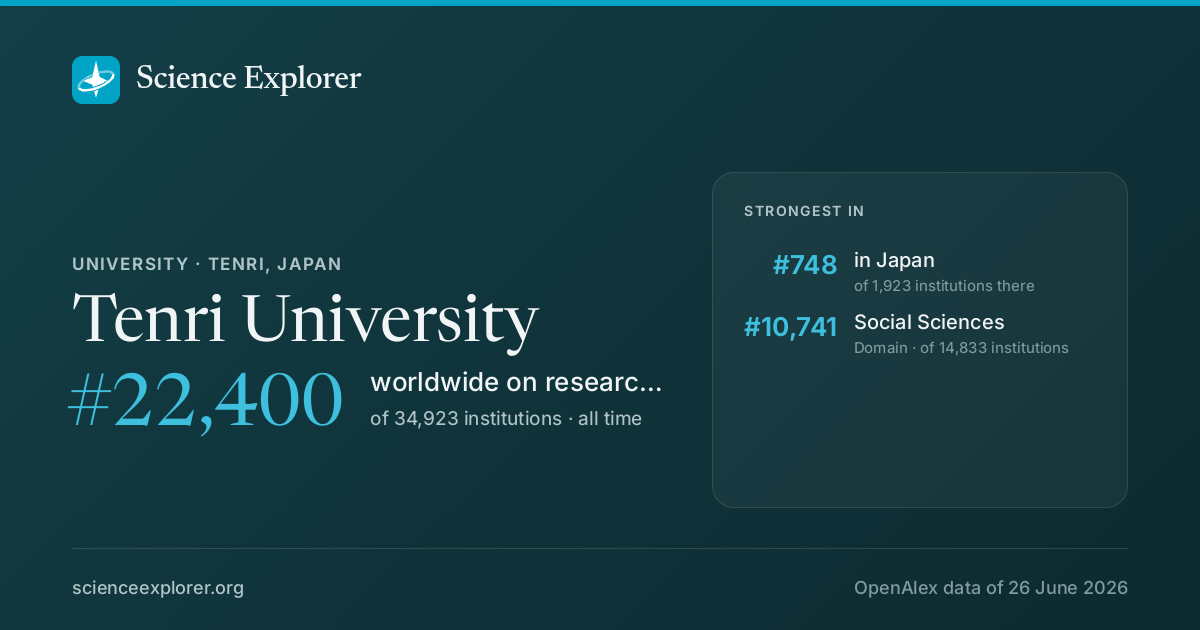
Tenri University on Science Explorer

A card with Tenri University's standing and the fields it leads in, for a post or a slide. A link to this page previews as the same card.

Download the card

1200 × 630 PNG, sized for social posts, drawn from the latest snapshot.

Badges for a website1Each links back here and updates with every snapshot

Research measures only: rankings here say nothing about teaching, admissions or student experience. Comparable institutions and collaboration partners have tabs of their own, above.

Discussion

Ask a question or share a note about Tenri University. Keep it to the research: no personal attacks, advertising or links. Any reader can report a post, which collapses it for everyone until it is opened.
