Science Explorer Back to mapMap
Discussion
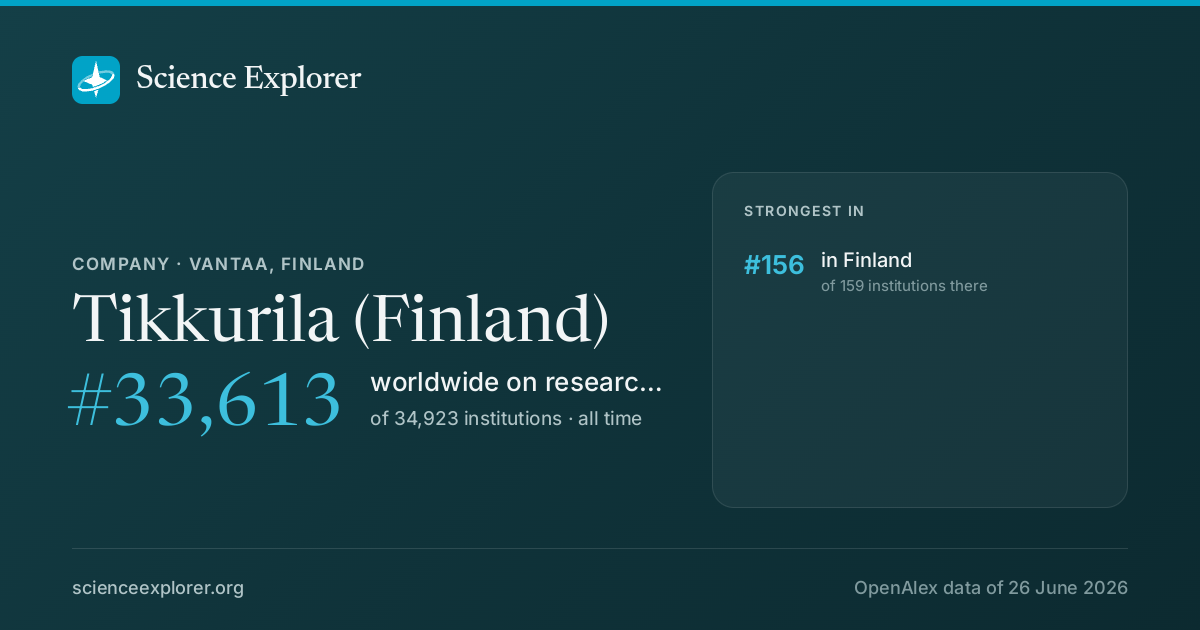
Company · Vantaa · Finland

Tikkurila (Finland)

World rank, all time
#33,613
of 34,923
Rank in Finland
#156
of 159
Research works
130
▼ 34% vs 2018-21
Citations
609
4.7 per fractional work
Top-10% rate
48.3%
all institutions 10.0%
vs its own fields
0.91×
1.00× is exactly expected
Open access
65%
world 40%
International
10%
world 18%

Which fields of science does Tikkurila (Finland) work in?

In all years, 58% of research at Tikkurila (Finland) is in Life Sciences, 26% in Physical Sciences. Its largest fields are Agricultural and Biological Sciences (45%), Environmental Science (13%), Biochemistry, Genetics and Molecular Biology (12%). It does 3.5× the world's share of Life Sciences.

Life Sciences: 75 fractional works · 57.7% of its workAgricultural and Biological Sciences: 58 fractional works · 44.9% of its workPlant Science: 22 fractional works · 17.1% of its workAgronomy and Crop Science: 7 fractional works · 5.3% of its workAnimal Science and Zoology: 6 fractional works · 5.0% of its workGeneral Agricultural and Biological Sciences: 5 fractional works · 4.0% of its workFood Science: 5 fractional works · 3.7% of its workEcology, Evolution, Behavior and Systematics: 4 fractional works · 3.3% of its workInsect Science: 4 fractional works · 3.0% of its workSoil Science: 4 fractional works · 3.0% of its workForestry: 1 fractional works · 0.5% of its workBiochemistry, Genetics and Molecular Biology: 15 fractional works · 11.7% of its workGenetics: 8 fractional works · 6.5% of its workMolecular Biology: 4 fractional works · 2.9% of its workCell Biology: 2 fractional works · 1.5% of its workEndocrinology: 1 fractional works · 0.6% of its workSmaller subfields together: 0 fractional works · 0.1% of its workNeuroscience: 1 fractional works · 0.7% of its workCognitive Neuroscience: 1 fractional works · 0.7% of its workImmunology and Microbiology: 0 fractional works · 0.4% of its workImmunology: 0 fractional works · 0.3% of its workSmaller subfields together: 0 fractional works · 0.1% of its workPhysical Sciences: 34 fractional works · 26.3% of its workEnvironmental Science: 17 fractional works · 12.9% of its workEcology: 4 fractional works · 2.9% of its workGlobal and Planetary Change: 3 fractional works · 2.6% of its workEnvironmental Chemistry: 3 fractional works · 2.1% of its workNature and Landscape Conservation: 3 fractional works · 2.1% of its workIndustrial and Manufacturing Engineering: 1 fractional works · 0.9% of its workPollution: 1 fractional works · 0.8% of its workHealth, Toxicology and Mutagenesis: 1 fractional works · 0.7% of its workWater Science and Technology: 1 fractional works · 0.5% of its workManagement, Monitoring, Policy and Law: 0 fractional works · 0.3% of its workSmaller subfields together: 0 fractional works · 0.2% of its workEngineering: 9 fractional works · 7.2% of its workCivil and Structural Engineering: 3 fractional works · 2.2% of its workMechanical Engineering: 2 fractional works · 1.3% of its workBiomedical Engineering: 2 fractional works · 1.2% of its workElectrical and Electronic Engineering: 1 fractional works · 1.1% of its workBuilding and Construction: 1 fractional works · 0.4% of its workAerospace Engineering: 0 fractional works · 0.3% of its workOcean Engineering: 0 fractional works · 0.3% of its workSafety, Risk, Reliability and Quality: 0 fractional works · 0.2% of its workSmaller subfields together: 0 fractional works · 0.1% of its workMaterials Science: 3 fractional works · 2.1% of its workMaterials Chemistry: 1 fractional works · 0.8% of its workBiomaterials: 1 fractional works · 0.8% of its workPolymers and Plastics: 0 fractional works · 0.3% of its workSurfaces, Coatings and Films: 0 fractional works · 0.3% of its workComputer Science: 1 fractional works · 1.0% of its workHardware and Architecture: 0 fractional works · 0.4% of its workSoftware: 0 fractional works · 0.4% of its workSmaller subfields together: 0 fractional works · 0.2% of its workEarth and Planetary Sciences: 1 fractional works · 0.9% of its workOceanography: 1 fractional works · 0.5% of its workPaleontology: 0 fractional works · 0.3% of its workSmaller subfields together: 0 fractional works · 0.2% of its workPhysics and Astronomy: 1 fractional works · 0.9% of its workAstronomy and Astrophysics: 1 fractional works · 0.5% of its workAtomic and Molecular Physics, and Optics: 0 fractional works · 0.3% of its workSmaller subfields together: 0 fractional works · 0.1% of its workChemistry: 1 fractional works · 0.8% of its workSpectroscopy: 1 fractional works · 0.5% of its workAnalytical Chemistry: 0 fractional works · 0.3% of its workChemical Engineering: 0 fractional works · 0.4% of its workProcess Chemistry and Technology: 0 fractional works · 0.4% of its workEnergy: 0 fractional works · 0.1% of its workHealth Sciences: 11 fractional works · 8.6% of its workMedicine: 6 fractional works · 4.8% of its workRadiology, Nuclear Medicine and Imaging: 1 fractional works · 1.1% of its workCardiology and Cardiovascular Medicine: 1 fractional works · 0.5% of its workEpidemiology: 1 fractional works · 0.5% of its workBiochemistry: 0 fractional works · 0.3% of its workEndocrinology, Diabetes and Metabolism: 0 fractional works · 0.3% of its workPublic Health, Environmental and Occupational Health: 0 fractional works · 0.3% of its workPharmacology: 0 fractional works · 0.3% of its workDermatology: 0 fractional works · 0.3% of its workNephrology: 0 fractional works · 0.3% of its workPathology and Forensic Medicine: 0 fractional works · 0.3% of its workPhysiology: 0 fractional works · 0.2% of its workSmaller subfields together: 1 fractional works · 0.4% of its workVeterinary: 4 fractional works · 2.7% of its workSmall Animals: 3 fractional works · 2.3% of its workEquine: 0 fractional works · 0.4% of its workDentistry: 1 fractional works · 0.5% of its workOrthodontics: 0 fractional works · 0.3% of its workSmaller subfields together: 0 fractional works · 0.2% of its workHealth Professions: 0 fractional works · 0.4% of its workGeneral Health Professions: 0 fractional works · 0.4% of its workNursing: 0 fractional works · 0.2% of its workSocial Sciences: 10 fractional works · 7.4% of its workSocial Sciences: 7 fractional works · 5.2% of its workEducation: 5 fractional works · 3.5% of its workPolitical Science and International Relations: 1 fractional works · 0.6% of its workSociology and Political Science: 1 fractional works · 0.6% of its workLaw: 1 fractional works · 0.5% of its workBusiness, Management and Accounting: 1 fractional works · 1.0% of its workStrategy and Management: 1 fractional works · 0.5% of its workManagement Information Systems: 0 fractional works · 0.4% of its workSmaller subfields together: 0 fractional works · 0.1% of its workPsychology: 1 fractional works · 0.7% of its workExperimental and Cognitive Psychology: 0 fractional works · 0.3% of its workSmaller subfields together: 1 fractional works · 0.4% of its workDecision Sciences: 1 fractional works · 0.5% of its workManagement Science and Operations Research: 0 fractional works · 0.4% of its workSmaller subfields together: 0 fractional works · 0.1% of its workALL ITS WORKTikkurila(Finland)130fractional works, all years
Life Sciences58%Physical Sciences26%Health Sciences9%Social Sciences7%

Each ring splits the one inside it: the four domains of science, their fields, their subfields. Size is fractional works in all years. Every slice is a page; the interactive view zooms down to single topics and colours each by how much more of it this institution does than the world.

Its 4 domains and 22 fields, with their numbers
    1. Agricultural and Biological Sciences5844.9%
    2. Biochemistry, Genetics and Molecular Biology1511.7%
    3. Neuroscience10.7%
    4. Immunology and Microbiology00.4%
    1. Environmental Science1712.9%
    2. Engineering97.2%
    3. Materials Science32.1%
    4. Computer Science11.0%
    5. Earth and Planetary Sciences10.9%
    6. Physics and Astronomy10.9%
    7. Chemistry10.8%
    8. Chemical Engineering00.4%
    9. Energy00.1%
    1. Medicine64.8%
    2. Veterinary42.7%
    3. Dentistry10.5%
    4. Health Professions00.4%
    5. Nursing00.2%
    1. Social Sciences75.2%
    2. Business, Management and Accounting11.0%
    3. Psychology10.7%
    4. Decision Sciences10.5%
All of science, and how each field's share has moved since 1950: the Science domain explorer

Field profile

Location quotient across every field it publishes in: outside the ring is more than an institution of this size would be expected to publish, inside it is less.

Agricultural and Biological Sciences: 1.17× its world share, 0 worksAgricultural and Bio…Biochemistry, Genetics and Molecular Biology: 0.17× its world share, 0 worksBiochemistry, Geneti…Earth and Planetary Sciences: 7.85× its world share, 0 worksEarth and Planetary …Engineering: 1.32× its world share, 0 worksEngineeringEnvironmental Science: 2.57× its world share, 0 worksEnvironmental ScienceDentistry: 48.77× its world share, 1 worksDentistryMedicine: 0.34× its world share, 0 worksMedicineNursing: 6.28× its world share, 0 worksNursingBusiness, Management and Accounting: 4.77× its world share, 0 worksBusiness, Management…1×world share
more than its size predictsabout as predictedless

Rings at 0.5×, 1× and 2×. Widest outward: Dentistry, 48.8×. Every wedge is a field page.

All 9 fields, with their numbers
  1. Dentistry48.77×1 works
  2. Earth and Planetary Sciences7.85×0 works
  3. Nursing6.28×0 works
  4. Business, Management and Accounting4.77×0 works
  5. Environmental Science2.57×0 works
  6. Engineering1.32×0 works
  7. Agricultural and Biological Sciences1.17×0 works
  8. Medicine0.34×0 works
  9. Biochemistry, Genetics and Molecular Biology0.17×0 works

Who are the top researchers at Tikkurila (Finland)?

Ranked on the quality score, Annikki Linnasalmi, I. Poijärvi and Esko Lakanen lead among researchers whose main affiliation is Tikkurila (Finland).

  1. 1 Annikki Linnasalmi Finland · #2,876,321 worldwide 2.7k citations · 94 works
  2. 2 I. Poijärvi Finland · #3,687,205 worldwide 10 citations · 27 works
  3. 3 Esko Lakanen Finland · #3,929,596 worldwide 549 citations · 26 works
  4. 4 Irja Uotila Finland · #4,519,786 worldwide 1 citations · 16 works
  5. 5 Esko Seppänen Finland · #4,679,585 worldwide 63 citations · 30 works
  6. 6 Aarre Ylimäki Finland · #4,819,387 worldwide 82 citations · 21 works
  7. 7 Martti Salonen Finland · #4,833,539 worldwide 9 citations · 31 works
  8. 8 E. A. Jamalainen Finland · #4,842,203 worldwide 138 citations · 35 works
  9. 9 Jaakko Mukula Finland · #4,927,862 worldwide 216 citations · 41 works
  10. 10 Arja Vasarainen Finland · #5,164,941 worldwide 180 citations · 43 works
All ranked researchers at Tikkurila (Finland)

What are the most cited papers from Tikkurila (Finland)?

The most cited paper from Tikkurila (Finland) is "Systolic blood pressure variability as a risk factor for stroke and cardiovascular mortality in the elderly hypertensive population" (Edward Pringle, Charles M. Phillips, Lutgarde Thijs et al., 2003), with 348 citations. Next come "The genetic basis of balanced polymorphism in Philaenus (Homoptera)" (51) and "Systemic Damage Caused by Trioza Apicalis on Carrot" (29).

Most cited papers
#PaperReleasedCitations
1 Systolic blood pressure variability as a risk factor for stroke and cardiovascular mortality in the elderly hypertensive population Edward Pringle, Charles M. Phillips, Lutgarde Thijs et al. · Journal of Hypertension Open access 24 Nov 2003 348
2 The genetic basis of balanced polymorphism in Philaenus (Homoptera) Olli Halkka, Liisa Halkka, Mikko Raatikainen et al. · Hereditas Open access 12 Feb 2009 51
3 Systemic Damage Caused by Trioza Apicalis on Carrot Martti Markkula, Seppo Laurema, K. Tiittanen Book chapter 1976 29
4 Exposure to MTBE, TAME and Aromatic Hydrocarbons during Gasoline Pump Maintenance, Repair and Inspection Sinikka Vainiotalo, Leea Kuusimäki, Kaija Pekari · Journal of Occupational Health Open access Sep 2006 27
5 Choice Architecture Cueing to Healthier Dietary Choices and Physical Activity at the Workplace: Implementation and Feasibility Evaluation Eeva Rantala, Saara Vanhatalo, Tanja Tilles‐Tirkkonen et al. · Nutrients Open access 14 Oct 2021 26
All 63 most cited papers, with filters and sorting

Which keywords describe research at Tikkurila (Finland)?

By fractional works in all years, weighted toward what it does more of than the world: Climate Change, Genetic Diversity, Biodiversity, Population Genetics, Marker-Assisted Selection, Invasive Species, Genomic Selection and Plant Breeding.

▲ more of its work than of the world's◆ about the world's share▼ less than the world's

Size is fractional works in all years in the topics tagged with each word; colour is the word's share of this institution's work against its share of the world's. The 40 words are chosen for being large and distinctive. Each links to the topic it comes from most.

All 40 words, with their numbers
  1. Climate Change14▲ 4.1×13 topics
  2. Genetic Diversity7▲ 11×5 topics
  3. Biodiversity7▲ 7.2×7 topics
  4. Population Genetics6▲ 29×2 topics
  5. Invasive Species6▲ 8.1×7 topics
  6. Marker-Assisted Selection6▲ 48×2 topics
  7. Genomic Selection6▲ 77×1 topic
  8. Plant Breeding6▲ 41×1 topic
  9. Gut Microbiota5▲ 12×3 topics
  10. Health Effects5▲ 6.9×8 topics
  11. Soil Fertility5▲ 22×3 topics
  12. Amino Acids5▲ 29×1 topic
  13. Animal Welfare5▲ 32×2 topics
  14. Nutrient Uptake5▲ 50×3 topics
  15. Probiotics5▲ 14×1 topic
  16. Sustainable Agriculture4▲ 12×6 topics
  17. Phylogenetic Analysis4▲ 8.1×6 topics
  18. Biological Control4▲ 17×6 topics
  19. Environmental Impacts4▲ 14×3 topics
  20. Antioxidant Activity4▲ 5.2×7 topics
  21. Ethics4▲ 6.0×2 topics
  22. Qualitative Research4▲ 4.9×2 topics
  23. Rootstock4▲ 47×2 topics
  24. Transcriptome Analysis4▲ 37×2 topics
  25. Genetic Mapping4▲ 27×3 topics
  26. Soil Properties4▲ 17×3 topics
  27. Work Environment4▲ 94×2 topics
  28. Antimicrobial Activity3▲ 13×3 topics
  29. Fungal Pathogens3▲ 15×3 topics
  30. Phenomenology3▲ 21×1 topic
  31. Social Sciences3▲ 16×1 topic
  32. Crop Productivity3▲ 44×3 topics
  33. Ecology3▲ 12×2 topics
  34. Food Safety3▲ 9.0×4 topics
  35. Energy Balance3▲ 26×2 topics
  36. Fukushima Daiichi3▲ 91×1 topic
  37. Vegetation3▲ 23×2 topics
  38. nuclear accident3▲ 91×1 topic
  39. Biotechnology3▲ 22×2 topics
  40. Host Specificity3▲ 17×3 topics

Which research topics does Tikkurila (Finland) publish most on?

By volume in 2022-now: Coastal and Marine Management, Wave and Wind Energy Systems, Management Systems and Quality Improvement and Coastal and Marine Dynamics.

  1. 1 Coastal and Marine Management Management, Monitoring, Policy and Law 0 works
  2. 2 Wave and Wind Energy Systems Ocean Engineering 0 works
  3. 3 Management Systems and Quality Improvement Strategy and Management 0 works
  4. 4 Coastal and Marine Dynamics Earth-Surface Processes 0 works
  5. 5 Dental materials and restorations Orthodontics 0 works
  6. 6 Technology Assessment and Management Safety, Risk, Reliability and Quality 0 works
  7. 7 Quality and Management Systems Strategy and Management 0 works
  8. 8 Marine and coastal plant biology Oceanography 0 works
  9. 9 Food Waste Reduction and Sustainability Food Science 0 works
  10. 10 Endodontics and Root Canal Treatments Oral Surgery 0 works

How open and international is its research?

Against the world's own shares: the tick on each track. Both are shares of its output, so they sit on one scale and can be read against each other as well as against the world.

openly available65.4%not open34.6%

World: 40% of research is openly available.

with international co-authors9.8%domestic only90.2%

World: 18% is written across borders.

How has Tikkurila (Finland)'s research output changed?

Output in 2022-2025 was 34% lower than in 2018-2021.

still counting200020102020
grewheldshrank

The same series as a ribbon: one cell per year, darker for more. The line above answers how much; this answers when.

Its share of all research

Growing output can still be a shrinking share: all of science grows. This is Tikkurila (Finland) as a percentage of every work published that year, 0.000013% in 2024.

still counting0.0020%0.0040%Tikkurila (Finland)0.000032% in 202519801990200020102020

Fractional works of Tikkurila (Finland) over all fractional works that year. How the balance of science has shifted.

Other research institutions in Vantaa

All research institutions in Vantaa

Share Tikkurila (Finland)'s ranking

Tikkurila (Finland) on Science Explorer

A card with Tikkurila (Finland)'s standing and the fields it leads in, for a post or a slide. A link to this page previews as the same card.

Download the card

1200 × 630 PNG, sized for social posts, drawn from the latest snapshot.

Badges for a website1Each links back here and updates with every snapshot

Research measures only: rankings here say nothing about teaching, admissions or student experience. Comparable institutions and collaboration partners have tabs of their own, above.

Discussion

Ask a question or share a note about Tikkurila (Finland). Posts are plain text and can be reported.