Science Explorer Back to mapMap
Discussion
Government institution · Murwillumbah · Australia

Tweed Shire Council

World rank, all time
#27,056
of 34,923
Rank in Australia
#404
of 476
Research works
180
▲ 50% vs 2018-21
Citations
2.2k
12.3 per fractional work
Top-10% rate
9.0%
all institutions 10.0%
vs its own fields
0.88×
1.00× is exactly expected
Open access
45%
world 40%
International
26%
world 18%

Which fields of science does Tweed Shire Council work in?

In 2022-now, 61% of research at Tweed Shire Council is in Health Sciences, 25% in Physical Sciences. Its largest fields are Medicine (56%), Engineering (15%), Environmental Science (5%). It does 2.3× the world's share of Health Sciences.

Health Sciences: 26 fractional works · 61.5% of its workMedicine: 24 fractional works · 56.5% of its workSurgery: 6 fractional works · 14.5% of its workPulmonary and Respiratory Medicine: 3 fractional works · 7.3% of its workCardiology and Cardiovascular Medicine: 2 fractional works · 4.2% of its workOncology: 2 fractional works · 3.9% of its workEmergency Medicine: 1 fractional works · 2.5% of its workInfectious Diseases: 1 fractional works · 2.5% of its workPublic Health, Environmental and Occupational Health: 1 fractional works · 2.1% of its workPathology and Forensic Medicine: 1 fractional works · 2.0% of its workRheumatology: 1 fractional works · 1.8% of its workObstetrics and Gynecology: 1 fractional works · 1.8% of its workEpidemiology: 1 fractional works · 1.7% of its workPediatrics, Perinatology and Child Health: 1 fractional works · 1.6% of its workNeurology: 1 fractional works · 1.6% of its workPhysiology: 1 fractional works · 1.5% of its workPsychiatry and Mental health: 0 fractional works · 0.9% of its workNephrology: 0 fractional works · 0.9% of its workGenetics: 0 fractional works · 0.8% of its workUrology: 0 fractional works · 0.6% of its workRadiology, Nuclear Medicine and Imaging: 0 fractional works · 0.6% of its workCritical Care and Intensive Care Medicine: 0 fractional works · 0.5% of its workHematology: 0 fractional works · 0.5% of its workTransplantation: 0 fractional works · 0.5% of its workAnesthesiology and Pain Medicine: 0 fractional works · 0.4% of its workDermatology: 0 fractional works · 0.3% of its workEndocrinology, Diabetes and Metabolism: 0 fractional works · 0.3% of its workInternal Medicine: 0 fractional works · 0.3% of its workReproductive Medicine: 0 fractional works · 0.3% of its workSmaller subfields together: 0 fractional works · 0.5% of its workHealth Professions: 2 fractional works · 4.6% of its workGeneral Health Professions: 1 fractional works · 3.2% of its workPharmacy: 0 fractional works · 0.8% of its workRadiological and Ultrasound Technology: 0 fractional works · 0.4% of its workSmaller subfields together: 0 fractional works · 0.2% of its workNursing: 0 fractional works · 0.2% of its workNutrition and Dietetics: 0 fractional works · 0.2% of its workVeterinary: 0 fractional works · 0.2% of its workPhysical Sciences: 11 fractional works · 24.8% of its workEngineering: 6 fractional works · 14.9% of its workAerospace Engineering: 3 fractional works · 7.0% of its workAutomotive Engineering: 1 fractional works · 3.0% of its workBiomedical Engineering: 1 fractional works · 1.2% of its workBuilding and Construction: 0 fractional works · 0.8% of its workElectrical and Electronic Engineering: 0 fractional works · 0.8% of its workMechanical Engineering: 0 fractional works · 0.8% of its workMechanics of Materials: 0 fractional works · 0.8% of its workMedia Technology: 0 fractional works · 0.4% of its workSmaller subfields together: 0 fractional works · 0.2% of its workEnvironmental Science: 2 fractional works · 4.7% of its workEcology: 1 fractional works · 1.4% of its workEcological Modeling: 0 fractional works · 0.9% of its workEnvironmental Chemistry: 0 fractional works · 0.8% of its workGlobal and Planetary Change: 0 fractional works · 0.8% of its workEnvironmental Engineering: 0 fractional works · 0.3% of its workManagement, Monitoring, Policy and Law: 0 fractional works · 0.3% of its workSmaller subfields together: 0 fractional works · 0.2% of its workEnergy: 1 fractional works · 1.6% of its workRenewable Energy, Sustainability and the Environment: 1 fractional works · 1.6% of its workComputer Science: 1 fractional works · 1.4% of its workInformation Systems: 0 fractional works · 0.8% of its workComputer Vision and Pattern Recognition: 0 fractional works · 0.4% of its workComputer Science Applications: 0 fractional works · 0.3% of its workMaterials Science: 0 fractional works · 1.2% of its workMaterials Chemistry: 0 fractional works · 1.2% of its workMathematics: 0 fractional works · 0.5% of its workModeling and Simulation: 0 fractional works · 0.5% of its workEarth and Planetary Sciences: 0 fractional works · 0.4% of its workPaleontology: 0 fractional works · 0.4% of its workSmaller subfields together: 0 fractional works · 0.0% of its workChemistry: 0 fractional works · 0.1% of its workSocial Sciences: 3 fractional works · 7.0% of its workSocial Sciences: 1 fractional works · 3.1% of its workEducation: 0 fractional works · 0.9% of its workDemography: 0 fractional works · 0.6% of its workSafety Research: 0 fractional works · 0.6% of its workSociology and Political Science: 0 fractional works · 0.5% of its workHealth: 0 fractional works · 0.4% of its workSmaller subfields together: 0 fractional works · 0.1% of its workPsychology: 1 fractional works · 2.6% of its workClinical Psychology: 0 fractional works · 1.2% of its workSocial Psychology: 0 fractional works · 0.9% of its workDevelopmental and Educational Psychology: 0 fractional works · 0.4% of its workSmaller subfields together: 0 fractional works · 0.1% of its workBusiness, Management and Accounting: 0 fractional works · 1.0% of its workMarketing: 0 fractional works · 0.8% of its workSmaller subfields together: 0 fractional works · 0.2% of its workEconomics, Econometrics and Finance: 0 fractional works · 0.3% of its workEconomics and Econometrics: 0 fractional works · 0.3% of its workLife Sciences: 3 fractional works · 6.8% of its workAgricultural and Biological Sciences: 1 fractional works · 3.0% of its workEcology, Evolution, Behavior and Systematics: 1 fractional works · 1.9% of its workPlant Science: 0 fractional works · 0.5% of its workInsect Science: 0 fractional works · 0.3% of its workSoil Science: 0 fractional works · 0.3% of its workSmaller subfields together: 0 fractional works · 0.0% of its workBiochemistry, Genetics and Molecular Biology: 1 fractional works · 2.0% of its workMolecular Biology: 0 fractional works · 0.9% of its workCancer Research: 0 fractional works · 0.5% of its workEndocrinology: 0 fractional works · 0.4% of its workSmaller subfields together: 0 fractional works · 0.3% of its workImmunology and Microbiology: 1 fractional works · 1.6% of its workParasitology: 0 fractional works · 0.9% of its workImmunology: 0 fractional works · 0.7% of its workNeuroscience: 0 fractional works · 0.2% of its workALL ITS WORKTweed ShireCouncil43fractional works, 2022-now
Life Sciences7%Physical Sciences25%Health Sciences61%Social Sciences7%

Each ring splits the one inside it: the four domains of science, their fields, their subfields. Size is fractional works in 2022-now. Every slice is a page; the interactive view zooms down to single topics and colours each by how much more of it this institution does than the world.

Its 4 domains and 20 fields, with their numbers
    1. Medicine2456.5%
    2. Health Professions24.6%
    3. Nursing00.2%
    4. Veterinary00.2%
    1. Engineering614.9%
    2. Environmental Science24.7%
    3. Energy11.6%
    4. Computer Science11.4%
    5. Materials Science01.2%
    6. Mathematics00.5%
    7. Earth and Planetary Sciences00.4%
    8. Chemistry00.1%
    1. Social Sciences13.1%
    2. Psychology12.6%
    3. Business, Management and Accounting01.0%
    4. Economics, Econometrics and Finance00.3%
    1. Agricultural and Biological Sciences13.0%
    2. Biochemistry, Genetics and Molecular Biology12.0%
    3. Immunology and Microbiology11.6%
    4. Neuroscience00.2%
All of science, and how each field's share has moved since 1950: the Science domain explorer

Field profile

Location quotient across every field it publishes in: outside the ring is more than an institution of this size would be expected to publish, inside it is less.

Agricultural and Biological Sciences: 0.62× its world share, 1 worksAgricultural and Bio…Biochemistry, Genetics and Molecular Biology: 0.37× its world share, 1 worksBiochemistry, Geneti…Immunology and Microbiology: 1.62× its world share, 1 worksImmunology and Micro…Neuroscience: 0.14× its world share, 0 worksNeuroscienceChemistry: 0.04× its world share, 0 worksChemistryComputer Science: 0.18× its world share, 1 worksComputer ScienceEarth and Planetary Sciences: 0.27× its world share, 0 worksEarth and Planetary …Energy: 1.68× its world share, 1 worksEnergyEngineering: 0.99× its world share, 6 worksEngineeringEnvironmental Science: 0.95× its world share, 2 worksEnvironmental ScienceMaterials Science: 0.33× its world share, 0 worksMaterials ScienceMathematics: 0.46× its world share, 0 worksMathematicsHealth Professions: 1.75× its world share, 2 worksHealth ProfessionsMedicine: 2.94× its world share, 24 worksMedicineNursing: 0.47× its world share, 0 worksNursingVeterinary: 1.14× its world share, 0 worksVeterinaryBusiness, Management and Accounting: 0.30× its world share, 0 worksBusiness, Management…Economics, Econometrics and Finance: 0.16× its world share, 0 worksEconomics, Econometr…Psychology: 0.84× its world share, 1 worksPsychologySocial Sciences: 0.24× its world share, 1 worksSocial Sciences1×world share
more than its size predictsabout as predictedless

Rings at 0.5×, 1× and 2×. Widest outward: Medicine, 2.9×. Every wedge is a field page.

All 20 fields, with their numbers
  1. Medicine2.94×24 works
  2. Health Professions1.75×2 works
  3. Energy1.68×1 works
  4. Immunology and Microbiology1.62×1 works
  5. Veterinary1.14×0 works
  6. Engineering0.99×6 works
  7. Environmental Science0.95×2 works
  8. Psychology0.84×1 works
  9. Agricultural and Biological Sciences0.62×1 works
  10. Nursing0.47×0 works
  11. Mathematics0.46×0 works
  12. Biochemistry, Genetics and Molecular Biology0.37×1 works
  13. Materials Science0.33×0 works
  14. Business, Management and Accounting0.30×0 works
  15. Earth and Planetary Sciences0.27×0 works
  16. Social Sciences0.24×1 works
  17. Computer Science0.18×1 works
  18. Economics, Econometrics and Finance0.16×0 works
  19. Neuroscience0.14×0 works
  20. Chemistry0.04×0 works

Who are the top researchers at Tweed Shire Council?

Ranked on the quality score, Ratnesh Kumar Srivastav, Ehtesham A. Abdi and Stephen I. White lead among researchers whose main affiliation is Tweed Shire Council.

  1. 1 Ratnesh Kumar Srivastav Australia · #622,262 worldwide 586 citations · 25 works
  2. 2 Ehtesham A. Abdi Australia · #768,470 worldwide 3.5k citations · 98 works
  3. 3 Stephen I. White Australia · #1,996,611 worldwide 788 citations · 23 works
  4. 4 Michael Nolan Australia · #4,614,270 worldwide 149 citations · 53 works
  5. 5 Paul J. Wright Australia · #4,731,473 worldwide 262 citations · 18 works
  6. 6 Zackariah Clement Australia · #5,439,969 worldwide 124 citations · 23 works
All ranked researchers at Tweed Shire Council

What are the most cited papers from Tweed Shire Council?

The most cited paper from Tweed Shire Council is "Virtual reality and mixed reality for second chance tourism" (Alexandra Bec, Brent Moyle, Vikki Schaffer et al., 2020), with 295 citations. Next come "Profile of injuries arising from the 2005 Kashmir Earthquake: The first 72h" (189) and "Oral THC:CBD cannabis extract for refractory chemotherapy-induced nausea and vomiting: a randomised, placebo-controlled, phase II crossover trial" (160).

Most cited papers
#PaperReleasedCitations
1 Virtual reality and mixed reality for second chance tourism Alexandra Bec, Brent Moyle, Vikki Schaffer et al. · Tourism Management Open access 10 Nov 2020 295
2 Profile of injuries arising from the 2005 Kashmir Earthquake: The first 72h Jamin M. Mulvey, Saeed Awan, Alam Qadri et al. · Injury 5 Dec 2007 189
3 Oral THC:CBD cannabis extract for refractory chemotherapy-induced nausea and vomiting: a randomised, placebo-controlled, phase II crossover trial Peter Grimison et al. · Annals of Oncology Open access 12 Aug 2020 160
4 Effect of sertraline on symptoms and survival in patients with advanced cancer, but without major depression: a placebo-controlled double-blind randomised trial Martin R. Stockler, Rachel L. O’Connell, Anna K. Nowak et al. · The Lancet Oncology 5 Jun 2007 152
5 Laparoscopic inguinal hernia repair without mesh fixation, early results of a large randomised clinical trial Craig J. Taylor, Laurent Layani, Victor Liew et al. · Surgical Endoscopy 20 Sep 2007 150
All 60 most cited papers, with filters and sorting

Which keywords describe research at Tweed Shire Council?

By fractional works in 2022-now, weighted toward what it does more of than the world: Treatment, Epidemiology, Guidelines, Diagnosis, Surgical Management, Polymer Composites, Management and 3D Printing.

▲ more of its work than of the world's◆ about the world's share▼ less than the world's

Size is fractional works in 2022-now in the topics tagged with each word; colour is the word's share of this institution's work against its share of the world's. The 23 words are chosen for being large and distinctive. Each links to the topic it comes from most.

All 23 words, with their numbers
  1. Epidemiology4▲ 2.5×26 topics
  2. Treatment4▲ 7.5×15 topics
  3. Diagnosis2▲ 6.1×10 topics
  4. Guidelines2▲ 11×8 topics
  5. Management2▲ 5.4×7 topics
  6. Surgical Management2▲ 11×6 topics
  7. Risk Factors2▲ 3.6×8 topics
  8. 3D Printing2▲ 16×2 topics
  9. Additive Manufacturing2▲ 12×2 topics
  10. Complications2▲ 7.3×6 topics
  11. Polymer Composites2▲ 14×2 topics
  12. Cardiovascular Disease2▲ 3.0×9 topics
  13. Laparoscopic Surgery2▲ 29×4 topics
  14. Quality of Life2▲ 2.4×8 topics
  15. Climate Change1▲ 1.19×12 topics
  16. Public Health1▲ 2.3×8 topics
  17. Sustainability1▲ 1.32×2 topics
  18. Applications1▲ 11×1 topic
  19. Materials1▲ 13×1 topic
  20. Clinical Practice Guidelines1▲ 5.0×6 topics
  21. Signal Processing1▲ 19×2 topics
  22. Inflammation1▲ 1.25×16 topics
  23. Pathogenesis1▲ 4.8×5 topics

Which research topics does Tweed Shire Council publish most on?

By volume in 2022-now: Additive Manufacturing and 3D Printing Technologies, Radar Systems and Signal Processing, GNSS positioning and interference and Genital Health and Disease.

  1. 1 Additive Manufacturing and 3D Printing Technologies Automotive Engineering 1 works
  2. 2 Radar Systems and Signal Processing Aerospace Engineering 1 works
  3. 3 GNSS positioning and interference Aerospace Engineering 1 works
  4. 4 Genital Health and Disease Surgery 1 works
  5. 5 Colorectal Cancer Surgical Treatments Oncology 1 works
  6. 6 Heart Failure Treatment and Management Cardiology and Cardiovascular Medicine 1 works
  7. 7 Antenna Design and Optimization Aerospace Engineering 0 works
  8. 8 Silicone and Siloxane Chemistry Materials Chemistry 0 works
  9. 9 Intestinal and Peritoneal Adhesions Surgery 0 works
  10. 10 Appendicitis Diagnosis and Management Emergency Medicine 0 works

How open and international is its research?

Against the world's own shares: the tick on each track. Both are shares of its output, so they sit on one scale and can be read against each other as well as against the world.

openly available45.1%not open54.9%

World: 40% of research is openly available.

with international co-authors26.0%domestic only74.0%

World: 18% is written across borders.

How has Tweed Shire Council's research output changed?

Output in 2022-2025 was 50% higher than in 2018-2021.

still counting1990200020102020
grewheldshrank

The same series as a ribbon: one cell per year, darker for more. The line above answers how much; this answers when.

Its share of all research

Growing output can still be a shrinking share: all of science grows. This is Tweed Shire Council as a percentage of every work published that year, 0.00012% in 2024.

still counting0.00050%0.0010%Tweed Shire Council0.00016% in 202519801990200020102020

Fractional works of Tweed Shire Council over all fractional works that year. How the balance of science has shifted.

Share Tweed Shire Council's ranking

Tweed Shire Council on Science Explorer

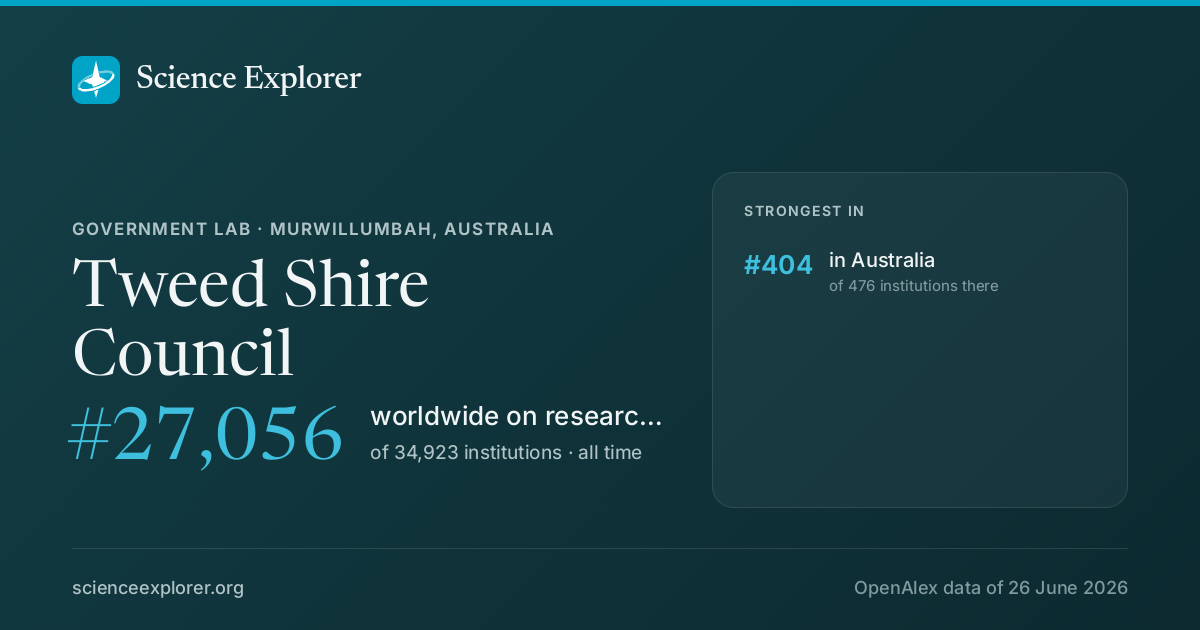
A card with Tweed Shire Council's standing and the fields it leads in, for a post or a slide. A link to this page previews as the same card.

Download the card

1200 × 630 PNG, sized for social posts, drawn from the latest snapshot.

Badges for a website1Each links back here and updates with every snapshot

Research measures only: rankings here say nothing about teaching, admissions or student experience. Comparable institutions and collaboration partners have tabs of their own, above.

Discussion

Ask a question or share a note about Tweed Shire Council. Keep it to the research: no personal attacks, advertising or links. Any reader can report a post, which collapses it for everyone until it is opened.