Universitätskinderklinik
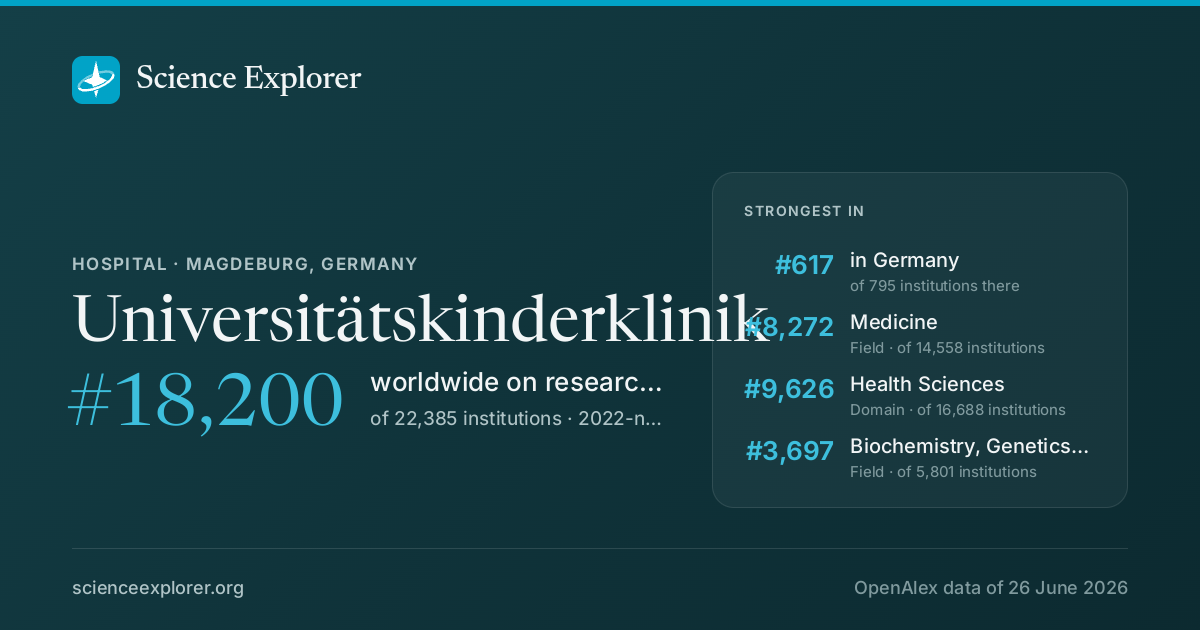
In research, Universitätskinderklinik stands highest in Medicine (#8,272 of 14,558 worldwide), Health Sciences (#9,626 of 16,688 worldwide) and Biochemistry, Genetics and Molecular Biology (#3,697 of 5,801 worldwide), over all time.
- World rank, 2022-now
- #18,200 of 22,385 · #13,955 all time
- Rank in Germany
- #617 of 795
- Research works
- 6.1k ▼ 28% vs 2018-21
- Citations
- 47k 7.6 per fractional work
- Top-10% rate
- 4.1% all institutions 10.0%
- vs its own fields
- 0.99× 1.00× is exactly expected
- Open access
- 5% world 40%
- International
- 8% world 18%
What is Universitätskinderklinik known for in research?
The fields where it stands highest, over all time, ranked among every institution above the floor in each field.
| Field | World rank | Where that sits | Top-10% rate | Works |
|---|---|---|---|---|
| MedicineField | #8,272 of 14,558 | 2.3% | 3,896 | |
| Health SciencesDomain | #9,626 of 16,688 | 2.5% | 4,360 | |
| Biochemistry, Genetics and Molecular BiologyField | #3,697 of 5,801 | 2.6% | 882 | |
| SurgerySubfield | #2,098 of 3,248 | 2.6% | 515 | |
| Pulmonary and Respiratory MedicineSubfield | #1,565 of 2,077 | 1.6% | 490 | |
| Molecular BiologySubfield | #2,853 of 3,729 | 2.7% | 296 | |
| Life SciencesDomain | #8,647 of 11,023 | 2.6% | 1,330 | |
| EpidemiologySubfield | #1,563 of 1,970 | 2.6% | 286 | |
| Endocrinology, Diabetes and MetabolismSubfield | #781 of 959 | 2.5% | 179 | |
| RheumatologySubfield | #706 of 865 | 3.6% | 121 |
Each strip is that field's whole ranked pool, with the notch where Universitätskinderklinik sits in it, in the colour of the band that rank falls in. The track under the rate is the rate itself: it carries no average mark, because the average differs by field (from about 6% in Dentistry to 21% in Economics).
Which fields of science does Universitätskinderklinik work in?
In 2022-now, 56% of research at Universitätskinderklinik is in Health Sciences, 26% in Social Sciences. Its largest fields are Medicine (48%), Social Sciences (14%), Biochemistry, Genetics and Molecular Biology (9%). It does 2.3× the world's share of Health Sciences.
Each ring splits the one inside it: the four domains of science, their fields, their subfields. Size is fractional works in 2022-now. Every slice is a page; the interactive view zooms down to single topics and colours each by how much more of it this institution does than the world.
Its 4 domains and 20 fields, with their numbers
- Health Sciences4956.4%
- Medicine4247.8%
- Health Professions55.8%
- Nursing11.0%
- Veterinary10.9%
- Dentistry10.8%
- Social Sciences2326.3%
- Life Sciences1112.9%
- Physical Sciences44.5%
- Computer Science22.6%
- Engineering10.8%
- Environmental Science10.6%
- Physics and Astronomy00.2%
- Earth and Planetary Sciences00.1%
- Chemical Engineering00.1%
Field profile
Location quotient across every field it publishes in: outside the ring is more than an institution of this size would be expected to publish, inside it is less.
Rings at 0.5×, 1× and 2×. Widest outward: Veterinary, 6.6×. Every wedge is a field page.
All 20 fields, with their numbers
- Veterinary6.57×1 works
- Arts and Humanities2.61×7 works
- Medicine2.49×42 works
- Health Professions2.21×5 works
- Nursing2.12×1 works
- Biochemistry, Genetics and Molecular Biology1.61×8 works
- Dentistry1.58×1 works
- Social Sciences1.12×12 works
- Immunology and Microbiology0.97×1 works
- Neuroscience0.85×1 works
- Psychology0.70×2 works
- Business, Management and Accounting0.67×2 works
- Agricultural and Biological Sciences0.40×2 works
- Chemical Engineering0.36×0 works
- Computer Science0.33×2 works
- Environmental Science0.13×1 works
- Economics, Econometrics and Finance0.13×0 works
- Physics and Astronomy0.10×0 works
- Earth and Planetary Sciences0.09×0 works
- Engineering0.05×1 works
- Veterinary 6.6×
- Arts and Humanities 2.6×
- Medicine 2.5×
- Health Professions 2.2×
- Nursing 2.1×
- Biochemistry, Genetics and Molecular Biology 1.6×
- Dentistry 1.6×
- Social Sciences 1.1×
- Immunology and Microbiology 1.0×
- Neuroscience 0.8×
- Psychology 0.7×
- Business, Management and Accounting 0.7×
- Agricultural and Biological Sciences 0.4×
- Chemical Engineering 0.4×
- Computer Science 0.3×
- Environmental Science 0.1×
- Economics, Econometrics and Finance 0.1×
- Physics and Astronomy 0.1×
- Earth and Planetary Sciences 0.1×
- Engineering 0.1×
Who are the top researchers at Universitätskinderklinik?
Ranked on the quality score, G. Schellong, Peter G. Weber and Radvan Urbanek lead among researchers whose main affiliation is Universitätskinderklinik.
- 1
G. Schellong
 Germany · #2,453,458 worldwide
4.4k citations · 191 works
- 2
Peter G. Weber
Germany · #3,140,646 worldwide
719 citations · 18 works
- 3
Radvan Urbanek
Germany · #3,588,403 worldwide
7.5k citations · 242 works
- 4
Hinrich Karsten Harms
Germany · #3,727,048 worldwide
2.1k citations · 44 works
- 5
S. Sauter
Germany · #4,139,983 worldwide
1.5k citations · 34 works
- 6
B. Stollmann-Gibbels
Germany · #4,582,506 worldwide
909 citations · 19 works
- 7
Gerhard Beron
Germany · #4,587,708 worldwide
1.4k citations · 30 works
- 8
Brigitte Stollmann
Germany · #4,703,116 worldwide
796 citations · 28 works
- 9
T. Brander
Germany · #4,965,914 worldwide
206 citations · 22 works
- 10
M. Pfaundler
Germany · #4,966,062 worldwide
722 citations · 64 works
Which keywords describe research at Universitätskinderklinik?
By fractional works in 2022-now, weighted toward what it does more of than the world: Genetics, Gender, Epidemiology, Identity, Human Rights, Glycemic Control, Insulin Therapy and Preterm Infants.
- HLA Genes
- Biochemical Genetics
- Transition
- Metabolic Disorders
- Lung Stem Cells
- Autoimmunity
- Eugenics
- Diabetes Mellitus
- Newborn Screening
- Pulmonary Hypertension
- Intensive Care Unit
- European Union
- Bildung
- Type 1 Diabetes
- Complications
- Insulin Therapy
- Treatment
- Identity
- Human Rights
- Genetics
- Epidemiology
- Gender
- Inflammation
- Management
- Glycemic Control
- Diagnosis
- Preterm Infants
- Autorschaft
- Critical Care
- Heart Failure
- Pregnancy
- Neurodevelopmental Outcomes
- SARS-CoV-2
- Drug Resistance
- Mitochondrial Function
- Bronchopulmonary Dysplasia
- Medical Ethics
- Social History
- Antibiotic Prophylaxis
- Carnitine
Size is fractional works in 2022-now in the topics tagged with each word; colour is the word's share of this institution's work against its share of the world's. The 40 words are chosen for being large and distinctive. Each links to the topic it comes from most.
All 40 words, with their numbers
- Epidemiology7▲ 1.90×36 topics
- Genetics5▲ 8.3×11 topics
- Gender4▲ 8.3×8 topics
- Human Rights4▲ 4.3×14 topics
- Inflammation4▲ 2.1×23 topics
- Identity4▲ 5.8×6 topics
- Management3▲ 3.7×14 topics
- Treatment2▲ 2.3×16 topics
- Glycemic Control2▲ 16×3 topics
- Insulin Therapy2▲ 21×3 topics
- Diagnosis2▲ 2.6×13 topics
- Complications2▲ 4.7×5 topics
- Preterm Infants2▲ 18×3 topics
- Type 1 Diabetes2▲ 26×2 topics
- Autorschaft2▲ 106×1 topic
- Bildung2▲ 67×1 topic
- Critical Care2▲ 8.4×4 topics
- European Union2▲ 8.6×5 topics
- Heart Failure2▲ 4.4×5 topics
- Intensive Care Unit2▲ 15×3 topics
- Pregnancy2▲ 8.4×7 topics
- Pulmonary Hypertension2▲ 13×2 topics
- Neurodevelopmental Outcomes1▲ 8.4×5 topics
- Newborn Screening1▲ 32×2 topics
- SARS-CoV-21▲ 5.3×4 topics
- Diabetes Mellitus1▲ 7.3×3 topics
- Drug Resistance1▲ 5.3×4 topics
- Eugenics1▲ 59×2 topics
- Mitochondrial Function1▲ 16×3 topics
- Autoimmunity1▲ 9.8×3 topics
- Bronchopulmonary Dysplasia1▲ 22×1 topic
- Lung Stem Cells1▲ 24×1 topic
- Medical Ethics1▲ 11×2 topics
- Metabolic Disorders1▲ 12×2 topics
- Social History1▲ 17×3 topics
- Transition1▲ 16×2 topics
- Antibiotic Prophylaxis1▲ 15×2 topics
- Biochemical Genetics1▲ 39×1 topic
- Carnitine1▲ 39×1 topic
- HLA Genes1▲ 33×1 topic
Which research topics does Universitätskinderklinik publish most on?
By volume in 2022-now: German Literature and Culture Studies, Neonatal Respiratory Health Research, Medical Practices and Rehabilitation and Metabolism and Genetic Disorders.
Area is fractional works; colour is the subfield each topic belongs to.
- 1 German Literature and Culture Studies Literature and Literary Theory 2 works
- 2 Neonatal Respiratory Health Research Pulmonary and Respiratory Medicine 1 works
- 3 Medical Practices and Rehabilitation Physical Therapy, Sports Therapy and Rehabilitation 1 works
- 4 Metabolism and Genetic Disorders Clinical Biochemistry 1 works
- 5 Diabetes and associated disorders Genetics 1 works
- 6 Medical History and Research History 1 works
- 7 COVID-19 Impact on Reproduction Obstetrics and Gynecology 1 works
- 8 Diverse Legal and Medical Studies Strategy and Management 1 works
- 9 Horticultural and Viticultural Research Plant Science 1 works
- 10 Hyperglycemia and glycemic control in critically ill and hospitalized patients Endocrinology, Diabetes and Metabolism 1 works
How open and international is its research?
Against the world's own shares: the tick on each track. Both are shares of its output, so they sit on one scale and can be read against each other as well as against the world.
World: 40% of research is openly available.
World: 18% is written across borders.
How has Universitätskinderklinik's research output changed?
Output in 2022-2025 was 28% lower than in 2018-2021.
The same series as a ribbon: one cell per year, darker for more. The line above answers how much; this answers when.
Its share of all research
Growing output can still be a shrinking share: all of science grows. This is Universitätskinderklinik as a percentage of every work published that year, 0.00024% in 2024.
Fractional works of Universitätskinderklinik over all fractional works that year. How the balance of science has shifted.
How much of it reaches the world top 10%
Year by year, against all institutions in the same year.
Of each year's output, the share that reached the world's 10% most cited for its field and year. Peak 5.4% in 1995.
Other research institutions in Magdeburg
- Otto-von-Guericke-Universität Magdeburg
- University Hospital Magdeburg
- Orthopädische Universitätsklinik
- Universitätsklinik für Strahlentherapie
- Universitätsklinik für Hals-, Nasen- und Ohrenheilkunde
- Hochschule Magdeburg-Stendal
- Institut für Automation und Kommunikation
- Universitätsaugenklinik Magdeburg

Share Universitätskinderklinik's ranking
Badges for a website1Each links back here and updates with every snapshot

Research measures only: rankings here say nothing about teaching, admissions or student experience. Comparable institutions and collaboration partners have tabs of their own, above.
Discussion
Ask a question or share a note about Universitätskinderklinik. Posts are plain text and can be reported.