Science Explorer Back to mapMap
Discussion
Government institution · Västerås · Sweden

Västerås Municipality

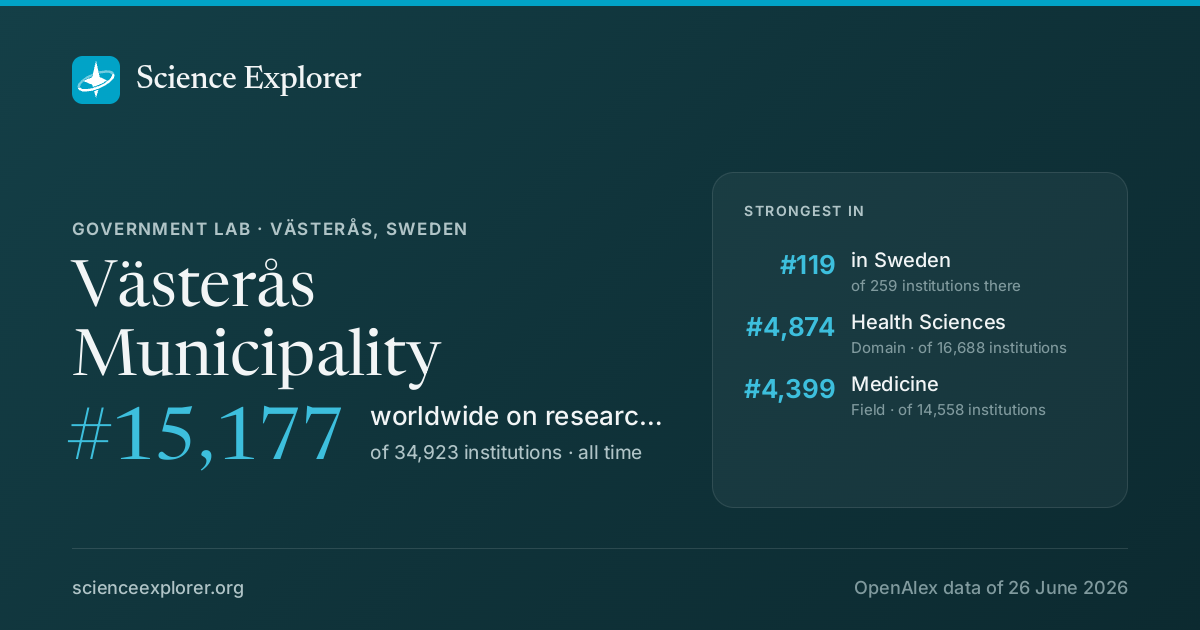
In research, Västerås Municipality stands highest in Health Sciences (#4,874 of 16,688 worldwide) and Medicine (#4,399 of 14,558 worldwide), over all time.

World rank, all time
#15,177
of 34,923
Rank in Sweden
#119
of 259
Research works
270
▲ 12% vs 2018-21
Citations
10k
38.0 per fractional work
Top-10% rate
11.8%
all institutions 10.0%
vs its own fields
1.13×
1.00× is exactly expected
Open access
26%
world 40%
International
15%
world 18%

What is Västerås Municipality known for in research?

The fields where it stands highest, over all time, ranked among every institution above the floor in each field.

FieldWorld rankWhere that sitsTop-10% rateWorks
Health SciencesDomain #4,874 of 16,688 17.3%167
MedicineField #4,399 of 14,558 16.9%147

Each strip is that field's whole ranked pool, with the notch where Västerås Municipality sits in it, in the colour of the band that rank falls in. The track under the rate is the rate itself: it carries no average mark, because the average differs by field (from about 6% in Dentistry to 21% in Economics).

Which fields of science does Västerås Municipality work in?

In 2022-now, 57% of research at Västerås Municipality is in Health Sciences, 24% in Physical Sciences. Its largest fields are Medicine (46%), Engineering (12%), Biochemistry, Genetics and Molecular Biology (6%). It does 1.9× the world's share of Health Sciences.

Health Sciences: 14 fractional works · 56.8% of its workMedicine: 11 fractional works · 46.3% of its workSurgery: 3 fractional works · 12.7% of its workOncology: 1 fractional works · 4.8% of its workPublic Health, Environmental and Occupational Health: 1 fractional works · 2.9% of its workPulmonary and Respiratory Medicine: 1 fractional works · 2.9% of its workEpidemiology: 1 fractional works · 2.4% of its workCardiology and Cardiovascular Medicine: 1 fractional works · 2.3% of its workEndocrinology, Diabetes and Metabolism: 1 fractional works · 2.2% of its workRadiology, Nuclear Medicine and Imaging: 0 fractional works · 1.8% of its workPsychiatry and Mental health: 0 fractional works · 1.7% of its workOtorhinolaryngology: 0 fractional works · 1.5% of its workReproductive Medicine: 0 fractional works · 1.4% of its workPhysiology: 0 fractional works · 1.1% of its workEmergency Medicine: 0 fractional works · 0.9% of its workInfectious Diseases: 0 fractional works · 0.9% of its workHepatology: 0 fractional works · 0.7% of its workNeurology: 0 fractional works · 0.7% of its workOphthalmology: 0 fractional works · 0.7% of its workObstetrics and Gynecology: 0 fractional works · 0.5% of its workPediatrics, Perinatology and Child Health: 0 fractional works · 0.5% of its workAnesthesiology and Pain Medicine: 0 fractional works · 0.5% of its workCritical Care and Intensive Care Medicine: 0 fractional works · 0.5% of its workDermatology: 0 fractional works · 0.5% of its workGeriatrics and Gerontology: 0 fractional works · 0.5% of its workImmunology and Allergy: 0 fractional works · 0.5% of its workRheumatology: 0 fractional works · 0.5% of its workPathology and Forensic Medicine: 0 fractional works · 0.3% of its workPharmacology: 0 fractional works · 0.3% of its workHealth Informatics: 0 fractional works · 0.3% of its workHealth Professions: 1 fractional works · 5.8% of its workGeneral Health Professions: 1 fractional works · 4.0% of its workOccupational Therapy: 0 fractional works · 0.5% of its workPhysical Therapy, Sports Therapy and Rehabilitation: 0 fractional works · 0.5% of its workEmergency Medical Services: 0 fractional works · 0.3% of its workPharmacy: 0 fractional works · 0.3% of its workHealth Information Management: 0 fractional works · 0.2% of its workDentistry: 1 fractional works · 3.3% of its workPeriodontics: 0 fractional works · 1.4% of its workOrthodontics: 0 fractional works · 1.2% of its workOral Surgery: 0 fractional works · 0.7% of its workVeterinary: 0 fractional works · 0.8% of its workSmall Animals: 0 fractional works · 0.8% of its workNursing: 0 fractional works · 0.7% of its workNutrition and Dietetics: 0 fractional works · 0.7% of its workPhysical Sciences: 6 fractional works · 23.5% of its workEngineering: 3 fractional works · 11.5% of its workMechanical Engineering: 1 fractional works · 4.1% of its workElectrical and Electronic Engineering: 0 fractional works · 2.0% of its workBiomedical Engineering: 0 fractional works · 1.8% of its workIndustrial and Manufacturing Engineering: 0 fractional works · 1.3% of its workAutomotive Engineering: 0 fractional works · 0.9% of its workControl and Systems Engineering: 0 fractional works · 0.5% of its workCivil and Structural Engineering: 0 fractional works · 0.4% of its workBuilding and Construction: 0 fractional works · 0.3% of its workOcean Engineering: 0 fractional works · 0.2% of its workEnvironmental Science: 1 fractional works · 5.8% of its workWater Science and Technology: 0 fractional works · 2.0% of its workEnvironmental Engineering: 0 fractional works · 0.8% of its workEcology: 0 fractional works · 0.7% of its workGlobal and Planetary Change: 0 fractional works · 0.7% of its workHealth, Toxicology and Mutagenesis: 0 fractional works · 0.7% of its workIndustrial and Manufacturing Engineering: 0 fractional works · 0.4% of its workPollution: 0 fractional works · 0.3% of its workSmaller subfields together: 0 fractional works · 0.1% of its workComputer Science: 1 fractional works · 2.7% of its workArtificial Intelligence: 0 fractional works · 1.0% of its workHuman-Computer Interaction: 0 fractional works · 0.8% of its workComputer Vision and Pattern Recognition: 0 fractional works · 0.5% of its workSmaller subfields together: 0 fractional works · 0.4% of its workMathematics: 0 fractional works · 1.6% of its workApplied Mathematics: 0 fractional works · 1.4% of its workSmaller subfields together: 0 fractional works · 0.2% of its workEarth and Planetary Sciences: 0 fractional works · 0.8% of its workGeochemistry and Petrology: 0 fractional works · 0.3% of its workAtmospheric Science: 0 fractional works · 0.3% of its workEarth-Surface Processes: 0 fractional works · 0.2% of its workMaterials Science: 0 fractional works · 0.6% of its workElectronic, Optical and Magnetic Materials: 0 fractional works · 0.6% of its workEnergy: 0 fractional works · 0.5% of its workEnergy Engineering and Power Technology: 0 fractional works · 0.5% of its workSocial Sciences: 3 fractional works · 10.8% of its workSocial Sciences: 1 fractional works · 5.0% of its workGeography, Planning and Development: 0 fractional works · 2.1% of its workSociology and Political Science: 0 fractional works · 1.4% of its workDemography: 0 fractional works · 0.8% of its workPublic Administration: 0 fractional works · 0.3% of its workGender Studies: 0 fractional works · 0.2% of its workSmaller subfields together: 0 fractional works · 0.2% of its workPsychology: 1 fractional works · 3.4% of its workSocial Psychology: 0 fractional works · 1.0% of its workClinical Psychology: 0 fractional works · 0.8% of its workDevelopmental and Educational Psychology: 0 fractional works · 0.5% of its workExperimental and Cognitive Psychology: 0 fractional works · 0.5% of its workNeuropsychology and Physiological Psychology: 0 fractional works · 0.5% of its workApplied Psychology: 0 fractional works · 0.3% of its workArts and Humanities: 0 fractional works · 1.0% of its workConservation: 0 fractional works · 0.5% of its workHistory and Philosophy of Science: 0 fractional works · 0.3% of its workSmaller subfields together: 0 fractional works · 0.2% of its workDecision Sciences: 0 fractional works · 0.8% of its workManagement Science and Operations Research: 0 fractional works · 0.5% of its workStatistics, Probability and Uncertainty: 0 fractional works · 0.3% of its workEconomics, Econometrics and Finance: 0 fractional works · 0.5% of its workFinance: 0 fractional works · 0.3% of its workSmaller subfields together: 0 fractional works · 0.2% of its workBusiness, Management and Accounting: 0 fractional works · 0.2% of its workLife Sciences: 2 fractional works · 8.9% of its workBiochemistry, Genetics and Molecular Biology: 2 fractional works · 6.2% of its workMolecular Biology: 1 fractional works · 3.3% of its workCancer Research: 1 fractional works · 2.4% of its workGenetics: 0 fractional works · 0.6% of its workImmunology and Microbiology: 0 fractional works · 1.4% of its workImmunology: 0 fractional works · 1.0% of its workParasitology: 0 fractional works · 0.4% of its workNeuroscience: 0 fractional works · 0.9% of its workCognitive Neuroscience: 0 fractional works · 0.4% of its workSmaller subfields together: 0 fractional works · 0.5% of its workPharmacology, Toxicology and Pharmaceutics: 0 fractional works · 0.2% of its workToxicology: 0 fractional works · 0.2% of its workAgricultural and Biological Sciences: 0 fractional works · 0.2% of its workALL ITS WORKVästeråsMunicipality24fractional works, 2022-now
Life Sciences9%Physical Sciences24%Health Sciences57%Social Sciences11%

Each ring splits the one inside it: the four domains of science, their fields, their subfields. Size is fractional works in 2022-now. Every slice is a page; the interactive view zooms down to single topics and colours each by how much more of it this institution does than the world.

Its 4 domains and 23 fields, with their numbers
    1. Medicine1146.3%
    2. Health Professions15.8%
    3. Dentistry13.3%
    4. Veterinary00.8%
    5. Nursing00.7%
    1. Engineering311.5%
    2. Environmental Science15.8%
    3. Computer Science12.7%
    4. Mathematics01.6%
    5. Earth and Planetary Sciences00.8%
    6. Materials Science00.6%
    7. Energy00.5%
    1. Social Sciences15.0%
    2. Psychology13.4%
    3. Arts and Humanities01.0%
    4. Decision Sciences00.8%
    5. Economics, Econometrics and Finance00.5%
    6. Business, Management and Accounting00.2%
    1. Biochemistry, Genetics and Molecular Biology26.2%
    2. Immunology and Microbiology01.4%
    3. Neuroscience00.9%
    4. Pharmacology, Toxicology and Pharmaceutics00.2%
    5. Agricultural and Biological Sciences00.2%
All of science, and how each field's share has moved since 1950: the Science domain explorer

Field profile

Location quotient across every field it publishes in: outside the ring is more than an institution of this size would be expected to publish, inside it is less.

Agricultural and Biological Sciences: 0.03× its world share, 0 worksAgricultural and Bio…Biochemistry, Genetics and Molecular Biology: 1.17× its world share, 2 worksBiochemistry, Geneti…Immunology and Microbiology: 1.35× its world share, 0 worksImmunology and Micro…Neuroscience: 0.53× its world share, 0 worksNeurosciencePharmacology, Toxicology and Pharmaceutics: 0.65× its world share, 0 worksPharmacology, Toxico…Computer Science: 0.34× its world share, 1 worksComputer ScienceEarth and Planetary Sciences: 0.53× its world share, 0 worksEarth and Planetary …Energy: 0.56× its world share, 0 worksEnergyEngineering: 0.77× its world share, 3 worksEngineeringEnvironmental Science: 1.16× its world share, 1 worksEnvironmental ScienceMaterials Science: 0.18× its world share, 0 worksMaterials ScienceMathematics: 1.32× its world share, 0 worksMathematicsDentistry: 6.78× its world share, 1 worksDentistryHealth Professions: 2.19× its world share, 1 worksHealth ProfessionsMedicine: 2.41× its world share, 11 worksMedicineNursing: 1.41× its world share, 0 worksNursingVeterinary: 5.80× its world share, 0 worksVeterinaryArts and Humanities: 0.34× its world share, 0 worksArts and HumanitiesBusiness, Management and Accounting: 0.05× its world share, 0 worksBusiness, Management…Decision Sciences: 0.82× its world share, 0 worksDecision SciencesEconomics, Econometrics and Finance: 0.21× its world share, 0 worksEconomics, Econometr…Psychology: 1.13× its world share, 1 worksPsychologySocial Sciences: 0.39× its world share, 1 worksSocial Sciences1×world share
more than its size predictsabout as predictedless

Rings at 0.5×, 1× and 2×. Widest outward: Dentistry, 6.8×. Every wedge is a field page.

All 23 fields, with their numbers
  1. Dentistry6.78×1 works
  2. Veterinary5.80×0 works
  3. Medicine2.41×11 works
  4. Health Professions2.19×1 works
  5. Nursing1.41×0 works
  6. Immunology and Microbiology1.35×0 works
  7. Mathematics1.32×0 works
  8. Biochemistry, Genetics and Molecular Biology1.17×2 works
  9. Environmental Science1.16×1 works
  10. Psychology1.13×1 works
  11. Decision Sciences0.82×0 works
  12. Engineering0.77×3 works
  13. Pharmacology, Toxicology and Pharmaceutics0.65×0 works
  14. Energy0.56×0 works
  15. Neuroscience0.53×0 works
  16. Earth and Planetary Sciences0.53×0 works
  17. Social Sciences0.39×1 works
  18. Computer Science0.34×1 works
  19. Arts and Humanities0.34×0 works
  20. Economics, Econometrics and Finance0.21×0 works
  21. Materials Science0.18×0 works
  22. Business, Management and Accounting0.05×0 works
  23. Agricultural and Biological Sciences0.03×0 works

Who are the top researchers at Västerås Municipality?

Ranked on the quality score, Ivar Ringqvist, Wladimir Schuisky and Tommy Jonason lead among researchers whose main affiliation is Västerås Municipality.

  1. 1 Ivar Ringqvist Sweden · #2,344,769 worldwide 4.3k citations · 114 works
  2. 2 Wladimir Schuisky Sweden · #3,353,256 worldwide 34 citations · 19 works
  3. 3 Tommy Jonason Sweden · #4,030,641 worldwide 1.2k citations · 49 works
  4. 4 Torsten Fredriksson Sweden · #4,176,881 worldwide 604 citations · 26 works
  5. 5 Johan Knutsson Sweden · #4,838,764 worldwide 461 citations · 27 works
All ranked researchers at Västerås Municipality

What are the most cited papers from Västerås Municipality?

The most cited paper from Västerås Municipality is "Thrombus Aspiration during ST-Segment Elevation Myocardial Infarction" (Ole Fröbert et al., 2013), with 1,163 citations. Next come "Glucose metabolism in patients with acute myocardial infarction and no previous diagnosis of diabetes mellitus: a prospective study" (1,124) and "The Duration of Oral Anticoagulant Therapy after a Second Episode of Venous Thromboembolism" (611).

Most cited papers
#PaperReleasedCitations
1 Thrombus Aspiration during ST-Segment Elevation Myocardial Infarction Ole Fröbert et al. · New England Journal of Medicine Open access Sep 2013 1,163
2 Glucose metabolism in patients with acute myocardial infarction and no previous diagnosis of diabetes mellitus: a prospective study Anna Norhammar, Åke Tenerz, Göran Nilsson et al. · The Lancet Jun 2002 1,124
3 The Duration of Oral Anticoagulant Therapy after a Second Episode of Venous Thromboembolism Sam Schulman, Staffan Granqvist, Margareta Holmström et al. · New England Journal of Medicine Open access 6 Feb 1997 611
4 Appendectomy versus Antibiotic Treatment in Acute Appendicitis. A Prospective Multicenter Randomized Controlled Trial Johan Styrud, Staffan Eriksson, Ingemar Nilsson et al. · World Journal of Surgery 27 Apr 2006 539
5 Post‐thrombotic syndrome, recurrence, and death 10 years after the first episode of venous thromboembolism treated with warfarin for 6 weeks or 6 months Sam Schulman, Per Lindmarker, Margareta Holmström et al. · Journal of Thrombosis and Haemostasis Open access 15 Mar 2006 509
All 61 most cited papers, with filters and sorting

Which research topics does Västerås Municipality publish most on?

By volume in 2022-now: Metallurgical Processes and Thermodynamics, Religious Tourism and Spaces, Breast Cancer Treatment Studies and Dental Education, Practice, Research.

  1. 1 Metallurgical Processes and Thermodynamics Mechanical Engineering 1 works
  2. 2 Religious Tourism and Spaces Geography, Planning and Development 0 works
  3. 3 Breast Cancer Treatment Studies Cancer Research 0 works
  4. 4 Dental Education, Practice, Research General Health Professions 0 works
  5. 5 Coronary Interventions and Diagnostics Surgery 0 works
  6. 6 Orthodontics and Dentofacial Orthopedics Orthodontics 0 works
  7. 7 Radiomics and Machine Learning in Medical Imaging Radiology, Nuclear Medicine and Imaging 0 works
  8. 8 Ovarian cancer diagnosis and treatment Reproductive Medicine 0 works
  9. 9 Intraperitoneal and Appendiceal Malignancies Surgery 0 works
  10. 10 Vascular Tumors and Angiosarcomas Oncology 0 works

How open and international is its research?

Against the world's own shares: the tick on each track. Both are shares of its output, so they sit on one scale and can be read against each other as well as against the world.

openly available25.9%not open74.1%

World: 40% of research is openly available.

with international co-authors14.6%domestic only85.4%

World: 18% is written across borders.

How has Västerås Municipality's research output changed?

Output in 2022-2025 was 12% higher than in 2018-2021.

still counting1990200020102020
grewheldshrank

The same series as a ribbon: one cell per year, darker for more. The line above answers how much; this answers when.

Its share of all research

Growing output can still be a shrinking share: all of science grows. This is Västerås Municipality as a percentage of every work published that year, 0.00011% in 2024.

still counting0.00050%0.0010%0.0015%Västerås Municipality0.00011% in 202519801990200020102020

Fractional works of Västerås Municipality over all fractional works that year. How the balance of science has shifted.

Other research institutions in Västerås

All research institutions in Västerås

Share Västerås Municipality's ranking

Västerås Municipality on Science Explorer

A card with Västerås Municipality's standing and the fields it leads in, for a post or a slide. A link to this page previews as the same card.

Download the card

1200 × 630 PNG, sized for social posts, drawn from the latest snapshot.

Badges for a website1Each links back here and updates with every snapshot

Research measures only: rankings here say nothing about teaching, admissions or student experience. Comparable institutions and collaboration partners have tabs of their own, above.

Discussion

Ask a question or share a note about Västerås Municipality. Keep it to the research: no personal attacks, advertising or links. Any reader can report a post, which collapses it for everyone until it is opened.