 Science in Tunisia
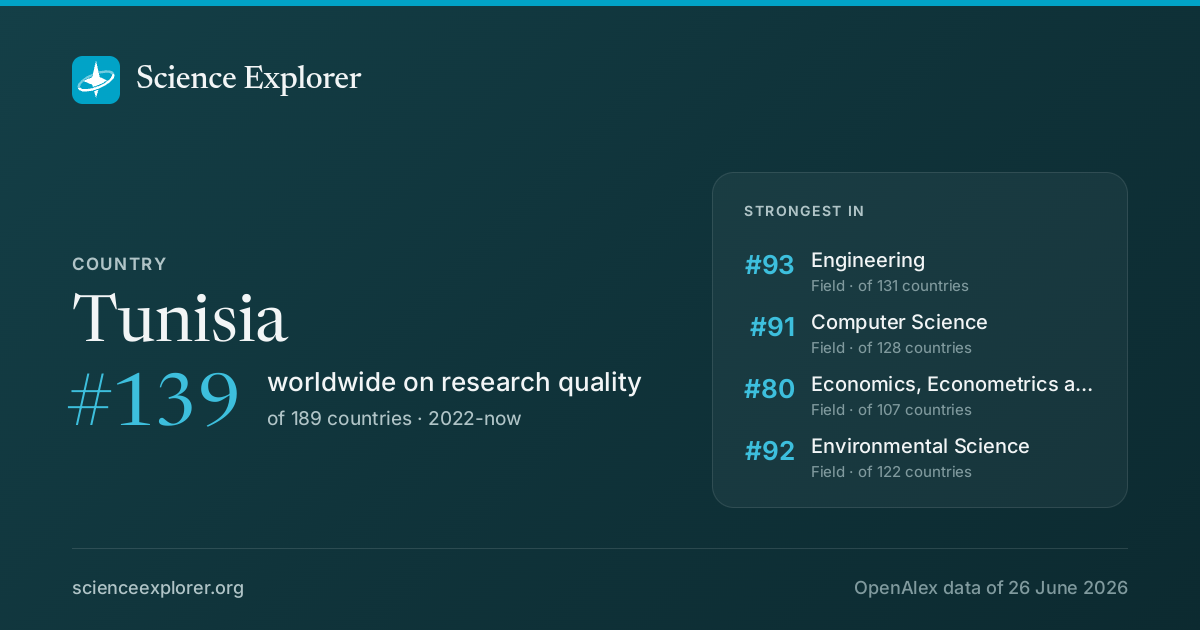
Tunisia ranks #139 of 189 countries on research quality in 2022-now (#115 all time), with 38k research works and 5.9% of them in the world's top 10%.
- World rank, 2022-now
- #139 of 189 · #115 all time
- Works, 2022-now
- 38k ▲ 7% vs 2018-21
- Citations
- 1.5M 10.1 per fractional work, all time
- Top-10% rate
- 5.9% all institutions 10.0%
- vs its own fields
- 0.54× 1.00× is exactly expected
- In the world top 100
- 0 0 in the top 1,000
- Open access
- 33% world 40%
- International
- 33% world 18%
TunisiaWhat is Tunisia strongest at in science?
On research quality in 2022-now, Tunisia ranks highest in Engineering (#93 of 131), Computer Science (#91 of 128) and Economics, Econometrics and Finance (#80 of 107). Relative to its size it is most specialised in Algebra and Number Theory, Mathematical Physics and Applied Mathematics.
| Field | World rank | Where that sits | Top-10% rate | Works | All time | Institutions |
|---|---|---|---|---|---|---|
| EngineeringField | #93 of 131 | 5.8% | 5,672 | #75 | Institutions | |
| Computer ScienceField | #91 of 128 | 7.6% | 3,379 | #74 | Institutions | |
| Economics, Econometrics and FinanceField | #80 of 107 | 12.7% | 1,191 | #83 | Institutions | |
| Environmental ScienceField | #92 of 122 | 6.9% | 1,632 | #81 | Institutions | |
| Economics and EconometricsSubfield | #79 of 98 | 13.5% | 832 | #87 | Institutions | |
| Agricultural and Biological SciencesField | #100 of 124 | 8.8% | 2,305 | #95 | Institutions | |
| AccountingSubfield | #53 of 64 | 20.1% | 444 | #67 | Institutions | |
| Plant ScienceSubfield | #76 of 90 | 8.0% | 1,095 | #81 | Institutions | |
| Business, Management and AccountingField | #94 of 110 | 13.2% | 1,268 | #88 | Institutions | |
| Materials ScienceField | #75 of 87 | 6.4% | 1,387 | #78 | Institutions | |
| MathematicsField | #69 of 80 | 8.1% | 1,085 | #76 | Institutions | |
| Earth and Planetary SciencesField | #68 of 78 | 4.8% | 531 | #74 | Institutions |
Where its research is concentrated
Location quotient: how much more (or less) of each node it does than its size predicts. Drawn around 1×, where "twice the world share" and "half of it" are the same distance apart in opposite directions. A volume reading, which on a country axis is largely population and industrial structure.
- Algebra and Number TheorySubfield · 116.8 works · #26 of 162 active here4.2×
- Mathematical PhysicsSubfield · 272.7 works · #29 of 173 active here4.0×
- Applied MathematicsSubfield · 462.5 works · #26 of 195 active here3.7×
- RheumatologySubfield · 714.6 works · #32 of 213 active here3.6×
- MicrobiologySubfield · 8.3 works · #33 of 137 active here3.3×
- DermatologySubfield · 350.8 works · #32 of 211 active here3.1×
- BiochemistrySubfield · 140.2 works · #39 of 198 active here2.6×
- Pathology and Forensic MedicineSubfield · 577.0 works · #35 of 216 active here2.5×
The whole field profile
All 26 fields at once. A specialist and a generalist produce the same ranked list and a completely different shape.
Rings at 0.5×, 1× and 2×. Widest outward: Mathematics, 2.4×. Every wedge is a field page.
All 26 fields, with their numbers
- Mathematics2.38×1,217 works
- Medicine1.49×12k works
- Energy1.44×576 works
- Economics, Econometrics and Finance1.44×1,341 works
- Agricultural and Biological Sciences1.26×2,613 works
- Computer Science1.14×3,855 works
- Materials Science1.06×1,610 works
- Dentistry1.05×222 works
- Business, Management and Accounting1.03×1,449 works
- Veterinary1.02×60 works
- Nursing1.00×213 works
- Engineering0.97×6,348 works
- Chemistry0.92×631 works
- Earth and Planetary Sciences0.91×619 works
- Immunology and Microbiology0.90×396 works
- Environmental Science0.89×1,921 works
- Health Professions0.89×1,022 works
- Decision Sciences0.87×365 works
- Pharmacology, Toxicology and Pharmaceutics0.81×124 works
- Biochemistry, Genetics and Molecular Biology0.77×1,786 works
- Psychology0.77×1,021 works
- Neuroscience0.72×505 works
- Chemical Engineering0.63×96 works
- Physics and Astronomy0.50×481 works
- Social Sciences0.39×2,164 works
- Arts and Humanities0.35×442 works
Which fields of science does Tunisia work in?
In 2022-now, 40% of research in Tunisia is in Physical Sciences, 32% in Health Sciences. Its largest fields are Medicine (29%), Engineering (15%), Computer Science (9%). It does 1.4× the world's share of Health Sciences.
Each ring splits the one inside it: the four domains of science, their fields, their subfields. Size is fractional works in 2022-now. Every slice is a page; the interactive view zooms down to single topics and colours each by how much more of it this country does than the world.
Its 4 domains and 26 fields, with their numbers
- Physical Sciences17k39.9%
- Engineering6,34814.6%
- Computer Science3,8558.9%
- Environmental Science1,9214.4%
- Materials Science1,6103.7%
- Mathematics1,2172.8%
- Chemistry6311.5%
- Earth and Planetary Sciences6191.4%
- Energy5751.3%
- Physics and Astronomy4811.1%
- Chemical Engineering950.2%
- Health Sciences14k32.0%
- Medicine12k28.6%
- Health Professions1,0222.3%
- Dentistry2220.5%
- Nursing2130.5%
- Veterinary600.1%
- Social Sciences6,78215.6%
- Social Sciences2,1645.0%
- Business, Management and Accounting1,4493.3%
- Economics, Econometrics and Finance1,3413.1%
- Psychology1,0212.3%
- Arts and Humanities4421.0%
- Decision Sciences3650.8%
- Life Sciences5,42412.5%
Which keywords describe research in Tunisia?
By fractional works in 2022-now, weighted toward what it does more of than the world: Epidemiology, Deep Learning, Diagnosis, Treatment, Machine Learning, Autoantibodies, Renewable Energy and Inflammation.
- Warfare
- Transport Policy
- Phenolic Compounds
- Malay Language
- Immunosuppressive Therapy
- Monetary Policy
- Global Burden
- Surgical Management
- Chemotherapy
- Antioxidant Activity
- Convolutional Neural Networks
- Risk Factors
- Cardiovascular Disease
- Quality of Life
- Environmental Impact
- Sustainability
- Renewable Energy
- Inflammation
- Treatment
- Deep Learning
- Epidemiology
- Machine Learning
- Diagnosis
- Climate Change
- Neural Networks
- Oxidative Stress
- Management
- Healthcare
- Genetics
- Autoantibodies
- Corporate Governance
- Economic Growth
- Clinical Practice Guidelines
- Pathogenesis
- Classification
- Islam
- Social Influence
- Sharia Law
- Public Oversight
- Air Force
Size is fractional works in 2022-now in the topics tagged with each word; colour is the word's share of this country's work against its share of the world's. The 40 words are chosen for being large and distinctive. Each links to the topic it comes from most.
All 40 words, with their numbers
- Epidemiology2,800▲ 1.62×140 topics
- Deep Learning2,110▲ 1.41×84 topics
- Machine Learning1,653◆ 1.14×95 topics
- Treatment1,221▲ 2.3×52 topics
- Diagnosis1,199▲ 3.0×41 topics
- Inflammation1,097▲ 1.19×83 topics
- Climate Change1,054◆ 0.89×118 topics
- Renewable Energy956▲ 1.52×58 topics
- Neural Networks818▲ 1.22×42 topics
- Sustainability791▼ 0.74×113 topics
- Oxidative Stress785◆ 1.10×62 topics
- Environmental Impact738◆ 1.00×71 topics
- Management681▲ 1.96×39 topics
- Quality of Life650◆ 1.03×59 topics
- Healthcare609▲ 1.23×36 topics
- Cardiovascular Disease592▲ 1.19×39 topics
- Genetics548▲ 1.78×27 topics
- Risk Factors548◆ 1.14×37 topics
- Autoantibodies535▲ 5.2×8 topics
- Convolutional Neural Networks522▲ 1.65×14 topics
- Corporate Governance495▲ 1.55×29 topics
- Antioxidant Activity478▲ 1.77×32 topics
- Economic Growth477▲ 1.35×33 topics
- Chemotherapy463▲ 1.50×25 topics
- Clinical Practice Guidelines460▲ 1.92×14 topics
- Surgical Management449▲ 2.5×20 topics
- Pathogenesis421▲ 1.89×24 topics
- Global Burden414▲ 1.74×12 topics
- Classification383▲ 1.93×13 topics
- Monetary Policy380▲ 3.7×11 topics
- Islam369▲ 4.1×5 topics
- Immunosuppressive Therapy313▲ 3.8×8 topics
- Social Influence307▲ 3.3×3 topics
- Malay Language282▲ 4.6×1 topic
- Sharia Law282▲ 4.5×1 topic
- Phenolic Compounds277▲ 3.5×9 topics
- Public Oversight239▲ 4.5×1 topic
- Transport Policy239▲ 4.5×1 topic
- Air Force238▲ 4.6×1 topic
- Warfare238▲ 4.6×1 topic
Which research topics does Tunisia publish the most in?
Its largest topics in 2022-now are Linguistic, Cultural, and Literary Studies, Legal and Regulatory Analysis, Military Technology and Strategies.
Area is fractional works in 2022-now; colour is the subfield each topic belongs to. Every tile is a topic page.
- 1 Linguistic, Cultural, and Literary Studies Sociology and Political Science 281 works
- 2 Legal and Regulatory Analysis Transportation 239 works
- 3 Military Technology and Strategies Aerospace Engineering 238 works
- 4 Market Dynamics and Volatility Economics and Econometrics 191 works
- 5 Energy, Environment, Economic Growth Economics and Econometrics 184 works
- 6 Blockchain Technology Applications and Security Information Systems 151 works
- 7 Rheumatoid Arthritis Research and Therapies Rheumatology 140 works
- 8 Islamic Finance and Banking Studies Accounting 139 works
- 9 Essential Oils and Antimicrobial Activity Food Science 135 works
- 10 Corporate Finance and Governance Accounting 132 works
- 11 Chronic Obstructive Pulmonary Disease (COPD) Research Pulmonary and Respiratory Medicine 121 works
- 12 IoT and Edge/Fog Computing Computer Networks and Communications 118 works
Which universities in Tunisia lead research?
Manouba University, Institut National de la Recherche Agronomique de Tunisie and University of Sousse rank highest in Tunisia on research quality in 2022-now.
One dot per institution in the list below. The upper left is the interesting corner.
- 1Manouba UniversityUniversity · Manouba · #2,116 worldwide9.9% top 10% · 1.3k works
- 2Institut National de la Recherche Agronomique de TunisieUniversity · Aryanah · #2,372 worldwide3.4% top 10% · 1.3k works
- 3University of SousseUniversity · Sousse · #3,531 worldwide7.3% top 10% · 2.5k works
- 4University of JendoubaUniversity · Jendouba · #4,717 worldwide11.4% top 10% · 578 works
- 5University of SfaxUniversity · Sfax · #5,394 worldwide8.3% top 10% · 5.2k works
- 6University of GabèsUniversity · Gabès · #5,408 worldwide6.7% top 10% · 1.6k works
- 7University of GafsaUniversity · Gafsa · #6,646 worldwide10.0% top 10% · 404 works
- 8Tunis UniversityUniversity · Tunis · #7,716 worldwide6.9% top 10% · 1.9k works
- 9University of MonastirUniversity · Monastir · #9,198 worldwide7.1% top 10% · 3.1k works
- 10University of CarthageUniversity · Tunis · #9,298 worldwide7.5% top 10% · 2.2k works
- 11Hôpital Charles-NicolleHospital / health system · Tunis · #9,602 worldwide1.4% top 10% · 814 works
- 12University of KairouanUniversity · Kairouan · #9,976 worldwide8.2% top 10% · 518 works
- 13Ministry of AgricultureGovernment institution · Tunis · #10,007 worldwide16.0% top 10% · 298 works
- 14Hopital Universitaire Hedi ChakerHospital / health system · Sfax · #10,564 worldwide1.4% top 10% · 1.3k works
- 15Tunis El Manar UniversityUniversity · Tunis · #10,832 worldwide5.1% top 10% · 4.7k works



The track on each row is its top-10% rate; the tick is the average of all institutions, 10.0% (how it is set): teal above it, red below.
All ranked institutions in TunisiaWho are the top researchers in Tunisia?
Naima Lassoued, Imen Khanchel and Karim Rejeb rank highest among researchers based in Tunisia.
- 1 Naima Lassoued #58,759 worldwide 1.6k citations · 79 works
- 2 Imen Khanchel #94,831 worldwide 1.6k citations · 78 works
- 3 Karim Rejeb #97,324 worldwide 6.2k citations · 80 works
- 4 Khaled Mokni #103,833 worldwide 2.5k citations · 70 works
- 5 Anis Chaouachi #111,304 worldwide 10k citations · 146 works
- 6 Wissem Dhahbi #116,373 worldwide 1.6k citations · 113 works
- 7 Mohamed Hsaïri #121,045 worldwide 97k citations · 136 works
- 8 Youba Sokona #122,846 worldwide 14k citations · 107 works
- 9 Rania Jammazi #155,356 worldwide 2.3k citations · 48 works
- 10 Kais Saidi #161,608 worldwide 4.4k citations · 37 works
Which cities in Tunisia are research hubs?
How open and international is Tunisia's research?
33% of its research is openly available (world: 40%), and 33% is written with international co-authors (world: 18%).
World: 40% of research is openly available.
World: 18% is written across borders.
In 2022-now, 45% of its research is openly available (world 63%) and 33% is written with co-authors abroad (world 22%). Against what its own mix of topics predicts, that is 0.76× the expected open access and 1.44× the expected international share, which puts it #165 of 173 countries on openness.
How has Tunisia's research grown?
Output in 2022-2025 was 7% higher than in 2018-2021.
The same series as a ribbon: one cell per year, darker for more. The line above answers how much; this answers when.
Its share of all research
Growing output can still be a shrinking share: all of science grows. This is Tunisia as a percentage of every work published that year, 0.18% in 2024.
Fractional works of Tunisia over all fractional works that year. How the balance of science has shifted.
How much of it reaches the world top 10%
Over the whole record, 5.7% of its 151k works since 1950 reached the world top 10% for their field and year.
Of each year's output, the share that reached the world's 10% most cited for its field and year. Peak 6.9% in 1997.
Which countries have research most like Tunisia's?
Morocco is Tunisia's closest research twin: of all countries, its research is spread across the fields most like Tunisia's, with both strong in Mathematics.
- 1
 MoroccoBoth strong in Mathematics, Energy, Agricultural and Biological Sciences
0.70 Compare
- 2
 MauritaniaBoth strong in Mathematics, Energy, Agricultural and Biological Sciences
0.51 Compare
- 3
 Saudi ArabiaBoth strong in Mathematics, Energy, Computer Science
0.50 Compare
- 4
 Burkina FasoBoth strong in Mathematics, Economics, Econometrics and Finance, Agricultural and Biological Sciences
0.48 Compare
- 5
 SenegalBoth strong in Mathematics, Medicine, Economics, Econometrics and Finance
0.46 Compare
Similarity is the correlation of each side's location quotients across every field it publishes in, on a log scale: 1 is the same shape of research, 0 is unrelated. It ignores size. How it is measured.
Compare Tunisia with
 Bosnia and Herzegovina
 Bhutan
 New Caledonia
 Trinidad and Tobago
 Jamaica
 Kyrgyzstan
Share Tunisia's ranking
Badges for a website1Each links back here and updates with every snapshot

Research fields in Tunisia
- Physical Sciences
- Engineering
- Computer Science
- Economics, Econometrics and Finance
- Environmental Science
- Economics and Econometrics
- Agricultural and Biological Sciences
- Accounting
- Plant Science
- Business, Management and Accounting
- Materials Science
- Mathematics
- Earth and Planetary Sciences
- Electrical and Electronic Engineering
- Biochemistry, Genetics and Molecular Biology
- Life Sciences
- Computer Networks and Communications
- Energy
- Health Professions
- Neuroscience
- Finance
- Artificial Intelligence
- Computer Vision and Pattern Recognition
- Renewable Energy, Sustainability and the Environment
- Medicine
- Chemistry
- Molecular Biology
- Transportation
- Surgery
- Social Sciences
- Rheumatology
- Health Sciences
- Physiology
- Psychology
- Pathology and Forensic Medicine
- Pulmonary and Respiratory Medicine
- Industrial and Manufacturing Engineering
- Information Systems
- Strategy and Management
- Dentistry
- Biomedical Engineering
- Aerospace Engineering
- Mathematical Physics
- Sociology and Political Science
- Control and Systems Engineering
- Infectious Diseases
- Mechanical Engineering
- Physics and Astronomy
- Computational Theory and Mathematics
- Epidemiology
- Electronic, Optical and Magnetic Materials
- Applied Mathematics
- Decision Sciences
- Public Health, Environmental and Occupational Health
- Oncology
- Materials Chemistry
- Civil and Structural Engineering
- Clinical Psychology
- Social Sciences
Discussion
Ask a question or share a note about Tunisia. Posts are plain text and can be reported.