- World rank, 2022-now
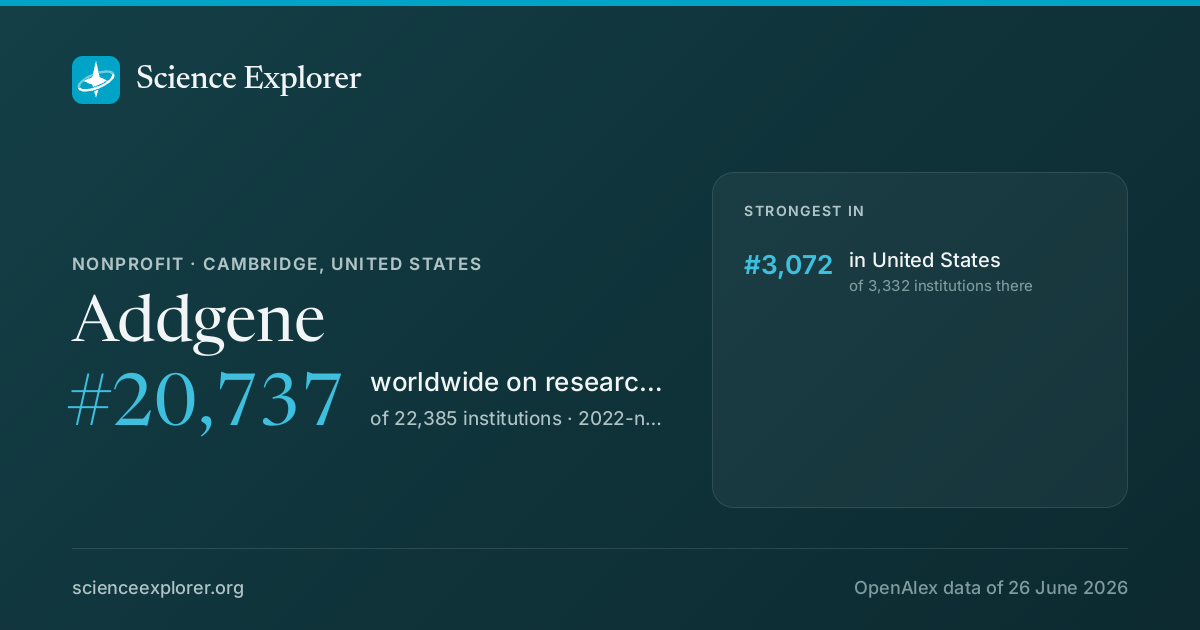
- #20,737 of 22,385 · #29,484 all time
- Rank in United States
- #3,072 of 3,332
- Research works
- 127 ▲ 203% vs 2018-21
- Citations
- 3k 23.4 per fractional work
- Top-10% rate
- 15.7% all institutions 10.0%
- vs its own fields
- 0.99× 1.00× is exactly expected
- Open access
- 44% world 40%
- International
- 23% world 18%
Which fields of science does Addgene work in?
In 2022-now, 52% of research at Addgene is in Health Sciences, 39% in Life Sciences. Its largest fields are Medicine (51%), Biochemistry, Genetics and Molecular Biology (31%), Immunology and Microbiology (4%). It does 2.5× the world's share of Life Sciences.
Each ring splits the one inside it: the four domains of science, their fields, their subfields. Size is fractional works in 2022-now. Every slice is a page; the interactive view zooms down to single topics and colours each by how much more of it this institution does than the world.
Its 4 domains and 18 fields, with their numbers
- Health Sciences3751.7%
- Medicine3651.1%
- Health Professions00.4%
- Dentistry00.3%
- Life Sciences2738.9%
- Physical Sciences56.8%
- Computer Science34.0%
- Engineering22.3%
- Environmental Science00.4%
- Chemistry00.0%
- Mathematics00.0%
- Social Sciences22.6%
Field profile
Location quotient across every field it publishes in: outside the ring is more than an institution of this size would be expected to publish, inside it is less.
Rings at 0.5×, 1× and 2×. Widest outward: Biochemistry, Genetics and Molecular Biology, 5.8×. Every wedge is a field page.
All 18 fields, with their numbers
- Biochemistry, Genetics and Molecular Biology5.85×22 works
- Immunology and Microbiology4.25×3 works
- Medicine2.66×36 works
- Pharmacology, Toxicology and Pharmaceutics1.34×0 works
- Neuroscience1.33×2 works
- Computer Science0.52×3 works
- Dentistry0.52×0 works
- Economics, Econometrics and Finance0.40×1 works
- Agricultural and Biological Sciences0.17×1 works
- Engineering0.15×2 works
- Health Professions0.14×0 works
- Social Sciences0.10×1 works
- Environmental Science0.09×0 works
- Arts and Humanities0.08×0 works
- Business, Management and Accounting0.07×0 works
- Mathematics0.03×0 works
- Psychology0.03×0 works
- Chemistry0.02×0 works
- Biochemistry, Genetics and Molecular Biology 5.8×
- Immunology and Microbiology 4.2×
- Medicine 2.7×
- Pharmacology, Toxicology and Pharmaceutics 1.3×
- Neuroscience 1.3×
- Computer Science 0.5×
- Dentistry 0.5×
- Economics, Econometrics and Finance 0.4×
- Agricultural and Biological Sciences 0.2×
- Engineering 0.1×
- Health Professions 0.1×
- Social Sciences 0.1×
- Environmental Science 0.1×
- Arts and Humanities 0.1×
- Business, Management and Accounting 0.1×
- Mathematics 0.0×
- Psychology 0.0×
- Chemistry 0.0×
Who are the top researchers at Addgene?
Ranked on the quality score, Nikita Kotlov, Viktor Svekolkin and Olga M. Kudryashova lead among researchers whose main affiliation is Addgene.
- 1
Nikita Kotlov
 United States · #298,868 worldwide
3.9k citations · 215 works
- 2
Viktor Svekolkin
United States · #301,258 worldwide
2.1k citations · 78 works
- 3
Olga M. Kudryashova
United States · #345,631 worldwide
527 citations · 44 works
- 4
Alexander Bagaev
United States · #414,287 worldwide
2.7k citations · 184 works
- 5
Joanne Kamens
United States · #635,872 worldwide
2.2k citations · 47 works
- 6
Ilia Galkin
United States · #730,452 worldwide
411 citations · 40 works
- 7
Felix E. Frenkel
United States · #734,109 worldwide
2.7k citations · 55 works
- 8
Iris Wang
United States · #762,918 worldwide
810 citations · 38 works
- 9
Ekaterina Postovalova
United States · #900,409 worldwide
548 citations · 97 works
- 10
Meghan A. Rego
United States · #997,104 worldwide
1.4k citations · 25 works
Which keywords describe research at Addgene?
By fractional works in 2022-now, weighted toward what it does more of than the world: Targeted Therapy, Immunotherapy, Gene Expression, Genomic Instability, Cancer Genomics, Mutational Signatures, Tumor Microenvironment and Lymphoma.
- Quantitative
- Lipid Peroxidation
- Therapeutic Targets
- Prognosis
- Neoadjuvant Therapy
- Normalization
- Metastatic
- Cell Death
- Precision Medicine
- Breast Cancer
- PD-1 and PD-L1
- Genetic Pathogenesis
- PET Imaging
- Molecular Profiling
- Rituximab
- Lymphoma
- Cancer
- Mutational Signatures
- Genomic Instability
- Immunotherapy
- Targeted Therapy
- Gene Expression
- Cancer Genomics
- Tumor Microenvironment
- Machine Learning
- Chemotherapy
- Prognostic Factors
- Gene Expression Profiling
- Classification
- Immune Checkpoint Blockade
- Clinical Practice Guidelines
- Cancer Immunotherapy
- Tumor Regression
- Data Analysis
- Molecular Characterization
- Autoantibodies
- Immunity
- Radiotherapy
- Ferroptosis
- Prognostic Markers
Size is fractional works in 2022-now in the topics tagged with each word; colour is the word's share of this institution's work against its share of the world's. The 40 words are chosen for being large and distinctive. Each links to the topic it comes from most.
All 40 words, with their numbers
- Targeted Therapy7▲ 46×4 topics
- Immunotherapy7▲ 14×14 topics
- Gene Expression6▲ 14×7 topics
- Genomic Instability6▲ 76×2 topics
- Cancer Genomics6▲ 117×1 topic
- Mutational Signatures6▲ 117×1 topic
- Tumor Microenvironment6▲ 17×6 topics
- Cancer5▲ 5.7×13 topics
- Machine Learning5▲ 2.1×8 topics
- Lymphoma5▲ 42×3 topics
- Chemotherapy5▲ 9.3×11 topics
- Rituximab4▲ 44×3 topics
- Prognostic Factors4▲ 13×9 topics
- Molecular Profiling4▲ 54×3 topics
- Gene Expression Profiling3▲ 62×2 topics
- PET Imaging3▲ 29×4 topics
- Classification3▲ 9.6×1 topic
- Genetic Pathogenesis3▲ 83×1 topic
- Immune Checkpoint Blockade3▲ 36×1 topic
- PD-1 and PD-L13▲ 36×1 topic
- Clinical Practice Guidelines3▲ 7.3×4 topics
- Breast Cancer3▲ 15×5 topics
- Cancer Immunotherapy3▲ 25×3 topics
- Precision Medicine2▲ 6.7×6 topics
- Tumor Regression2▲ 30×2 topics
- Cell Death2▲ 13×2 topics
- Data Analysis2▲ 12×3 topics
- Metastatic2▲ 47×2 topics
- Molecular Characterization2▲ 18×4 topics
- Normalization2▲ 60×2 topics
- Autoantibodies2▲ 12×4 topics
- Neoadjuvant Therapy2▲ 12×3 topics
- Immunity2▲ 6.6×3 topics
- Prognosis2▲ 8.0×4 topics
- Radiotherapy2▲ 6.6×5 topics
- Therapeutic Targets2▲ 17×4 topics
- Ferroptosis2▲ 30×1 topic
- Lipid Peroxidation2▲ 22×1 topic
- Prognostic Markers2▲ 22×3 topics
- Quantitative2▲ 27×1 topic
Which research topics does Addgene publish most on?
By volume in 2022-now: Cancer Genomics and Diagnostics, Lymphoma Diagnosis and Treatment, Cancer Immunotherapy and Biomarkers and Ferroptosis and cancer prognosis.
Area is fractional works; colour is the subfield each topic belongs to.
- 1 Cancer Genomics and Diagnostics Cancer Research 6 works
- 2 Lymphoma Diagnosis and Treatment Pathology and Forensic Medicine 3 works
- 3 Cancer Immunotherapy and Biomarkers Oncology 3 works
- 4 Ferroptosis and cancer prognosis Pulmonary and Respiratory Medicine 2 works
- 5 Molecular Biology Techniques and Applications Molecular Biology 2 works
- 6 CAR-T cell therapy research Oncology 2 works
- 7 Myasthenia Gravis and Thymoma Neurology 2 works
- 8 Sarcoma Diagnosis and Treatment Pulmonary and Respiratory Medicine 1 works
- 9 Pituitary Gland Disorders and Treatments Endocrinology, Diabetes and Metabolism 1 works
- 10 HER2/EGFR in Cancer Research Oncology 1 works
How open and international is its research?
Against the world's own shares: the tick on each track. Both are shares of its output, so they sit on one scale and can be read against each other as well as against the world.
World: 40% of research is openly available.
World: 18% is written across borders.
How has Addgene's research output changed?
Output in 2022-2025 was 203% higher than in 2018-2021.
The same series as a ribbon: one cell per year, darker for more. The line above answers how much; this answers when.
Its share of all research
Growing output can still be a shrinking share: all of science grows. This is Addgene as a percentage of every work published that year, 0.00042% in 2024.
Fractional works of Addgene over all fractional works that year. How the balance of science has shifted.
Other research institutions in Cambridge
- Harvard University
- Massachusetts Institute of Technology
- National Bureau of Economic Research
- World Wide Web Consortium
- Biogen (United States)
- Draper Laboratory
- Cambridge Health Alliance
- Harvard Global Health Institute




Share Addgene's ranking
Badges for a website1Each links back here and updates with every snapshot

Research measures only: rankings here say nothing about teaching, admissions or student experience. Comparable institutions and collaboration partners have tabs of their own, above.
Discussion
Ask a question or share a note about Addgene. Posts are plain text and can be reported.