Andover Eye Associates
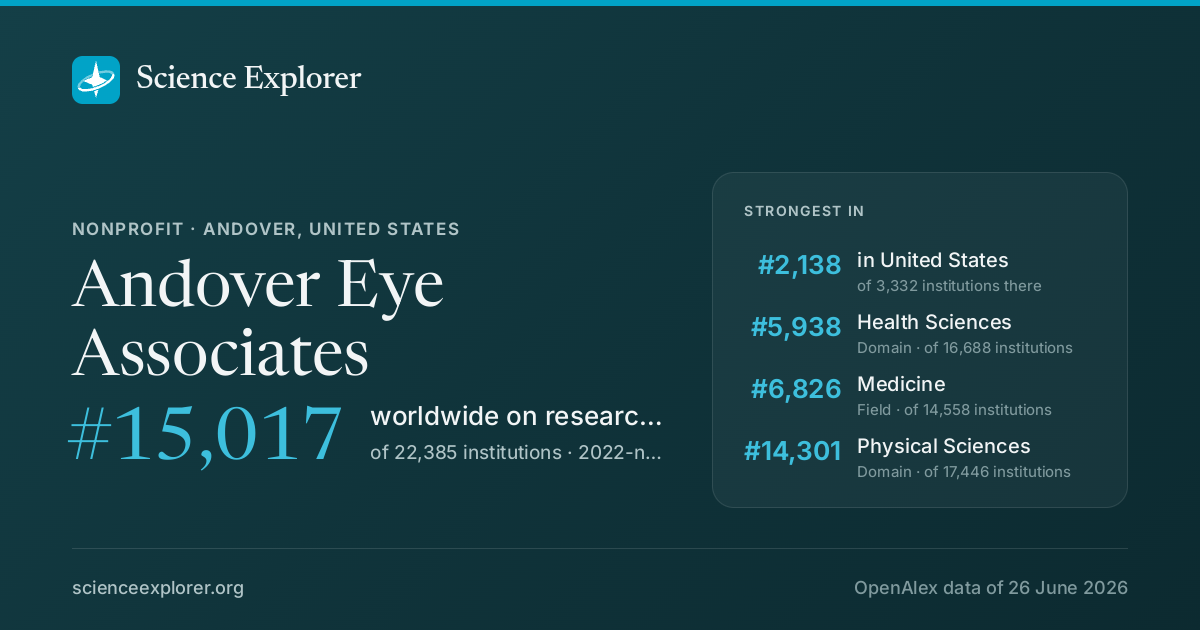
In research, Andover Eye Associates stands highest in Health Sciences (#5,938 of 16,688 worldwide), Medicine (#6,826 of 14,558 worldwide) and Physical Sciences (#14,301 of 17,446 worldwide), over all time.
- World rank, 2022-now
- #15,017 of 22,385 · #10,616 all time
- Rank in United States
- #2,138 of 3,332
- Research works
- 626 ◆ 1% vs 2018-21
- Citations
- 9.7k 15.5 per fractional work
- Top-10% rate
- 9.5% all institutions 10.0%
- vs its own fields
- 1.00× 1.00× is exactly expected
- Open access
- 28% world 40%
- International
- 13% world 18%
What is Andover Eye Associates known for in research?
The fields where it stands highest, over all time, ranked among every institution above the floor in each field.
| Field | World rank | Where that sits | Top-10% rate | Works |
|---|---|---|---|---|
| Health SciencesDomain | #5,938 of 16,688 | 8.6% | 266 | |
| MedicineField | #6,826 of 14,558 | 8.8% | 241 | |
| Physical SciencesDomain | #14,301 of 17,446 | 7.7% | 141 | |
| Social SciencesDomain | #12,787 of 14,833 | 4.5% | 131 |
Each strip is that field's whole ranked pool, with the notch where Andover Eye Associates sits in it, in the colour of the band that rank falls in. The track under the rate is the rate itself: it carries no average mark, because the average differs by field (from about 6% in Dentistry to 21% in Economics).
Which fields of science does Andover Eye Associates work in?
In 2022-now, 35% of research at Andover Eye Associates is in Physical Sciences, 26% in Social Sciences. Its largest fields are Medicine (22%), Computer Science (20%), Social Sciences (10%).
Each ring splits the one inside it: the four domains of science, their fields, their subfields. Size is fractional works in 2022-now. Every slice is a page; the interactive view zooms down to single topics and colours each by how much more of it this institution does than the world.
Its 4 domains and 24 fields, with their numbers
- Physical Sciences3235.3%
- Computer Science1819.8%
- Engineering66.4%
- Materials Science32.7%
- Physics and Astronomy22.0%
- Mathematics21.9%
- Environmental Science11.4%
- Earth and Planetary Sciences00.5%
- Chemical Engineering00.4%
- Chemistry00.2%
- Social Sciences2426.2%
- Health Sciences2426.0%
- Medicine2122.4%
- Health Professions33.5%
- Dentistry00.2%
- Nursing00.0%
- Life Sciences1212.5%
Field profile
Location quotient across every field it publishes in: outside the ring is more than an institution of this size would be expected to publish, inside it is less.
Rings at 0.5×, 1× and 2×. Widest outward: Pharmacology, Toxicology and Pharmaceutics, 4.6×. Every wedge is a field page.
All 24 fields, with their numbers
- Pharmacology, Toxicology and Pharmaceutics4.62×2 works
- Decision Sciences3.56×3 works
- Computer Science2.55×18 works
- Psychology2.43×7 works
- Neuroscience2.16×3 works
- Mathematics1.58×2 works
- Health Professions1.31×3 works
- Medicine1.16×21 works
- Biochemistry, Genetics and Molecular Biology1.06×5 works
- Chemical Engineering1.03×0 works
- Business, Management and Accounting0.90×3 works
- Physics and Astronomy0.89×2 works
- Arts and Humanities0.82×2 works
- Materials Science0.78×2 works
- Social Sciences0.78×9 works
- Immunology and Microbiology0.43×0 works
- Engineering0.43×6 works
- Dentistry0.34×0 works
- Earth and Planetary Sciences0.32×0 works
- Environmental Science0.28×1 works
- Agricultural and Biological Sciences0.27×1 works
- Chemistry0.12×0 works
- Nursing0.09×0 works
- Economics, Econometrics and Finance0.08×0 works
- Pharmacology, Toxicology and Pharmaceutics 4.6×
- Decision Sciences 3.6×
- Computer Science 2.5×
- Psychology 2.4×
- Neuroscience 2.2×
- Mathematics 1.6×
- Health Professions 1.3×
- Medicine 1.2×
- Biochemistry, Genetics and Molecular Biology 1.1×
- Chemical Engineering 1.0×
- Business, Management and Accounting 0.9×
- Physics and Astronomy 0.9×
- Arts and Humanities 0.8×
- Materials Science 0.8×
- Social Sciences 0.8×
- Immunology and Microbiology 0.4×
- Engineering 0.4×
- Dentistry 0.3×
- Earth and Planetary Sciences 0.3×
- Environmental Science 0.3×
- Agricultural and Biological Sciences 0.3×
- Chemistry 0.1×
- Nursing 0.1×
- Economics, Econometrics and Finance 0.1×
Who are the top researchers at Andover Eye Associates?
Ranked on the quality score, Richard S. MacNeish, Gary W. Jerkins and Gail L. Torkildsen lead among researchers whose main affiliation is Andover Eye Associates.
- 1
Richard S. MacNeish
 United States · #615,353 worldwide
1.9k citations · 94 works
- 2
Gary W. Jerkins
United States · #866,184 worldwide
579 citations · 15 works
- 3
Gail L. Torkildsen
United States · #1,204,716 worldwide
1.4k citations · 53 works
- 4
George W Ousler
United States · #1,501,646 worldwide
2.1k citations · 93 works
- 5
Eugene E. Protzko
United States · #1,657,597 worldwide
630 citations · 15 works
- 6
P.J. Gomes
United States · #1,945,473 worldwide
1.1k citations · 27 works
- 7
Samuel C. Shaw
United States · #2,104,632 worldwide
321 citations · 73 works
- 8
Endri Angjeli
United States · #2,461,721 worldwide
537 citations · 35 works
- 9
Seth Wait
United States · #2,490,390 worldwide
0 citations · 56 works
- 10
Selah Merrill
United States · #2,621,429 worldwide
43 citations · 43 works
Which keywords describe research at Andover Eye Associates?
By fractional works in 2022-now, weighted toward what it does more of than the world: Machine Learning, Epidemiology, Evidence-Based Practice, Artificial Intelligence, Big Data, Neural Networks, Behavioral Interventions and Special Education.
- Surface Engineering
- Tumor Targeting
- Argumentation Frameworks
- Agent-Based Modeling
- Ocular Surface
- Dry Eye Disease
- Simulation
- Topic Modeling
- Social Skills Interventions
- Executive Functioning
- Medical Imaging
- Clinical Decision Support
- Emotion Recognition
- Genetics
- Health Equity
- Behavioral Interventions
- Healthcare
- Big Data
- Artificial Intelligence
- Epidemiology
- Machine Learning
- Deep Learning
- Neural Networks
- Evidence-Based Practice
- Quality of Life
- Special Education
- Precision Medicine
- Autism Spectrum Disorders
- Mental Health
- Drug Delivery
- Text Classification
- Neurodevelopmental Disorders
- Information Retrieval
- Machine Translation
- Word Representation
- Neural Machine Translation
- Statistical Machine Translation
- Psychopathology
- Multi-Agent Systems
- Nanocarriers
Size is fractional works in 2022-now in the topics tagged with each word; colour is the word's share of this institution's work against its share of the world's. The 40 words are chosen for being large and distinctive. Each links to the topic it comes from most.
All 40 words, with their numbers
- Machine Learning9▲ 2.9×28 topics
- Epidemiology8▲ 2.2×19 topics
- Deep Learning6▲ 1.79×21 topics
- Artificial Intelligence5▲ 4.1×8 topics
- Neural Networks5▲ 3.3×7 topics
- Big Data4▲ 4.7×6 topics
- Evidence-Based Practice4▲ 33×3 topics
- Healthcare4▲ 3.5×5 topics
- Quality of Life4▲ 2.6×12 topics
- Behavioral Interventions3▲ 41×1 topic
- Special Education3▲ 56×1 topic
- Health Equity3▲ 11×2 topics
- Precision Medicine3▲ 6.1×2 topics
- Genetics3▲ 4.1×5 topics
- Autism Spectrum Disorders3▲ 28×2 topics
- Emotion Recognition3▲ 14×3 topics
- Mental Health3▲ 2.0×9 topics
- Clinical Decision Support2▲ 17×1 topic
- Drug Delivery2▲ 4.7×3 topics
- Medical Imaging2▲ 5.0×1 topic
- Text Classification2▲ 16×3 topics
- Executive Functioning2▲ 19×2 topics
- Neurodevelopmental Disorders2▲ 17×1 topic
- Social Skills Interventions2▲ 36×1 topic
- Information Retrieval2▲ 9.9×2 topics
- Topic Modeling2▲ 14×2 topics
- Machine Translation2▲ 12×1 topic
- Simulation2▲ 8.0×4 topics
- Word Representation2▲ 17×1 topic
- Dry Eye Disease2▲ 56×1 topic
- Neural Machine Translation2▲ 21×1 topic
- Ocular Surface2▲ 56×1 topic
- Statistical Machine Translation2▲ 21×1 topic
- Agent-Based Modeling1▲ 12×2 topics
- Psychopathology1▲ 8.5×2 topics
- Argumentation Frameworks1▲ 111×1 topic
- Multi-Agent Systems1▲ 7.6×1 topic
- Tumor Targeting1▲ 7.4×2 topics
- Nanocarriers1▲ 23×1 topic
- Surface Engineering1▲ 14×1 topic
Which research topics does Andover Eye Associates publish most on?
By volume in 2022-now: Behavioral and Psychological Studies, Artificial Intelligence in Healthcare and Education, Autism Spectrum Disorder Research and Topic Modeling.
Area is fractional works; colour is the subfield each topic belongs to.
- 1 Behavioral and Psychological Studies Developmental and Educational Psychology 3 works
- 2 Artificial Intelligence in Healthcare and Education Health Informatics 2 works
- 3 Autism Spectrum Disorder Research Cognitive Neuroscience 2 works
- 4 Topic Modeling Artificial Intelligence 2 works
- 5 Ocular Surface and Contact Lens Public Health, Environmental and Occupational Health 2 works
- 6 Natural Language Processing Techniques Artificial Intelligence 2 works
- 7 Child and Adolescent Psychosocial and Emotional Development Clinical Psychology 1 works
- 8 Multi-Agent Systems and Negotiation Artificial Intelligence 1 works
- 9 Nanoparticle-Based Drug Delivery Biomaterials 1 works
- 10 Evaluation and Performance Assessment Management Science and Operations Research 1 works
How open and international is its research?
Against the world's own shares: the tick on each track. Both are shares of its output, so they sit on one scale and can be read against each other as well as against the world.
World: 40% of research is openly available.
World: 18% is written across borders.
How has Andover Eye Associates's research output changed?
Output in 2022-2025 was 1% lower than in 2018-2021.
The same series as a ribbon: one cell per year, darker for more. The line above answers how much; this answers when.
Its share of all research
Growing output can still be a shrinking share: all of science grows. This is Andover Eye Associates as a percentage of every work published that year, 0.00038% in 2024.
Fractional works of Andover Eye Associates over all fractional works that year. How the balance of science has shifted.
How much of it reaches the world top 10%
Year by year, against all institutions in the same year.
Of each year's output, the share that reached the world's 10% most cited for its field and year. Peak 16.6% in 2014.
Other research institutions in Andover
- Physical Sciences (United States)
- Robert S. Peabody Museum of Archaeology
- Massachusetts School of Law
- Phillips Academy
- Schneider Electric (United States)
- MKS Instruments (United States)
- Northeast Document Conservation Center
- Vista Scientific (United States)
Share Andover Eye Associates's ranking
Badges for a website1Each links back here and updates with every snapshot

Research measures only: rankings here say nothing about teaching, admissions or student experience. Comparable institutions and collaboration partners have tabs of their own, above.
Discussion
Ask a question or share a note about Andover Eye Associates. Posts are plain text and can be reported.