
Science Explorer Back to mapMap
Discussion
University · Ankara · Türkiye

Atilim University

In research, Atilim University stands highest in Physical Sciences (#2,591 of 10,670 worldwide), Engineering (#1,867 of 5,901 worldwide) and Social Sciences (#3,306 of 9,585 worldwide), 2022-now.

World rank, 2022-now
#3,318
of 22,385 · #3,434 all time
Rank in Türkiye
#59
of 297
Research works
3.2k
▲ 2% vs 2018-21
Citations
47k
14.6 per fractional work
Top-10% rate
10.1%
all institutions 10.0%
vs its own fields
0.95×
1.00× is exactly expected
Open access
47%
world 40%
International
19%
world 18%

What is Atilim University known for in research?

The fields where it stands highest, 2022-now, ranked among every institution above the floor in each field.

FieldWorld rankWhere that sitsTop-10% rateWorksAll time
Physical SciencesDomain #2,591 of 10,670 11.5%360 #2218
EngineeringField #1,867 of 5,901 10.5%162 #1936
Social SciencesDomain #3,306 of 9,585 8.3%320 #3331
Computer ScienceField #2,462 of 4,417 15.2%75 #1654
Health SciencesDomain #5,817 of 9,902 10.3%123 #10903
MedicineField #5,235 of 8,541 10.2%98 #9507
Social SciencesField #3,684 of 5,988 8.5%142 #4004

Each strip is that field's whole ranked pool, with the notch where Atilim University sits in it, in the colour of the band that rank falls in. The track under the rate is the rate itself: it carries no average mark, because the average differs by field (from about 6% in Dentistry to 21% in Economics).

Which of those standings moved

The same fields on both windows: where it stood over the whole record, and where it stands in 2022-now. The distance is the story, and it is the one thing the two rank columns above cannot show.

  1. Physical Sciences#2,218 #2,591
  2. Engineering#1,936 #1,867
  3. Social Sciences#3,331 #3,306
  4. Computer Science#1,654 #2,462
  5. Health Sciences#10,903 #5,817
  6. Medicine#9,507 #5,235
  7. Social Sciences#4,004 #3,684
all time2022-now, better2022-now, worse

A dot further right is a better standing. Fields it was not ranked in over the whole record are left out.

Which fields of science does Atilim University work in?

In 2022-now, 43% of research at Atilim University is in Physical Sciences, 38% in Social Sciences. Its largest fields are Engineering (19%), Social Sciences (17%), Medicine (12%). It does 1.5× the world's share of Social Sciences.

Physical Sciences: 403 fractional works · 43.4% of its workEngineering: 179 fractional works · 19.2% of its workElectrical and Electronic Engineering: 34 fractional works · 3.7% of its workMechanical Engineering: 20 fractional works · 2.2% of its workCivil and Structural Engineering: 19 fractional works · 2.1% of its workBiomedical Engineering: 19 fractional works · 2.0% of its workBuilding and Construction: 15 fractional works · 1.6% of its workAerospace Engineering: 14 fractional works · 1.5% of its workSafety, Risk, Reliability and Quality: 12 fractional works · 1.3% of its workControl and Systems Engineering: 9 fractional works · 0.9% of its workAutomotive Engineering: 8 fractional works · 0.9% of its workIndustrial and Manufacturing Engineering: 8 fractional works · 0.8% of its workComputational Mechanics: 6 fractional works · 0.7% of its workMechanics of Materials: 6 fractional works · 0.7% of its workMedia Technology: 5 fractional works · 0.5% of its workSmaller subfields together: 3 fractional works · 0.3% of its workComputer Science: 87 fractional works · 9.3% of its workArtificial Intelligence: 28 fractional works · 3.0% of its workInformation Systems: 23 fractional works · 2.5% of its workComputer Vision and Pattern Recognition: 11 fractional works · 1.2% of its workComputer Networks and Communications: 11 fractional works · 1.2% of its workComputer Science Applications: 4 fractional works · 0.4% of its workComputational Theory and Mathematics: 3 fractional works · 0.3% of its workHuman-Computer Interaction: 2 fractional works · 0.3% of its workSoftware: 2 fractional works · 0.2% of its workSignal Processing: 2 fractional works · 0.2% of its workSmaller subfields together: 1 fractional works · 0.1% of its workMathematics: 36 fractional works · 3.9% of its workStatistics and Probability: 12 fractional works · 1.2% of its workApplied Mathematics: 8 fractional works · 0.8% of its workGeometry and Topology: 5 fractional works · 0.5% of its workNumerical Analysis: 4 fractional works · 0.4% of its workModeling and Simulation: 3 fractional works · 0.3% of its workMathematical Physics: 2 fractional works · 0.2% of its workSmaller subfields together: 3 fractional works · 0.3% of its workEnvironmental Science: 35 fractional works · 3.8% of its workEnvironmental Engineering: 10 fractional works · 1.1% of its workGlobal and Planetary Change: 7 fractional works · 0.8% of its workManagement, Monitoring, Policy and Law: 6 fractional works · 0.7% of its workWater Science and Technology: 4 fractional works · 0.4% of its workHealth, Toxicology and Mutagenesis: 2 fractional works · 0.3% of its workIndustrial and Manufacturing Engineering: 2 fractional works · 0.2% of its workSmaller subfields together: 4 fractional works · 0.4% of its workMaterials Science: 30 fractional works · 3.2% of its workMaterials Chemistry: 18 fractional works · 1.9% of its workPolymers and Plastics: 5 fractional works · 0.5% of its workBiomaterials: 3 fractional works · 0.4% of its workElectronic, Optical and Magnetic Materials: 3 fractional works · 0.3% of its workSmaller subfields together: 1 fractional works · 0.1% of its workPhysics and Astronomy: 14 fractional works · 1.5% of its workAtomic and Molecular Physics, and Optics: 5 fractional works · 0.5% of its workNuclear and High Energy Physics: 4 fractional works · 0.4% of its workAstronomy and Astrophysics: 3 fractional works · 0.3% of its workStatistical and Nonlinear Physics: 2 fractional works · 0.2% of its workEnergy: 10 fractional works · 1.1% of its workRenewable Energy, Sustainability and the Environment: 7 fractional works · 0.8% of its workEnergy Engineering and Power Technology: 2 fractional works · 0.2% of its workSmaller subfields together: 1 fractional works · 0.1% of its workEarth and Planetary Sciences: 8 fractional works · 0.9% of its workGeophysics: 4 fractional works · 0.4% of its workSmaller subfields together: 4 fractional works · 0.4% of its workChemistry: 3 fractional works · 0.4% of its workChemical Engineering: 2 fractional works · 0.2% of its workSocial Sciences: 353 fractional works · 38.0% of its workSocial Sciences: 159 fractional works · 17.2% of its workPolitical Science and International Relations: 47 fractional works · 5.1% of its workSociology and Political Science: 46 fractional works · 4.9% of its workEducation: 20 fractional works · 2.1% of its workGender Studies: 8 fractional works · 0.9% of its workUrban Studies: 8 fractional works · 0.8% of its workCommunication: 7 fractional works · 0.8% of its workCultural Studies: 5 fractional works · 0.5% of its workDemography: 4 fractional works · 0.4% of its workLaw: 4 fractional works · 0.4% of its workSafety Research: 2 fractional works · 0.3% of its workSmaller subfields together: 9 fractional works · 1.0% of its workBusiness, Management and Accounting: 50 fractional works · 5.3% of its workStrategy and Management: 14 fractional works · 1.5% of its workAccounting: 9 fractional works · 1.0% of its workManagement Information Systems: 9 fractional works · 0.9% of its workMarketing: 7 fractional works · 0.8% of its workOrganizational Behavior and Human Resource Management: 6 fractional works · 0.7% of its workManagement of Technology and Innovation: 3 fractional works · 0.3% of its workSmaller subfields together: 1 fractional works · 0.1% of its workEconomics, Econometrics and Finance: 45 fractional works · 4.9% of its workEconomics and Econometrics: 29 fractional works · 3.1% of its workGeneral Economics, Econometrics and Finance: 8 fractional works · 0.9% of its workFinance: 8 fractional works · 0.9% of its workPsychology: 41 fractional works · 4.4% of its workSocial Psychology: 17 fractional works · 1.8% of its workClinical Psychology: 12 fractional works · 1.3% of its workExperimental and Cognitive Psychology: 5 fractional works · 0.5% of its workDevelopmental and Educational Psychology: 4 fractional works · 0.5% of its workApplied Psychology: 2 fractional works · 0.3% of its workSmaller subfields together: 1 fractional works · 0.1% of its workArts and Humanities: 38 fractional works · 4.1% of its workLiterature and Literary Theory: 14 fractional works · 1.5% of its workMuseology: 5 fractional works · 0.6% of its workLanguage and Linguistics: 5 fractional works · 0.5% of its workPhilosophy: 4 fractional works · 0.4% of its workHistory: 4 fractional works · 0.4% of its workVisual Arts and Performing Arts: 3 fractional works · 0.3% of its workSmaller subfields together: 3 fractional works · 0.4% of its workDecision Sciences: 21 fractional works · 2.2% of its workManagement Science and Operations Research: 10 fractional works · 1.1% of its workStatistics, Probability and Uncertainty: 8 fractional works · 0.8% of its workInformation Systems and Management: 2 fractional works · 0.3% of its workSmaller subfields together: 0 fractional works · 0.0% of its workHealth Sciences: 135 fractional works · 14.6% of its workMedicine: 108 fractional works · 11.6% of its workSurgery: 19 fractional works · 2.1% of its workPublic Health, Environmental and Occupational Health: 8 fractional works · 0.9% of its workRadiology, Nuclear Medicine and Imaging: 6 fractional works · 0.7% of its workPulmonary and Respiratory Medicine: 6 fractional works · 0.7% of its workPhysiology: 6 fractional works · 0.6% of its workEpidemiology: 5 fractional works · 0.5% of its workOncology: 5 fractional works · 0.5% of its workCardiology and Cardiovascular Medicine: 5 fractional works · 0.5% of its workPsychiatry and Mental health: 4 fractional works · 0.5% of its workPediatrics, Perinatology and Child Health: 4 fractional works · 0.4% of its workDermatology: 3 fractional works · 0.4% of its workOphthalmology: 3 fractional works · 0.4% of its workNeurology: 3 fractional works · 0.3% of its workEndocrinology, Diabetes and Metabolism: 3 fractional works · 0.3% of its workPharmacology: 3 fractional works · 0.3% of its workPathology and Forensic Medicine: 3 fractional works · 0.3% of its workHealth Informatics: 3 fractional works · 0.3% of its workInfectious Diseases: 2 fractional works · 0.2% of its workOrthopedics and Sports Medicine: 2 fractional works · 0.2% of its workSmaller subfields together: 14 fractional works · 1.5% of its workHealth Professions: 21 fractional works · 2.3% of its workGeneral Health Professions: 8 fractional works · 0.9% of its workSpeech and Hearing: 4 fractional works · 0.5% of its workEmergency Medical Services: 2 fractional works · 0.2% of its workSmaller subfields together: 7 fractional works · 0.8% of its workDentistry: 3 fractional works · 0.4% of its workNursing: 3 fractional works · 0.3% of its workLife Sciences: 38 fractional works · 4.1% of its workBiochemistry, Genetics and Molecular Biology: 19 fractional works · 2.0% of its workMolecular Biology: 12 fractional works · 1.3% of its workCell Biology: 2 fractional works · 0.2% of its workSmaller subfields together: 4 fractional works · 0.5% of its workNeuroscience: 8 fractional works · 0.9% of its workCognitive Neuroscience: 5 fractional works · 0.5% of its workSmaller subfields together: 3 fractional works · 0.3% of its workAgricultural and Biological Sciences: 8 fractional works · 0.9% of its workPlant Science: 4 fractional works · 0.4% of its workSmaller subfields together: 4 fractional works · 0.5% of its workImmunology and Microbiology: 2 fractional works · 0.2% of its workPharmacology, Toxicology and Pharmaceutics: 1 fractional works · 0.1% of its workALL ITS WORKAtilim University929fractional works, 2022-now
Life Sciences4%Physical Sciences43%Health Sciences15%Social Sciences38%

Each ring splits the one inside it: the four domains of science, their fields, their subfields. Size is fractional works in 2022-now. Every slice is a page; the interactive view zooms down to single topics and colours each by how much more of it this institution does than the world.

Its 4 domains and 26 fields, with their numbers
    1. Engineering17919.2%
    2. Computer Science879.3%
    3. Mathematics363.9%
    4. Environmental Science353.8%
    5. Materials Science303.2%
    6. Physics and Astronomy141.5%
    7. Energy101.1%
    8. Earth and Planetary Sciences80.9%
    9. Chemistry30.4%
    10. Chemical Engineering20.2%
    1. Social Sciences15917.2%
    2. Business, Management and Accounting505.3%
    3. Economics, Econometrics and Finance454.9%
    4. Psychology414.4%
    5. Arts and Humanities384.1%
    6. Decision Sciences212.2%
    1. Medicine10811.6%
    2. Health Professions212.3%
    3. Dentistry30.4%
    4. Nursing30.3%
    5. Veterinary00.0%
    1. Biochemistry, Genetics and Molecular Biology192.0%
    2. Neuroscience80.9%
    3. Agricultural and Biological Sciences80.9%
    4. Immunology and Microbiology20.2%
    5. Pharmacology, Toxicology and Pharmaceutics10.1%
All of science, and how each field's share has moved since 1950: the Science domain explorer

Field profile

Location quotient across every field it publishes in: outside the ring is more than an institution of this size would be expected to publish, inside it is less.

Agricultural and Biological Sciences: 0.18× its world share, 8 worksAgricultural and Bio…Biochemistry, Genetics and Molecular Biology: 0.38× its world share, 19 worksBiochemistry, Geneti…Immunology and Microbiology: 0.25× its world share, 2 worksImmunology and Micro…Neuroscience: 0.54× its world share, 8 worksNeurosciencePharmacology, Toxicology and Pharmaceutics: 0.23× its world share, 1 worksPharmacology, Toxico…Chemical Engineering: 0.64× its world share, 2 worksChemical EngineeringChemistry: 0.23× its world share, 3 worksChemistryComputer Science: 1.20× its world share, 86 worksComputer ScienceEarth and Planetary Sciences: 0.55× its world share, 8 worksEarth and Planetary …Energy: 1.17× its world share, 10 worksEnergyEngineering: 1.28× its world share, 179 worksEngineeringEnvironmental Science: 0.76× its world share, 35 worksEnvironmental ScienceMaterials Science: 0.91× its world share, 30 worksMaterials ScienceMathematics: 3.30× its world share, 36 worksMathematicsPhysics and Astronomy: 0.66× its world share, 14 worksPhysics and AstronomyDentistry: 0.73× its world share, 3 worksDentistryHealth Professions: 0.87× its world share, 21 worksHealth ProfessionsMedicine: 0.60× its world share, 108 worksMedicineNursing: 0.58× its world share, 3 worksNursingVeterinary: 0.13× its world share, 0 worksVeterinaryArts and Humanities: 1.40× its world share, 38 worksArts and HumanitiesBusiness, Management and Accounting: 1.65× its world share, 50 worksBusiness, Management…Decision Sciences: 2.32× its world share, 21 worksDecision SciencesEconomics, Econometrics and Finance: 2.27× its world share, 45 worksEconomics, Econometr…Psychology: 1.44× its world share, 41 worksPsychologySocial Sciences: 1.36× its world share, 159 worksSocial Sciences1×world share
more than its size predictsabout as predictedless

Rings at 0.5×, 1× and 2×. Widest outward: Mathematics, 3.3×. Every wedge is a field page.

All 26 fields, with their numbers
  1. Mathematics3.30×36 works
  2. Decision Sciences2.32×21 works
  3. Economics, Econometrics and Finance2.27×45 works
  4. Business, Management and Accounting1.65×50 works
  5. Psychology1.44×41 works
  6. Arts and Humanities1.40×38 works
  7. Social Sciences1.36×159 works
  8. Engineering1.28×179 works
  9. Computer Science1.20×86 works
  10. Energy1.17×10 works
  11. Materials Science0.91×30 works
  12. Health Professions0.87×21 works
  13. Environmental Science0.76×35 works
  14. Dentistry0.73×3 works
  15. Physics and Astronomy0.66×14 works
  16. Chemical Engineering0.64×2 works
  17. Medicine0.60×108 works
  18. Nursing0.58×3 works
  19. Earth and Planetary Sciences0.55×8 works
  20. Neuroscience0.54×8 works
  21. Biochemistry, Genetics and Molecular Biology0.38×19 works
  22. Immunology and Microbiology0.25×2 works
  23. Pharmacology, Toxicology and Pharmaceutics0.23×1 works
  24. Chemistry0.23×3 works
  25. Agricultural and Biological Sciences0.18×8 works
  26. Veterinary0.13×0 works

Who are the top researchers at Atilim University?

Ranked on the quality score, Alok Mishra, Erdal Karapınar and Irem Metin-Orta lead among researchers whose main affiliation is Atilim University.

  1. 1 Alok Mishra Türkiye · #213,421 worldwide 5.3k citations · 295 works
  2. 2 Erdal Karapınar Türkiye · #343,687 worldwide 14k citations · 565 works
  3. 3 Irem Metin-Orta Türkiye · #610,144 worldwide 817 citations · 54 works
  4. 4 Kemal Gürkan Küçükergi̇n Türkiye · #610,286 worldwide 1.2k citations · 39 works
  5. 5 Şacip Toker Türkiye · #632,179 worldwide 802 citations · 57 works
  6. 6 Yılser G. Devrim Türkiye · #901,422 worldwide 4.3k citations · 89 works
  7. 7 Nergiz Ercil Çağıltay Türkiye · #907,553 worldwide 2k citations · 127 works
  8. 8 İncı M. Erhan Türkiye · #987,566 worldwide 1.2k citations · 74 works
  9. 9 Serkan Eryılmaz Türkiye · #1,132,047 worldwide 5.1k citations · 245 works
  10. 10 Murat Kaya Türkiye · #1,150,023 worldwide 2.1k citations · 54 works
All ranked researchers at Atilim University

What are the most cited papers from Atilim University?

The most cited paper from Atilim University is "Refining the theory of basic individual values." (Shalom H. Schwartz, Jan Cieciuch, Michele Vecchione et al., 2012), with 2,610 citations. Next come "Stability analysis of swarms" (942) and "A Comprehensive Review of Cyber Security Vulnerabilities, Threats, Attacks, and Solutions" (739).

Most cited papers
#PaperReleasedCitations
1 Refining the theory of basic individual values. Shalom H. Schwartz, Jan Cieciuch, Michele Vecchione et al. · Journal of Personality and Social Psychology Open access 23 Jul 2012 2,610
2 Stability analysis of swarms Veysel Gazi, Kevin M. Passino · IEEE Transactions on Automatic Control Open access Apr 2003 942
3 A Comprehensive Review of Cyber Security Vulnerabilities, Threats, Attacks, and Solutions Ömer Aslan, Semih Serkant Aktuğ, Merve Ozkan-Okay et al. · Electronics Open access 11 Mar 2023 739
4 Stability Analysis of Social Foraging Swarms Veysel Gazi, Kevin M. Passino · IEEE Transactions on Systems Man and Cybernetics Part B (Cybernetics) Feb 2004 640
5 Transformative effects of IoT, Blockchain and Artificial Intelligence on cloud computing: Evolution, vision, trends and open challenges Sukhpal Singh Gill, Shreshth Tuli, Minxian Xu et al. · Internet of Things Open access 19 Sep 2019 505
All 60 most cited papers, with filters and sorting

Which keywords describe research at Atilim University?

By fractional works in 2022-now, weighted toward what it does more of than the world: Human Rights, Nationalism, Cultural Heritage, International Law, Economic Growth, Sustainability, Neoliberalism and Thermal Comfort.

▲ more of its work than of the world's◆ about the world's share▼ less than the world's

Size is fractional works in 2022-now in the topics tagged with each word; colour is the word's share of this institution's work against its share of the world's. The 40 words are chosen for being large and distinctive. Each links to the topic it comes from most.

All 40 words, with their numbers
  1. Machine Learning35◆ 1.13×60 topics
  2. Sustainability32▲ 1.43×41 topics
  3. Deep Learning28◆ 0.88×45 topics
  4. Human Rights28▲ 3.0×25 topics
  5. Globalization28▲ 1.51×40 topics
  6. Economic Growth22▲ 3.0×17 topics
  7. Nationalism20▲ 4.9×13 topics
  8. Social Media20▲ 1.59×20 topics
  9. Cultural Heritage20▲ 4.1×12 topics
  10. Renewable Energy18▲ 1.33×25 topics
  11. Big Data17▲ 1.96×18 topics
  12. Energy Efficiency17▲ 1.99×18 topics
  13. International Law17▲ 5.7×12 topics
  14. Neoliberalism16▲ 4.8×13 topics
  15. Supply Chain Management16▲ 1.93×17 topics
  16. Social Justice14▲ 2.5×10 topics
  17. Thermal Comfort12▲ 10×2 topics
  18. Artificial Neural Networks12▲ 2.8×8 topics
  19. Monetary Policy12▲ 5.4×6 topics
  20. Fiscal Policy12▲ 6.1×6 topics
  21. Ethnic Conflict10▲ 23×3 topics
  22. Stock Market10▲ 4.8×2 topics
  23. Diplomacy9▲ 10×4 topics
  24. Panel Data Analysis9▲ 6.0×3 topics
  25. Civil Society8▲ 8.3×3 topics
  26. Authoritarianism8▲ 10×2 topics
  27. Criminal Law8▲ 5.8×2 topics
  28. Ethical Dilemmas8▲ 34×1 topic
  29. Gender politics8▲ 22×2 topics
  30. Legal Principles8▲ 121×1 topic
  31. Stochastic Modeling8▲ 24×2 topics
  32. Maintenance Optimization8▲ 40×1 topic
  33. Ottoman Empire8▲ 12×3 topics
  34. Reliability Engineering8▲ 40×1 topic
  35. Energy Simulation8▲ 9.5×2 topics
  36. AKP8▲ 43×1 topic
  37. Building Energy Consumption7▲ 10×1 topic
  38. Sustainable Buildings7▲ 10×1 topic
  39. Weibull Distribution7▲ 17×2 topics
  40. Sovereignty7▲ 8.3×4 topics

Which research topics does Atilim University publish most on?

By volume in 2022-now: Legal Issues in Turkey, Reliability and Maintenance Optimization, Turkey's Politics and Society and Building Energy and Comfort Optimization.

  1. 1 Legal Issues in Turkey Political Science and International Relations 8 works
  2. 2 Reliability and Maintenance Optimization Safety, Risk, Reliability and Quality 8 works
  3. 3 Turkey's Politics and Society Political Science and International Relations 8 works
  4. 4 Building Energy and Comfort Optimization Building and Construction 7 works
  5. 5 Market Dynamics and Volatility Economics and Econometrics 6 works
  6. 6 Statistical Distribution Estimation and Applications Statistics and Probability 6 works
  7. 7 Historical Turkish Studies Political Science and International Relations 5 works
  8. 8 Cultural and Sociopolitical Studies Museology 5 works
  9. 9 Monetary Policy and Economic Impact General Economics, Econometrics and Finance 5 works
  10. 10 Urban Heat Island Mitigation Environmental Engineering 5 works

How open and international is its research?

Against the world's own shares: the tick on each track. Both are shares of its output, so they sit on one scale and can be read against each other as well as against the world.

openly available47.4%not open52.6%

World: 40% of research is openly available.

with international co-authors19.4%domestic only80.6%

World: 18% is written across borders.

How has Atilim University's research output changed?

Output in 2022-2025 was 2% higher than in 2018-2021.

still counting1990200020102020
grewheldshrank

The same series as a ribbon: one cell per year, darker for more. The line above answers how much; this answers when.

Its share of all research

Growing output can still be a shrinking share: all of science grows. This is Atilim University as a percentage of every work published that year, 0.0037% in 2024.

still counting0.0020%0.0040%0.0060%Atilim University0.0030% in 202519801990200020102020

Fractional works of Atilim University over all fractional works that year. How the balance of science has shifted.

How much of it reaches the world top 10%

Year by year, against all institutions in the same year.

still counting10%20%30%Atilim University13.5% in 2025all institutions10.0% in 202520102020

Of each year's output, the share that reached the world's 10% most cited for its field and year. Peak 21.2% in 2005.

Other research institutions in Ankara

All research institutions in Ankara

Share Atilim University's ranking
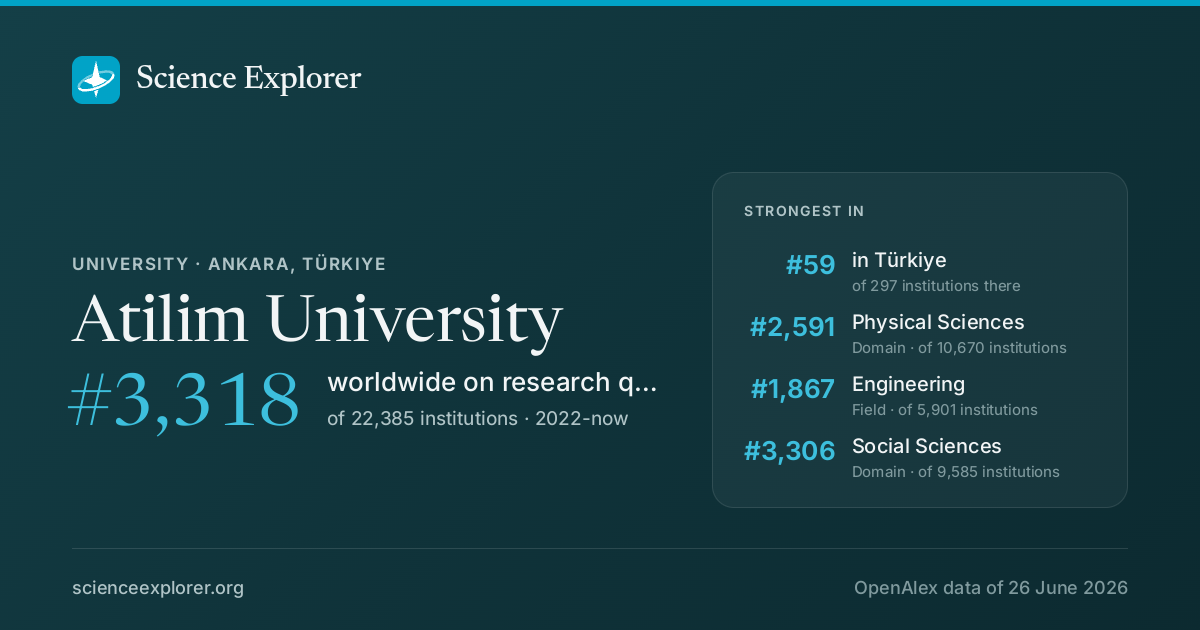
Atilim University on Science Explorer

A card with Atilim University's standing and the fields it leads in, for a post or a slide. A link to this page previews as the same card.

Download the card

1200 × 630 PNG, sized for social posts, drawn from the latest snapshot.

Badges for a website1Each links back here and updates with every snapshot

Research measures only: rankings here say nothing about teaching, admissions or student experience. Comparable institutions and collaboration partners have tabs of their own, above.

Discussion

Ask a question or share a note about Atilim University. Posts are plain text and can be reported.