Science Explorer Back to mapMap
Discussion

Autoimmune Technologies (United States)

World rank, all time
#31,039
of 34,923
Rank in United States
#6,557
of 7,310
Research works
173
▲ 10% vs 2018-21
Citations
8.5k
49.2 per fractional work
Top-10% rate
16.5%
all institutions 10.0%
vs its own fields
1.08×
1.00× is exactly expected
Open access
39%
world 40%
International
40%
world 18%

Which fields of science does Autoimmune Technologies (United States) work in?

In 2022-now, 67% of research at Autoimmune Technologies (United States) is in Health Sciences, 22% in Life Sciences. Its largest fields are Medicine (65%), Immunology and Microbiology (14%), Biochemistry, Genetics and Molecular Biology (6%). It does 2.3× the world's share of Health Sciences.

Health Sciences: 20 fractional works · 66.6% of its workMedicine: 19 fractional works · 65.2% of its workRheumatology: 5 fractional works · 15.8% of its workPathology and Forensic Medicine: 2 fractional works · 7.5% of its workSurgery: 1 fractional works · 4.8% of its workInfectious Diseases: 1 fractional works · 4.2% of its workPulmonary and Respiratory Medicine: 1 fractional works · 4.0% of its workEpidemiology: 1 fractional works · 3.9% of its workDermatology: 1 fractional works · 3.1% of its workNeurology: 1 fractional works · 3.0% of its workRadiology, Nuclear Medicine and Imaging: 1 fractional works · 3.0% of its workHepatology: 1 fractional works · 1.9% of its workHematology: 1 fractional works · 1.9% of its workRehabilitation: 1 fractional works · 1.9% of its workOncology: 0 fractional works · 1.6% of its workNephrology: 0 fractional works · 1.0% of its workGastroenterology: 0 fractional works · 0.9% of its workEndocrinology, Diabetes and Metabolism: 0 fractional works · 0.9% of its workCardiology and Cardiovascular Medicine: 0 fractional works · 0.8% of its workObstetrics and Gynecology: 0 fractional works · 0.7% of its workPharmacology: 0 fractional works · 0.6% of its workGenetics: 0 fractional works · 0.4% of its workUrology: 0 fractional works · 0.4% of its workComplementary and alternative medicine: 0 fractional works · 0.4% of its workOrthopedics and Sports Medicine: 0 fractional works · 0.4% of its workPediatrics, Perinatology and Child Health: 0 fractional works · 0.4% of its workPhysiology: 0 fractional works · 0.4% of its workTransplantation: 0 fractional works · 0.4% of its workPsychiatry and Mental health: 0 fractional works · 0.3% of its workImmunology and Allergy: 0 fractional works · 0.2% of its workSmaller subfields together: 0 fractional works · 0.5% of its workHealth Professions: 0 fractional works · 1.0% of its workGeneral Health Professions: 0 fractional works · 0.4% of its workHealth Information Management: 0 fractional works · 0.4% of its workSmaller subfields together: 0 fractional works · 0.1% of its workDentistry: 0 fractional works · 0.4% of its workOral Surgery: 0 fractional works · 0.4% of its workLife Sciences: 6 fractional works · 21.6% of its workImmunology and Microbiology: 4 fractional works · 14.2% of its workImmunology: 4 fractional works · 13.8% of its workMicrobiology: 0 fractional works · 0.5% of its workBiochemistry, Genetics and Molecular Biology: 2 fractional works · 5.9% of its workMolecular Biology: 1 fractional works · 3.3% of its workGenetics: 0 fractional works · 1.3% of its workCancer Research: 0 fractional works · 0.6% of its workBiotechnology: 0 fractional works · 0.4% of its workMolecular Medicine: 0 fractional works · 0.3% of its workNeuroscience: 0 fractional works · 1.2% of its workDevelopmental Neuroscience: 0 fractional works · 0.4% of its workNeurology: 0 fractional works · 0.4% of its workEndocrine and Autonomic Systems: 0 fractional works · 0.2% of its workSmaller subfields together: 0 fractional works · 0.2% of its workPharmacology, Toxicology and Pharmaceutics: 0 fractional works · 0.3% of its workPhysical Sciences: 3 fractional works · 9.5% of its workComputer Science: 1 fractional works · 2.7% of its workComputer Graphics and Computer-Aided Design: 0 fractional works · 1.1% of its workComputer Vision and Pattern Recognition: 0 fractional works · 1.1% of its workInformation Systems: 0 fractional works · 0.4% of its workSmaller subfields together: 0 fractional works · 0.0% of its workEngineering: 1 fractional works · 2.4% of its workAutomotive Engineering: 0 fractional works · 1.1% of its workBiomedical Engineering: 0 fractional works · 0.4% of its workIndustrial and Manufacturing Engineering: 0 fractional works · 0.4% of its workMechanical Engineering: 0 fractional works · 0.4% of its workSmaller subfields together: 0 fractional works · 0.0% of its workPhysics and Astronomy: 1 fractional works · 2.3% of its workAtomic and Molecular Physics, and Optics: 1 fractional works · 2.3% of its workMaterials Science: 0 fractional works · 1.4% of its workMaterials Chemistry: 0 fractional works · 1.1% of its workSurfaces, Coatings and Films: 0 fractional works · 0.3% of its workSmaller subfields together: 0 fractional works · 0.0% of its workEnvironmental Science: 0 fractional works · 0.7% of its workHealth, Toxicology and Mutagenesis: 0 fractional works · 0.5% of its workSmaller subfields together: 0 fractional works · 0.2% of its workSocial Sciences: 1 fractional works · 2.3% of its workSocial Sciences: 0 fractional works · 1.1% of its workEducation: 0 fractional works · 0.8% of its workDemography: 0 fractional works · 0.3% of its workSmaller subfields together: 0 fractional works · 0.0% of its workPsychology: 0 fractional works · 0.9% of its workClinical Psychology: 0 fractional works · 0.8% of its workSmaller subfields together: 0 fractional works · 0.1% of its workDecision Sciences: 0 fractional works · 0.3% of its workInformation Systems and Management: 0 fractional works · 0.3% of its workALL ITS WORKAutoimmuneTechnologies…29fractional works, 2022-now
Life Sciences22%Physical Sciences9%Health Sciences67%Social Sciences2%

Each ring splits the one inside it: the four domains of science, their fields, their subfields. Size is fractional works in 2022-now. Every slice is a page; the interactive view zooms down to single topics and colours each by how much more of it this institution does than the world.

Its 4 domains and 15 fields, with their numbers
    1. Medicine1965.2%
    2. Health Professions01.0%
    3. Dentistry00.4%
    1. Immunology and Microbiology414.2%
    2. Biochemistry, Genetics and Molecular Biology25.9%
    3. Neuroscience01.2%
    4. Pharmacology, Toxicology and Pharmaceutics00.3%
    1. Computer Science12.7%
    2. Engineering12.4%
    3. Physics and Astronomy12.3%
    4. Materials Science01.4%
    5. Environmental Science00.7%
    1. Social Sciences01.1%
    2. Psychology00.9%
    3. Decision Sciences00.3%
All of science, and how each field's share has moved since 1950: the Science domain explorer

Field profile

Location quotient across every field it publishes in: outside the ring is more than an institution of this size would be expected to publish, inside it is less.

Biochemistry, Genetics and Molecular Biology: 1.11× its world share, 2 worksBiochemistry, Geneti…Immunology and Microbiology: 14.15× its world share, 4 worksImmunology and Micro…Neuroscience: 0.71× its world share, 0 worksNeurosciencePharmacology, Toxicology and Pharmaceutics: 1.00× its world share, 0 worksPharmacology, Toxico…Computer Science: 0.35× its world share, 1 worksComputer ScienceEngineering: 0.16× its world share, 1 worksEngineeringEnvironmental Science: 0.14× its world share, 0 worksEnvironmental ScienceMaterials Science: 0.41× its world share, 0 worksMaterials SciencePhysics and Astronomy: 1.02× its world share, 1 worksPhysics and AstronomyDentistry: 0.78× its world share, 0 worksDentistryHealth Professions: 0.37× its world share, 0 worksHealth ProfessionsMedicine: 3.39× its world share, 19 worksMedicineDecision Sciences: 0.29× its world share, 0 worksDecision SciencesPsychology: 0.30× its world share, 0 worksPsychologySocial Sciences: 0.09× its world share, 0 worksSocial Sciences1×world share
more than its size predictsabout as predictedless

Rings at 0.5×, 1× and 2×. Widest outward: Immunology and Microbiology, 14.2×. Every wedge is a field page.

All 15 fields, with their numbers
  1. Immunology and Microbiology14.15×4 works
  2. Medicine3.39×19 works
  3. Biochemistry, Genetics and Molecular Biology1.11×2 works
  4. Physics and Astronomy1.02×1 works
  5. Pharmacology, Toxicology and Pharmaceutics1.00×0 works
  6. Dentistry0.78×0 works
  7. Neuroscience0.71×0 works
  8. Materials Science0.41×0 works
  9. Health Professions0.37×0 works
  10. Computer Science0.35×1 works
  11. Psychology0.30×0 works
  12. Decision Sciences0.29×0 works
  13. Engineering0.16×1 works
  14. Environmental Science0.14×0 works
  15. Social Sciences0.09×0 works

Who are the top researchers at Autoimmune Technologies (United States)?

Ranked on the quality score, John D. Fikes and Brian D. Livingston lead among researchers whose main affiliation is Autoimmune Technologies (United States).

  1. 1 John D. Fikes United States · #590,644 worldwide 3.9k citations · 52 works
  2. 2 Brian D. Livingston United States · #923,144 worldwide 3.6k citations · 59 works
All ranked researchers at Autoimmune Technologies (United States)

What are the most cited papers from Autoimmune Technologies (United States)?

The most cited paper from Autoimmune Technologies (United States) is "EULAR recommendations for the management of antiphospholipid syndrome in adults" (Maria G. Tektonidou et al., 2019), with 1,254 citations. Next come "Regulatory T-Cell Responses to Low-Dose Interleukin-2 in HCV-Induced Vasculitis" (762) and "Tat-specific cytotoxic T lymphocytes select for SIV escape variants during resolution of primary viraemia" (686).

Most cited papers
#PaperReleasedCitations
1 EULAR recommendations for the management of antiphospholipid syndrome in adults Maria G. Tektonidou et al. · Annals of the Rheumatic Diseases Open access 15 May 2019 1,254
2 Regulatory T-Cell Responses to Low-Dose Interleukin-2 in HCV-Induced Vasculitis David Saadoun, Michèlle Rosenzwajg, Florence Joly et al. · New England Journal of Medicine Open access Dec 2011 762
3 Tat-specific cytotoxic T lymphocytes select for SIV escape variants during resolution of primary viraemia Todd M. Allen, David H. O’Connor, Peicheng Jing et al. · Nature 21 Sep 2000 686
4 Several Common HLA-DR Types Share Largely Overlapping Peptide Binding Repertoires Scott Southwood, John Sidney, Akihiro Kondo et al. · The Journal of Immunology Apr 1998 670
5 Nine major HLA class I supertypes account for the vast preponderance of HLA-A and -B polymorphism Alessandro Sette, John Sidney · Immunogenetics Nov 1999 650
All 59 most cited papers, with filters and sorting

Which keywords describe research at Autoimmune Technologies (United States)?

By fractional works in 2022-now, weighted toward what it does more of than the world: Autoantibodies, Diagnosis, Treatment, Toll-like Receptors, Antiphospholipid Syndrome, Systemic Lupus Erythematosus, Inflammation and Epidemiology.

▲ more of its work than of the world's◆ about the world's share▼ less than the world's

Size is fractional works in 2022-now in the topics tagged with each word; colour is the word's share of this institution's work against its share of the world's. The 25 words are chosen for being large and distinctive. Each links to the topic it comes from most.

All 25 words, with their numbers
  1. Autoantibodies6▲ 86×8 topics
  2. Diagnosis4▲ 15×15 topics
  3. Epidemiology4▲ 3.3×23 topics
  4. Treatment4▲ 9.9×14 topics
  5. Inflammation3▲ 5.0×15 topics
  6. Toll-like Receptors3▲ 90×2 topics
  7. Antiphospholipid Syndrome3▲ 191×1 topic
  8. Systemic Lupus Erythematosus3▲ 168×1 topic
  9. Immunosuppressive Therapy2▲ 37×6 topics
  10. Management2▲ 8.8×9 topics
  11. Immune Response2▲ 12×10 topics
  12. TGF-ß2▲ 33×4 topics
  13. Genetics2▲ 7.2×4 topics
  14. Autoimmunity1▲ 33×2 topics
  15. Public Health1▲ 3.3×5 topics
  16. Cytokines1▲ 14×3 topics
  17. Fibrosis1▲ 20×4 topics
  18. Autoimmune1▲ 82×2 topics
  19. Cardiovascular Risk1▲ 11×2 topics
  20. Innate Immunity1▲ 11×4 topics
  21. CD4+CD25+1▲ 103×1 topic
  22. Foxp31▲ 103×1 topic
  23. Immunity1▲ 8.7×3 topics
  24. Leprosy1▲ 385×1 topic
  25. Mycobacterium leprae1▲ 385×1 topic

Which research topics does Autoimmune Technologies (United States) publish most on?

By volume in 2022-now: Systemic Lupus Erythematosus Research, Leprosy Research and Treatment, T-cell and B-cell Immunology and Rheumatoid Arthritis Research and Therapies.

  1. 1 Systemic Lupus Erythematosus Research Rheumatology 3 works
  2. 2 Leprosy Research and Treatment Infectious Diseases 1 works
  3. 3 T-cell and B-cell Immunology Immunology 1 works
  4. 4 Rheumatoid Arthritis Research and Therapies Rheumatology 1 works
  5. 5 Immune Cell Function and Interaction Immunology 1 works
  6. 6 Monoclonal and Polyclonal Antibodies Research Radiology, Nuclear Medicine and Imaging 1 works
  7. 7 Systemic Sclerosis and Related Diseases Pathology and Forensic Medicine 1 works
  8. 8 Autoimmune Bullous Skin Diseases Pathology and Forensic Medicine 1 works
  9. 9 Immunotherapy and Immune Responses Immunology 1 works
  10. 10 Liver Diseases and Immunity Hepatology 0 works

How open and international is its research?

Against the world's own shares: the tick on each track. Both are shares of its output, so they sit on one scale and can be read against each other as well as against the world.

openly available39.0%not open61.0%

World: 40% of research is openly available.

with international co-authors40.1%domestic only59.9%

World: 18% is written across borders.

How has Autoimmune Technologies (United States)'s research output changed?

Output in 2022-2025 was 10% higher than in 2018-2021.

still counting1990200020102020
grewheldshrank

The same series as a ribbon: one cell per year, darker for more. The line above answers how much; this answers when.

Its share of all research

Growing output can still be a shrinking share: all of science grows. This is Autoimmune Technologies (United States) as a percentage of every work published that year, 0.00014% in 2024.

still counting0.00025%0.00050%0.00075%Autoimmune Technologies (United States)0.00010% in 20251990200020102020

Fractional works of Autoimmune Technologies (United States) over all fractional works that year. How the balance of science has shifted.

Other research institutions in New Orleans

All research institutions in New Orleans

Share Autoimmune Technologies (United States)'s ranking
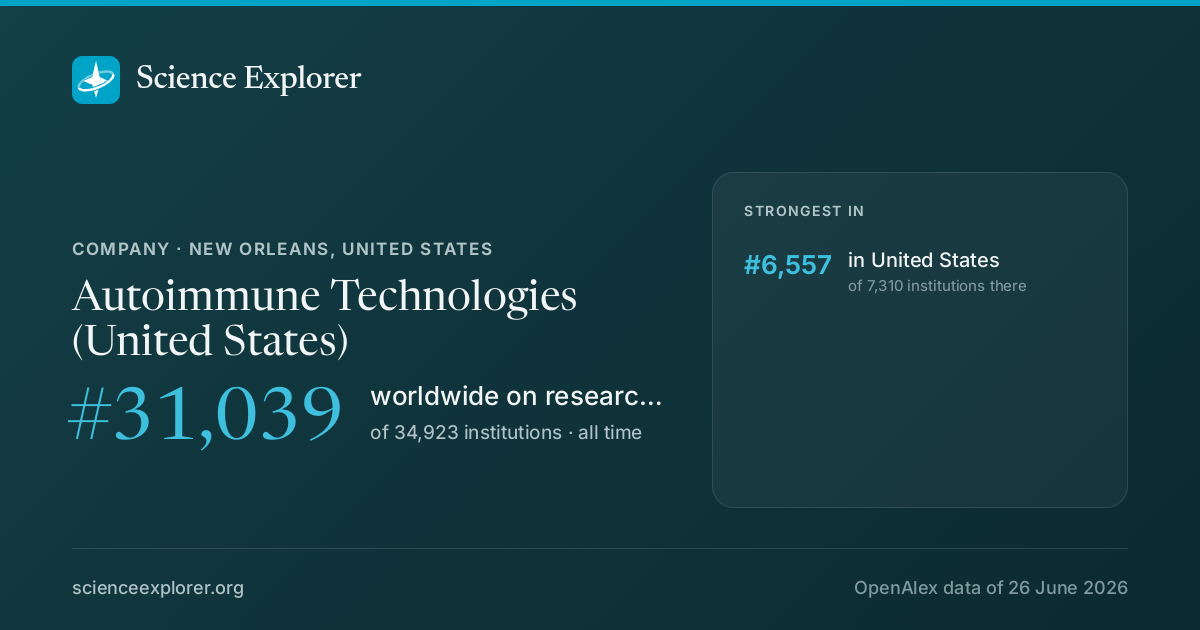
Autoimmune Technologies (United States) on Science Explorer

A card with Autoimmune Technologies (United States)'s standing and the fields it leads in, for a post or a slide. A link to this page previews as the same card.

Download the card

1200 × 630 PNG, sized for social posts, drawn from the latest snapshot.

Badges for a website1Each links back here and updates with every snapshot

Research measures only: rankings here say nothing about teaching, admissions or student experience. Comparable institutions and collaboration partners have tabs of their own, above.

Discussion

Ask a question or share a note about Autoimmune Technologies (United States). Posts are plain text and can be reported.