Science Explorer Back to mapMap
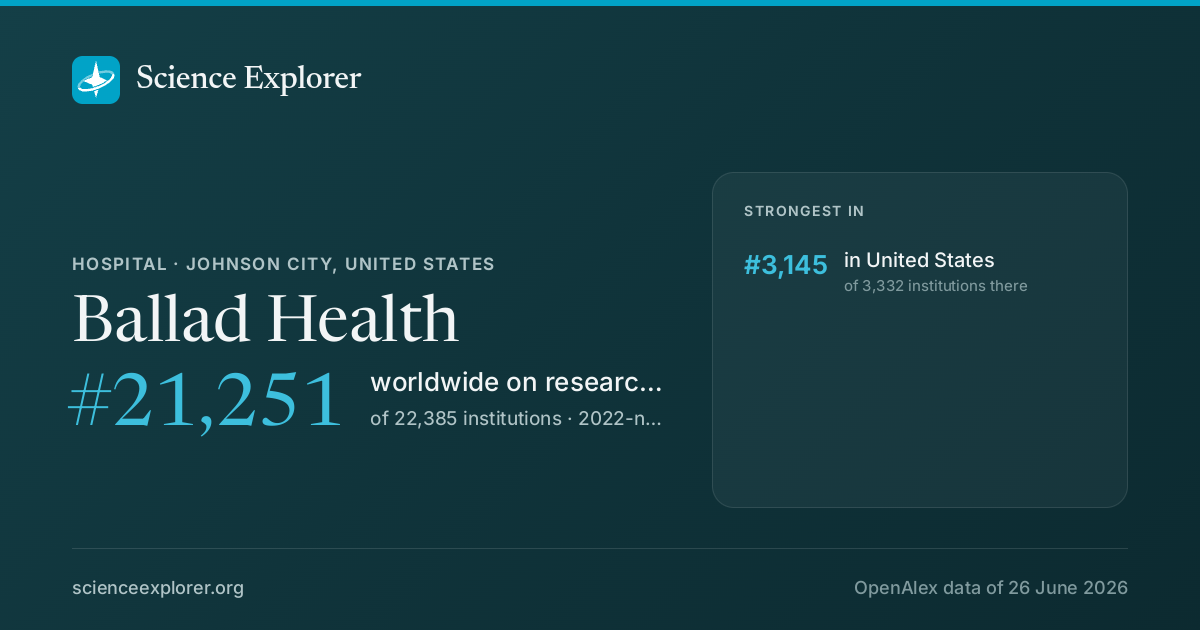
Hospital / health system · Johnson City · United States

Ballad Health

World rank, 2022-now
#21,251
of 22,385 · #31,423 all time
Rank in United States
#3,145
of 3,332
Research works
152
▲ 129% vs 2018-21
Citations
862
5.7 per fractional work
Top-10% rate
7.4%
all institutions 10.0%
vs its own fields
0.93×
1.00× is exactly expected
Open access
47%
world 40%
International
16%
world 18%

Which fields of science does Ballad Health work in?

In 2022-now, 66% of research at Ballad Health is in Health Sciences, 16% in Physical Sciences. Its largest fields are Medicine (49%), Health Professions (14%), Engineering (8%). It does 2.6× the world's share of Health Sciences.

Health Sciences: 51 fractional works · 66.0% of its workMedicine: 38 fractional works · 49.3% of its workSurgery: 5 fractional works · 6.6% of its workPulmonary and Respiratory Medicine: 4 fractional works · 5.2% of its workEmergency Medicine: 4 fractional works · 5.1% of its workCardiology and Cardiovascular Medicine: 4 fractional works · 4.6% of its workPublic Health, Environmental and Occupational Health: 4 fractional works · 4.6% of its workPediatrics, Perinatology and Child Health: 3 fractional works · 3.4% of its workEpidemiology: 2 fractional works · 2.8% of its workOncology: 1 fractional works · 1.8% of its workEndocrinology, Diabetes and Metabolism: 1 fractional works · 1.4% of its workPsychiatry and Mental health: 1 fractional works · 1.3% of its workNeurology: 1 fractional works · 1.3% of its workInternal Medicine: 1 fractional works · 1.1% of its workRheumatology: 1 fractional works · 1.1% of its workObstetrics and Gynecology: 1 fractional works · 1.0% of its workComplementary and alternative medicine: 1 fractional works · 0.8% of its workCritical Care and Intensive Care Medicine: 1 fractional works · 0.8% of its workOrthopedics and Sports Medicine: 1 fractional works · 0.7% of its workPhysiology: 1 fractional works · 0.7% of its workInfectious Diseases: 0 fractional works · 0.5% of its workPharmacology: 0 fractional works · 0.4% of its workDermatology: 0 fractional works · 0.4% of its workNephrology: 0 fractional works · 0.4% of its workAnesthesiology and Pain Medicine: 0 fractional works · 0.4% of its workRadiology, Nuclear Medicine and Imaging: 0 fractional works · 0.4% of its workHepatology: 0 fractional works · 0.4% of its workHematology: 0 fractional works · 0.3% of its workPathology and Forensic Medicine: 0 fractional works · 0.2% of its workTransplantation: 0 fractional works · 0.2% of its workUrology: 0 fractional works · 0.2% of its workSmaller subfields together: 1 fractional works · 1.2% of its workHealth Professions: 11 fractional works · 14.2% of its workGeneral Health Professions: 5 fractional works · 6.0% of its workHealth Information Management: 2 fractional works · 2.7% of its workEmergency Medical Services: 1 fractional works · 1.4% of its workPhysical Therapy, Sports Therapy and Rehabilitation: 1 fractional works · 1.2% of its workOccupational Therapy: 1 fractional works · 0.9% of its workRadiological and Ultrasound Technology: 1 fractional works · 0.8% of its workSpeech and Hearing: 1 fractional works · 0.7% of its workMedical Terminology: 0 fractional works · 0.4% of its workNursing: 2 fractional works · 2.1% of its workIssues, ethics and legal aspects: 1 fractional works · 1.1% of its workNutrition and Dietetics: 0 fractional works · 0.6% of its workResearch and Theory: 0 fractional works · 0.4% of its workDentistry: 0 fractional works · 0.4% of its workPeriodontics: 0 fractional works · 0.4% of its workPhysical Sciences: 13 fractional works · 16.4% of its workEngineering: 6 fractional works · 7.6% of its workBiomedical Engineering: 2 fractional works · 2.1% of its workElectrical and Electronic Engineering: 1 fractional works · 1.4% of its workSafety, Risk, Reliability and Quality: 1 fractional works · 1.0% of its workControl and Systems Engineering: 1 fractional works · 0.9% of its workMechanical Engineering: 1 fractional works · 0.9% of its workCivil and Structural Engineering: 1 fractional works · 0.8% of its workComputational Mechanics: 0 fractional works · 0.4% of its workAutomotive Engineering: 0 fractional works · 0.2% of its workChemistry: 2 fractional works · 2.9% of its workOrganic Chemistry: 1 fractional works · 1.3% of its workSpectroscopy: 1 fractional works · 1.3% of its workSmaller subfields together: 0 fractional works · 0.3% of its workEnvironmental Science: 1 fractional works · 1.4% of its workManagement, Monitoring, Policy and Law: 1 fractional works · 1.0% of its workIndustrial and Manufacturing Engineering: 0 fractional works · 0.2% of its workPollution: 0 fractional works · 0.2% of its workComputer Science: 1 fractional works · 1.1% of its workComputer Vision and Pattern Recognition: 0 fractional works · 0.7% of its workComputer Networks and Communications: 0 fractional works · 0.3% of its workSmaller subfields together: 0 fractional works · 0.1% of its workMaterials Science: 1 fractional works · 1.1% of its workMaterials Chemistry: 0 fractional works · 0.7% of its workBiomaterials: 0 fractional works · 0.2% of its workPolymers and Plastics: 0 fractional works · 0.2% of its workPhysics and Astronomy: 1 fractional works · 0.9% of its workStatistical and Nonlinear Physics: 1 fractional works · 0.9% of its workEnergy: 0 fractional works · 0.7% of its workRenewable Energy, Sustainability and the Environment: 0 fractional works · 0.7% of its workChemical Engineering: 0 fractional works · 0.4% of its workFluid Flow and Transfer Processes: 0 fractional works · 0.2% of its workProcess Chemistry and Technology: 0 fractional works · 0.2% of its workMathematics: 0 fractional works · 0.3% of its workStatistics and Probability: 0 fractional works · 0.3% of its workSocial Sciences: 9 fractional works · 11.3% of its workPsychology: 4 fractional works · 4.9% of its workClinical Psychology: 3 fractional works · 3.4% of its workSocial Psychology: 1 fractional works · 0.8% of its workDevelopmental and Educational Psychology: 1 fractional works · 0.7% of its workSocial Sciences: 3 fractional works · 4.1% of its workEducation: 1 fractional works · 1.3% of its workSociology and Political Science: 1 fractional works · 1.1% of its workSafety Research: 1 fractional works · 0.9% of its workDemography: 0 fractional works · 0.4% of its workHealth: 0 fractional works · 0.3% of its workSmaller subfields together: 0 fractional works · 0.1% of its workArts and Humanities: 1 fractional works · 1.2% of its workPhilosophy: 0 fractional works · 0.7% of its workReligious studies: 0 fractional works · 0.4% of its workConservation: 0 fractional works · 0.2% of its workEconomics, Econometrics and Finance: 1 fractional works · 0.8% of its workEconomics and Econometrics: 1 fractional works · 0.8% of its workDecision Sciences: 0 fractional works · 0.2% of its workStatistics, Probability and Uncertainty: 0 fractional works · 0.2% of its workLife Sciences: 5 fractional works · 6.3% of its workBiochemistry, Genetics and Molecular Biology: 1 fractional works · 1.8% of its workCancer Research: 0 fractional works · 0.5% of its workGenetics: 0 fractional works · 0.5% of its workMolecular Biology: 0 fractional works · 0.3% of its workCell Biology: 0 fractional works · 0.3% of its workSmaller subfields together: 0 fractional works · 0.2% of its workNeuroscience: 1 fractional works · 1.3% of its workCognitive Neuroscience: 1 fractional works · 0.8% of its workSmaller subfields together: 0 fractional works · 0.6% of its workImmunology and Microbiology: 1 fractional works · 1.3% of its workParasitology: 1 fractional works · 0.9% of its workImmunology: 0 fractional works · 0.3% of its workSmaller subfields together: 0 fractional works · 0.1% of its workAgricultural and Biological Sciences: 1 fractional works · 1.2% of its workFood Science: 1 fractional works · 0.9% of its workSmaller subfields together: 0 fractional works · 0.2% of its workPharmacology, Toxicology and Pharmaceutics: 0 fractional works · 0.7% of its workDrug Discovery: 0 fractional works · 0.4% of its workPharmacology: 0 fractional works · 0.2% of its workALL ITS WORKBallad Health77fractional works, 2022-now
Life Sciences6%Physical Sciences16%Health Sciences66%Social Sciences11%

Each ring splits the one inside it: the four domains of science, their fields, their subfields. Size is fractional works in 2022-now. Every slice is a page; the interactive view zooms down to single topics and colours each by how much more of it this institution does than the world.

Its 4 domains and 23 fields, with their numbers
    1. Medicine3849.3%
    2. Health Professions1114.2%
    3. Nursing22.1%
    4. Dentistry00.4%
    1. Engineering67.6%
    2. Chemistry22.9%
    3. Environmental Science11.4%
    4. Computer Science11.1%
    5. Materials Science11.1%
    6. Physics and Astronomy10.9%
    7. Energy00.7%
    8. Chemical Engineering00.4%
    9. Mathematics00.3%
    1. Psychology44.9%
    2. Social Sciences34.1%
    3. Arts and Humanities11.2%
    4. Economics, Econometrics and Finance10.8%
    5. Decision Sciences00.2%
    1. Biochemistry, Genetics and Molecular Biology11.8%
    2. Neuroscience11.3%
    3. Immunology and Microbiology11.3%
    4. Agricultural and Biological Sciences11.2%
    5. Pharmacology, Toxicology and Pharmaceutics00.7%
All of science, and how each field's share has moved since 1950: the Science domain explorer

Field profile

Location quotient across every field it publishes in: outside the ring is more than an institution of this size would be expected to publish, inside it is less.

Agricultural and Biological Sciences: 0.25× its world share, 1 worksAgricultural and Bio…Biochemistry, Genetics and Molecular Biology: 0.34× its world share, 1 worksBiochemistry, Geneti…Immunology and Microbiology: 1.30× its world share, 1 worksImmunology and Micro…Neuroscience: 0.83× its world share, 1 worksNeurosciencePharmacology, Toxicology and Pharmaceutics: 1.85× its world share, 0 worksPharmacology, Toxico…Chemical Engineering: 1.24× its world share, 0 worksChemical EngineeringChemistry: 1.85× its world share, 2 worksChemistryComputer Science: 0.14× its world share, 1 worksComputer ScienceEnergy: 0.71× its world share, 0 worksEnergyEngineering: 0.51× its world share, 6 worksEngineeringEnvironmental Science: 0.29× its world share, 1 worksEnvironmental ScienceMaterials Science: 0.31× its world share, 1 worksMaterials ScienceMathematics: 0.25× its world share, 0 worksMathematicsPhysics and Astronomy: 0.39× its world share, 1 worksPhysics and AstronomyDentistry: 0.90× its world share, 0 worksDentistryHealth Professions: 5.37× its world share, 11 worksHealth ProfessionsMedicine: 2.56× its world share, 38 worksMedicineNursing: 4.29× its world share, 2 worksNursingArts and Humanities: 0.43× its world share, 1 worksArts and HumanitiesDecision Sciences: 0.23× its world share, 0 worksDecision SciencesEconomics, Econometrics and Finance: 0.39× its world share, 1 worksEconomics, Econometr…Psychology: 1.61× its world share, 4 worksPsychologySocial Sciences: 0.33× its world share, 3 worksSocial Sciences1×world share
more than its size predictsabout as predictedless

Rings at 0.5×, 1× and 2×. Widest outward: Health Professions, 5.4×. Every wedge is a field page.

All 23 fields, with their numbers
  1. Health Professions5.37×11 works
  2. Nursing4.29×2 works
  3. Medicine2.56×38 works
  4. Pharmacology, Toxicology and Pharmaceutics1.85×0 works
  5. Chemistry1.85×2 works
  6. Psychology1.61×4 works
  7. Immunology and Microbiology1.30×1 works
  8. Chemical Engineering1.24×0 works
  9. Dentistry0.90×0 works
  10. Neuroscience0.83×1 works
  11. Energy0.71×0 works
  12. Engineering0.51×6 works
  13. Arts and Humanities0.43×1 works
  14. Physics and Astronomy0.39×1 works
  15. Economics, Econometrics and Finance0.39×1 works
  16. Biochemistry, Genetics and Molecular Biology0.34×1 works
  17. Social Sciences0.33×3 works
  18. Materials Science0.31×1 works
  19. Environmental Science0.29×1 works
  20. Agricultural and Biological Sciences0.25×1 works
  21. Mathematics0.25×0 works
  22. Decision Sciences0.23×0 works
  23. Computer Science0.14×1 works

Who are the top researchers at Ballad Health?

Ranked on the quality score, Chris Metzger lead among researchers whose main affiliation is Ballad Health.

  1. 1 Chris Metzger United States · #1,737,147 worldwide 601 citations · 25 works
All ranked researchers at Ballad Health

What are the most cited papers from Ballad Health?

The most cited paper from Ballad Health is "Platelet reactivity and clinical outcomes after coronary artery implantation of drug-eluting stents (ADAPT-DES): a prospective multicentre registry study" (Gregg W. Stone, Bernhard Witzenbichler, Giora Weisz et al., 2013), with 863 citations. Next come "Incidence, Predictors, and Impact of Post-Discharge Bleeding After Percutaneous Coronary Intervention" (456) and "Nonculprit Plaques in Patients With Acute Coronary Syndromes Have More Vulnerable Features Compared With Those With Non–Acute Coronary Syndromes" (237).

Most cited papers
#PaperReleasedCitations
1 Platelet reactivity and clinical outcomes after coronary artery implantation of drug-eluting stents (ADAPT-DES): a prospective multicentre registry study Gregg W. Stone, Bernhard Witzenbichler, Giora Weisz et al. · The Lancet 25 Jul 2013 863
2 Incidence, Predictors, and Impact of Post-Discharge Bleeding After Percutaneous Coronary Intervention Philippe Généreux, Gennaro Giustino, Bernhard Witzenbichler et al. · Journal of the American College of Cardiology Open access 24 Aug 2015 456
3 Nonculprit Plaques in Patients With Acute Coronary Syndromes Have More Vulnerable Features Compared With Those With Non–Acute Coronary Syndromes Koji Kato, Taishi Yonetsu, Soo–Joong Kim et al. · Circulation Cardiovascular Imaging 8 Jun 2012 237
4 Long-Term Clinical Effectiveness of a Drug-Coated Balloon for the Treatment of Femoropopliteal Lesions John A. Laird, Peter A. Schneider, Michael R. Jaff et al. · Circulation Cardiovascular Interventions Open access Jun 2019 186
5 Blinded outcomes and angina assessment of coronary bioresorbable scaffolds: 30-day and 1-year results from the ABSORB IV randomised trial Gregg W. Stone, Stephen G. Ellis, Tommaso Gori et al. · The Lancet 25 Sep 2018 142
All 61 most cited papers, with filters and sorting

Which keywords describe research at Ballad Health?

By fractional works in 2022-now, weighted toward what it does more of than the world: Mortality, Epidemiology, Quality Improvement, Risk Factors, Health Outcomes, Injury Severity, Guidelines and Prehospital Care.

▲ more of its work than of the world's◆ about the world's share▼ less than the world's

Size is fractional works in 2022-now in the topics tagged with each word; colour is the word's share of this institution's work against its share of the world's. The 40 words are chosen for being large and distinctive. Each links to the topic it comes from most.

All 40 words, with their numbers
  1. Epidemiology7▲ 2.2×31 topics
  2. Mortality4▲ 9.3×8 topics
  3. Risk Factors4▲ 4.4×12 topics
  4. Quality Improvement4▲ 24×4 topics
  5. Public Health3▲ 2.5×10 topics
  6. Health Outcomes3▲ 13×4 topics
  7. Guidelines2▲ 6.8×9 topics
  8. Injury Severity2▲ 40×2 topics
  9. Quality of Life2▲ 2.2×15 topics
  10. Prehospital Care2▲ 72×1 topic
  11. Trauma Center2▲ 72×1 topic
  12. Coping Strategies2▲ 11×4 topics
  13. Mental Health2▲ 1.98×10 topics
  14. Diagnosis2▲ 2.6×9 topics
  15. Patient Satisfaction2▲ 7.6×6 topics
  16. Clinical Outcomes2▲ 10×5 topics
  17. Pain Management2▲ 9.7×6 topics
  18. Complications2▲ 4.1×8 topics
  19. Global Burden2▲ 3.9×3 topics
  20. Resuscitation2▲ 16×3 topics
  21. Clinical Practice Guidelines2▲ 3.7×7 topics
  22. Nutrition2▲ 4.4×2 topics
  23. Patient Outcomes2▲ 32×3 topics
  24. Resilience2▲ 4.0×2 topics
  25. Trauma1▲ 8.3×5 topics
  26. Deep Vein Thrombosis1▲ 20×2 topics
  27. Echocardiography1▲ 5.8×4 topics
  28. Electronic Health Records1▲ 15×2 topics
  29. Health Research1▲ 14×1 topic
  30. Ischemic Stroke1▲ 10×2 topics
  31. Nursing1▲ 8.1×1 topic
  32. Percutaneous Coronary Intervention1▲ 11×4 topics
  33. Health Policy1▲ 9.5×2 topics
  34. Injury Prevention1▲ 11×3 topics
  35. Revascularization1▲ 9.0×2 topics
  36. Vibration Control1▲ 22×2 topics
  37. Caregiver Well-Being1▲ 25×1 topic
  38. Chiral Separation1▲ 31×1 topic
  39. Liquid Chromatography1▲ 22×1 topic
  40. Parenting Stress1▲ 19×1 topic

Which research topics does Ballad Health publish most on?

By volume in 2022-now: Trauma and Emergency Care Studies, Methodologies in Health Research and Practice, Analytical Chemistry and Chromatography and Family and Disability Support Research.

  1. 1 Trauma and Emergency Care Studies Emergency Medicine 2 works
  2. 2 Methodologies in Health Research and Practice Health Information Management 1 works
  3. 3 Analytical Chemistry and Chromatography Spectroscopy 1 works
  4. 4 Family and Disability Support Research Clinical Psychology 1 works
  5. 5 Acoustic Wave Phenomena Research Biomedical Engineering 1 works
  6. 6 Injury Epidemiology and Prevention Public Health, Environmental and Occupational Health 1 works
  7. 7 Venous Thromboembolism Diagnosis and Management Internal Medicine 1 works
  8. 8 Sports and Physical Education Research Physical Therapy, Sports Therapy and Rehabilitation 1 works
  9. 9 Nursing Diagnosis and Documentation Issues, ethics and legal aspects 1 works
  10. 10 Parasites and Host Interactions Parasitology 1 works

How open and international is its research?

Against the world's own shares: the tick on each track. Both are shares of its output, so they sit on one scale and can be read against each other as well as against the world.

openly available47.2%not open52.8%

World: 40% of research is openly available.

with international co-authors15.8%domestic only84.2%

World: 18% is written across borders.

How has Ballad Health's research output changed?

Output in 2022-2025 was 129% higher than in 2018-2021.

still counting1990200020102020
grewheldshrank

The same series as a ribbon: one cell per year, darker for more. The line above answers how much; this answers when.

Its share of all research

Growing output can still be a shrinking share: all of science grows. This is Ballad Health as a percentage of every work published that year, 0.00034% in 2024.

still counting0.00020%0.00040%Ballad Health0.00026% in 202519801990200020102020

Fractional works of Ballad Health over all fractional works that year. How the balance of science has shifted.

Other research institutions in Johnson City

All research institutions in Johnson City

Share Ballad Health's ranking

Ballad Health on Science Explorer

A card with Ballad Health's standing and the fields it leads in, for a post or a slide. A link to this page previews as the same card.

Download the card

1200 × 630 PNG, sized for social posts, drawn from the latest snapshot.

Badges for a website1Each links back here and updates with every snapshot

Research measures only: rankings here say nothing about teaching, admissions or student experience. Comparable institutions and collaboration partners have tabs of their own, above.

Discussion

Ask a question or share a note about Ballad Health. Keep it to the research: no personal attacks, advertising or links. Any reader can report a post, which collapses it for everyone until it is opened.