Science Explorer Back to mapMap
Discussion
Hospital / health system · Bendigo · Australia

Bendigo Health

In research, Bendigo Health stands highest in Health Sciences (#4,702 of 9,902 worldwide), 2022-now. Relative to its size it is most specialised in Health Professions (Health Professions is 6.5× its share of world research).

World rank, 2022-now
#13,510
of 22,385 · #11,282 all time
Rank in Australia
#151
of 270
Research works
675
▲ 10% vs 2018-21
Citations
10k
15.4 per fractional work
Top-10% rate
8.9%
all institutions 10.0%
vs its own fields
0.98×
1.00× is exactly expected
Open access
38%
world 40%
International
18%
world 18%

What is Bendigo Health known for in research?

The fields where it stands highest, 2022-now, ranked among every institution above the floor in each field.

FieldWorld rankWhere that sitsTop-10% rateWorksAll time
Health SciencesDomain #4,702 of 9,902 9.7%80 #6616

Each strip is that field's whole ranked pool, with the notch where Bendigo Health sits in it, in the colour of the band that rank falls in. The track under the rate is the rate itself: it carries no average mark, because the average differs by field (from about 6% in Dentistry to 21% in Economics).

Which fields of science does Bendigo Health work in?

In 2022-now, 66% of research at Bendigo Health is in Health Sciences, 20% in Social Sciences. Its largest fields are Medicine (44%), Health Professions (17%), Social Sciences (11%). It does 2.7× the world's share of Health Sciences.

Health Sciences: 95 fractional works · 65.7% of its workMedicine: 63 fractional works · 43.5% of its workPublic Health, Environmental and Occupational Health: 10 fractional works · 6.7% of its workSurgery: 9 fractional works · 6.0% of its workCardiology and Cardiovascular Medicine: 6 fractional works · 4.0% of its workPulmonary and Respiratory Medicine: 5 fractional works · 3.5% of its workEpidemiology: 5 fractional works · 3.1% of its workOncology: 3 fractional works · 2.3% of its workPhysiology: 3 fractional works · 1.9% of its workEmergency Medicine: 2 fractional works · 1.4% of its workEndocrinology, Diabetes and Metabolism: 2 fractional works · 1.4% of its workOrthopedics and Sports Medicine: 2 fractional works · 1.3% of its workRadiology, Nuclear Medicine and Imaging: 2 fractional works · 1.2% of its workInfectious Diseases: 2 fractional works · 1.1% of its workPsychiatry and Mental health: 1 fractional works · 0.9% of its workDermatology: 1 fractional works · 0.8% of its workPathology and Forensic Medicine: 1 fractional works · 0.7% of its workRheumatology: 1 fractional works · 0.7% of its workPharmacology: 1 fractional works · 0.7% of its workNeurology: 1 fractional works · 0.6% of its workPediatrics, Perinatology and Child Health: 1 fractional works · 0.5% of its workObstetrics and Gynecology: 1 fractional works · 0.5% of its workHematology: 1 fractional works · 0.5% of its workCritical Care and Intensive Care Medicine: 1 fractional works · 0.5% of its workRehabilitation: 1 fractional works · 0.4% of its workComplementary and alternative medicine: 1 fractional works · 0.4% of its workReproductive Medicine: 1 fractional works · 0.4% of its workUrology: 0 fractional works · 0.3% of its workOtorhinolaryngology: 0 fractional works · 0.3% of its workInternal Medicine: 0 fractional works · 0.3% of its workHealth Informatics: 0 fractional works · 0.3% of its workGeriatrics and Gerontology: 0 fractional works · 0.2% of its workSmaller subfields together: 1 fractional works · 0.6% of its workHealth Professions: 25 fractional works · 17.1% of its workGeneral Health Professions: 14 fractional works · 9.9% of its workEmergency Medical Services: 6 fractional works · 3.9% of its workPhysical Therapy, Sports Therapy and Rehabilitation: 1 fractional works · 0.9% of its workSpeech and Hearing: 1 fractional works · 0.7% of its workHealth Information Management: 1 fractional works · 0.5% of its workOccupational Therapy: 1 fractional works · 0.4% of its workPharmacy: 0 fractional works · 0.3% of its workRadiological and Ultrasound Technology: 0 fractional works · 0.3% of its workMedical Terminology: 0 fractional works · 0.2% of its workDentistry: 5 fractional works · 3.2% of its workPeriodontics: 3 fractional works · 1.8% of its workOral Surgery: 1 fractional works · 0.9% of its workGeneral Dentistry: 1 fractional works · 0.5% of its workNursing: 2 fractional works · 1.2% of its workNutrition and Dietetics: 1 fractional works · 0.7% of its workResearch and Theory: 1 fractional works · 0.5% of its workSmaller subfields together: 0 fractional works · 0.0% of its workVeterinary: 1 fractional works · 0.6% of its workSmall Animals: 1 fractional works · 0.6% of its workSocial Sciences: 29 fractional works · 20.4% of its workSocial Sciences: 17 fractional works · 11.5% of its workSociology and Political Science: 4 fractional works · 2.7% of its workHealth: 3 fractional works · 2.2% of its workPublic Administration: 3 fractional works · 1.8% of its workEducation: 2 fractional works · 1.5% of its workSafety Research: 2 fractional works · 1.4% of its workGender Studies: 2 fractional works · 1.3% of its workDemography: 0 fractional works · 0.2% of its workSmaller subfields together: 0 fractional works · 0.3% of its workPsychology: 8 fractional works · 5.5% of its workClinical Psychology: 4 fractional works · 2.8% of its workSocial Psychology: 2 fractional works · 1.6% of its workApplied Psychology: 1 fractional works · 0.4% of its workDevelopmental and Educational Psychology: 1 fractional works · 0.4% of its workExperimental and Cognitive Psychology: 1 fractional works · 0.4% of its workEconomics, Econometrics and Finance: 2 fractional works · 1.4% of its workEconomics and Econometrics: 2 fractional works · 1.3% of its workSmaller subfields together: 0 fractional works · 0.2% of its workArts and Humanities: 1 fractional works · 0.9% of its workBusiness, Management and Accounting: 1 fractional works · 0.7% of its workOrganizational Behavior and Human Resource Management: 1 fractional works · 0.4% of its workSmaller subfields together: 0 fractional works · 0.3% of its workDecision Sciences: 1 fractional works · 0.5% of its workLife Sciences: 11 fractional works · 7.8% of its workBiochemistry, Genetics and Molecular Biology: 4 fractional works · 2.7% of its workGenetics: 2 fractional works · 1.2% of its workMolecular Biology: 1 fractional works · 0.9% of its workCancer Research: 0 fractional works · 0.3% of its workSmaller subfields together: 0 fractional works · 0.3% of its workAgricultural and Biological Sciences: 3 fractional works · 2.3% of its workPlant Science: 1 fractional works · 0.8% of its workGeneral Agricultural and Biological Sciences: 1 fractional works · 0.7% of its workAgronomy and Crop Science: 0 fractional works · 0.3% of its workFood Science: 0 fractional works · 0.3% of its workSmaller subfields together: 0 fractional works · 0.2% of its workNeuroscience: 2 fractional works · 1.2% of its workCognitive Neuroscience: 1 fractional works · 0.7% of its workEndocrine and Autonomic Systems: 1 fractional works · 0.4% of its workSmaller subfields together: 0 fractional works · 0.2% of its workImmunology and Microbiology: 2 fractional works · 1.2% of its workMicrobiology: 1 fractional works · 0.5% of its workImmunology: 1 fractional works · 0.4% of its workParasitology: 0 fractional works · 0.3% of its workPharmacology, Toxicology and Pharmaceutics: 1 fractional works · 0.4% of its workToxicology: 0 fractional works · 0.3% of its workSmaller subfields together: 0 fractional works · 0.1% of its workPhysical Sciences: 9 fractional works · 6.2% of its workEnvironmental Science: 3 fractional works · 2.3% of its workManagement, Monitoring, Policy and Law: 1 fractional works · 0.4% of its workEcology: 0 fractional works · 0.3% of its workHealth, Toxicology and Mutagenesis: 0 fractional works · 0.3% of its workEnvironmental Chemistry: 0 fractional works · 0.3% of its workEnvironmental Engineering: 0 fractional works · 0.2% of its workSmaller subfields together: 1 fractional works · 0.8% of its workEngineering: 3 fractional works · 2.2% of its workCivil and Structural Engineering: 1 fractional works · 0.9% of its workBiomedical Engineering: 1 fractional works · 0.8% of its workMechanical Engineering: 0 fractional works · 0.2% of its workSmaller subfields together: 0 fractional works · 0.2% of its workComputer Science: 1 fractional works · 0.8% of its workArtificial Intelligence: 1 fractional works · 0.5% of its workSmaller subfields together: 0 fractional works · 0.3% of its workMathematics: 1 fractional works · 0.4% of its workPhysics and Astronomy: 0 fractional works · 0.3% of its workEarth and Planetary Sciences: 0 fractional works · 0.2% of its workALL ITS WORKBendigo Health144fractional works, 2022-now
Life Sciences8%Physical Sciences6%Health Sciences66%Social Sciences20%

Each ring splits the one inside it: the four domains of science, their fields, their subfields. Size is fractional works in 2022-now. Every slice is a page; the interactive view zooms down to single topics and colours each by how much more of it this institution does than the world.

Its 4 domains and 22 fields, with their numbers
    1. Medicine6343.5%
    2. Health Professions2517.1%
    3. Dentistry53.2%
    4. Nursing21.2%
    5. Veterinary10.6%
    1. Social Sciences1711.5%
    2. Psychology85.5%
    3. Economics, Econometrics and Finance21.4%
    4. Arts and Humanities10.9%
    5. Business, Management and Accounting10.7%
    6. Decision Sciences10.5%
    1. Biochemistry, Genetics and Molecular Biology42.7%
    2. Agricultural and Biological Sciences32.3%
    3. Neuroscience21.2%
    4. Immunology and Microbiology21.2%
    5. Pharmacology, Toxicology and Pharmaceutics10.4%
    1. Environmental Science32.3%
    2. Engineering32.2%
    3. Computer Science10.8%
    4. Mathematics10.4%
    5. Physics and Astronomy00.3%
    6. Earth and Planetary Sciences00.2%
All of science, and how each field's share has moved since 1950: the Science domain explorer

What does Bendigo Health specialise in?

Where its research is concentrated relative to its size: Health Professions takes 6.5× the share of its output that it takes of world research.

  1. Health ProfessionsField · 24.7 works6.5×
← less than its size predicts1×more →

Location quotient, a volume reading rather than an impact one. It surfaces small, lopsided specialities.

Field profile

Location quotient across every field it publishes in: outside the ring is more than an institution of this size would be expected to publish, inside it is less.

Agricultural and Biological Sciences: 0.49× its world share, 3 worksAgricultural and Bio…Biochemistry, Genetics and Molecular Biology: 0.50× its world share, 4 worksBiochemistry, Geneti…Immunology and Microbiology: 1.14× its world share, 2 worksImmunology and Micro…Neuroscience: 0.75× its world share, 2 worksNeurosciencePharmacology, Toxicology and Pharmaceutics: 1.12× its world share, 1 worksPharmacology, Toxico…Computer Science: 0.10× its world share, 1 worksComputer ScienceEarth and Planetary Sciences: 0.15× its world share, 0 worksEarth and Planetary …Engineering: 0.15× its world share, 3 worksEngineeringEnvironmental Science: 0.46× its world share, 3 worksEnvironmental ScienceMathematics: 0.37× its world share, 1 worksMathematicsPhysics and Astronomy: 0.13× its world share, 0 worksPhysics and AstronomyDentistry: 6.57× its world share, 5 worksDentistryHealth Professions: 6.51× its world share, 25 worksHealth ProfessionsMedicine: 2.26× its world share, 63 worksMedicineNursing: 2.53× its world share, 2 worksNursingVeterinary: 4.19× its world share, 1 worksVeterinaryArts and Humanities: 0.30× its world share, 1 worksArts and HumanitiesBusiness, Management and Accounting: 0.20× its world share, 1 worksBusiness, Management…Decision Sciences: 0.48× its world share, 1 worksDecision SciencesEconomics, Econometrics and Finance: 0.66× its world share, 2 worksEconomics, Econometr…Psychology: 1.80× its world share, 8 worksPsychologySocial Sciences: 0.91× its world share, 16 worksSocial Sciences1×world share
more than its size predictsabout as predictedless

Rings at 0.5×, 1× and 2×. Widest outward: Dentistry, 6.6×. Every wedge is a field page.

All 22 fields, with their numbers
  1. Dentistry6.57×5 works
  2. Health Professions6.51×25 works
  3. Veterinary4.19×1 works
  4. Nursing2.53×2 works
  5. Medicine2.26×63 works
  6. Psychology1.80×8 works
  7. Immunology and Microbiology1.14×2 works
  8. Pharmacology, Toxicology and Pharmaceutics1.12×1 works
  9. Social Sciences0.91×16 works
  10. Neuroscience0.75×2 works
  11. Economics, Econometrics and Finance0.66×2 works
  12. Biochemistry, Genetics and Molecular Biology0.50×4 works
  13. Agricultural and Biological Sciences0.49×3 works
  14. Decision Sciences0.48×1 works
  15. Environmental Science0.46×3 works
  16. Mathematics0.37×1 works
  17. Arts and Humanities0.30×1 works
  18. Business, Management and Accounting0.20×1 works
  19. Earth and Planetary Sciences0.15×0 works
  20. Engineering0.15×3 works
  21. Physics and Astronomy0.13×0 works
  22. Computer Science0.10×1 works

Who are the top researchers at Bendigo Health?

Ranked on the quality score, Caitlin Fraser, Sam Harris and John Edington lead among researchers whose main affiliation is Bendigo Health.

  1. 1 Caitlin Fraser Australia · #767,938 worldwide 1.8k citations · 25 works
  2. 2 Sam Harris Australia · #1,199,674 worldwide 1.5k citations · 40 works
  3. 3 John Edington Australia · #1,736,536 worldwide 875 citations · 16 works
  4. 4 Neil Barr Australia · #1,773,086 worldwide 2.2k citations · 49 works
  5. 5 Chun Hin Angus Lee Australia · #2,042,951 worldwide 386 citations · 29 works
  6. 6 Voltaire Nadurata Australia · #2,866,670 worldwide 618 citations · 64 works
  7. 7 Dane Loder Halliwell Australia · #3,107,125 worldwide 2 citations · 19 works
  8. 8 Marc Cohn Australia · #3,215,134 worldwide 17 citations · 28 works
  9. 9 Angela Crombie Australia · #3,285,034 worldwide 173 citations · 18 works
  10. 10 Kevin Masman Australia · #3,335,668 worldwide 241 citations · 19 works
All ranked researchers at Bendigo Health

What are the most cited papers from Bendigo Health?

The most cited paper from Bendigo Health is "Understanding and promoting adoption of conservation practices by rural landholders" (David J. Pannell, Graham R. Marshall, Neil Barr et al., 2006), with 1,478 citations. Next come "Circulating Tumor DNA Analysis Guiding Adjuvant Therapy in Stage II Colon Cancer" (1,076) and "Addressing the health disadvantage of rural populations: How does epidemiological evidence inform rural health policies and research?" (616).

Most cited papers
#PaperReleasedCitations
1 Understanding and promoting adoption of conservation practices by rural landholders David J. Pannell, Graham R. Marshall, Neil Barr et al. · Australian Journal of Experimental Agriculture Open access 9 Oct 2006 1,478
2 Circulating Tumor DNA Analysis Guiding Adjuvant Therapy in Stage II Colon Cancer Jeanne Tie et al. · New England Journal of Medicine Open access 4 Jun 2022 1,076
3 Addressing the health disadvantage of rural populations: How does epidemiological evidence inform rural health policies and research? Karly B. Smith, John Stirling Humphreys, M. G. A. Wilson · Australian Journal of Rural Health 4 Mar 2008 616
4 N-Acetyl Cysteine as a Glutathione Precursor for Schizophrenia—A Double-Blind, Randomized, Placebo-Controlled Trial Michael Berk, David Copolov, Olivia May Dean et al. · Biological Psychiatry Open access 24 Apr 2008 550
5 Portfolios and assessment of competence: a review of the literature Mirjam McMullan, Ruth Endacott, Morag Gray et al. · Journal of Advanced Nursing Open access Feb 2003 511
All 60 most cited papers, with filters and sorting

Which keywords describe research at Bendigo Health?

By fractional works in 2022-now, weighted toward what it does more of than the world: Epidemiology, Quality of Life, Job Satisfaction, Health Workforce, Primary Care, Public Health, Health Policy and Global Health.

▲ more of its work than of the world's◆ about the world's share▼ less than the world's

Size is fractional works in 2022-now in the topics tagged with each word; colour is the word's share of this institution's work against its share of the world's. The 40 words are chosen for being large and distinctive. Each links to the topic it comes from most.

All 40 words, with their numbers
  1. Epidemiology15▲ 2.6×64 topics
  2. Quality of Life8▲ 4.0×30 topics
  3. Public Health8▲ 3.6×24 topics
  4. Mental Health7▲ 3.4×20 topics
  5. Risk Factors6▲ 3.7×19 topics
  6. Job Satisfaction6▲ 9.0×8 topics
  7. Health Workforce6▲ 94×2 topics
  8. Primary Care5▲ 10×10 topics
  9. Health Policy5▲ 23×2 topics
  10. Global Health5▲ 23×4 topics
  11. Physician Migration5▲ 113×1 topic
  12. Rural Health5▲ 113×1 topic
  13. Depression4▲ 3.5×12 topics
  14. Chronic Disease Management4▲ 15×5 topics
  15. Evidence-Based Practice4▲ 21×4 topics
  16. COVID-194▲ 2.1×8 topics
  17. Reflective Practice4▲ 15×4 topics
  18. Social Justice4▲ 4.7×10 topics
  19. Burnout4▲ 30×5 topics
  20. Cultural Competence4▲ 20×4 topics
  21. Physical Activity3▲ 4.9×6 topics
  22. Patient Satisfaction3▲ 7.4×7 topics
  23. Prevention3▲ 5.5×11 topics
  24. Guidelines3▲ 4.7×10 topics
  25. Prevalence3▲ 5.4×9 topics
  26. Stress3▲ 6.1×5 topics
  27. Child Welfare3▲ 59×2 topics
  28. Health Equity3▲ 6.8×5 topics
  29. Mortality3▲ 3.5×8 topics
  30. Professional Development3▲ 9.3×2 topics
  31. Anxiety3▲ 4.0×6 topics
  32. Ethical Considerations3▲ 5.3×10 topics
  33. Health Promotion3▲ 5.7×6 topics
  34. Retention3▲ 109×1 topic
  35. Supervision3▲ 59×1 topic
  36. Patient Engagement2▲ 12×2 topics
  37. Behavior Change2▲ 9.7×2 topics
  38. Collaborative Practice2▲ 36×2 topics
  39. Dental Caries2▲ 15×2 topics
  40. Patient Care2▲ 12×2 topics

Which research topics does Bendigo Health publish most on?

By volume in 2022-now: Global Health Workforce Issues, Social Work Education and Practice, Telemedicine and Telehealth Implementation and Dental Health and Care Utilization.

  1. 1 Global Health Workforce Issues Emergency Medical Services 5 works
  2. 2 Social Work Education and Practice Public Administration 3 works
  3. 3 Telemedicine and Telehealth Implementation Public Health, Environmental and Occupational Health 2 works
  4. 4 Dental Health and Care Utilization Periodontics 1 works
  5. 5 Physical Activity and Health Physiology 1 works
  6. 6 Mobile Health and mHealth Applications General Health Professions 1 works
  7. 7 Primary Care and Health Outcomes General Health Professions 1 works
  8. 8 Interprofessional Education and Collaboration General Health Professions 1 works
  9. 9 Public Health Policies and Education General Health Professions 1 works
  10. 10 Diversity and Career in Medicine Gender Studies 1 works

How open and international is its research?

Against the world's own shares: the tick on each track. Both are shares of its output, so they sit on one scale and can be read against each other as well as against the world.

openly available38.4%not open61.6%

World: 40% of research is openly available.

with international co-authors18.1%domestic only81.9%

World: 18% is written across borders.

How has Bendigo Health's research output changed?

Output in 2022-2025 was 10% higher than in 2018-2021.

still counting1990200020102020
grewheldshrank

The same series as a ribbon: one cell per year, darker for more. The line above answers how much; this answers when.

Its share of all research

Growing output can still be a shrinking share: all of science grows. This is Bendigo Health as a percentage of every work published that year, 0.00052% in 2024.

still counting0.0010%0.0020%0.0030%Bendigo Health0.00062% in 202519801990200020102020

Fractional works of Bendigo Health over all fractional works that year. How the balance of science has shifted.

How much of it reaches the world top 10%

Year by year, against all institutions in the same year.

still counting5%10%15%all institutions10.0% in 2025Bendigo Health8.8% in 20252020

Of each year's output, the share that reached the world's 10% most cited for its field and year. Peak 14.3% in 2020.

Other research institutions in Bendigo

All research institutions in Bendigo

Share Bendigo Health's ranking
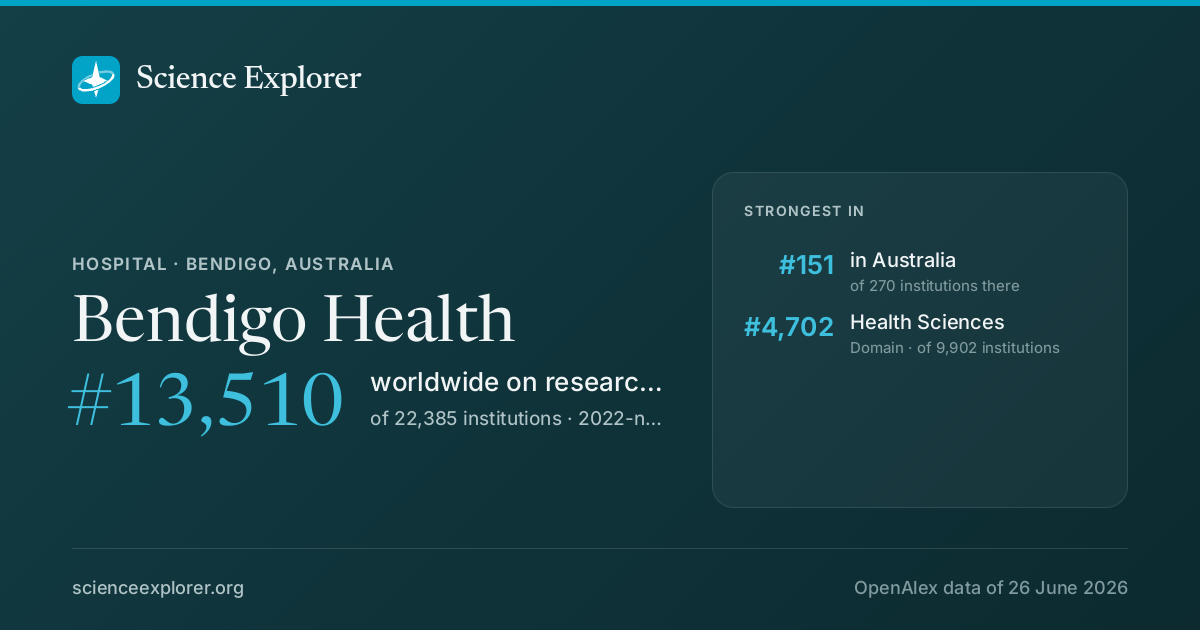
Bendigo Health on Science Explorer

A card with Bendigo Health's standing and the fields it leads in, for a post or a slide. A link to this page previews as the same card.

Download the card

1200 × 630 PNG, sized for social posts, drawn from the latest snapshot.

Badges for a website1Each links back here and updates with every snapshot

Research measures only: rankings here say nothing about teaching, admissions or student experience. Comparable institutions and collaboration partners have tabs of their own, above.

Discussion

Ask a question or share a note about Bendigo Health. Posts are plain text and can be reported.