
- World rank, all time
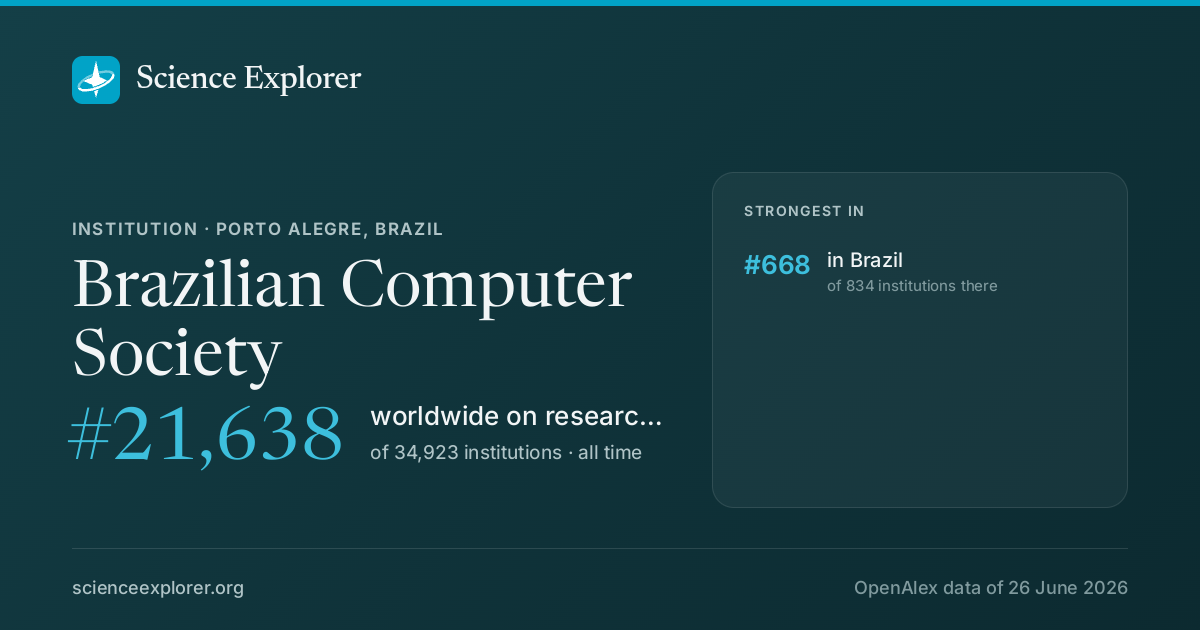
- #21,638 of 34,923
- Rank in Brazil
- #668 of 834
- Research works
- 223 ◆ 1% vs 2018-21
- Citations
- 1.7k 7.6 per fractional work
- Top-10% rate
- 9.0% all institutions 10.0%
- vs its own fields
- 0.91× 1.00× is exactly expected
- Open access
- 60% world 40%
- International
- 28% world 18%
Which fields of science does Brazilian Computer Society work in?
In 2022-now, 41% of research at Brazilian Computer Society is in Health Sciences, 25% in Physical Sciences. Its largest fields are Medicine (29%), Computer Science (9%), Health Professions (9%). It does 1.6× the world's share of Health Sciences.
Each ring splits the one inside it: the four domains of science, their fields, their subfields. Size is fractional works in 2022-now. Every slice is a page; the interactive view zooms down to single topics and colours each by how much more of it this institution does than the world.
Its 4 domains and 22 fields, with their numbers
- Health Sciences2541.1%
- Medicine1828.8%
- Health Professions58.6%
- Dentistry12.1%
- Nursing11.1%
- Veterinary00.6%
- Physical Sciences1625.1%
- Computer Science69.1%
- Engineering47.2%
- Environmental Science34.4%
- Materials Science12.3%
- Earth and Planetary Sciences11.2%
- Physics and Astronomy00.7%
- Chemistry00.2%
- Social Sciences1523.8%
- Life Sciences69.9%
Field profile
Location quotient across every field it publishes in: outside the ring is more than an institution of this size would be expected to publish, inside it is less.
Rings at 0.5×, 1× and 2×. Widest outward: Dentistry, 4.4×. Every wedge is a field page.
All 22 fields, with their numbers
- Dentistry4.39×1 works
- Veterinary4.35×0 works
- Health Professions3.25×5 works
- Nursing2.21×1 works
- Psychology1.97×4 works
- Business, Management and Accounting1.83×4 works
- Decision Sciences1.77×1 works
- Medicine1.50×18 works
- Immunology and Microbiology1.26×1 works
- Computer Science1.17×6 works
- Agricultural and Biological Sciences1.14×3 works
- Environmental Science0.88×3 works
- Earth and Planetary Sciences0.78×1 works
- Materials Science0.66×1 works
- Social Sciences0.63×5 works
- Economics, Econometrics and Finance0.57×1 works
- Neuroscience0.55×1 works
- Engineering0.48×4 works
- Biochemistry, Genetics and Molecular Biology0.44×1 works
- Physics and Astronomy0.33×0 works
- Arts and Humanities0.32×1 works
- Chemistry0.11×0 works
- Dentistry 4.4×
- Veterinary 4.3×
- Health Professions 3.2×
- Nursing 2.2×
- Psychology 2.0×
- Business, Management and Accounting 1.8×
- Decision Sciences 1.8×
- Medicine 1.5×
- Immunology and Microbiology 1.3×
- Computer Science 1.2×
- Agricultural and Biological Sciences 1.1×
- Environmental Science 0.9×
- Earth and Planetary Sciences 0.8×
- Materials Science 0.7×
- Social Sciences 0.6×
- Economics, Econometrics and Finance 0.6×
- Neuroscience 0.6×
- Engineering 0.5×
- Biochemistry, Genetics and Molecular Biology 0.4×
- Physics and Astronomy 0.3×
- Arts and Humanities 0.3×
- Chemistry 0.1×
Which keywords describe research at Brazilian Computer Society?
By fractional works in 2022-now, weighted toward what it does more of than the world: Quality of Life, Healthcare, Epidemiology, Mental Health, Training, Distance Education, Legislation and Dynamic Capabilities.
- Temporomandibular Disorders
- Diagnostic Criteria
- Patient Satisfaction
- Polymer
- Educational Technology
- Chronic Diseases
- Reconstruction
- Nanocomposites
- Health Policy
- Qualitative Research
- Sustainability
- Knowledge Transfer
- Internet of Things
- Social Capital
- Distance Education
- Depression
- COVID-19
- Public Health
- Mental Health
- Epidemiology
- Quality of Life
- Healthcare
- Machine Learning
- Deep Learning
- Online Learning
- Climate Change
- Legislation
- Training
- Dynamic Capabilities
- Muscle Strength
- Complications
- Agroecology
- Healthcare Access
- Psychological Factors
- Brachial Plexus
- Dielectrics
- Nerve Transfer
- Renewable Energy
- Bruxism
- Strategic Planning
Size is fractional works in 2022-now in the topics tagged with each word; colour is the word's share of this institution's work against its share of the world's. The 40 words are chosen for being large and distinctive. Each links to the topic it comes from most.
All 40 words, with their numbers
- Quality of Life6▲ 6.1×18 topics
- Epidemiology5▲ 1.97×39 topics
- Healthcare4▲ 6.4×9 topics
- Mental Health3▲ 3.1×14 topics
- Machine Learning2◆ 1.08×11 topics
- Public Health2▲ 2.4×9 topics
- Deep Learning2◆ 0.97×11 topics
- COVID-192▲ 2.4×9 topics
- Online Learning2▲ 3.8×3 topics
- Depression2▲ 3.4×10 topics
- Climate Change2◆ 1.04×9 topics
- Distance Education2▲ 14×1 topic
- Legislation2▲ 17×1 topic
- Social Capital2▲ 5.3×4 topics
- Training2▲ 13×2 topics
- Internet of Things2▲ 3.0×4 topics
- Dynamic Capabilities2▲ 69×1 topic
- Knowledge Transfer2▲ 51×1 topic
- Muscle Strength2▲ 22×3 topics
- Sustainability2◆ 1.03×5 topics
- Complications1▲ 4.5×5 topics
- Qualitative Research1▲ 2.6×5 topics
- Agroecology1▲ 15×4 topics
- Health Policy1▲ 14×3 topics
- Healthcare Access1▲ 7.9×3 topics
- Nanocomposites1▲ 2.6×2 topics
- Psychological Factors1▲ 9.9×3 topics
- Reconstruction1▲ 12×2 topics
- Brachial Plexus1▲ 81×1 topic
- Chronic Diseases1▲ 7.4×2 topics
- Dielectrics1▲ 62×1 topic
- Educational Technology1▲ 1.67×4 topics
- Nerve Transfer1▲ 81×1 topic
- Polymer1▲ 27×1 topic
- Renewable Energy1▲ 1.37×4 topics
- Patient Satisfaction1▲ 5.7×3 topics
- Bruxism1▲ 57×1 topic
- Diagnostic Criteria1▲ 7.2×2 topics
- Strategic Planning1▲ 11×2 topics
- Temporomandibular Disorders1▲ 57×1 topic
Which research topics does Brazilian Computer Society publish most on?
By volume in 2022-now: Academic Research in Diverse Fields, Innovation and Knowledge Management, High voltage insulation and dielectric phenomena and Nerve Injury and Rehabilitation.
Area is fractional works; colour is the subfield each topic belongs to.
- 1 Academic Research in Diverse Fields Education 2 works
- 2 Innovation and Knowledge Management Strategy and Management 2 works
- 3 High voltage insulation and dielectric phenomena Materials Chemistry 1 works
- 4 Nerve Injury and Rehabilitation Surgery 1 works
- 5 Temporomandibular Joint Disorders Complementary and Manual Therapy 1 works
- 6 Information Science and Libraries Information Systems 1 works
- 7 Business and Management Studies Information Systems and Management 1 works
- 8 Health, Nursing, Elderly Care General Health Professions 1 works
- 9 Healthcare during COVID-19 Pandemic Information Systems 1 works
- 10 IoT and Edge/Fog Computing Computer Networks and Communications 1 works
How open and international is its research?
Against the world's own shares: the tick on each track. Both are shares of its output, so they sit on one scale and can be read against each other as well as against the world.
World: 40% of research is openly available.
World: 18% is written across borders.
How has Brazilian Computer Society's research output changed?
Output in 2022-2025 was 1% lower than in 2018-2021.
The same series as a ribbon: one cell per year, darker for more. The line above answers how much; this answers when.
Its share of all research
Growing output can still be a shrinking share: all of science grows. This is Brazilian Computer Society as a percentage of every work published that year, 0.00021% in 2024.
Fractional works of Brazilian Computer Society over all fractional works that year. How the balance of science has shifted.
Other research institutions in Porto Alegre
- Universidade Federal do Rio Grande do Sul
- Pontifícia Universidade Católica do Rio Grande do Sul
- Universidade Federal de Ciências da Saúde de Porto Alegre
- Grupo Hospitalar Conceição
- Centro Universitário Metodista IPA
- Hospital Moinhos de Vento
- Fundação Universitária de Cardiologia
- Governo do Estado do Rio Grande do Sul


Share Brazilian Computer Society's ranking
Badges for a website1Each links back here and updates with every snapshot

Research measures only: rankings here say nothing about teaching, admissions or student experience. Comparable institutions and collaboration partners have tabs of their own, above.
Discussion
Ask a question or share a note about Brazilian Computer Society. Posts are plain text and can be reported.