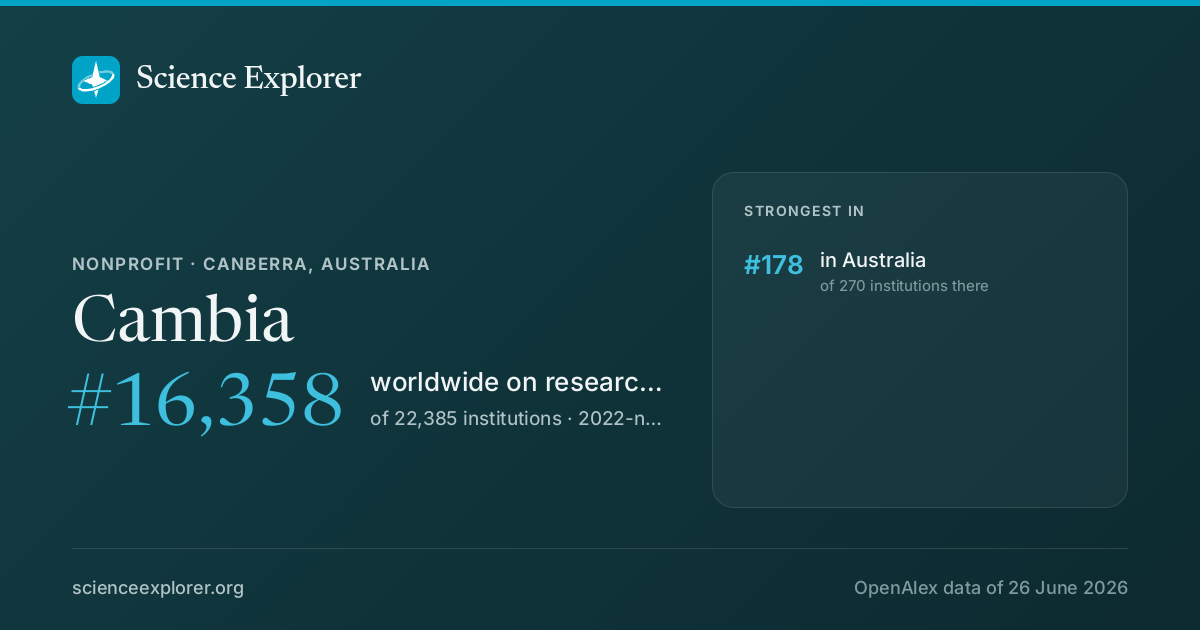
- World rank, 2022-now
- #16,358 of 22,385 · #13,953 all time
- Rank in Australia
- #178 of 270
- Research works
- 317 ▲ 26% vs 2018-21
- Citations
- 5k 15.8 per fractional work
- Top-10% rate
- 9.9% all institutions 10.0%
- vs its own fields
- 1.01× 1.00× is exactly expected
- Open access
- 61% world 40%
- International
- 54% world 18%
Which fields of science does Cambia work in?
In 2022-now, 33% of research at Cambia is in Social Sciences, 31% in Health Sciences. Its largest fields are Medicine (29%), Social Sciences (16%), Environmental Science (10%). It does 1.3× the world's share of Health Sciences.
Each ring splits the one inside it: the four domains of science, their fields, their subfields. Size is fractional works in 2022-now. Every slice is a page; the interactive view zooms down to single topics and colours each by how much more of it this institution does than the world.
Its 4 domains and 22 fields, with their numbers
- Social Sciences2933.3%
- Health Sciences2731.3%
- Medicine2528.7%
- Health Professions22.0%
- Dentistry10.7%
- Physical Sciences2528.2%
- Environmental Science910.3%
- Engineering66.8%
- Computer Science44.6%
- Earth and Planetary Sciences33.1%
- Physics and Astronomy11.7%
- Energy10.9%
- Materials Science00.6%
- Chemistry00.3%
- Life Sciences67.1%
Field profile
Location quotient across every field it publishes in: outside the ring is more than an institution of this size would be expected to publish, inside it is less.
Rings at 0.5×, 1× and 2×. Widest outward: Arts and Humanities, 2.9×. Every wedge is a field page.
All 22 fields, with their numbers
- Arts and Humanities2.92×7 works
- Environmental Science2.07×9 works
- Earth and Planetary Sciences1.97×3 works
- Medicine1.49×25 works
- Dentistry1.44×1 works
- Economics, Econometrics and Finance1.33×2 works
- Social Sciences1.25×14 works
- Psychology1.01×3 works
- Energy0.95×1 works
- Decision Sciences0.95×1 works
- Agricultural and Biological Sciences0.77×3 works
- Physics and Astronomy0.76×2 works
- Health Professions0.74×2 works
- Business, Management and Accounting0.71×2 works
- Neuroscience0.65×1 works
- Computer Science0.60×4 works
- Engineering0.45×6 works
- Biochemistry, Genetics and Molecular Biology0.37×2 works
- Immunology and Microbiology0.34×0 works
- Chemistry0.18×0 works
- Pharmacology, Toxicology and Pharmaceutics0.16×0 works
- Materials Science0.16×0 works
- Arts and Humanities 2.9×
- Environmental Science 2.1×
- Earth and Planetary Sciences 2.0×
- Medicine 1.5×
- Dentistry 1.4×
- Economics, Econometrics and Finance 1.3×
- Social Sciences 1.2×
- Psychology 1.0×
- Energy 0.9×
- Decision Sciences 0.9×
- Agricultural and Biological Sciences 0.8×
- Physics and Astronomy 0.8×
- Health Professions 0.7×
- Business, Management and Accounting 0.7×
- Neuroscience 0.7×
- Computer Science 0.6×
- Engineering 0.5×
- Biochemistry, Genetics and Molecular Biology 0.4×
- Immunology and Microbiology 0.3×
- Chemistry 0.2×
- Pharmacology, Toxicology and Pharmaceutics 0.2×
- Materials Science 0.2×
Who are the top researchers at Cambia?
Ranked on the quality score, Richard Jefferson, Bat Ye’or and Francisco Eugenio y Díaz lead among researchers whose main affiliation is Cambia.
- 1
Richard Jefferson
 Australia · #462,918 worldwide
19k citations · 91 works
- 2
Bat Ye’or
Australia · #3,436,772 worldwide
145 citations · 27 works
- 3
Francisco Eugenio y Díaz
Australia · #5,176,562 worldwide
16 citations · 30 works
Which keywords describe research at Cambia?
By fractional works in 2022-now, weighted toward what it does more of than the world: Climate Change, Cultural Heritage, Sufism, Innovation, Cultural Studies, Globalization, Pathophysiology and Urban Planning.
- Welfare State
- Media
- Elderly Patients
- Palliative Care
- End-of-Life
- Social Responsibility
- Surgical Management
- Medical Education
- Ecosystem Services
- SARS-CoV-2
- Clinical Characteristics
- Immune Response
- Radiotherapy
- Sufism
- Pandemic
- Remote Sensing
- Sustainable Development
- Innovation
- Globalization
- Epidemiology
- Climate Change
- Cultural Heritage
- Sustainability
- Environmental Impact
- Education
- Cultural Studies
- Resilience
- Global Warming
- Pathophysiology
- Urban Planning
- Corporate Social Responsibility
- Thrombosis
- Ethical Considerations
- Social-Ecological Systems
- Divan Poetry
- Turkish Literature
- Ocean Circulation
- Competitiveness
- International Financial Reporting Standards
- Sustainability Accounting
Size is fractional works in 2022-now in the topics tagged with each word; colour is the word's share of this institution's work against its share of the world's. The 40 words are chosen for being large and distinctive. Each links to the topic it comes from most.
All 40 words, with their numbers
- Climate Change6▲ 2.6×32 topics
- Epidemiology4▲ 1.24×26 topics
- Cultural Heritage4▲ 7.5×11 topics
- Globalization3▲ 1.94×13 topics
- Sustainability3▲ 1.42×17 topics
- Innovation3▲ 3.2×10 topics
- Environmental Impact3▲ 1.83×12 topics
- Sustainable Development3▲ 1.92×10 topics
- Education2▲ 1.61×10 topics
- Remote Sensing2▲ 1.94×12 topics
- Cultural Studies2▲ 6.2×5 topics
- Pandemic2▲ 2.3×5 topics
- Resilience2▲ 4.6×5 topics
- Sufism2▲ 49×2 topics
- Global Warming2▲ 4.9×7 topics
- Radiotherapy2▲ 5.3×10 topics
- Pathophysiology2▲ 6.7×5 topics
- Immune Response2▲ 3.1×2 topics
- Urban Planning2▲ 21×3 topics
- Clinical Characteristics2▲ 14×1 topic
- Corporate Social Responsibility2▲ 11×3 topics
- SARS-CoV-22▲ 5.6×1 topic
- Thrombosis2▲ 6.3×2 topics
- Ecosystem Services1▲ 4.1×5 topics
- Ethical Considerations1▲ 4.7×4 topics
- Medical Education1▲ 5.8×5 topics
- Social-Ecological Systems1▲ 11×2 topics
- Surgical Management1▲ 3.9×7 topics
- Divan Poetry1▲ 60×1 topic
- Social Responsibility1▲ 6.5×4 topics
- Turkish Literature1▲ 60×1 topic
- End-of-Life1▲ 15×2 topics
- Ocean Circulation1▲ 9.8×3 topics
- Palliative Care1▲ 8.9×2 topics
- Competitiveness1▲ 15×2 topics
- Elderly Patients1▲ 7.4×4 topics
- International Financial Reporting Standards1▲ 23×1 topic
- Media1▲ 7.7×2 topics
- Sustainability Accounting1▲ 193×1 topic
- Welfare State1▲ 15×3 topics
Which research topics does Cambia publish most on?
By volume in 2022-now: COVID-19 Clinical Research Studies, Turkish Literature and Culture, Accounting and Financial Management and Palliative Care and End-of-Life Issues.
Area is fractional works; colour is the subfield each topic belongs to.
- 1 COVID-19 Clinical Research Studies Infectious Diseases 2 works
- 2 Turkish Literature and Culture Literature and Literary Theory 1 works
- 3 Accounting and Financial Management Accounting 1 works
- 4 Palliative Care and End-of-Life Issues Public Health, Environmental and Occupational Health 1 works
- 5 Sustainability and Climate Change Governance Global and Planetary Change 1 works
- 6 Management of metastatic bone disease Surgery 1 works
- 7 Classical Antiquity Studies Anthropology 1 works
- 8 Byzantine Studies and History Classics 1 works
- 9 Mineral Processing and Grinding Mechanical Engineering 1 works
- 10 Islamic Thought and Society Studies Religious studies 1 works
How open and international is its research?
Against the world's own shares: the tick on each track. Both are shares of its output, so they sit on one scale and can be read against each other as well as against the world.
World: 40% of research is openly available.
World: 18% is written across borders.
How has Cambia's research output changed?
Output in 2022-2025 was 26% higher than in 2018-2021.
The same series as a ribbon: one cell per year, darker for more. The line above answers how much; this answers when.
Its share of all research
Growing output can still be a shrinking share: all of science grows. This is Cambia as a percentage of every work published that year, 0.00028% in 2024.
Fractional works of Cambia over all fractional works that year. How the balance of science has shifted.
Other research institutions in Canberra
- Commonwealth Scientific and Industrial Research Organisation
- Australian National University
- University of Canberra
- Defence Science and Technology Group
- Department of Agriculture, Water and the Environment
- Australian Research Council
- Diabetes Australia
- National Health and Medical Research Council

Share Cambia's ranking
Badges for a website1Each links back here and updates with every snapshot

Research measures only: rankings here say nothing about teaching, admissions or student experience. Comparable institutions and collaboration partners have tabs of their own, above.
Discussion
Ask a question or share a note about Cambia. Posts are plain text and can be reported.