Chengdu Normal University
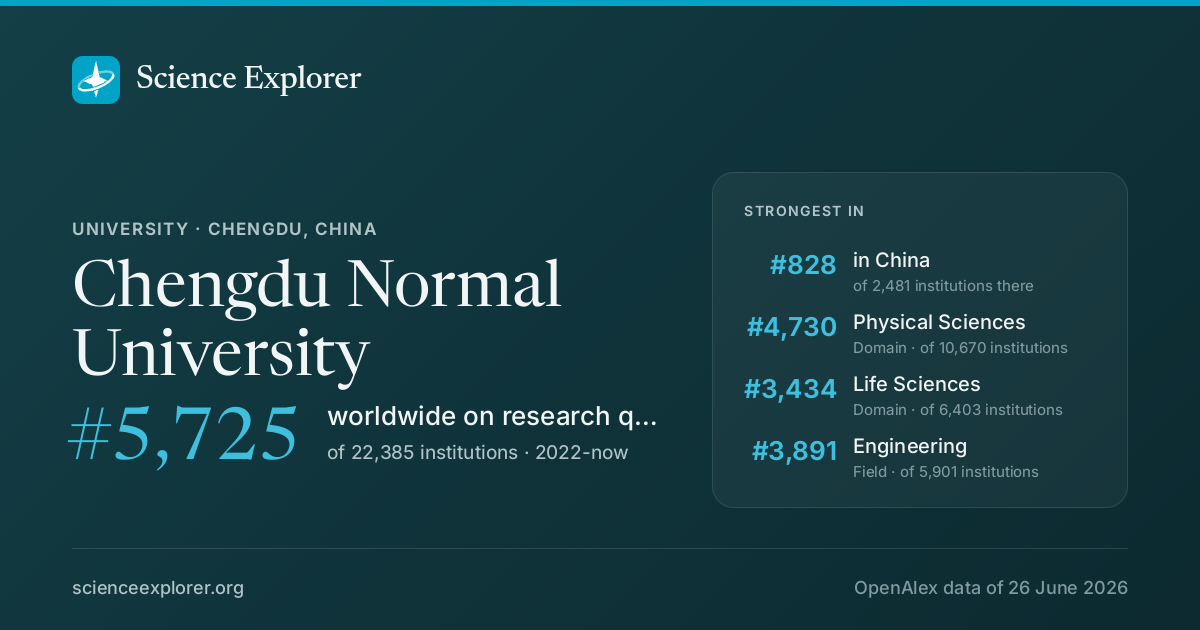
In research, Chengdu Normal University stands highest in Physical Sciences (#4,730 of 10,670 worldwide), Life Sciences (#3,434 of 6,403 worldwide) and Engineering (#3,891 of 5,901 worldwide), 2022-now.
- World rank, 2022-now
- #5,725 of 22,385 · #7,441 all time
- Rank in China
- #828 of 2,481
- Research works
- 1.6k ▲ 135% vs 2018-21
- Citations
- 8.6k 5.4 per fractional work
- Top-10% rate
- 11.4% all institutions 10.0%
- vs its own fields
- 0.91× 1.00× is exactly expected
- Open access
- 36% world 40%
- International
- 7% world 18%
What is Chengdu Normal University known for in research?
The fields where it stands highest, 2022-now, ranked among every institution above the floor in each field.
| Field | World rank | Where that sits | Top-10% rate | Works | All time |
|---|---|---|---|---|---|
| Physical SciencesDomain | #4,730 of 10,670 | 9.8% | 321 | #6863 | |
| Life SciencesDomain | #3,434 of 6,403 | 9.8% | 75 | #4840 | |
| EngineeringField | #3,891 of 5,901 | 9.5% | 94 | #6282 | |
| Computer ScienceField | #3,246 of 4,417 | 11.4% | 63 | #4717 | |
| Social SciencesDomain | #7,197 of 9,585 | 15.7% | 124 | #7407 |
Each strip is that field's whole ranked pool, with the notch where Chengdu Normal University sits in it, in the colour of the band that rank falls in. The track under the rate is the rate itself: it carries no average mark, because the average differs by field (from about 6% in Dentistry to 21% in Economics).
Which of those standings moved
The same fields on both windows: where it stood over the whole record, and where it stands in 2022-now. The distance is the story, and it is the one thing the two rank columns above cannot show.
- Physical Sciences#6,863 #4,730
- Life Sciences#4,840 #3,434
- Engineering#6,282 #3,891
- Computer Science#4,717 #3,246
- Social Sciences#7,407 #7,197
A dot further right is a better standing. Fields it was not ranked in over the whole record are left out.
Which fields of science does Chengdu Normal University work in?
In 2022-now, 57% of research at Chengdu Normal University is in Physical Sciences, 22% in Social Sciences. Its largest fields are Engineering (17%), Computer Science (11%), Social Sciences (8%). It does 1.5× the world's share of Physical Sciences.
Each ring splits the one inside it: the four domains of science, their fields, their subfields. Size is fractional works in 2022-now. Every slice is a page; the interactive view zooms down to single topics and colours each by how much more of it this institution does than the world.
Its 4 domains and 26 fields, with their numbers
- Physical Sciences35657.1%
- Engineering10416.7%
- Computer Science7011.3%
- Environmental Science497.9%
- Materials Science426.8%
- Physics and Astronomy233.6%
- Chemistry213.3%
- Mathematics203.2%
- Energy132.0%
- Earth and Planetary Sciences111.8%
- Chemical Engineering30.5%
- Social Sciences14022.4%
- Social Sciences518.1%
- Psychology375.9%
- Arts and Humanities172.8%
- Business, Management and Accounting172.7%
- Economics, Econometrics and Finance111.7%
- Decision Sciences71.2%
- Life Sciences8914.2%
- Health Sciences406.4%
- Medicine325.2%
- Health Professions40.6%
- Nursing30.5%
- Veterinary00.0%
- Dentistry00.0%
Field profile
Location quotient across every field it publishes in: outside the ring is more than an institution of this size would be expected to publish, inside it is less.
Rings at 0.5×, 1× and 2×. Widest outward: Mathematics, 2.7×. Every wedge is a field page.
All 26 fields, with their numbers
- Mathematics2.70×20 works
- Energy2.19×13 works
- Chemistry2.13×21 works
- Psychology1.94×37 works
- Materials Science1.93×42 works
- Pharmacology, Toxicology and Pharmaceutics1.76×4 works
- Physics and Astronomy1.64×23 works
- Environmental Science1.58×49 works
- Chemical Engineering1.54×3 works
- Computer Science1.45×70 works
- Agricultural and Biological Sciences1.34×40 works
- Decision Sciences1.21×7 works
- Earth and Planetary Sciences1.12×11 works
- Engineering1.12×104 works
- Nursing1.09×3 works
- Biochemistry, Genetics and Molecular Biology1.06×35 works
- Arts and Humanities0.96×17 works
- Neuroscience0.86×9 works
- Business, Management and Accounting0.83×17 works
- Economics, Econometrics and Finance0.80×11 works
- Social Sciences0.64×51 works
- Medicine0.27×32 works
- Health Professions0.24×4 works
- Immunology and Microbiology0.18×1 works
- Veterinary0.10×0 works
- Dentistry0.01×0 works
- Mathematics 2.7×
- Energy 2.2×
- Chemistry 2.1×
- Psychology 1.9×
- Materials Science 1.9×
- Pharmacology, Toxicology and Pharmaceutics 1.8×
- Physics and Astronomy 1.6×
- Environmental Science 1.6×
- Chemical Engineering 1.5×
- Computer Science 1.4×
- Agricultural and Biological Sciences 1.3×
- Decision Sciences 1.2×
- Earth and Planetary Sciences 1.1×
- Engineering 1.1×
- Nursing 1.1×
- Biochemistry, Genetics and Molecular Biology 1.1×
- Arts and Humanities 1.0×
- Neuroscience 0.9×
- Business, Management and Accounting 0.8×
- Economics, Econometrics and Finance 0.8×
- Social Sciences 0.6×
- Medicine 0.3×
- Health Professions 0.2×
- Immunology and Microbiology 0.2×
- Veterinary 0.1×
- Dentistry 0.0×
Who are the top researchers at Chengdu Normal University?
Ranked on the quality score, Xinjian Liang, Shuyong Shang and Jiexue Wang lead among researchers whose main affiliation is Chengdu Normal University.
- 1
Xinjian Liang
 China · #1,074,612 worldwide
607 citations · 21 works
- 2
Shuyong Shang
China · #1,228,293 worldwide
1.7k citations · 54 works
- 3
Jiexue Wang
China · #1,293,013 worldwide
485 citations · 25 works
- 4
Jie Zeng
China · #1,383,390 worldwide
174 citations · 22 works
- 5
Qiang Feng
China · #1,413,550 worldwide
1.7k citations · 77 works
- 6
Guowei Deng
China · #2,478,808 worldwide
2.2k citations · 150 works
- 7
Xiaohong Fu
China · #3,648,197 worldwide
447 citations · 32 works
- 8
Yousong Hu
China · #3,753,283 worldwide
199 citations · 20 works
- 9
Chengshu Qiu
China · #4,245,420 worldwide
182 citations · 18 works
- 10
Xiaowei Liu
China · #4,313,111 worldwide
400 citations · 28 works
Which keywords describe research at Chengdu Normal University?
By fractional works in 2022-now, weighted toward what it does more of than the world: Deep Learning, Nanomaterials, Regional Planning, Graphene, Biomedical Applications, Biochar Application, Artificial Intelligence and Bioimaging.
- Second Language Acquisition
- Chinese Medicinal Prescription
- Graph Embedding
- Visual Question Answering
- CO2 Emissions
- Cancer Treatment
- Online Education
- Electrochemistry
- Pollution Monitoring
- Cathode Materials
- Biosensors
- Water Splitting
- Reactive Oxygen Species
- Bioimaging
- Wireless Sensor Networks
- Metal-Organic Frameworks
- Neural Networks
- Nanoparticles
- Artificial Intelligence
- Nanomaterials
- Deep Learning
- Machine Learning
- Biomedical Applications
- Graphene
- Internet of Things
- Regional Planning
- Energy Storage
- Cloud Computing
- Water Quality
- Biochar Application
- Environmental Risk Assessment
- Conservation Issues
- Semiconductor
- Image Classification
- Big Data Analytics
- Convolutional Neural Network
- Semantic Reasoning
- Multimedia Technology
- Semantic Representation
- Integrative Medicine
Size is fractional works in 2022-now in the topics tagged with each word; colour is the word's share of this institution's work against its share of the world's. The 40 words are chosen for being large and distinctive. Each links to the topic it comes from most.
All 40 words, with their numbers
- Deep Learning39▲ 1.81×56 topics
- Nanomaterials20▲ 3.0×12 topics
- Machine Learning18◆ 0.89×51 topics
- Artificial Intelligence18▲ 1.97×20 topics
- Biomedical Applications17▲ 2.3×31 topics
- Nanoparticles16▲ 2.1×25 topics
- Graphene14▲ 3.4×10 topics
- Neural Networks14▲ 1.45×28 topics
- Internet of Things12▲ 2.3×16 topics
- Metal-Organic Frameworks10▲ 4.0×5 topics
- Regional Planning10▲ 24×2 topics
- Wireless Sensor Networks10▲ 3.5×13 topics
- Energy Storage10▲ 2.3×6 topics
- Bioimaging9▲ 6.6×5 topics
- Cloud Computing9▲ 5.2×7 topics
- Reactive Oxygen Species9▲ 3.6×8 topics
- Water Quality9▲ 3.7×10 topics
- Water Splitting9▲ 4.0×2 topics
- Biochar Application9▲ 14×2 topics
- Biosensors9▲ 2.8×11 topics
- Environmental Risk Assessment8▲ 15×2 topics
- Cathode Materials8▲ 3.2×3 topics
- Conservation Issues8▲ 32×1 topic
- Pollution Monitoring8▲ 32×1 topic
- Semiconductor7▲ 3.6×6 topics
- Electrochemistry7▲ 5.2×3 topics
- Image Classification7▲ 6.1×2 topics
- Online Education7▲ 5.6×3 topics
- Big Data Analytics7▲ 5.0×5 topics
- Cancer Treatment6▲ 4.4×3 topics
- Convolutional Neural Network6▲ 6.5×4 topics
- CO2 Emissions6▲ 5.4×4 topics
- Semantic Reasoning6▲ 10×2 topics
- Visual Question Answering6▲ 10×2 topics
- Multimedia Technology6▲ 14×2 topics
- Graph Embedding5▲ 24×1 topic
- Semantic Representation5▲ 21×1 topic
- Chinese Medicinal Prescription5▲ 25×1 topic
- Integrative Medicine5▲ 14×1 topic
- Second Language Acquisition5▲ 8.6×2 topics
Which research topics does Chengdu Normal University publish most on?
By volume in 2022-now: Educational Reforms and Innovations, Advanced Technologies in Various Fields, Advanced Photocatalysis Techniques and Medical Research and Treatments.
Area is fractional works; colour is the subfield each topic belongs to.
- 1 Educational Reforms and Innovations Health, Toxicology and Mutagenesis 8 works
- 2 Advanced Technologies in Various Fields Artificial Intelligence 5 works
- 3 Advanced Photocatalysis Techniques Renewable Energy, Sustainability and the Environment 5 works
- 4 Medical Research and Treatments Complementary and alternative medicine 5 works
- 5 EFL/ESL Teaching and Learning Language and Linguistics 5 works
- 6 Ideological and Political Education Education 4 works
- 7 E-commerce and Technology Innovations Business and International Management 4 works
- 8 Educational Technology and Pedagogy Artificial Intelligence 4 works
- 9 Advanced battery technologies research Electrical and Electronic Engineering 4 works
- 10 Electrocatalysts for Energy Conversion Renewable Energy, Sustainability and the Environment 4 works
How open and international is its research?
Against the world's own shares: the tick on each track. Both are shares of its output, so they sit on one scale and can be read against each other as well as against the world.
World: 40% of research is openly available.
World: 18% is written across borders.
How has Chengdu Normal University's research output changed?
Output in 2022-2025 was 135% higher than in 2018-2021.
The same series as a ribbon: one cell per year, darker for more. The line above answers how much; this answers when.
Its share of all research
Growing output can still be a shrinking share: all of science grows. This is Chengdu Normal University as a percentage of every work published that year, 0.0028% in 2024.
Fractional works of Chengdu Normal University over all fractional works that year. How the balance of science has shifted.
How much of it reaches the world top 10%
Year by year, against all institutions in the same year.
Of each year's output, the share that reached the world's 10% most cited for its field and year. Peak 13.8% in 2024.
Other research institutions in Chengdu
- Sichuan University
- University of Electronic Science and Technology of China
- Southwest Jiaotong University
- Chengdu University of Technology
- Southwest Petroleum University
- Chengdu University
- Chengdu University of Traditional Chinese Medicine
- Xihua University
Share Chengdu Normal University's ranking
Badges for a website1Each links back here and updates with every snapshot

Research measures only: rankings here say nothing about teaching, admissions or student experience. Comparable institutions and collaboration partners have tabs of their own, above.
Discussion
Ask a question or share a note about Chengdu Normal University. Keep it to the research: no personal attacks, advertising or links. Any reader can report a post, which collapses it for everyone until it is opened.