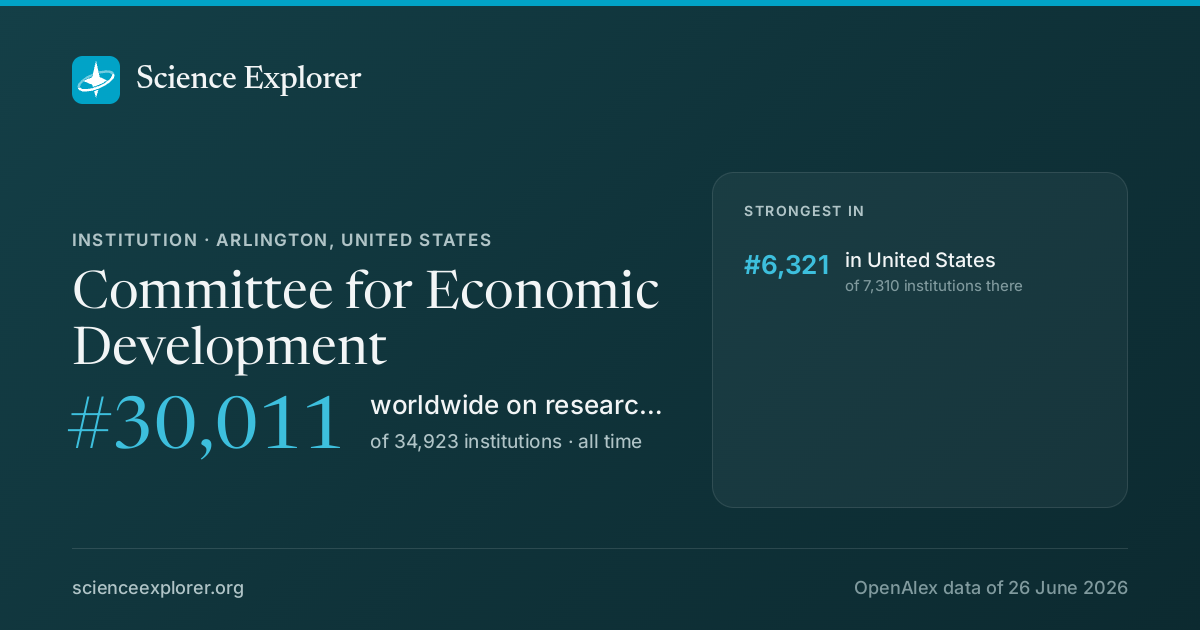
- World rank, all time
- #30,011 of 34,923
- Rank in United States
- #6,321 of 7,310
- Research works
- 177 ▲ 56% vs 2018-21
- Citations
- 1k 5.7 per fractional work
- Top-10% rate
- 7.3% all institutions 10.0%
- vs its own fields
- 0.87× 1.00× is exactly expected
- Open access
- 31% world 40%
- International
- 15% world 18%
Which fields of science does Committee for Economic Development work in?
In all years, 67% of research at Committee for Economic Development is in Social Sciences, 15% in Health Sciences. Its largest fields are Economics, Econometrics and Finance (24%), Social Sciences (23%), Medicine (9%). It does 3.0× the world's share of Social Sciences.
Each ring splits the one inside it: the four domains of science, their fields, their subfields. Size is fractional works in all years. Every slice is a page; the interactive view zooms down to single topics and colours each by how much more of it this institution does than the world.
Its 4 domains and 23 fields, with their numbers
- Social Sciences11866.6%
- Economics, Econometrics and Finance4324.2%
- Social Sciences4123.0%
- Business, Management and Accounting158.3%
- Decision Sciences95.0%
- Psychology63.5%
- Arts and Humanities52.7%
- Health Sciences2715.5%
- Medicine169.2%
- Health Professions116.2%
- Nursing00.0%
- Physical Sciences2413.5%
- Engineering105.7%
- Environmental Science52.7%
- Computer Science52.6%
- Physics and Astronomy10.6%
- Chemical Engineering10.6%
- Mathematics10.4%
- Earth and Planetary Sciences10.4%
- Chemistry00.3%
- Energy00.2%
- Materials Science00.1%
- Life Sciences84.3%
Field profile
Location quotient across every field it publishes in: outside the ring is more than an institution of this size would be expected to publish, inside it is less.
Rings at 0.5×, 1× and 2×. Widest outward: Economics, Econometrics and Finance, 8.5×. Every wedge is a field page.
All 16 fields, with their numbers
- Economics, Econometrics and Finance8.50×4 works
- Psychology4.62×3 works
- Business, Management and Accounting2.22×1 works
- Social Sciences2.11×5 works
- Mathematics1.49×0 works
- Environmental Science1.39×1 works
- Health Professions1.25×1 works
- Decision Sciences0.91×0 works
- Nursing0.89×0 works
- Earth and Planetary Sciences0.88×0 works
- Agricultural and Biological Sciences0.65×1 works
- Medicine0.45×2 works
- Computer Science0.37×1 works
- Biochemistry, Genetics and Molecular Biology0.22×0 works
- Engineering0.20×1 works
- Materials Science0.17×0 works
- Economics, Econometrics and Finance 8.5×
- Psychology 4.6×
- Business, Management and Accounting 2.2×
- Social Sciences 2.1×
- Mathematics 1.5×
- Environmental Science 1.4×
- Health Professions 1.2×
- Decision Sciences 0.9×
- Nursing 0.9×
- Earth and Planetary Sciences 0.9×
- Agricultural and Biological Sciences 0.7×
- Medicine 0.5×
- Computer Science 0.4×
- Biochemistry, Genetics and Molecular Biology 0.2×
- Engineering 0.2×
- Materials Science 0.2×
Who are the top researchers at Committee for Economic Development?
Ranked on the quality score, Diane Lim Rogers, Homer Jones and Hugo Spring-Ragain lead among researchers whose main affiliation is Committee for Economic Development.
- 1
Diane Lim Rogers
 United States · #1,331,325 worldwide
690 citations · 29 works
- 2
Homer Jones
United States · #2,201,695 worldwide
56 citations · 41 works
- 3
Hugo Spring-Ragain
United States · #2,800,678 worldwide
0 citations · 24 works
- 4
Howard B. Myers
United States · #2,986,808 worldwide
11 citations · 18 works
- 5
Elliot S. Schwartz
United States · #3,227,811 worldwide
158 citations · 18 works
- 6
Karl Schriftgiesser
United States · #3,323,066 worldwide
96 citations · 21 works
- 7
Richard F. Kaufman
United States · #3,831,715 worldwide
87 citations · 15 works
- 8
R. Scott Fosler
United States · #4,158,975 worldwide
209 citations · 31 works
- 9
Sharon K. Merrick
United States · #6,437,301 worldwide
122 citations · 78 works
- 10
Matthew T. Popovich
United States · #6,633,569 worldwide
23 citations · 54 works
Which keywords describe research at Committee for Economic Development?
By fractional works in all years, weighted toward what it does more of than the world: Economic Growth, Fiscal Policy, Income Tax, Economic Development, Globalization, Regional Development, Infrastructure and Taxation.
- Property Rights
- Military Expenditure
- National Security
- Technology Development
- Gender Inequality
- Theory-Based Evaluation
- Behavioral Economics
- Aggregate Demand
- Income Distribution
- Income Inequality
- Structural Change
- Perioperative
- Inequality
- Political Economy
- Neoliberalism
- Public Investment
- Taxation
- Regional Development
- Income Tax
- Globalization
- Economic Growth
- Fiscal Policy
- Economic Development
- Infrastructure
- Government Expenditure
- Monetary Policy
- Guidelines
- Mortality
- Cardiac Risk
- Financial Crisis
- Industrialization
- Social Policy
- Panel Data Analysis
- Debt
- Concept Mapping
- Rural Development
- Public Policy
- Marketization
- Defense Spending
- Capital Flows
Size is fractional works in all years in the topics tagged with each word; colour is the word's share of this institution's work against its share of the world's. The 40 words are chosen for being large and distinctive. Each links to the topic it comes from most.
All 40 words, with their numbers
- Economic Growth24▲ 18×16 topics
- Globalization12▲ 3.8×21 topics
- Fiscal Policy11▲ 27×5 topics
- Income Tax10▲ 62×2 topics
- Economic Development10▲ 8.0×11 topics
- Regional Development8▲ 17×4 topics
- Infrastructure8▲ 38×2 topics
- Taxation7▲ 43×2 topics
- Government Expenditure7▲ 65×1 topic
- Public Investment7▲ 65×1 topic
- Monetary Policy7▲ 14×5 topics
- Neoliberalism7▲ 10×6 topics
- Guidelines7▲ 7.8×3 topics
- Political Economy7▲ 15×8 topics
- Mortality6▲ 7.3×4 topics
- Inequality6▲ 13×4 topics
- Cardiac Risk6▲ 38×1 topic
- Perioperative6▲ 38×1 topic
- Financial Crisis6▲ 22×3 topics
- Structural Change5▲ 29×2 topics
- Industrialization5▲ 36×2 topics
- Income Inequality5▲ 19×5 topics
- Social Policy5▲ 20×2 topics
- Income Distribution5▲ 46×2 topics
- Panel Data Analysis5▲ 24×2 topics
- Aggregate Demand4▲ 53×1 topic
- Debt4▲ 53×1 topic
- Behavioral Economics4▲ 39×2 topics
- Concept Mapping4▲ 44×1 topic
- Theory-Based Evaluation4▲ 102×1 topic
- Rural Development4▲ 7.8×7 topics
- Gender Inequality4▲ 18×5 topics
- Public Policy4▲ 5.3×2 topics
- Technology Development4▲ 64×2 topics
- Marketization4▲ 51×2 topics
- National Security4▲ 48×2 topics
- Defense Spending4▲ 218×1 topic
- Military Expenditure4▲ 218×1 topic
- Capital Flows4▲ 36×2 topics
- Property Rights3▲ 16×3 topics
Which research topics does Committee for Economic Development publish most on?
By volume in 2022-now: Psychoanalysis and Psychopathology Research, Counseling, Therapy, and Family Dynamics, Higher Education and Employability and COVID-19 Pandemic Impacts.
Area is fractional works; colour is the subfield each topic belongs to.
- 1 Psychoanalysis and Psychopathology Research Clinical Psychology 1 works
- 2 Counseling, Therapy, and Family Dynamics Clinical Psychology 1 works
- 3 Higher Education and Employability Education 1 works
- 4 COVID-19 Pandemic Impacts Economics and Econometrics 0 works
- 5 Diverse Aspects of Tourism Research Sociology and Political Science 0 works
- 6 Innovations in Medical Education Public Health, Environmental and Occupational Health 0 works
- 7 Innovative Education and Learning Practices Human Factors and Ergonomics 0 works
- 8 Education, Healthcare and Sociology Research Social Psychology 0 works
- 9 Education Systems and Policy Education 0 works
- 10 Environmental Education and Sustainability Management, Monitoring, Policy and Law 0 works
How open and international is its research?
Against the world's own shares: the tick on each track. Both are shares of its output, so they sit on one scale and can be read against each other as well as against the world.
World: 40% of research is openly available.
World: 18% is written across borders.
How has Committee for Economic Development's research output changed?
Output in 2022-2025 was 56% higher than in 2018-2021.
The same series as a ribbon: one cell per year, darker for more. The line above answers how much; this answers when.
Its share of all research
Growing output can still be a shrinking share: all of science grows. This is Committee for Economic Development as a percentage of every work published that year, 0.000054% in 2024.
Fractional works of Committee for Economic Development over all fractional works that year. How the balance of science has shifted.
Other research institutions in Arlington
- Marymount University
- The Nature Conservancy
- RTX (United States)
- In-Q-Tel
- Industrial Research Institute
- NatureServe
- Millennium Engineering and Integration (United States)
- International Foundation for Electoral Systems

Share Committee for Economic Development's ranking
Badges for a website1Each links back here and updates with every snapshot

Research measures only: rankings here say nothing about teaching, admissions or student experience. Comparable institutions and collaboration partners have tabs of their own, above.
Discussion
Ask a question or share a note about Committee for Economic Development. Keep it to the research: no personal attacks, advertising or links. Any reader can report a post, which collapses it for everyone until it is opened.