Science Explorer Back to mapMap
Discussion
Company · Yonkers · United States

ContraFect (United States)

World rank, all time
#27,212
of 34,923
Rank in United States
#5,695
of 7,310
Research works
155
▼ 36% vs 2018-21
Citations
2.6k
17.0 per fractional work
Top-10% rate
12.6%
all institutions 10.0%
vs its own fields
0.95×
1.00× is exactly expected
Open access
20%
world 40%
International
4%
world 18%

Which fields of science does ContraFect (United States) work in?

In all years, 35% of research at ContraFect (United States) is in Physical Sciences, 26% in Life Sciences. Its largest fields are Medicine (18%), Biochemistry, Genetics and Molecular Biology (15%), Chemistry (10%). It does 1.6× the world's share of Life Sciences.

Physical Sciences: 54 fractional works · 34.6% of its workChemistry: 16 fractional works · 10.4% of its workSpectroscopy: 8 fractional works · 5.0% of its workPhysical and Theoretical Chemistry: 5 fractional works · 3.0% of its workOrganic Chemistry: 2 fractional works · 1.2% of its workAnalytical Chemistry: 1 fractional works · 0.6% of its workInorganic Chemistry: 1 fractional works · 0.5% of its workEnvironmental Science: 12 fractional works · 7.6% of its workEcology: 6 fractional works · 4.0% of its workEnvironmental Chemistry: 2 fractional works · 1.3% of its workPollution: 1 fractional works · 0.8% of its workWater Science and Technology: 1 fractional works · 0.4% of its workGlobal and Planetary Change: 0 fractional works · 0.3% of its workHealth, Toxicology and Mutagenesis: 0 fractional works · 0.3% of its workNature and Landscape Conservation: 0 fractional works · 0.3% of its workSmaller subfields together: 0 fractional works · 0.2% of its workEngineering: 10 fractional works · 6.4% of its workBiomedical Engineering: 2 fractional works · 1.6% of its workComputational Mechanics: 2 fractional works · 1.2% of its workAerospace Engineering: 1 fractional works · 0.8% of its workElectrical and Electronic Engineering: 1 fractional works · 0.7% of its workMechanical Engineering: 1 fractional works · 0.6% of its workMechanics of Materials: 1 fractional works · 0.5% of its workAutomotive Engineering: 1 fractional works · 0.4% of its workMedia Technology: 0 fractional works · 0.2% of its workSmaller subfields together: 1 fractional works · 0.4% of its workMaterials Science: 7 fractional works · 4.8% of its workMaterials Chemistry: 4 fractional works · 2.4% of its workSurfaces, Coatings and Films: 3 fractional works · 1.7% of its workPolymers and Plastics: 0 fractional works · 0.3% of its workGeneral Materials Science: 0 fractional works · 0.2% of its workSmaller subfields together: 0 fractional works · 0.1% of its workEarth and Planetary Sciences: 3 fractional works · 1.9% of its workAtmospheric Science: 2 fractional works · 1.0% of its workGeochemistry and Petrology: 1 fractional works · 0.6% of its workOceanography: 0 fractional works · 0.3% of its workComputer Science: 3 fractional works · 1.7% of its workInformation Systems: 1 fractional works · 0.6% of its workArtificial Intelligence: 0 fractional works · 0.3% of its workComputer Graphics and Computer-Aided Design: 0 fractional works · 0.2% of its workComputer Vision and Pattern Recognition: 0 fractional works · 0.2% of its workHardware and Architecture: 0 fractional works · 0.2% of its workSmaller subfields together: 0 fractional works · 0.2% of its workMathematics: 1 fractional works · 0.6% of its workModeling and Simulation: 0 fractional works · 0.3% of its workMathematical Physics: 0 fractional works · 0.2% of its workSmaller subfields together: 0 fractional works · 0.1% of its workPhysics and Astronomy: 1 fractional works · 0.6% of its workRadiation: 1 fractional works · 0.4% of its workStatistical and Nonlinear Physics: 0 fractional works · 0.2% of its workChemical Engineering: 1 fractional works · 0.4% of its workBioengineering: 0 fractional works · 0.3% of its workSmaller subfields together: 0 fractional works · 0.1% of its workEnergy: 0 fractional works · 0.1% of its workLife Sciences: 40 fractional works · 25.6% of its workBiochemistry, Genetics and Molecular Biology: 23 fractional works · 15.0% of its workMolecular Biology: 14 fractional works · 8.8% of its workMolecular Medicine: 3 fractional works · 1.6% of its workClinical Biochemistry: 2 fractional works · 1.4% of its workBiophysics: 2 fractional works · 1.1% of its workCell Biology: 1 fractional works · 0.5% of its workEndocrinology: 1 fractional works · 0.5% of its workGenetics: 1 fractional works · 0.4% of its workCancer Research: 0 fractional works · 0.3% of its workBiochemistry: 0 fractional works · 0.2% of its workSmaller subfields together: 0 fractional works · 0.2% of its workAgricultural and Biological Sciences: 10 fractional works · 6.6% of its workPlant Science: 4 fractional works · 2.4% of its workInsect Science: 3 fractional works · 2.0% of its workFood Science: 3 fractional works · 2.0% of its workSmaller subfields together: 0 fractional works · 0.3% of its workNeuroscience: 3 fractional works · 1.9% of its workCognitive Neuroscience: 2 fractional works · 1.2% of its workCellular and Molecular Neuroscience: 1 fractional works · 0.4% of its workSensory Systems: 0 fractional works · 0.2% of its workSmaller subfields together: 0 fractional works · 0.0% of its workImmunology and Microbiology: 3 fractional works · 1.9% of its workMicrobiology: 2 fractional works · 1.1% of its workImmunology: 1 fractional works · 0.4% of its workParasitology: 0 fractional works · 0.2% of its workVirology: 0 fractional works · 0.2% of its workPharmacology, Toxicology and Pharmaceutics: 0 fractional works · 0.2% of its workPharmacology: 0 fractional works · 0.2% of its workHealth Sciences: 33 fractional works · 21.0% of its workMedicine: 28 fractional works · 17.9% of its workInfectious Diseases: 7 fractional works · 4.6% of its workPublic Health, Environmental and Occupational Health: 3 fractional works · 1.9% of its workEpidemiology: 2 fractional works · 1.5% of its workPharmacology: 2 fractional works · 1.3% of its workSurgery: 2 fractional works · 1.2% of its workPsychiatry and Mental health: 2 fractional works · 1.0% of its workRadiology, Nuclear Medicine and Imaging: 1 fractional works · 0.7% of its workPulmonary and Respiratory Medicine: 1 fractional works · 0.7% of its workComplementary and alternative medicine: 1 fractional works · 0.7% of its workPhysiology: 1 fractional works · 0.7% of its workRheumatology: 1 fractional works · 0.6% of its workOncology: 1 fractional works · 0.4% of its workEndocrinology, Diabetes and Metabolism: 1 fractional works · 0.4% of its workReproductive Medicine: 1 fractional works · 0.4% of its workEmergency Medicine: 1 fractional works · 0.3% of its workHematology: 0 fractional works · 0.3% of its workCardiology and Cardiovascular Medicine: 0 fractional works · 0.3% of its workRehabilitation: 0 fractional works · 0.2% of its workSmaller subfields together: 1 fractional works · 0.6% of its workHealth Professions: 3 fractional works · 2.0% of its workOccupational Therapy: 2 fractional works · 1.0% of its workGeneral Health Professions: 1 fractional works · 0.4% of its workHealth Information Management: 0 fractional works · 0.3% of its workPharmacy: 0 fractional works · 0.2% of its workSmaller subfields together: 0 fractional works · 0.1% of its workDentistry: 1 fractional works · 0.6% of its workOral Surgery: 1 fractional works · 0.6% of its workVeterinary: 0 fractional works · 0.3% of its workSmall Animals: 0 fractional works · 0.3% of its workNursing: 0 fractional works · 0.1% of its workSocial Sciences: 29 fractional works · 18.9% of its workSocial Sciences: 11 fractional works · 7.1% of its workSociology and Political Science: 2 fractional works · 1.4% of its workPolitical Science and International Relations: 2 fractional works · 1.4% of its workAnthropology: 2 fractional works · 1.1% of its workEducation: 2 fractional works · 1.0% of its workLaw: 1 fractional works · 0.5% of its workHealth: 1 fractional works · 0.5% of its workCommunication: 1 fractional works · 0.4% of its workHuman Factors and Ergonomics: 0 fractional works · 0.3% of its workSmaller subfields together: 1 fractional works · 0.5% of its workPsychology: 9 fractional works · 5.6% of its workDevelopmental and Educational Psychology: 4 fractional works · 2.6% of its workClinical Psychology: 2 fractional works · 1.4% of its workExperimental and Cognitive Psychology: 2 fractional works · 1.1% of its workSocial Psychology: 1 fractional works · 0.5% of its workArts and Humanities: 6 fractional works · 3.8% of its workArcheology: 1 fractional works · 0.9% of its workLiterature and Literary Theory: 1 fractional works · 0.7% of its workVisual Arts and Performing Arts: 1 fractional works · 0.6% of its workHistory and Philosophy of Science: 1 fractional works · 0.5% of its workPhilosophy: 1 fractional works · 0.5% of its workLanguage and Linguistics: 0 fractional works · 0.3% of its workSmaller subfields together: 0 fractional works · 0.3% of its workBusiness, Management and Accounting: 2 fractional works · 1.2% of its workMarketing: 1 fractional works · 0.4% of its workAccounting: 0 fractional works · 0.3% of its workManagement Information Systems: 0 fractional works · 0.3% of its workSmaller subfields together: 0 fractional works · 0.1% of its workEconomics, Econometrics and Finance: 2 fractional works · 1.1% of its workEconomics and Econometrics: 2 fractional works · 1.1% of its workDecision Sciences: 0 fractional works · 0.0% of its workALL ITS WORKContraFect(United States)155fractional works, all years
Life Sciences26%Physical Sciences35%Health Sciences21%Social Sciences19%

Each ring splits the one inside it: the four domains of science, their fields, their subfields. Size is fractional works in all years. Every slice is a page; the interactive view zooms down to single topics and colours each by how much more of it this institution does than the world.

Its 4 domains and 26 fields, with their numbers
    1. Chemistry1610.4%
    2. Environmental Science127.6%
    3. Engineering106.4%
    4. Materials Science74.8%
    5. Earth and Planetary Sciences31.9%
    6. Computer Science31.7%
    7. Mathematics10.6%
    8. Physics and Astronomy10.6%
    9. Chemical Engineering10.4%
    10. Energy00.1%
    1. Biochemistry, Genetics and Molecular Biology2315.0%
    2. Agricultural and Biological Sciences106.6%
    3. Neuroscience31.9%
    4. Immunology and Microbiology31.9%
    5. Pharmacology, Toxicology and Pharmaceutics00.2%
    1. Medicine2817.9%
    2. Health Professions32.0%
    3. Dentistry10.6%
    4. Veterinary00.3%
    5. Nursing00.1%
    1. Social Sciences117.1%
    2. Psychology95.6%
    3. Arts and Humanities63.8%
    4. Business, Management and Accounting21.2%
    5. Economics, Econometrics and Finance21.1%
    6. Decision Sciences00.0%
All of science, and how each field's share has moved since 1950: the Science domain explorer

Field profile

Location quotient across every field it publishes in: outside the ring is more than an institution of this size would be expected to publish, inside it is less.

Agricultural and Biological Sciences: 0.52× its world share, 0 worksAgricultural and Bio…Biochemistry, Genetics and Molecular Biology: 1.29× its world share, 1 worksBiochemistry, Geneti…Immunology and Microbiology: 2.77× its world share, 0 worksImmunology and Micro…Neuroscience: 4.77× its world share, 2 worksNeuroscienceComputer Science: 0.28× its world share, 0 worksComputer ScienceEngineering: 0.41× its world share, 1 worksEngineeringEnvironmental Science: 0.28× its world share, 0 worksEnvironmental ScienceMathematics: 0.75× its world share, 0 worksMathematicsHealth Professions: 1.13× its world share, 1 worksHealth ProfessionsMedicine: 0.64× its world share, 2 worksMedicineArts and Humanities: 1.83× its world share, 1 worksArts and HumanitiesBusiness, Management and Accounting: 0.47× its world share, 0 worksBusiness, Management…Psychology: 9.38× its world share, 5 worksPsychologySocial Sciences: 1.49× its world share, 4 worksSocial Sciences1×world share
more than its size predictsabout as predictedless

Rings at 0.5×, 1× and 2×. Widest outward: Psychology, 9.4×. Every wedge is a field page.

All 14 fields, with their numbers
  1. Psychology9.38×5 works
  2. Neuroscience4.77×2 works
  3. Immunology and Microbiology2.77×0 works
  4. Arts and Humanities1.83×1 works
  5. Social Sciences1.49×4 works
  6. Biochemistry, Genetics and Molecular Biology1.29×1 works
  7. Health Professions1.13×1 works
  8. Mathematics0.75×0 works
  9. Medicine0.64×2 works
  10. Agricultural and Biological Sciences0.52×0 works
  11. Business, Management and Accounting0.47×0 works
  12. Engineering0.41×1 works
  13. Computer Science0.28×0 works
  14. Environmental Science0.28×0 works

Who are the top researchers at ContraFect (United States)?

Ranked on the quality score, Raymond Schuch, Cara Cassino and Dario E. Lehoux lead among researchers whose main affiliation is ContraFect (United States).

  1. 1 Raymond Schuch United States · #721,146 worldwide 4.8k citations · 90 works
  2. 2 Cara Cassino United States · #1,195,395 worldwide 2.1k citations · 61 works
  3. 3 Dario E. Lehoux United States · #4,294,805 worldwide 1.1k citations · 45 works
  4. 4 Nat Henry United States · #5,144,156 worldwide 7 citations · 24 works
All ranked researchers at ContraFect (United States)

What are the most cited papers from ContraFect (United States)?

The most cited paper from ContraFect (United States) is "Lysins: the arrival of pathogen-directed anti-infectives" (Mina Pastagia, Raymond Schuch, Vincent A. Fischetti et al., 2013), with 211 citations. Next come "Combination Therapy With Lysin CF-301 and Antibiotic Is Superior to Antibiotic Alone for Treating Methicillin-Resistant Staphylococcus aureus–Induced Murine Bacteremia" (197) and "Bacteriophage Lysin CF-301, a Potent Antistaphylococcal Biofilm Agent" (170).

Most cited papers
#PaperReleasedCitations
1 Lysins: the arrival of pathogen-directed anti-infectives Mina Pastagia, Raymond Schuch, Vincent A. Fischetti et al. · Journal of Medical Microbiology Open access 29 Jun 2013 211
2 Combination Therapy With Lysin CF-301 and Antibiotic Is Superior to Antibiotic Alone for Treating Methicillin-Resistant Staphylococcus aureus–Induced Murine Bacteremia Raymond Schuch, Han M. Lee, Brent C. Schneider et al. · The Journal of Infectious Diseases Open access 28 Nov 2013 197
3 Bacteriophage Lysin CF-301, a Potent Antistaphylococcal Biofilm Agent Raymond Schuch, Babar K. Khan, Assaf Raz et al. · Antimicrobial Agents and Chemotherapy Open access May 2017 170
4 Myrcene: A precursor of pheromones in Ips beetles Patrick Hughes · Journal of Insect Physiology Jul 1974 164
5 Psychiatric Symptoms Across the Menstrual Cycle in Adult Women: A Comprehensive Review Ariel B. Handy, Shelly F. Greenfield, Kimberly Ann Yonkers et al. · Harvard Review of Psychiatry Open access Mar 2022 150
All 62 most cited papers, with filters and sorting

Which keywords describe research at ContraFect (United States)?

By fractional works in all years, weighted toward what it does more of than the world: Liquid Chromatography, Chirality, Chiral Separation, Gas Chromatography, Epidemiology, Virulence Factors, Antimicrobial Resistance and Green Chemistry.

▲ more of its work than of the world's◆ about the world's share▼ less than the world's

Size is fractional works in all years in the topics tagged with each word; colour is the word's share of this institution's work against its share of the world's. The 40 words are chosen for being large and distinctive. Each links to the topic it comes from most.

All 40 words, with their numbers
  1. Epidemiology13▲ 2.1×23 topics
  2. Liquid Chromatography10▲ 42×2 topics
  3. Chirality8▲ 32×2 topics
  4. Chiral Separation7▲ 39×1 topic
  5. Gas Chromatography7▲ 39×1 topic
  6. Virulence Factors6▲ 20×4 topics
  7. Antimicrobial Resistance6▲ 14×3 topics
  8. Green Chemistry6▲ 12×4 topics
  9. Healthcare-Associated Infections5▲ 29×2 topics
  10. MRSA5▲ 94×1 topic
  11. Staphylococcus aureus5▲ 43×1 topic
  12. Genomics5▲ 9.1×6 topics
  13. Nanoparticles5▲ 2.4×3 topics
  14. 3D Printing5▲ 16×2 topics
  15. Distance Learning5▲ 13×3 topics
  16. Environmental Impact4▲ 2.2×6 topics
  17. Antibiotic Resistance4▲ 6.8×5 topics
  18. Chemistry Education4▲ 98×1 topic
  19. Laboratory Techniques4▲ 98×1 topic
  20. Virus4▲ 23×3 topics
  21. Synthesis4▲ 4.6×5 topics
  22. Ecology4▲ 13×2 topics
  23. Microbiome4▲ 18×2 topics
  24. Bacteremia4▲ 33×3 topics
  25. Bacteriophage4▲ 35×1 topic
  26. Metagenomics4▲ 18×1 topic
  27. Antimicrobial Activity3▲ 11×2 topics
  28. Fermentation3▲ 14×2 topics
  29. Microbial Production3▲ 41×1 topic
  30. Polyglutamic Acid3▲ 99×1 topic
  31. Mass Spectrometry3▲ 8.6×2 topics
  32. Scanning Electron Microscopy3▲ 28×1 topic
  33. X-ray Photoelectron Spectroscopy3▲ 12×1 topic
  34. Evidence-Based Practice3▲ 10×3 topics
  35. Monoclonal Antibodies3▲ 12×3 topics
  36. ESKAPE Pathogens2▲ 31×1 topic
  37. Multidrug-Resistant Bacteria2▲ 31×1 topic
  38. Immune Modulation2▲ 11×3 topics
  39. Multiresidue Method2▲ 58×1 topic
  40. Pesticide Residues2▲ 58×1 topic

Which research topics does ContraFect (United States) publish most on?

By volume in 2022-now: Behavioral and Psychological Studies, Anthropological Studies and Insights, Educational and Psychological Assessments and Antibiotic Resistance in Bacteria.

  1. 1 Behavioral and Psychological Studies Developmental and Educational Psychology 2 works
  2. 2 Anthropological Studies and Insights Anthropology 1 works
  3. 3 Educational and Psychological Assessments Developmental and Educational Psychology 1 works
  4. 4 Antibiotic Resistance in Bacteria Molecular Medicine 1 works
  5. 5 Antimicrobial Resistance in Staphylococcus Infectious Diseases 1 works
  6. 6 Antimicrobial Peptides and Activities Microbiology 0 works
  7. 7 Child and Animal Learning Development Developmental and Educational Psychology 0 works
  8. 8 Probiotics and Fermented Foods Food Science 0 works
  9. 9 Artistic and Creative Research Visual Arts and Performing Arts 0 works
  10. 10 Historical, Religious, and Philosophical Studies Archeology 0 works

How open and international is its research?

Against the world's own shares: the tick on each track. Both are shares of its output, so they sit on one scale and can be read against each other as well as against the world.

openly available19.5%not open80.5%

World: 40% of research is openly available.

with international co-authors3.7%domestic only96.3%

World: 18% is written across borders.

How has ContraFect (United States)'s research output changed?

Output in 2022-2025 was 36% lower than in 2018-2021.

still counting1990200020102020
grewheldshrank

The same series as a ribbon: one cell per year, darker for more. The line above answers how much; this answers when.

Its share of all research

Growing output can still be a shrinking share: all of science grows. This is ContraFect (United States) as a percentage of every work published that year, 0.0000092% in 2024.

still counting0.0010%0.0020%0.0030%ContraFect (United States)0.000041% in 202519801990200020102020

Fractional works of ContraFect (United States) over all fractional works that year. How the balance of science has shifted.

Other research institutions in Yonkers

All research institutions in Yonkers

Share ContraFect (United States)'s ranking
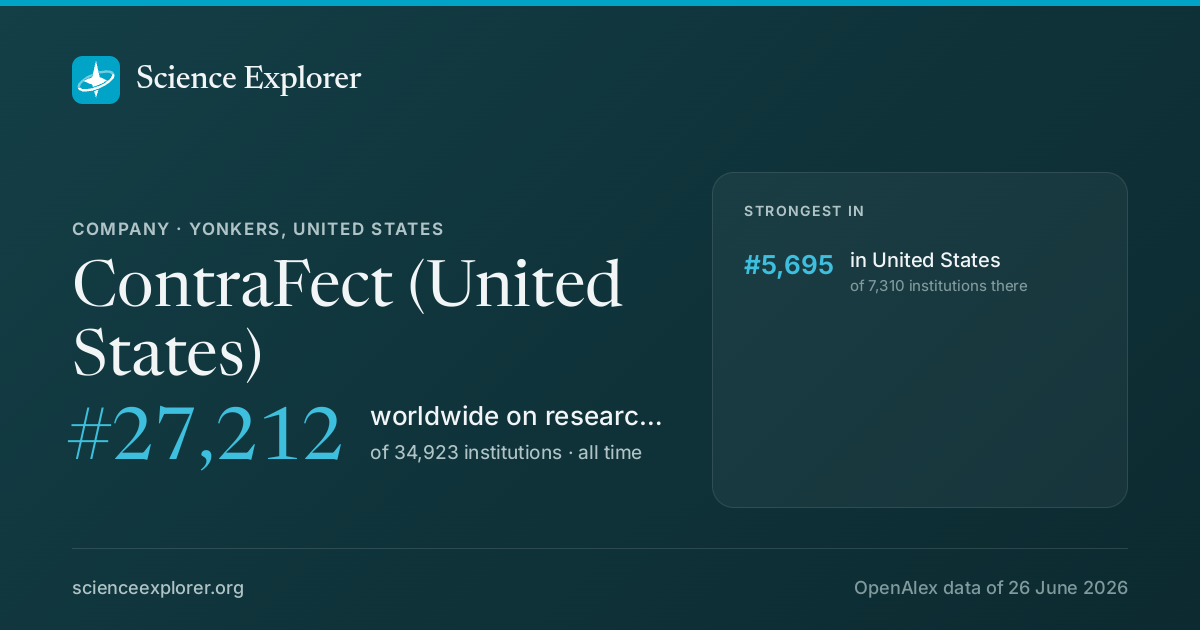
ContraFect (United States) on Science Explorer

A card with ContraFect (United States)'s standing and the fields it leads in, for a post or a slide. A link to this page previews as the same card.

Download the card

1200 × 630 PNG, sized for social posts, drawn from the latest snapshot.

Badges for a website1Each links back here and updates with every snapshot

Research measures only: rankings here say nothing about teaching, admissions or student experience. Comparable institutions and collaboration partners have tabs of their own, above.

Discussion

Ask a question or share a note about ContraFect (United States). Keep it to the research: no personal attacks, advertising or links. Any reader can report a post, which collapses it for everyone until it is opened.