Croydon College
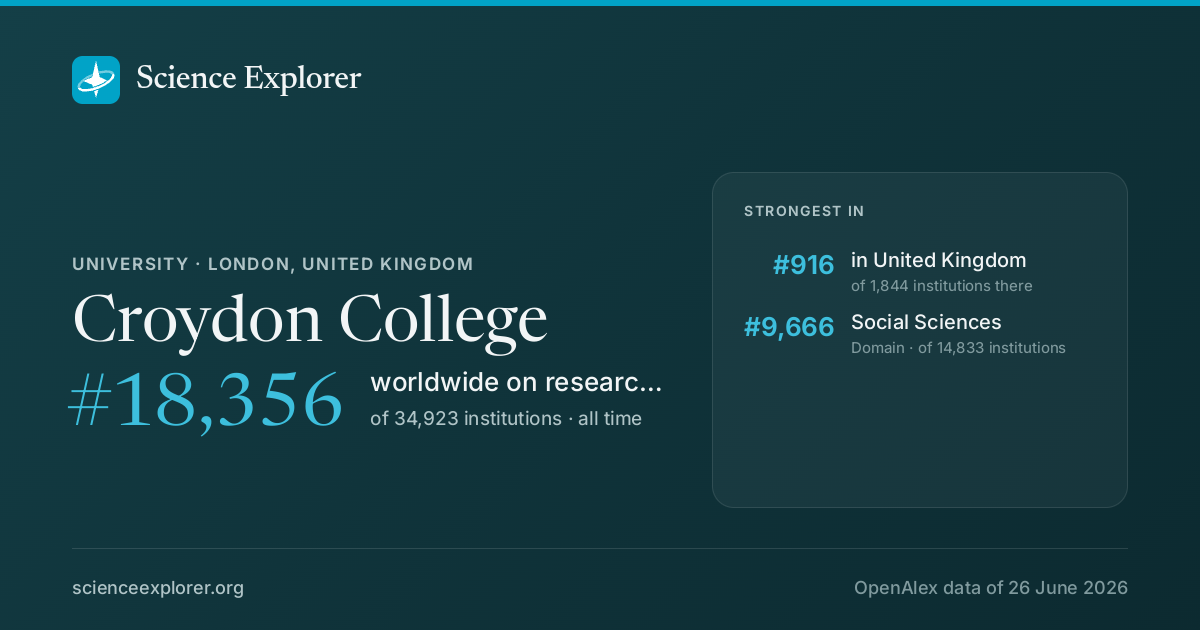
In research, Croydon College stands highest in Social Sciences (#9,666 of 14,833 worldwide), over all time.
- World rank, all time
- #18,356 of 34,923
- Rank in United Kingdom
- #916 of 1,844
- Research works
- 358 ▲ 134% vs 2018-21
- Citations
- 1.7k 4.6 per fractional work
- Top-10% rate
- 3.4% all institutions 10.0%
- vs its own fields
- 0.80× 1.00× is exactly expected
- Open access
- 12% world 40%
- International
- 7% world 18%
What is Croydon College known for in research?
The fields where it stands highest, over all time, ranked among every institution above the floor in each field.
| Field | World rank | Where that sits | Top-10% rate | Works |
|---|---|---|---|---|
| Social SciencesDomain | #9,666 of 14,833 | 3.8% | 165 |
Each strip is that field's whole ranked pool, with the notch where Croydon College sits in it, in the colour of the band that rank falls in. The track under the rate is the rate itself: it carries no average mark, because the average differs by field (from about 6% in Dentistry to 21% in Economics).
Which fields of science does Croydon College work in?
In 2022-now, 43% of research at Croydon College is in Physical Sciences, 29% in Social Sciences. Its largest fields are Computer Science (22%), Medicine (20%), Engineering (14%).
Each ring splits the one inside it: the four domains of science, their fields, their subfields. Size is fractional works in 2022-now. Every slice is a page; the interactive view zooms down to single topics and colours each by how much more of it this institution does than the world.
Its 4 domains and 20 fields, with their numbers
- Physical Sciences2343.2%
- Computer Science1221.7%
- Engineering814.3%
- Environmental Science23.4%
- Energy11.5%
- Physics and Astronomy11.5%
- Mathematics00.8%
- Social Sciences1629.5%
- Health Sciences1324.2%
- Medicine1120.1%
- Health Professions23.5%
- Dentistry00.3%
- Nursing00.3%
- Life Sciences23.1%
Field profile
Location quotient across every field it publishes in: outside the ring is more than an institution of this size would be expected to publish, inside it is less.
Rings at 0.5×, 1× and 2×. Widest outward: Decision Sciences, 7.0×. Every wedge is a field page.
All 20 fields, with their numbers
- Decision Sciences6.99×4 works
- Computer Science2.79×12 works
- Economics, Econometrics and Finance2.73×3 works
- Energy1.67×1 works
- Arts and Humanities1.49×2 works
- Health Professions1.32×2 works
- Psychology1.27×2 works
- Medicine1.05×11 works
- Neuroscience1.03×1 works
- Engineering0.96×8 works
- Physics and Astronomy0.69×1 works
- Environmental Science0.68×2 works
- Social Sciences0.67×5 works
- Mathematics0.65×0 works
- Dentistry0.63×0 works
- Nursing0.63×0 works
- Immunology and Microbiology0.31×0 works
- Biochemistry, Genetics and Molecular Biology0.12×0 works
- Agricultural and Biological Sciences0.09×0 works
- Business, Management and Accounting0.06×0 works
- Decision Sciences 7.0×
- Computer Science 2.8×
- Economics, Econometrics and Finance 2.7×
- Energy 1.7×
- Arts and Humanities 1.5×
- Health Professions 1.3×
- Psychology 1.3×
- Medicine 1.1×
- Neuroscience 1.0×
- Engineering 1.0×
- Physics and Astronomy 0.7×
- Environmental Science 0.7×
- Social Sciences 0.7×
- Mathematics 0.7×
- Dentistry 0.6×
- Nursing 0.6×
- Immunology and Microbiology 0.3×
- Biochemistry, Genetics and Molecular Biology 0.1×
- Agricultural and Biological Sciences 0.1×
- Business, Management and Accounting 0.1×
Who are the top researchers at Croydon College?
Ranked on the quality score, Norman Nicholson Lewis, Raymond Hutchings and Rebecca Stancliffe lead among researchers whose main affiliation is Croydon College.
- 1
Norman Nicholson Lewis
 United Kingdom · #1,918,014 worldwide
303 citations · 20 works
- 2
Raymond Hutchings
United Kingdom · #1,934,109 worldwide
378 citations · 105 works
- 3
Rebecca Stancliffe
United Kingdom · #2,124,976 worldwide
103 citations · 18 works
- 4
Sonja S. Singer
United Kingdom · #2,405,164 worldwide
102 citations · 45 works
- 5
Felix Singer
United Kingdom · #2,496,654 worldwide
149 citations · 67 works
- 6
Huw Richards
United Kingdom · #2,725,394 worldwide
90 citations · 73 works
- 7
A. E. Eaton
United Kingdom · #2,808,226 worldwide
348 citations · 30 works
- 8
W. H. Shrubsole
United Kingdom · #2,842,810 worldwide
12 citations · 19 works
- 9
Wynne E. Baxter
United Kingdom · #2,874,854 worldwide
6 citations · 32 works
- 10
Robert G. I. Maxwell
United Kingdom · #3,161,016 worldwide
7 citations · 19 works
Which keywords describe research at Croydon College?
By fractional works in 2022-now, weighted toward what it does more of than the world: Morphological Analysis, Decision Making, Complex Systems, Embedded Systems, Neuroanatomy, Anatomical Nomenclature, Eponyms and Fault Tolerance.
- Neoadjuvant Therapy
- Empirical Studies
- Conflict
- Agile Software Development
- Risk Aversion
- Expert Performance
- Ethical Considerations
- Energy Transition
- Soft Systems Methodology
- Performance Optimization
- FPGA
- Social Media
- Computational Physics
- Innovation
- Modeling
- Fault Tolerance
- Anatomical Nomenclature
- Complex Systems
- Decision Making
- Climate Change
- Morphological Analysis
- Sustainability
- Epidemiology
- Embedded Systems
- Eponyms
- Medical Education
- Neuroanatomy
- Public Health
- Educational Reform
- Distributed Systems
- Parallel Computing
- Security
- System Dynamics
- Literature
- Global Health
- Motor Imagery
- Time Discounting
- Antimicrobial Resistance
- Data Acquisition
- Fabric Defect Detection
Size is fractional works in 2022-now in the topics tagged with each word; colour is the word's share of this institution's work against its share of the world's. The 40 words are chosen for being large and distinctive. Each links to the topic it comes from most.
All 40 words, with their numbers
- Morphological Analysis4▲ 309×2 topics
- Climate Change3▲ 2.3×7 topics
- Sustainability3▲ 2.5×5 topics
- Decision Making3▲ 20×3 topics
- Epidemiology3▲ 1.46×13 topics
- Complex Systems2▲ 44×3 topics
- Embedded Systems2▲ 96×4 topics
- Anatomical Nomenclature2▲ 165×1 topic
- Eponyms2▲ 154×1 topic
- Fault Tolerance2▲ 24×3 topics
- Medical Education2▲ 14×3 topics
- Modeling2▲ 15×2 topics
- Neuroanatomy2▲ 36×2 topics
- Innovation2▲ 3.5×2 topics
- Public Health2▲ 2.4×5 topics
- Computational Physics2▲ 6355×1 topic
- Educational Reform2▲ 28×1 topic
- Social Media2▲ 2.4×3 topics
- Distributed Systems2▲ 18×3 topics
- FPGA2▲ 81×2 topics
- Parallel Computing2▲ 26×1 topic
- Performance Optimization2▲ 49×1 topic
- Security2▲ 4.6×3 topics
- Soft Systems Methodology2▲ 124×1 topic
- System Dynamics2▲ 54×1 topic
- Energy Transition2▲ 19×2 topics
- Literature2▲ 5.0×2 topics
- Ethical Considerations1▲ 7.3×4 topics
- Global Health1▲ 16×2 topics
- Expert Performance1▲ 75×1 topic
- Motor Imagery1▲ 17×1 topic
- Risk Aversion1▲ 117×1 topic
- Time Discounting1▲ 117×1 topic
- Agile Software Development1▲ 78×1 topic
- Antimicrobial Resistance1▲ 9.0×1 topic
- Conflict1▲ 11×1 topic
- Data Acquisition1▲ 173×2 topics
- Empirical Studies1▲ 78×1 topic
- Fabric Defect Detection1▲ 26×1 topic
- Neoadjuvant Therapy1▲ 7.9×2 topics
Which research topics does Croydon College publish most on?
By volume in 2022-now: Medical and Biological Sciences, Diverse Scientific and Engineering Research, Complex Systems and Decision Making and Parallel Computing and Optimization Techniques.
Area is fractional works; colour is the subfield each topic belongs to.
- 1 Medical and Biological Sciences Anatomy 2 works
- 2 Diverse Scientific and Engineering Research Computational Mechanics 2 works
- 3 Complex Systems and Decision Making Management Science and Operations Research 2 works
- 4 Parallel Computing and Optimization Techniques Hardware and Architecture 2 works
- 5 Decision-Making and Behavioral Economics General Decision Sciences 1 works
- 6 Sport Psychology and Performance Developmental and Educational Psychology 1 works
- 7 Software Engineering Techniques and Practices Information Systems 1 works
- 8 Health and Conflict Studies General Health Professions 1 works
- 9 Embedded Systems Design Techniques Hardware and Architecture 1 works
- 10 Renaissance and Early Modern Studies History 1 works
How open and international is its research?
Against the world's own shares: the tick on each track. Both are shares of its output, so they sit on one scale and can be read against each other as well as against the world.
World: 40% of research is openly available.
World: 18% is written across borders.
How has Croydon College's research output changed?
Output in 2022-2025 was 134% higher than in 2018-2021.
The same series as a ribbon: one cell per year, darker for more. The line above answers how much; this answers when.
Its share of all research
Growing output can still be a shrinking share: all of science grows. This is Croydon College as a percentage of every work published that year, 0.00031% in 2024.
Fractional works of Croydon College over all fractional works that year. How the balance of science has shifted.
Other research institutions in London
- University College London
- Imperial College London
- King's College London
- Queen Mary University of London
- London School of Economics and Political Science
- University of London
- Barts Health NHS Trust
- Brunel University of London






Share Croydon College's ranking
Badges for a website1Each links back here and updates with every snapshot

Research measures only: rankings here say nothing about teaching, admissions or student experience. Comparable institutions and collaboration partners have tabs of their own, above.
Discussion
Ask a question or share a note about Croydon College. Posts are plain text and can be reported.