Science Explorer Back to mapMap
Discussion
University · Tabuk · Saudi Arabia

Fahd bin Sultan University

In research, Fahd bin Sultan University stands highest in Physical Sciences (#7,459 of 10,670 worldwide), 2022-now.

World rank, 2022-now
#12,595
of 22,385 · #19,028 all time
Rank in Saudi Arabia
#69
of 91
Research works
274
▲ 153% vs 2018-21
Citations
3.5k
12.9 per fractional work
Top-10% rate
15.7%
all institutions 10.0%
vs its own fields
1.02×
1.00× is exactly expected
Open access
57%
world 40%
International
52%
world 18%

What is Fahd bin Sultan University known for in research?

The fields where it stands highest, 2022-now, ranked among every institution above the floor in each field.

FieldWorld rankWhere that sitsTop-10% rateWorksAll time
Physical SciencesDomain #7,459 of 10,670 19.1%70 #11136

Each strip is that field's whole ranked pool, with the notch where Fahd bin Sultan University sits in it, in the colour of the band that rank falls in. The track under the rate is the rate itself: it carries no average mark, because the average differs by field (from about 6% in Dentistry to 21% in Economics).

Which fields of science does Fahd bin Sultan University work in?

In 2022-now, 55% of research at Fahd bin Sultan University is in Physical Sciences, 25% in Social Sciences. Its largest fields are Engineering (31%), Business, Management and Accounting (11%), Computer Science (10%). It does 1.4× the world's share of Physical Sciences.

Physical Sciences: 86 fractional works · 55.0% of its workEngineering: 48 fractional works · 30.5% of its workElectrical and Electronic Engineering: 11 fractional works · 7.0% of its workCivil and Structural Engineering: 11 fractional works · 6.7% of its workControl and Systems Engineering: 7 fractional works · 4.3% of its workBuilding and Construction: 7 fractional works · 4.3% of its workBiomedical Engineering: 3 fractional works · 1.8% of its workMechanical Engineering: 2 fractional works · 1.6% of its workAutomotive Engineering: 2 fractional works · 1.6% of its workOcean Engineering: 1 fractional works · 0.8% of its workIndustrial and Manufacturing Engineering: 1 fractional works · 0.7% of its workMechanics of Materials: 1 fractional works · 0.5% of its workSafety, Risk, Reliability and Quality: 1 fractional works · 0.4% of its workMedia Technology: 1 fractional works · 0.4% of its workAerospace Engineering: 0 fractional works · 0.3% of its workComputational Mechanics: 0 fractional works · 0.2% of its workComputer Science: 15 fractional works · 9.8% of its workArtificial Intelligence: 7 fractional works · 4.6% of its workInformation Systems: 3 fractional works · 1.6% of its workComputer Networks and Communications: 2 fractional works · 1.2% of its workComputer Vision and Pattern Recognition: 1 fractional works · 0.9% of its workComputer Science Applications: 1 fractional works · 0.4% of its workSignal Processing: 1 fractional works · 0.4% of its workHardware and Architecture: 0 fractional works · 0.3% of its workSoftware: 0 fractional works · 0.2% of its workSmaller subfields together: 0 fractional works · 0.1% of its workEnvironmental Science: 8 fractional works · 5.4% of its workPollution: 2 fractional works · 1.2% of its workEnvironmental Engineering: 2 fractional works · 1.2% of its workWater Science and Technology: 1 fractional works · 0.9% of its workManagement, Monitoring, Policy and Law: 1 fractional works · 0.6% of its workIndustrial and Manufacturing Engineering: 1 fractional works · 0.4% of its workHealth, Toxicology and Mutagenesis: 1 fractional works · 0.4% of its workGlobal and Planetary Change: 1 fractional works · 0.3% of its workEcology: 0 fractional works · 0.3% of its workEnvironmental Chemistry: 0 fractional works · 0.2% of its workEnergy: 6 fractional works · 3.7% of its workRenewable Energy, Sustainability and the Environment: 3 fractional works · 1.9% of its workEnergy Engineering and Power Technology: 3 fractional works · 1.7% of its workSmaller subfields together: 0 fractional works · 0.1% of its workMaterials Science: 4 fractional works · 2.5% of its workMaterials Chemistry: 2 fractional works · 1.6% of its workBiomaterials: 1 fractional works · 0.5% of its workSmaller subfields together: 1 fractional works · 0.4% of its workMathematics: 3 fractional works · 1.7% of its workApplied Mathematics: 2 fractional works · 1.1% of its workStatistics and Probability: 1 fractional works · 0.4% of its workAlgebra and Number Theory: 0 fractional works · 0.2% of its workSmaller subfields together: 0 fractional works · 0.0% of its workChemistry: 1 fractional works · 0.6% of its workOrganic Chemistry: 1 fractional works · 0.3% of its workInorganic Chemistry: 0 fractional works · 0.3% of its workSmaller subfields together: 0 fractional works · 0.0% of its workPhysics and Astronomy: 1 fractional works · 0.4% of its workCondensed Matter Physics: 0 fractional works · 0.2% of its workSmaller subfields together: 0 fractional works · 0.2% of its workEarth and Planetary Sciences: 1 fractional works · 0.4% of its workAtmospheric Science: 0 fractional works · 0.3% of its workSmaller subfields together: 0 fractional works · 0.0% of its workChemical Engineering: 0 fractional works · 0.0% of its workSocial Sciences: 40 fractional works · 25.3% of its workBusiness, Management and Accounting: 17 fractional works · 10.9% of its workStrategy and Management: 8 fractional works · 5.3% of its workAccounting: 3 fractional works · 1.6% of its workMarketing: 2 fractional works · 1.4% of its workManagement Information Systems: 2 fractional works · 1.1% of its workManagement of Technology and Innovation: 1 fractional works · 0.6% of its workBusiness and International Management: 1 fractional works · 0.5% of its workOrganizational Behavior and Human Resource Management: 1 fractional works · 0.3% of its workSocial Sciences: 9 fractional works · 5.6% of its workSociology and Political Science: 5 fractional works · 3.0% of its workEducation: 2 fractional works · 1.3% of its workPolitical Science and International Relations: 1 fractional works · 0.5% of its workTransportation: 0 fractional works · 0.3% of its workCultural Studies: 0 fractional works · 0.2% of its workSmaller subfields together: 0 fractional works · 0.3% of its workEconomics, Econometrics and Finance: 6 fractional works · 4.1% of its workEconomics and Econometrics: 5 fractional works · 3.2% of its workFinance: 1 fractional works · 0.7% of its workGeneral Economics, Econometrics and Finance: 0 fractional works · 0.2% of its workDecision Sciences: 4 fractional works · 2.4% of its workManagement Science and Operations Research: 3 fractional works · 1.6% of its workInformation Systems and Management: 1 fractional works · 0.4% of its workStatistics, Probability and Uncertainty: 1 fractional works · 0.4% of its workPsychology: 2 fractional works · 1.2% of its workExperimental and Cognitive Psychology: 1 fractional works · 0.4% of its workClinical Psychology: 1 fractional works · 0.4% of its workDevelopmental and Educational Psychology: 0 fractional works · 0.2% of its workSmaller subfields together: 0 fractional works · 0.2% of its workArts and Humanities: 2 fractional works · 1.1% of its workLanguage and Linguistics: 1 fractional works · 0.6% of its workLiterature and Literary Theory: 1 fractional works · 0.4% of its workSmaller subfields together: 0 fractional works · 0.1% of its workHealth Sciences: 16 fractional works · 10.4% of its workMedicine: 14 fractional works · 9.2% of its workPulmonary and Respiratory Medicine: 1 fractional works · 0.9% of its workEpidemiology: 1 fractional works · 0.8% of its workInfectious Diseases: 1 fractional works · 0.8% of its workPhysiology: 1 fractional works · 0.8% of its workSurgery: 1 fractional works · 0.6% of its workOncology: 1 fractional works · 0.6% of its workPathology and Forensic Medicine: 1 fractional works · 0.5% of its workPharmacology: 1 fractional works · 0.4% of its workComplementary and alternative medicine: 0 fractional works · 0.3% of its workRadiology, Nuclear Medicine and Imaging: 0 fractional works · 0.3% of its workRheumatology: 0 fractional works · 0.3% of its workPublic Health, Environmental and Occupational Health: 0 fractional works · 0.3% of its workEndocrinology, Diabetes and Metabolism: 0 fractional works · 0.3% of its workObstetrics and Gynecology: 0 fractional works · 0.3% of its workPediatrics, Perinatology and Child Health: 0 fractional works · 0.3% of its workNephrology: 0 fractional works · 0.2% of its workHematology: 0 fractional works · 0.2% of its workSmaller subfields together: 2 fractional works · 1.3% of its workNursing: 1 fractional works · 0.7% of its workNutrition and Dietetics: 1 fractional works · 0.7% of its workHealth Professions: 1 fractional works · 0.5% of its workVeterinary: 0 fractional works · 0.1% of its workLife Sciences: 14 fractional works · 9.3% of its workBiochemistry, Genetics and Molecular Biology: 8 fractional works · 5.4% of its workMolecular Biology: 4 fractional works · 2.5% of its workCancer Research: 2 fractional works · 1.1% of its workGenetics: 1 fractional works · 0.7% of its workMolecular Medicine: 1 fractional works · 0.4% of its workCell Biology: 0 fractional works · 0.3% of its workSmaller subfields together: 1 fractional works · 0.4% of its workImmunology and Microbiology: 2 fractional works · 1.4% of its workImmunology: 2 fractional works · 1.1% of its workApplied Microbiology and Biotechnology: 0 fractional works · 0.2% of its workSmaller subfields together: 0 fractional works · 0.1% of its workAgricultural and Biological Sciences: 2 fractional works · 1.4% of its workFood Science: 1 fractional works · 0.5% of its workPlant Science: 1 fractional works · 0.4% of its workSmaller subfields together: 1 fractional works · 0.4% of its workNeuroscience: 1 fractional works · 0.6% of its workPharmacology, Toxicology and Pharmaceutics: 1 fractional works · 0.5% of its workPharmacology: 0 fractional works · 0.3% of its workPharmaceutical Science: 0 fractional works · 0.2% of its workALL ITS WORKFahd bin SultanUniversity156fractional works, 2022-now
Life Sciences9%Physical Sciences55%Health Sciences10%Social Sciences25%

Each ring splits the one inside it: the four domains of science, their fields, their subfields. Size is fractional works in 2022-now. Every slice is a page; the interactive view zooms down to single topics and colours each by how much more of it this institution does than the world.

Its 4 domains and 25 fields, with their numbers
    1. Engineering4830.5%
    2. Computer Science159.8%
    3. Environmental Science85.4%
    4. Energy63.7%
    5. Materials Science42.5%
    6. Mathematics31.7%
    7. Chemistry10.6%
    8. Physics and Astronomy10.4%
    9. Earth and Planetary Sciences10.4%
    10. Chemical Engineering00.0%
    1. Business, Management and Accounting1710.9%
    2. Social Sciences95.6%
    3. Economics, Econometrics and Finance64.1%
    4. Decision Sciences42.4%
    5. Psychology21.2%
    6. Arts and Humanities21.1%
    1. Medicine149.2%
    2. Nursing10.7%
    3. Health Professions10.5%
    4. Veterinary00.1%
    1. Biochemistry, Genetics and Molecular Biology85.4%
    2. Immunology and Microbiology21.4%
    3. Agricultural and Biological Sciences21.4%
    4. Neuroscience10.6%
    5. Pharmacology, Toxicology and Pharmaceutics10.5%
All of science, and how each field's share has moved since 1950: the Science domain explorer

Field profile

Location quotient across every field it publishes in: outside the ring is more than an institution of this size would be expected to publish, inside it is less.

Agricultural and Biological Sciences: 0.29× its world share, 2 worksAgricultural and Bio…Biochemistry, Genetics and Molecular Biology: 1.00× its world share, 8 worksBiochemistry, Geneti…Immunology and Microbiology: 1.40× its world share, 2 worksImmunology and Micro…Neuroscience: 0.36× its world share, 1 worksNeurosciencePharmacology, Toxicology and Pharmaceutics: 1.52× its world share, 1 worksPharmacology, Toxico…Chemical Engineering: 0.10× its world share, 0 worksChemical EngineeringChemistry: 0.41× its world share, 1 worksChemistryComputer Science: 1.26× its world share, 15 worksComputer ScienceEarth and Planetary Sciences: 0.23× its world share, 1 worksEarth and Planetary …Energy: 4.02× its world share, 6 worksEnergyEngineering: 2.04× its world share, 48 worksEngineeringEnvironmental Science: 1.08× its world share, 8 worksEnvironmental ScienceMaterials Science: 0.70× its world share, 4 worksMaterials ScienceMathematics: 1.47× its world share, 3 worksMathematicsPhysics and Astronomy: 0.17× its world share, 1 worksPhysics and AstronomyHealth Professions: 0.18× its world share, 1 worksHealth ProfessionsMedicine: 0.48× its world share, 14 worksMedicineNursing: 1.39× its world share, 1 worksNursingVeterinary: 0.39× its world share, 0 worksVeterinaryArts and Humanities: 0.39× its world share, 2 worksArts and HumanitiesBusiness, Management and Accounting: 3.37× its world share, 17 worksBusiness, Management…Decision Sciences: 2.48× its world share, 4 worksDecision SciencesEconomics, Econometrics and Finance: 1.92× its world share, 6 worksEconomics, Econometr…Psychology: 0.40× its world share, 2 worksPsychologySocial Sciences: 0.44× its world share, 9 worksSocial Sciences1×world share
more than its size predictsabout as predictedless

Rings at 0.5×, 1× and 2×. Widest outward: Energy, 4.0×. Every wedge is a field page.

All 25 fields, with their numbers
  1. Energy4.02×6 works
  2. Business, Management and Accounting3.37×17 works
  3. Decision Sciences2.48×4 works
  4. Engineering2.04×48 works
  5. Economics, Econometrics and Finance1.92×6 works
  6. Pharmacology, Toxicology and Pharmaceutics1.52×1 works
  7. Mathematics1.47×3 works
  8. Immunology and Microbiology1.40×2 works
  9. Nursing1.39×1 works
  10. Computer Science1.26×15 works
  11. Environmental Science1.08×8 works
  12. Biochemistry, Genetics and Molecular Biology1.00×8 works
  13. Materials Science0.70×4 works
  14. Medicine0.48×14 works
  15. Social Sciences0.44×9 works
  16. Chemistry0.41×1 works
  17. Psychology0.40×2 works
  18. Veterinary0.39×0 works
  19. Arts and Humanities0.39×2 works
  20. Neuroscience0.36×1 works
  21. Agricultural and Biological Sciences0.29×2 works
  22. Earth and Planetary Sciences0.23×1 works
  23. Health Professions0.18×1 works
  24. Physics and Astronomy0.17×1 works
  25. Chemical Engineering0.10×0 works

Who are the top researchers at Fahd bin Sultan University?

Ranked on the quality score, Ali Qasem Al-Shetwi, Mohammad Nadeem Akhtar and Shoeb Ahmad lead among researchers whose main affiliation is Fahd bin Sultan University.

  1. 1 Ali Qasem Al-Shetwi Saudi Arabia · #69,025 worldwide 6k citations · 94 works
  2. 2 Mohammad Nadeem Akhtar Saudi Arabia · #503,940 worldwide 957 citations · 58 works
  3. 3 Shoeb Ahmad Saudi Arabia · #1,100,866 worldwide 1.1k citations · 24 works
  4. 4 Mutsam A. Jarajreh Saudi Arabia · #2,751,591 worldwide 554 citations · 32 works
  5. 5 Ali Gohar Saudi Arabia · #2,889,057 worldwide 300 citations · 41 works
  6. 6 Mohammad A. Mezher Saudi Arabia · #4,198,657 worldwide 182 citations · 26 works
  7. 7 Ijaz Ali Saudi Arabia · #4,404,957 worldwide 99 citations · 18 works
  8. 8 Nazar Elfadil Saudi Arabia · #5,115,086 worldwide 126 citations · 32 works
  9. 9 Husam A. Bayoud Saudi Arabia · #5,355,932 worldwide 149 citations · 24 works
All ranked researchers at Fahd bin Sultan University

What are the most cited papers from Fahd bin Sultan University?

The most cited paper from Fahd bin Sultan University is "Extracellular vesicles as tools and targets in therapy for diseases" (Mudasir A. Kumar, Sadaf Khursheed Baba, Hana Q. Sadida et al., 2024), with 1,312 citations. Next come "Burden of 375 diseases and injuries, risk-attributable burden of 88 risk factors, and healthy life expectancy in 204 countries and territories, including 660 subnational locations, 1990–2023: a systematic analysis for the Global Burden of Disease Study 2023" (762) and "Sustainable development of renewable energy integrated power sector: Trends, environmental impacts, and recent challenges" (700).

Most cited papers
#PaperReleasedCitations
1 Extracellular vesicles as tools and targets in therapy for diseases Mudasir A. Kumar, Sadaf Khursheed Baba, Hana Q. Sadida et al. · Signal Transduction and Targeted Therapy Open access 4 Feb 2024 1,312
2 Burden of 375 diseases and injuries, risk-attributable burden of 88 risk factors, and healthy life expectancy in 204 countries and territories, including 660 subnational locations, 1990–2023: a systematic analysis for the Global Burden of Disease Study 2023 Simon I Hay et al. · The Lancet Open access2,780 authors Oct 2025 762
3 Sustainable development of renewable energy integrated power sector: Trends, environmental impacts, and recent challenges Ali Qasem Al-Shetwi · The Science of The Total Environment 3 Feb 2022 700
4 Hydrogen energy storage integrated hybrid renewable energy systems: A review analysis for future research directions A.Z. Arsad, M. A. Hannan, Ali Qasem Al-Shetwi et al. · International Journal of Hydrogen Energy 9 Apr 2022 555
5 Solar photovoltaic energy optimization methods, challenges and issues: A comprehensive review Omar A. Al-Shahri, Firas Basim Ismail, M. A. Hannan et al. · Journal of Cleaner Production 8 Dec 2020 514
All 60 most cited papers, with filters and sorting

Which keywords describe research at Fahd bin Sultan University?

By fractional works in 2022-now, weighted toward what it does more of than the world: Renewable Energy, Environmental Impact, Deep Learning, Renewable Energy Integration, Geopolymer, Machine Learning, Power Electronics and Risk Management.

▲ more of its work than of the world's◆ about the world's share▼ less than the world's

Size is fractional works in 2022-now in the topics tagged with each word; colour is the word's share of this institution's work against its share of the world's. The 40 words are chosen for being large and distinctive. Each links to the topic it comes from most.

All 40 words, with their numbers
  1. Renewable Energy11▲ 4.9×22 topics
  2. Environmental Impact10▲ 3.7×18 topics
  3. Deep Learning10▲ 1.78×24 topics
  4. Machine Learning9▲ 1.77×32 topics
  5. Sustainability7▲ 1.79×21 topics
  6. Neural Networks6▲ 2.5×14 topics
  7. Nanomaterials5▲ 2.8×11 topics
  8. Geopolymer4▲ 20×2 topics
  9. Renewable Energy Integration4▲ 8.7×4 topics
  10. Risk Management4▲ 6.0×6 topics
  11. Financial Performance4▲ 4.7×6 topics
  12. Energy Storage4▲ 3.9×7 topics
  13. Power Electronics4▲ 8.1×5 topics
  14. Artificial Neural Networks4▲ 5.1×3 topics
  15. Durability Performance4▲ 24×2 topics
  16. Recycled Materials4▲ 20×2 topics
  17. Consumer Behavior3▲ 3.5×5 topics
  18. Environmental Impact Assessment3▲ 30×2 topics
  19. Support Vector Machines3▲ 6.8×4 topics
  20. Carbon Emissions3▲ 18×2 topics
  21. Cementitious Materials3▲ 23×1 topic
  22. Environmental Management3▲ 5.0×4 topics
  23. Fly Ash3▲ 19×1 topic
  24. Social Networks3▲ 7.2×3 topics
  25. Concrete Properties3▲ 45×2 topics
  26. Life Cycle Assessment3▲ 6.8×6 topics
  27. Waste Reduction3▲ 29×2 topics
  28. Human Resource Management3▲ 12×2 topics
  29. Construction Waste Management3▲ 56×1 topic
  30. Energy Storage Systems3▲ 13×2 topics
  31. Recycled Aggregate3▲ 56×1 topic
  32. Guanxi3▲ 78×1 topic
  33. Smart Grid Applications3▲ 13×2 topics
  34. Wasta3▲ 78×1 topic
  35. Decentralized Control2▲ 14×2 topics
  36. Fiber Reinforced Concrete2▲ 20×1 topic
  37. Ultra-High Performance Concrete2▲ 20×1 topic
  38. Distributed Power Generation2▲ 15×1 topic
  39. Microgrid Control2▲ 15×1 topic
  40. Electrolysis2▲ 22×1 topic

Which research topics does Fahd bin Sultan University publish most on?

By volume in 2022-now: Concrete and Cement Materials Research, Recycled Aggregate Concrete Performance, Socioeconomic Development in MENA and Innovative concrete reinforcement materials.

  1. 1 Concrete and Cement Materials Research Civil and Structural Engineering 3 works
  2. 2 Recycled Aggregate Concrete Performance Building and Construction 3 works
  3. 3 Socioeconomic Development in MENA Sociology and Political Science 3 works
  4. 4 Innovative concrete reinforcement materials Civil and Structural Engineering 2 works
  5. 5 Microgrid Control and Optimization Control and Systems Engineering 2 works
  6. 6 Hybrid Renewable Energy Systems Energy Engineering and Power Technology 2 works
  7. 7 Environmental Sustainability in Business Marketing 2 works
  8. 8 Supply Chain Resilience and Risk Management Strategy and Management 2 works
  9. 9 Robot Manipulation and Learning Control and Systems Engineering 1 works
  10. 10 Energy and Environment Impacts Pollution 1 works

How open and international is its research?

Against the world's own shares: the tick on each track. Both are shares of its output, so they sit on one scale and can be read against each other as well as against the world.

openly available56.8%not open43.2%

World: 40% of research is openly available.

with international co-authors52.1%domestic only47.9%

World: 18% is written across borders.

How has Fahd bin Sultan University's research output changed?

Output in 2022-2025 was 153% higher than in 2018-2021.

still counting200020052010201520202025
grewheldshrank

The same series as a ribbon: one cell per year, darker for more. The line above answers how much; this answers when.

Its share of all research

Growing output can still be a shrinking share: all of science grows. This is Fahd bin Sultan University as a percentage of every work published that year, 0.00058% in 2024.

still counting0.00050%0.0010%Fahd bin Sultan University0.00092% in 202519801990200020102020

Fractional works of Fahd bin Sultan University over all fractional works that year. How the balance of science has shifted.

Other research institutions in Tabuk

All research institutions in Tabuk

Share Fahd bin Sultan University's ranking
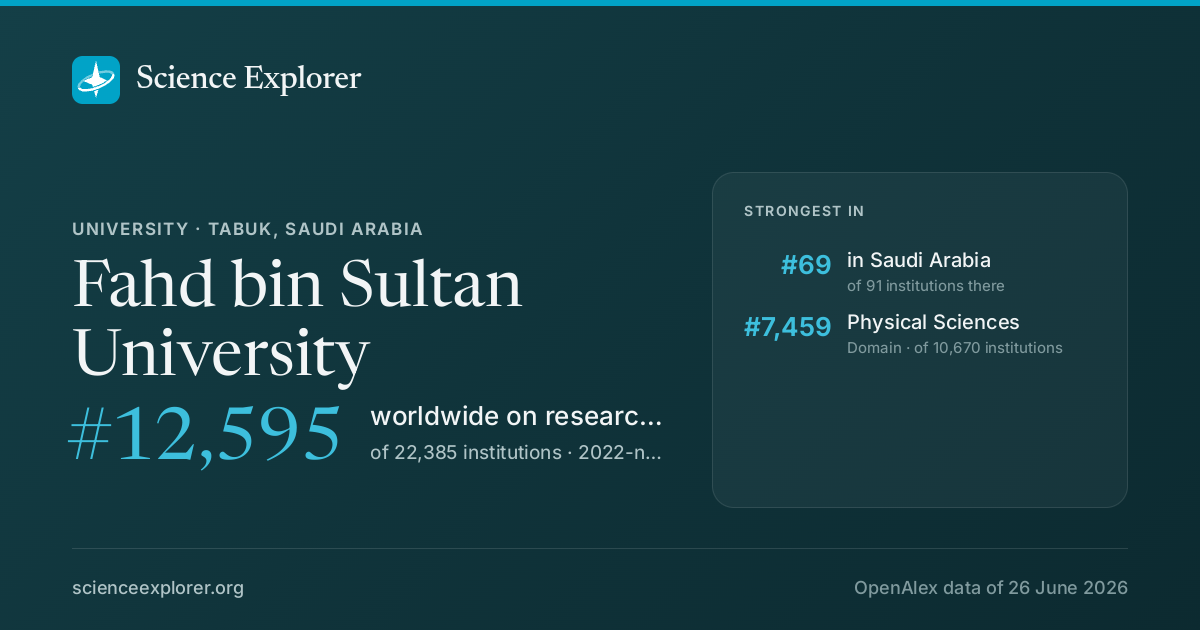
Fahd bin Sultan University on Science Explorer

A card with Fahd bin Sultan University's standing and the fields it leads in, for a post or a slide. A link to this page previews as the same card.

Download the card

1200 × 630 PNG, sized for social posts, drawn from the latest snapshot.

Badges for a website1Each links back here and updates with every snapshot

Research measures only: rankings here say nothing about teaching, admissions or student experience. Comparable institutions and collaboration partners have tabs of their own, above.

Discussion

Ask a question or share a note about Fahd bin Sultan University. Posts are plain text and can be reported.