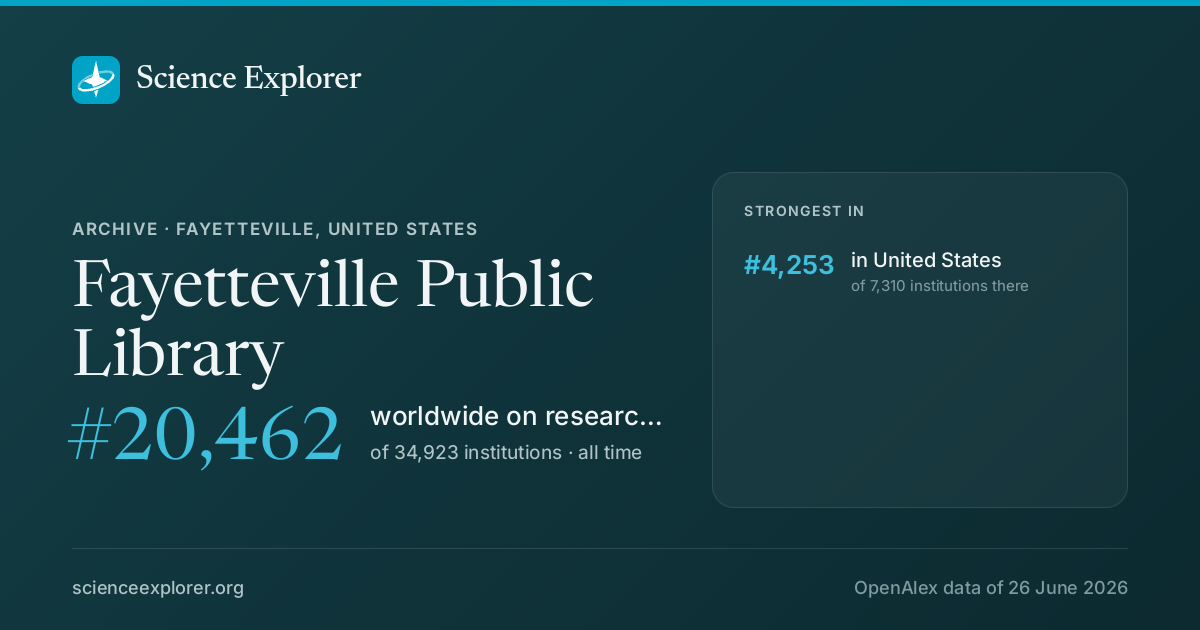
- World rank, all time
- #20,462 of 34,923
- Rank in United States
- #4,253 of 7,310
- Research works
- 218 ▼ 39% vs 2018-21
- Citations
- 1.9k 8.8 per fractional work
- Top-10% rate
- 5.3% all institutions 10.0%
- vs its own fields
- 0.92× 1.00× is exactly expected
- Open access
- 22% world 40%
- International
- 8% world 18%
Which fields of science does Fayetteville Public Library work in?
In 2022-now, 34% of research at Fayetteville Public Library is in Social Sciences, 32% in Physical Sciences. Its largest fields are Engineering (20%), Social Sciences (19%), Medicine (13%). It does 1.3× the world's share of Social Sciences.
Each ring splits the one inside it: the four domains of science, their fields, their subfields. Size is fractional works in 2022-now. Every slice is a page; the interactive view zooms down to single topics and colours each by how much more of it this institution does than the world.
Its 4 domains and 18 fields, with their numbers
- Social Sciences1433.5%
- Social Sciences819.3%
- Arts and Humanities25.3%
- Psychology25.3%
- Decision Sciences23.7%
- Physical Sciences1432.3%
- Engineering920.1%
- Computer Science24.8%
- Earth and Planetary Sciences12.8%
- Materials Science11.9%
- Environmental Science11.4%
- Physics and Astronomy11.2%
- Energy00.2%
- Health Sciences817.7%
- Medicine613.2%
- Dentistry12.1%
- Nursing11.3%
- Health Professions00.6%
- Veterinary00.5%
- Life Sciences716.4%
Field profile
Location quotient across every field it publishes in: outside the ring is more than an institution of this size would be expected to publish, inside it is less.
Rings at 0.5×, 1× and 2×. Widest outward: Dentistry, 4.3×. Every wedge is a field page.
All 18 fields, with their numbers
- Dentistry4.27×1 works
- Decision Sciences3.84×2 works
- Veterinary3.83×0 works
- Nursing2.66×1 works
- Biochemistry, Genetics and Molecular Biology2.13×5 works
- Arts and Humanities1.83×2 works
- Earth and Planetary Sciences1.79×1 works
- Psychology1.73×2 works
- Social Sciences1.52×8 works
- Engineering1.34×9 works
- Agricultural and Biological Sciences1.05×2 works
- Medicine0.69×6 works
- Computer Science0.61×2 works
- Materials Science0.56×1 works
- Physics and Astronomy0.54×0 works
- Environmental Science0.28×1 works
- Health Professions0.23×0 works
- Energy0.21×0 works
- Dentistry 4.3×
- Decision Sciences 3.8×
- Veterinary 3.8×
- Nursing 2.7×
- Biochemistry, Genetics and Molecular Biology 2.1×
- Arts and Humanities 1.8×
- Earth and Planetary Sciences 1.8×
- Psychology 1.7×
- Social Sciences 1.5×
- Engineering 1.3×
- Agricultural and Biological Sciences 1.1×
- Medicine 0.7×
- Computer Science 0.6×
- Materials Science 0.6×
- Physics and Astronomy 0.5×
- Environmental Science 0.3×
- Health Professions 0.2×
- Energy 0.2×
Who are the top researchers at Fayetteville Public Library?
Ranked on the quality score, Teresa Brawner Bevis, Charles William Woodworth and Naif G. Sinada lead among researchers whose main affiliation is Fayetteville Public Library.
- 1
Teresa Brawner Bevis
 United States · #2,156,812 worldwide
214 citations · 58 works
- 2
Charles William Woodworth
United States · #3,128,474 worldwide
54 citations · 15 works
- 3
Naif G. Sinada
United States · #3,519,733 worldwide
205 citations · 23 works
- 4
Jerome McNeill
United States · #3,777,164 worldwide
220 citations · 26 works
- 5
Linda Leavell
United States · #4,471,402 worldwide
84 citations · 16 works
Which keywords describe research at Fayetteville Public Library?
By fractional works in 2022-now, weighted toward what it does more of than the world: Quality Assurance, Higher Education, Globalization, Metabolic Engineering, Neoliberalism, Constraint-Based Models, Genome-Scale Models and Online Learning.
- Open Educational Resources
- Magnetic Resonance Imaging
- Geomycology
- Biogas Production
- Big Data Analytics
- Academic Writing
- Digital Twin
- Conservation
- Wide Bandgap Semiconductors
- Probiotics
- Enzymatic Hydrolysis
- Open Access
- Power Electronics
- Peer Review
- Internationalization
- Academic Identity
- Genome-Scale Models
- Neoliberalism
- Metabolic Engineering
- Quality Assurance
- Globalization
- Higher Education
- Online Learning
- Constraint-Based Models
- Social Justice
- Genetic Regulation
- Thermal Management
- Molecular Signaling
- Tooth Development
- Research Dissemination
- Pretreatment
- Reliability
- Biomineralization
- Osteopontin
- Gut Microbiota
- Anaerobic Digestion
- Biodeterioration
- Distance Education
- Learning Object Repositories
- Microbial Community
Size is fractional works in 2022-now in the topics tagged with each word; colour is the word's share of this institution's work against its share of the world's. The 40 words are chosen for being large and distinctive. Each links to the topic it comes from most.
All 40 words, with their numbers
- Globalization3▲ 3.8×5 topics
- Quality Assurance3▲ 37×2 topics
- Higher Education2▲ 10×3 topics
- Metabolic Engineering2▲ 53×2 topics
- Online Learning2▲ 5.8×3 topics
- Neoliberalism2▲ 13×2 topics
- Constraint-Based Models2▲ 105×1 topic
- Genome-Scale Models2▲ 105×1 topic
- Social Justice2▲ 7.0×5 topics
- Academic Identity2▲ 135×1 topic
- Genetic Regulation2▲ 24×2 topics
- Internationalization2▲ 66×1 topic
- Thermal Management2▲ 12×2 topics
- Peer Review2▲ 106×3 topics
- Molecular Signaling2▲ 182×1 topic
- Power Electronics2▲ 11×3 topics
- Tooth Development2▲ 182×1 topic
- Open Access1▲ 33×2 topics
- Research Dissemination1▲ 145×2 topics
- Enzymatic Hydrolysis1▲ 32×1 topic
- Pretreatment1▲ 58×1 topic
- Probiotics1▲ 13×2 topics
- Reliability1▲ 41×1 topic
- Wide Bandgap Semiconductors1▲ 75×1 topic
- Biomineralization1▲ 37×1 topic
- Conservation1▲ 6.8×3 topics
- Osteopontin1▲ 172×1 topic
- Digital Twin1▲ 18×2 topics
- Gut Microbiota1▲ 7.3×2 topics
- Academic Writing1▲ 63×1 topic
- Anaerobic Digestion1▲ 83×1 topic
- Big Data Analytics1▲ 11×1 topic
- Biodeterioration1▲ 85×1 topic
- Biogas Production1▲ 83×1 topic
- Distance Education1▲ 12×1 topic
- Geomycology1▲ 85×1 topic
- Learning Object Repositories1▲ 260×1 topic
- Magnetic Resonance Imaging1▲ 9.4×2 topics
- Microbial Community1▲ 29×2 topics
- Open Educational Resources1▲ 260×1 topic
Which research topics does Fayetteville Public Library publish most on?
By volume in 2022-now: Microbial Metabolic Engineering and Bioproduction, Higher Education Governance and Development, dental development and anomalies and Biofuel production and bioconversion.
Area is fractional works; colour is the subfield each topic belongs to.
- 1 Microbial Metabolic Engineering and Bioproduction Molecular Biology 2 works
- 2 Higher Education Governance and Development Political Science and International Relations 2 works
- 3 dental development and anomalies Molecular Biology 2 works
- 4 Biofuel production and bioconversion Biomedical Engineering 1 works
- 5 Silicon Carbide Semiconductor Technologies Electrical and Electronic Engineering 1 works
- 6 Bone and Dental Protein Studies Rheumatology 1 works
- 7 Building materials and conservation Earth-Surface Processes 1 works
- 8 Publishing and Scholarly Communication History and Philosophy of Science 1 works
- 9 Open Education and E-Learning Computer Science Applications 1 works
- 10 Academic Research in Diverse Fields Education 1 works
How open and international is its research?
Against the world's own shares: the tick on each track. Both are shares of its output, so they sit on one scale and can be read against each other as well as against the world.
World: 40% of research is openly available.
World: 18% is written across borders.
How has Fayetteville Public Library's research output changed?
Output in 2022-2025 was 39% lower than in 2018-2021.
The same series as a ribbon: one cell per year, darker for more. The line above answers how much; this answers when.
Its share of all research
Growing output can still be a shrinking share: all of science grows. This is Fayetteville Public Library as a percentage of every work published that year, 0.00028% in 2024.
Fractional works of Fayetteville Public Library over all fractional works that year. How the balance of science has shifted.
Other research institutions in Fayetteville
- University of Arkansas at Fayetteville
- Nanomaterials & Nanofabrication Laboratories (United States)
- Arkansas Power Electronics International
- Highlands Oncology Group
- Parallel Quantum Solutions (United States)
- Washington Regional Medical Center
- VinTech (United States)
- Space Photonics (United States)
Share Fayetteville Public Library's ranking
Badges for a website1Each links back here and updates with every snapshot

Research measures only: rankings here say nothing about teaching, admissions or student experience. Comparable institutions and collaboration partners have tabs of their own, above.
Discussion
Ask a question or share a note about Fayetteville Public Library. Posts are plain text and can be reported.