Science Explorer Back to mapMap
Discussion
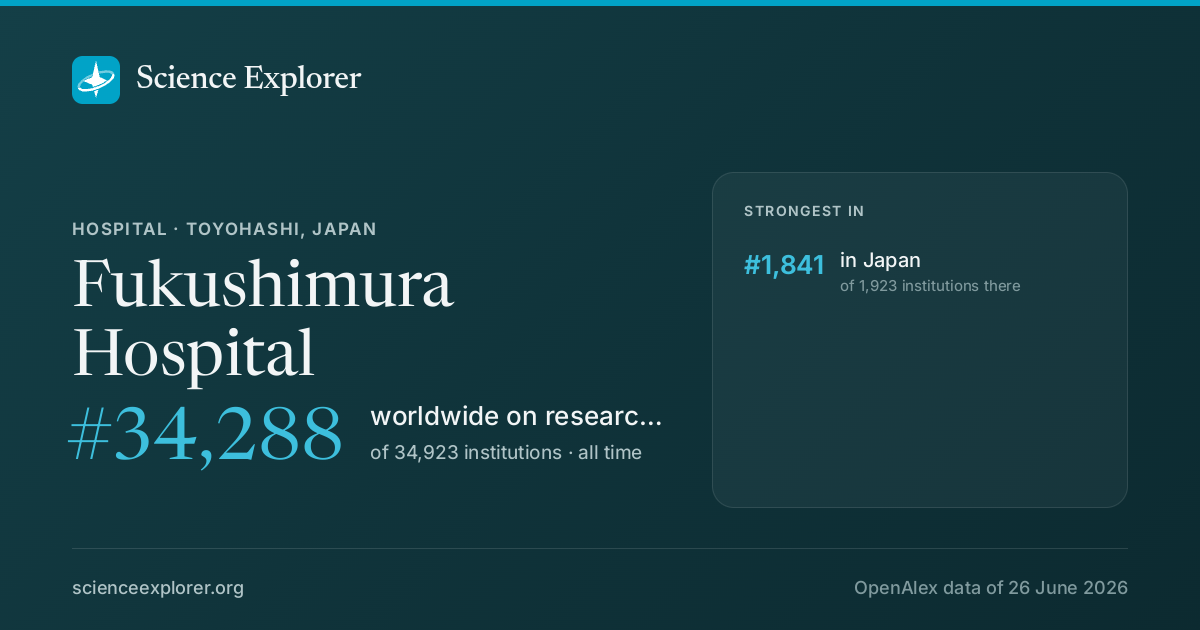
Hospital / health system · Toyohashi · Japan

Fukushimura Hospital

World rank, all time
#34,288
of 34,923
Rank in Japan
#1,841
of 1,923
Research works
130
▼ 30% vs 2018-21
Citations
3.1k
23.9 per fractional work
Top-10% rate
6.8%
all institutions 10.0%
vs its own fields
0.91×
1.00× is exactly expected
Open access
46%
world 40%
International
20%
world 18%

Which fields of science does Fukushimura Hospital work in?

In all years, 60% of research at Fukushimura Hospital is in Health Sciences, 32% in Life Sciences. Its largest fields are Medicine (56%), Biochemistry, Genetics and Molecular Biology (15%), Neuroscience (10%). It does 2.4× the world's share of Health Sciences.

Health Sciences: 78 fractional works · 60.0% of its workMedicine: 73 fractional works · 55.9% of its workPhysiology: 12 fractional works · 9.6% of its workNeurology: 10 fractional works · 7.4% of its workSurgery: 9 fractional works · 7.2% of its workEpidemiology: 6 fractional works · 4.4% of its workPsychiatry and Mental health: 6 fractional works · 4.4% of its workOrthopedics and Sports Medicine: 4 fractional works · 3.4% of its workOncology: 3 fractional works · 2.5% of its workPulmonary and Respiratory Medicine: 2 fractional works · 1.6% of its workGenetics: 2 fractional works · 1.3% of its workRheumatology: 2 fractional works · 1.3% of its workInfectious Diseases: 2 fractional works · 1.3% of its workPharmacology: 2 fractional works · 1.2% of its workPublic Health, Environmental and Occupational Health: 1 fractional works · 1.1% of its workHematology: 1 fractional works · 1.0% of its workRadiology, Nuclear Medicine and Imaging: 1 fractional works · 1.0% of its workPathology and Forensic Medicine: 1 fractional works · 1.0% of its workNephrology: 1 fractional works · 1.0% of its workCardiology and Cardiovascular Medicine: 1 fractional works · 0.8% of its workPediatrics, Perinatology and Child Health: 1 fractional works · 0.8% of its workEndocrinology, Diabetes and Metabolism: 1 fractional works · 0.7% of its workHepatology: 1 fractional works · 0.6% of its workComplementary and alternative medicine: 1 fractional works · 0.6% of its workRehabilitation: 1 fractional works · 0.6% of its workOphthalmology: 0 fractional works · 0.3% of its workUrology: 0 fractional works · 0.2% of its workSmaller subfields together: 1 fractional works · 0.8% of its workHealth Professions: 3 fractional works · 2.6% of its workComplementary and Manual Therapy: 1 fractional works · 0.8% of its workRadiological and Ultrasound Technology: 1 fractional works · 0.6% of its workSpeech and Hearing: 1 fractional works · 0.5% of its workGeneral Health Professions: 0 fractional works · 0.3% of its workSmaller subfields together: 0 fractional works · 0.3% of its workNursing: 2 fractional works · 1.3% of its workNutrition and Dietetics: 2 fractional works · 1.2% of its workSmaller subfields together: 0 fractional works · 0.1% of its workDentistry: 0 fractional works · 0.1% of its workLife Sciences: 42 fractional works · 32.0% of its workBiochemistry, Genetics and Molecular Biology: 19 fractional works · 14.8% of its workMolecular Biology: 13 fractional works · 10.1% of its workGenetics: 2 fractional works · 1.7% of its workCell Biology: 2 fractional works · 1.3% of its workCancer Research: 1 fractional works · 0.6% of its workPhysiology: 0 fractional works · 0.4% of its workClinical Biochemistry: 0 fractional works · 0.4% of its workSmaller subfields together: 0 fractional works · 0.4% of its workNeuroscience: 13 fractional works · 10.1% of its workCellular and Molecular Neuroscience: 5 fractional works · 4.2% of its workNeurology: 5 fractional works · 3.6% of its workCognitive Neuroscience: 1 fractional works · 1.0% of its workDevelopmental Neuroscience: 1 fractional works · 0.6% of its workSensory Systems: 1 fractional works · 0.4% of its workSmaller subfields together: 0 fractional works · 0.2% of its workImmunology and Microbiology: 6 fractional works · 4.8% of its workImmunology: 4 fractional works · 3.1% of its workVirology: 2 fractional works · 1.3% of its workMicrobiology: 0 fractional works · 0.4% of its workSmaller subfields together: 0 fractional works · 0.1% of its workAgricultural and Biological Sciences: 3 fractional works · 2.2% of its workInsect Science: 1 fractional works · 0.8% of its workPlant Science: 1 fractional works · 0.7% of its workFood Science: 1 fractional works · 0.4% of its workSmaller subfields together: 0 fractional works · 0.3% of its workPharmacology, Toxicology and Pharmaceutics: 0 fractional works · 0.2% of its workPhysical Sciences: 8 fractional works · 6.2% of its workEngineering: 3 fractional works · 2.2% of its workBiomedical Engineering: 2 fractional works · 1.2% of its workIndustrial and Manufacturing Engineering: 0 fractional works · 0.4% of its workSmaller subfields together: 1 fractional works · 0.6% of its workChemistry: 2 fractional works · 1.4% of its workAnalytical Chemistry: 1 fractional works · 0.8% of its workSpectroscopy: 1 fractional works · 0.4% of its workOrganic Chemistry: 0 fractional works · 0.2% of its workComputer Science: 1 fractional works · 1.1% of its workComputational Theory and Mathematics: 1 fractional works · 0.7% of its workSmaller subfields together: 1 fractional works · 0.4% of its workEnvironmental Science: 1 fractional works · 1.1% of its workHealth, Toxicology and Mutagenesis: 1 fractional works · 0.7% of its workSmaller subfields together: 0 fractional works · 0.4% of its workMaterials Science: 1 fractional works · 0.4% of its workMaterials Chemistry: 0 fractional works · 0.3% of its workSmaller subfields together: 0 fractional works · 0.1% of its workPhysics and Astronomy: 0 fractional works · 0.1% of its workSocial Sciences: 2 fractional works · 1.8% of its workSocial Sciences: 1 fractional works · 1.1% of its workSafety Research: 1 fractional works · 0.9% of its workSmaller subfields together: 0 fractional works · 0.2% of its workPsychology: 1 fractional works · 0.6% of its workClinical Psychology: 0 fractional works · 0.4% of its workSmaller subfields together: 0 fractional works · 0.2% of its workArts and Humanities: 0 fractional works · 0.1% of its workALL ITS WORKFukushimuraHospital130fractional works, all years
Life Sciences32%Physical Sciences6%Health Sciences60%Social Sciences2%

Each ring splits the one inside it: the four domains of science, their fields, their subfields. Size is fractional works in all years. Every slice is a page; the interactive view zooms down to single topics and colours each by how much more of it this institution does than the world.

Its 4 domains and 18 fields, with their numbers
    1. Medicine7355.9%
    2. Health Professions32.6%
    3. Nursing21.3%
    4. Dentistry00.1%
    1. Biochemistry, Genetics and Molecular Biology1914.8%
    2. Neuroscience1310.1%
    3. Immunology and Microbiology64.8%
    4. Agricultural and Biological Sciences32.2%
    5. Pharmacology, Toxicology and Pharmaceutics00.2%
    1. Engineering32.2%
    2. Chemistry21.4%
    3. Computer Science11.1%
    4. Environmental Science11.1%
    5. Materials Science10.4%
    6. Physics and Astronomy00.1%
    1. Social Sciences11.1%
    2. Psychology10.6%
    3. Arts and Humanities00.1%
All of science, and how each field's share has moved since 1950: the Science domain explorer

Field profile

Location quotient across every field it publishes in: outside the ring is more than an institution of this size would be expected to publish, inside it is less.

Agricultural and Biological Sciences: 0.21× its world share, 0 worksAgricultural and Bio…Biochemistry, Genetics and Molecular Biology: 2.18× its world share, 1 worksBiochemistry, Geneti…Immunology and Microbiology: 1.72× its world share, 0 worksImmunology and Micro…Neuroscience: 12.35× its world share, 2 worksNeuroscienceComputer Science: 0.05× its world share, 0 worksComputer ScienceEnvironmental Science: 0.22× its world share, 0 worksEnvironmental ScienceHealth Professions: 3.10× its world share, 1 worksHealth ProfessionsMedicine: 2.78× its world share, 6 worksMedicineNursing: 3.74× its world share, 0 worksNursingPsychology: 0.24× its world share, 0 worksPsychology1×world share
more than its size predictsabout as predictedless

Rings at 0.5×, 1× and 2×. Widest outward: Neuroscience, 12.3×. Every wedge is a field page.

All 10 fields, with their numbers
  1. Neuroscience12.35×2 works
  2. Nursing3.74×0 works
  3. Health Professions3.10×1 works
  4. Medicine2.78×6 works
  5. Biochemistry, Genetics and Molecular Biology2.18×1 works
  6. Immunology and Microbiology1.72×0 works
  7. Psychology0.24×0 works
  8. Environmental Science0.22×0 works
  9. Agricultural and Biological Sciences0.21×0 works
  10. Computer Science0.05×0 works

Who are the top researchers at Fukushimura Hospital?

Ranked on the quality score, Hiroyasu Akatsu, Takeshi Kanesaka and Daita Kaneda lead among researchers whose main affiliation is Fukushimura Hospital.

  1. 1 Hiroyasu Akatsu Japan · #1,709,973 worldwide 11k citations · 311 works
  2. 2 Takeshi Kanesaka Japan · #4,021,690 worldwide 324 citations · 16 works
  3. 3 Daita Kaneda Japan · #5,157,304 worldwide 718 citations · 65 works
  4. 4 Norihiro Ogawa Japan · #5,624,400 worldwide 251 citations · 24 works
All ranked researchers at Fukushimura Hospital

What are the most cited papers from Fukushimura Hospital?

The most cited paper from Fukushimura Hospital is "Diagnosis and management of dementia with Lewy bodies" (Ian Grant McKeith et al., 2005), with 5,092 citations. Next come "Brain homogenates from human tauopathies induce tau inclusions in mouse brain" (782) and "Florbetaben PET imaging to detect amyloid beta plaques in Alzheimer's disease: Phase 3 study" (628).

Most cited papers
#PaperReleasedCitations
1 Diagnosis and management of dementia with Lewy bodies Ian Grant McKeith et al. · Neurology 27 Dec 2005 5,092
2 Brain homogenates from human tauopathies induce tau inclusions in mouse brain Florence Clavaguera, Hiroyasu Akatsu, Graham Mathew Fraser et al. · Proceedings of the National Academy of Sciences Open access 20 May 2013 782
3 Florbetaben PET imaging to detect amyloid beta plaques in Alzheimer's disease: Phase 3 study Osama Sabri et al. · Alzheimer s & Dementia Open access 27 Mar 2015 628
4 Prion-like Properties of Pathological TDP-43 Aggregates from Diseased Brains Takashi Nonaka, Masami Masuda‐Suzukake, Tetsuaki Arai et al. · Cell Reports Open access Jul 2013 522
5 Reduced Neuron-Specific Expression of the TAF1 Gene Is Associated with X-Linked Dystonia-Parkinsonism Satoshi Makino, Ryuji Kaji, Satoshi Ando et al. · The American Journal of Human Genetics Open access 5 Feb 2007 291
All 60 most cited papers, with filters and sorting

Which keywords describe research at Fukushimura Hospital?

By fractional works in all years, weighted toward what it does more of than the world: Oxidative Stress, Neurodegeneration, Neuroinflammation, Therapeutic Strategies, Amyloid Hypothesis, Tau Pathology, Neuroimaging and Alzheimer's Disease.

▲ more of its work than of the world's◆ about the world's share▼ less than the world's

Size is fractional works in all years in the topics tagged with each word; colour is the word's share of this institution's work against its share of the world's. The 40 words are chosen for being large and distinctive. Each links to the topic it comes from most.

All 40 words, with their numbers
  1. Oxidative Stress19▲ 8.1×23 topics
  2. Neurodegeneration18▲ 44×9 topics
  3. Neuroinflammation13▲ 36×6 topics
  4. Epidemiology11▲ 2.1×52 topics
  5. Therapeutic Strategies10▲ 84×2 topics
  6. Amyloid Hypothesis10▲ 137×1 topic
  7. Tau Pathology10▲ 137×1 topic
  8. Neuroimaging8▲ 20×9 topics
  9. Alzheimer's Disease7▲ 20×7 topics
  10. Parkinson's Disease6▲ 22×8 topics
  11. Biomarkers6▲ 7.9×6 topics
  12. Inflammation6▲ 2.0×35 topics
  13. Mitochondrial Dysfunction6▲ 13×7 topics
  14. Aging6▲ 9.0×6 topics
  15. Neurological Disorders6▲ 6.8×13 topics
  16. Dementia5▲ 53×2 topics
  17. Dopaminergic Neurons5▲ 55×2 topics
  18. Genetics5▲ 4.6×10 topics
  19. Innate Immunity5▲ 10×7 topics
  20. Cognitive Decline4▲ 31×1 topic
  21. Mild Cognitive Impairment4▲ 53×1 topic
  22. Immune Response4▲ 4.9×12 topics
  23. Diagnostic Criteria4▲ 14×4 topics
  24. Genetic Risk Factors4▲ 57×1 topic
  25. Neurodegenerative Diseases4▲ 13×4 topics
  26. a-Synuclein4▲ 57×1 topic
  27. Vaccine4▲ 6.6×7 topics
  28. Cancer Therapy3▲ 3.6×11 topics
  29. Brain Development3▲ 11×4 topics
  30. Parathyroid Hormone3▲ 21×2 topics
  31. Pathophysiology3▲ 7.5×5 topics
  32. Angiogenesis3▲ 4.9×9 topics
  33. Rehabilitation2▲ 5.2×8 topics
  34. Wnt Signaling2▲ 15×2 topics
  35. Bone Mineral Density2▲ 19×1 topic
  36. Fractures2▲ 37×1 topic
  37. Ischemic Stroke2▲ 12×4 topics
  38. Anticoagulant Therapy2▲ 14×4 topics
  39. Osteoarthritis2▲ 13×4 topics
  40. Protein Aggregation2▲ 20×2 topics

Which research topics does Fukushimura Hospital publish most on?

By volume in 2022-now: Dementia and Cognitive Impairment Research, Occupational Health and Safety Research, Alzheimer's disease research and treatments and Parkinson's Disease Mechanisms and Treatments.

  1. 1 Dementia and Cognitive Impairment Research Psychiatry and Mental health 1 works
  2. 2 Occupational Health and Safety Research Radiological and Ultrasound Technology 1 works
  3. 3 Alzheimer's disease research and treatments Physiology 1 works
  4. 4 Parkinson's Disease Mechanisms and Treatments Neurology 1 works
  5. 5 Amyotrophic Lateral Sclerosis Research Neurology 1 works
  6. 6 Genetic Neurodegenerative Diseases Cellular and Molecular Neuroscience 0 works
  7. 7 Neurological diseases and metabolism Neurology 0 works
  8. 8 Olfactory and Sensory Function Studies Sensory Systems 0 works
  9. 9 Stroke Rehabilitation and Recovery Rehabilitation 0 works
  10. 10 Advanced Neuroimaging Techniques and Applications Radiology, Nuclear Medicine and Imaging 0 works

How open and international is its research?

Against the world's own shares: the tick on each track. Both are shares of its output, so they sit on one scale and can be read against each other as well as against the world.

openly available45.5%not open54.5%

World: 40% of research is openly available.

with international co-authors20.5%domestic only79.5%

World: 18% is written across borders.

How has Fukushimura Hospital's research output changed?

Output in 2022-2025 was 30% lower than in 2018-2021.

still counting1990200020102020
grewheldshrank

The same series as a ribbon: one cell per year, darker for more. The line above answers how much; this answers when.

Its share of all research

Growing output can still be a shrinking share: all of science grows. This is Fukushimura Hospital as a percentage of every work published that year, 0.000046% in 2024.

still counting0.00020%0.00040%Fukushimura Hospital0.000027% in 202519801990200020102020

Fractional works of Fukushimura Hospital over all fractional works that year. How the balance of science has shifted.

Other research institutions in Toyohashi

All research institutions in Toyohashi

Share Fukushimura Hospital's ranking

Fukushimura Hospital on Science Explorer

A card with Fukushimura Hospital's standing and the fields it leads in, for a post or a slide. A link to this page previews as the same card.

Download the card

1200 × 630 PNG, sized for social posts, drawn from the latest snapshot.

Badges for a website1Each links back here and updates with every snapshot

Research measures only: rankings here say nothing about teaching, admissions or student experience. Comparable institutions and collaboration partners have tabs of their own, above.

Discussion

Ask a question or share a note about Fukushimura Hospital. Posts are plain text and can be reported.