- World rank, all time
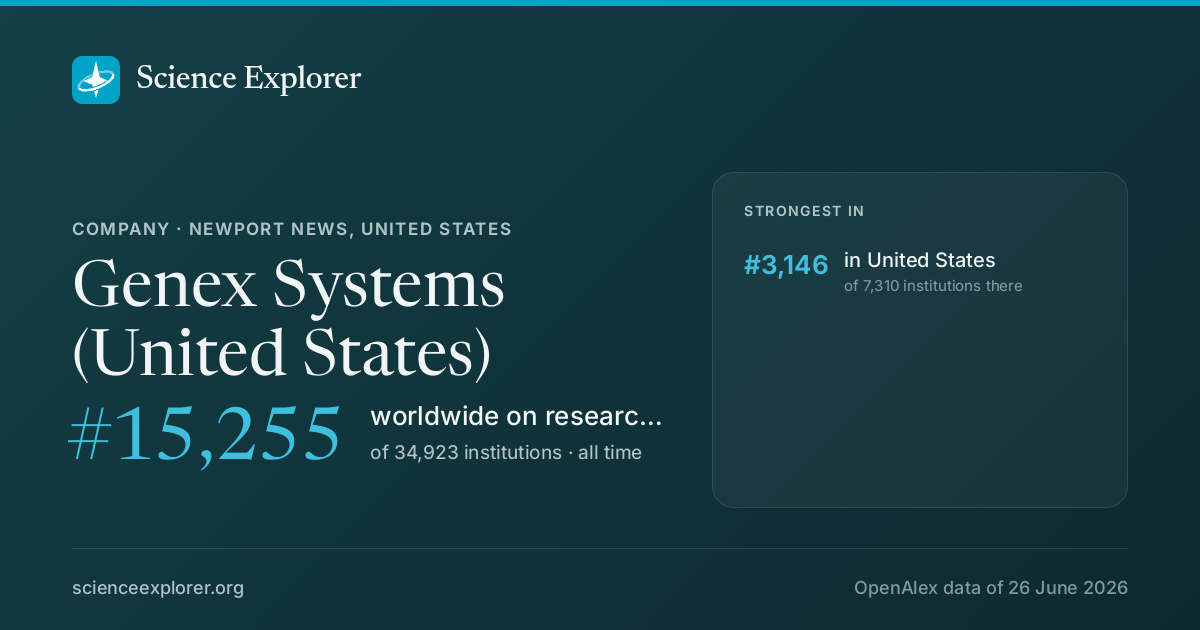
- #15,255 of 34,923
- Rank in United States
- #3,146 of 7,310
- Research works
- 308 ▲ 47% vs 2018-21
- Citations
- 9.7k 31.4 per fractional work
- Top-10% rate
- 9.3% all institutions 10.0%
- vs its own fields
- 1.17× 1.00× is exactly expected
- Open access
- 29% world 40%
- International
- 23% world 18%
Which fields of science does Genex Systems (United States) work in?
In 2022-now, 52% of research at Genex Systems (United States) is in Physical Sciences, 23% in Life Sciences. Its largest fields are Engineering (35%), Biochemistry, Genetics and Molecular Biology (17%), Medicine (12%). It does 1.5× the world's share of Life Sciences.
Each ring splits the one inside it: the four domains of science, their fields, their subfields. Size is fractional works in 2022-now. Every slice is a page; the interactive view zooms down to single topics and colours each by how much more of it this institution does than the world.
Its 4 domains and 24 fields, with their numbers
- Physical Sciences3052.2%
- Engineering2035.2%
- Computer Science34.6%
- Physics and Astronomy12.3%
- Environmental Science12.2%
- Materials Science12.1%
- Earth and Planetary Sciences12.0%
- Energy11.7%
- Chemistry11.2%
- Chemical Engineering00.6%
- Mathematics00.3%
- Life Sciences1322.9%
- Health Sciences814.6%
- Medicine712.2%
- Health Professions12.0%
- Nursing00.2%
- Veterinary00.1%
- Dentistry00.1%
- Social Sciences610.4%
- Social Sciences46.1%
- Psychology12.0%
- Arts and Humanities11.4%
- Decision Sciences00.5%
- Economics, Econometrics and Finance00.3%
Field profile
Location quotient across every field it publishes in: outside the ring is more than an institution of this size would be expected to publish, inside it is less.
Rings at 0.5×, 1× and 2×. Widest outward: Biochemistry, Genetics and Molecular Biology, 3.3×. Every wedge is a field page.
All 24 fields, with their numbers
- Biochemistry, Genetics and Molecular Biology3.27×10 works
- Engineering2.35×20 works
- Neuroscience1.93×2 works
- Energy1.85×1 works
- Chemical Engineering1.71×0 works
- Earth and Planetary Sciences1.26×1 works
- Veterinary1.04×0 works
- Physics and Astronomy1.03×1 works
- Immunology and Microbiology0.93×0 works
- Health Professions0.75×1 works
- Chemistry0.73×1 works
- Psychology0.66×1 works
- Medicine0.63×7 works
- Computer Science0.59×3 works
- Materials Science0.59×1 works
- Decision Sciences0.52×0 works
- Social Sciences0.49×4 works
- Arts and Humanities0.47×1 works
- Environmental Science0.45×1 works
- Nursing0.39×0 works
- Agricultural and Biological Sciences0.29×1 works
- Mathematics0.27×0 works
- Economics, Econometrics and Finance0.16×0 works
- Dentistry0.13×0 works
- Biochemistry, Genetics and Molecular Biology 3.3×
- Engineering 2.4×
- Neuroscience 1.9×
- Energy 1.9×
- Chemical Engineering 1.7×
- Earth and Planetary Sciences 1.3×
- Veterinary 1.0×
- Physics and Astronomy 1.0×
- Immunology and Microbiology 0.9×
- Health Professions 0.8×
- Chemistry 0.7×
- Psychology 0.7×
- Medicine 0.6×
- Computer Science 0.6×
- Materials Science 0.6×
- Decision Sciences 0.5×
- Social Sciences 0.5×
- Arts and Humanities 0.5×
- Environmental Science 0.5×
- Nursing 0.4×
- Agricultural and Biological Sciences 0.3×
- Mathematics 0.3×
- Economics, Econometrics and Finance 0.2×
- Dentistry 0.1×
Who are the top researchers at Genex Systems (United States)?
Ranked on the quality score, Michael W. Pantoliano, Michele L. Rollence and Raghu Kiran Appasani lead among researchers whose main affiliation is Genex Systems (United States).
- 1
Michael W. Pantoliano
 United States · #155,796 worldwide
5.5k citations · 38 works
- 2
Michele L. Rollence
United States · #431,289 worldwide
2.2k citations · 22 works
- 3
Raghu Kiran Appasani
United States · #3,138,445 worldwide
337 citations · 33 works
- 4
Smita K. Rao
United States · #3,505,026 worldwide
118 citations · 15 works
- 5
Humg‐Yu Hsiao
United States · #3,543,029 worldwide
679 citations · 19 works
- 6
Krishnarao Appasani
United States · #3,666,827 worldwide
369 citations · 53 works
- 7
Mohamadreza Banihashemi
United States · #3,809,254 worldwide
339 citations · 24 works
- 8
Hsiao‐Fen Grace Chang
United States · #4,660,134 worldwide
698 citations · 19 works
- 9
Yun‐Long Tsai
United States · #5,004,372 worldwide
790 citations · 25 works
- 10
Haoyin Shan
United States · #5,402,194 worldwide
127 citations · 20 works
Which keywords describe research at Genex Systems (United States)?
By fractional works in 2022-now, weighted toward what it does more of than the world: Recycled Materials, Mechanical Properties, Artificial Neural Networks, Fiber Reinforced Concrete, Nanotechnology, Ultra-High Performance Concrete, Concrete and Fly Ash.
- Super-Resolution Imaging
- Neurodevelopmental Disorders
- Fluorescent Proteins
- Chloride-induced
- Autism Spectrum Disorders
- Crack Detection
- Asphalt
- Genetics
- Gender
- Fiber-Reinforced Polymer Composites
- Rheology
- Precision Medicine
- Image Processing
- Defect Detection
- Alkali-Activated Materials
- Fly Ash
- Concrete
- Nanotechnology
- Artificial Neural Networks
- Mechanical Properties
- Recycled Materials
- Environmental Impact
- Fiber Reinforced Concrete
- Ultra-High Performance Concrete
- Durability Performance
- Geopolymer
- Cementitious Materials
- Convolutional Neural Networks
- Nanomaterials
- Reinforced Concrete
- Construction
- Breast Cancer
- Gene Expression
- Life Cycle Assessment
- Bitumen Modification
- Pavement
- Autogenous Shrinkage
- Corrosion
- Internal Curing
- RNA-Seq
Size is fractional works in 2022-now in the topics tagged with each word; colour is the word's share of this institution's work against its share of the world's. The 40 words are chosen for being large and distinctive. Each links to the topic it comes from most.
All 40 words, with their numbers
- Recycled Materials3▲ 49×2 topics
- Mechanical Properties3▲ 5.4×3 topics
- Environmental Impact2▲ 2.4×6 topics
- Artificial Neural Networks2▲ 8.5×2 topics
- Fiber Reinforced Concrete2▲ 47×1 topic
- Nanotechnology2▲ 20×2 topics
- Ultra-High Performance Concrete2▲ 47×1 topic
- Concrete2▲ 86×2 topics
- Durability Performance2▲ 29×2 topics
- Fly Ash2▲ 25×2 topics
- Geopolymer2▲ 19×2 topics
- Alkali-Activated Materials2▲ 28×1 topic
- Cementitious Materials2▲ 28×1 topic
- Defect Detection2▲ 20×3 topics
- Convolutional Neural Networks1▲ 3.4×2 topics
- Image Processing1▲ 5.7×2 topics
- Nanomaterials1▲ 2.3×3 topics
- Precision Medicine1▲ 4.7×5 topics
- Reinforced Concrete1▲ 31×2 topics
- Rheology1▲ 12×4 topics
- Construction1▲ 17×1 topic
- Fiber-Reinforced Polymer Composites1▲ 36×1 topic
- Breast Cancer1▲ 7.9×5 topics
- Gender1▲ 3.9×6 topics
- Gene Expression1▲ 3.4×7 topics
- Genetics1▲ 2.9×3 topics
- Life Cycle Assessment1▲ 7.6×2 topics
- Asphalt1▲ 55×1 topic
- Bitumen Modification1▲ 55×1 topic
- Crack Detection1▲ 28×1 topic
- Pavement1▲ 28×1 topic
- Autism Spectrum Disorders1▲ 17×1 topic
- Autogenous Shrinkage1▲ 114×1 topic
- Chloride-induced1▲ 38×1 topic
- Corrosion1▲ 14×1 topic
- Fluorescent Proteins1▲ 76×1 topic
- Internal Curing1▲ 114×1 topic
- Neurodevelopmental Disorders1▲ 13×1 topic
- RNA-Seq1▲ 15×2 topics
- Super-Resolution Imaging1▲ 55×1 topic
Which research topics does Genex Systems (United States) publish most on?
By volume in 2022-now: Innovative concrete reinforcement materials, Concrete and Cement Materials Research, Structural Behavior of Reinforced Concrete and Infrastructure Maintenance and Monitoring.
Area is fractional works; colour is the subfield each topic belongs to.
- 1 Innovative concrete reinforcement materials Civil and Structural Engineering 2 works
- 2 Concrete and Cement Materials Research Civil and Structural Engineering 2 works
- 3 Structural Behavior of Reinforced Concrete Building and Construction 1 works
- 4 Infrastructure Maintenance and Monitoring Civil and Structural Engineering 1 works
- 5 Asphalt Pavement Performance Evaluation Civil and Structural Engineering 1 works
- 6 Concrete Corrosion and Durability Civil and Structural Engineering 1 works
- 7 Advanced Fluorescence Microscopy Techniques Biophysics 1 works
- 8 Autism Spectrum Disorder Research Cognitive Neuroscience 1 works
- 9 Concrete Properties and Behavior Civil and Structural Engineering 1 works
- 10 Cancer Genomics and Diagnostics Cancer Research 1 works
How open and international is its research?
Against the world's own shares: the tick on each track. Both are shares of its output, so they sit on one scale and can be read against each other as well as against the world.
World: 40% of research is openly available.
World: 18% is written across borders.
How has Genex Systems (United States)'s research output changed?
Output in 2022-2025 was 47% higher than in 2018-2021.
The same series as a ribbon: one cell per year, darker for more. The line above answers how much; this answers when.
Its share of all research
Growing output can still be a shrinking share: all of science grows. This is Genex Systems (United States) as a percentage of every work published that year, 0.00018% in 2024.
Fractional works of Genex Systems (United States) over all fractional works that year. How the balance of science has shifted.
Other research institutions in Newport News
- Thomas Jefferson National Accelerator Facility
- Christopher Newport University
- Riverside Regional Medical Center
- G & A Technical Software (United States)
- Aerotech Research (United States)
- Bon Secours Mary Immaculate Hospital
- Children’s Clinics
- Newport News Public Schools

Share Genex Systems (United States)'s ranking
Badges for a website1Each links back here and updates with every snapshot

Research measures only: rankings here say nothing about teaching, admissions or student experience. Comparable institutions and collaboration partners have tabs of their own, above.
Discussion
Ask a question or share a note about Genex Systems (United States). Keep it to the research: no personal attacks, advertising or links. Any reader can report a post, which collapses it for everyone until it is opened.