Ikerbasque
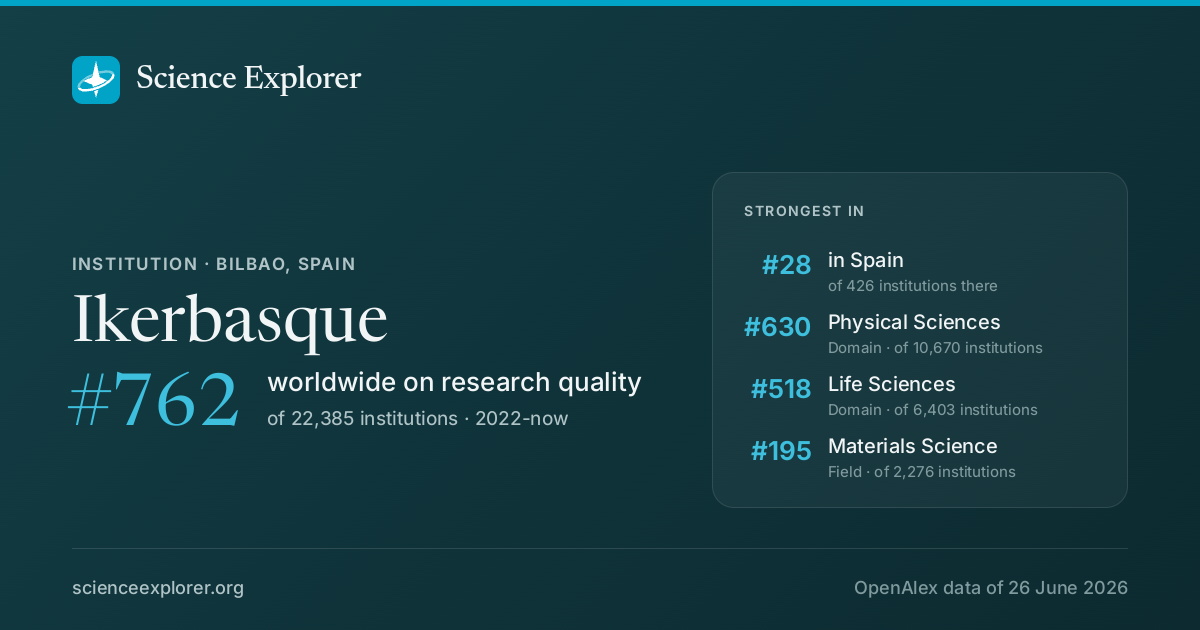
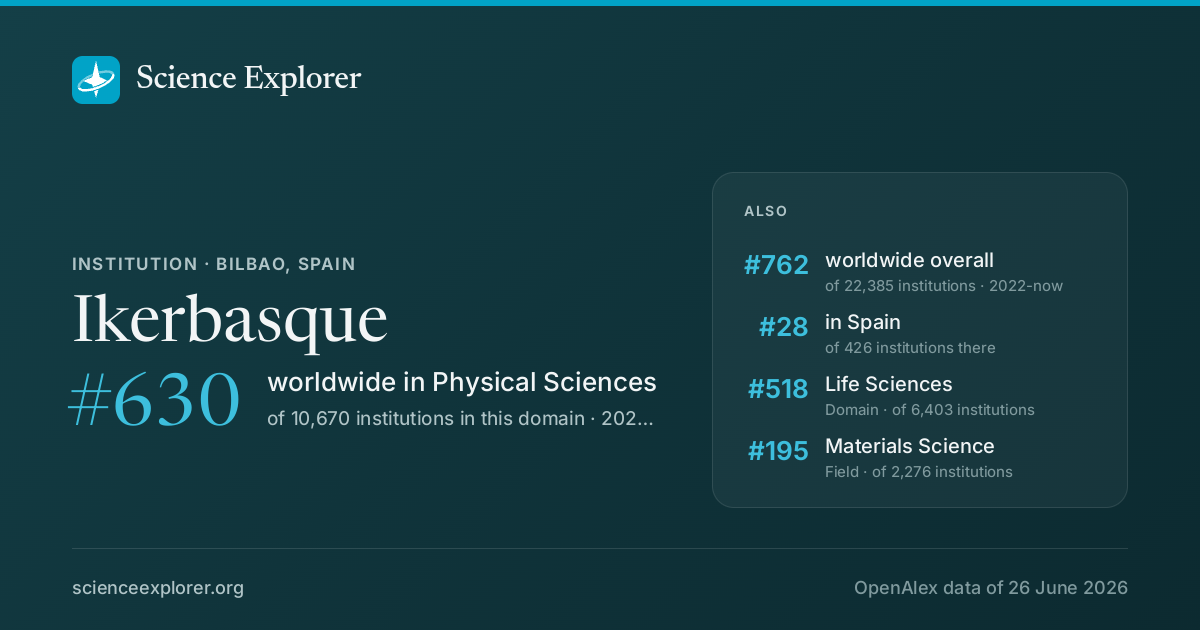
In research, Ikerbasque stands highest in Physical Sciences (#630 of 10,670 worldwide), Life Sciences (#518 of 6,403 worldwide) and Materials Science (#195 of 2,276 worldwide), 2022-now. Relative to its size it is most specialised in Atomic and Molecular Physics, and Optics, Polymers and Plastics and Electronic, Optical and Magnetic Materials (Atomic and Molecular Physics, and Optics is 7.8× its share of world research).
- World rank, 2022-now
- #762 of 22,385 · #434 all time
- Rank in Spain
- #28 of 426
- Research works
- 3.9k ▲ 20% vs 2018-21
- Citations
- 125k 31.8 per fractional work
- Top-10% rate
- 15.7% all institutions 10.0%
- vs its own fields
- 1.28× 1.00× is exactly expected
- Open access
- 67% world 40%
- International
- 61% world 18%
What is Ikerbasque known for in research?
The fields where it stands highest, 2022-now, ranked among every institution above the floor in each field.
| Field | World rank | Where that sits | Top-10% rate | Works | All time |
|---|---|---|---|---|---|
| Physical SciencesDomain | #630 of 10,670 | 14.6% | 909 | #314 | |
| Life SciencesDomain | #518 of 6,403 | 14.0% | 214 | #359 | |
| Materials ScienceField | #195 of 2,276 | 13.2% | 213 | #167 | |
| EngineeringField | #624 of 5,901 | 13.8% | 272 | #407 | |
| Health SciencesDomain | #1,090 of 9,902 | 19.8% | 102 | #841 | |
| MedicineField | #1,024 of 8,541 | 19.8% | 92 | #829 | |
| Biochemistry, Genetics and Molecular BiologyField | #520 of 2,964 | 12.3% | 112 | #380 | |
| Materials ChemistrySubfield | #298 of 1,473 | 14.6% | 97 | #221 | |
| Environmental ScienceField | #707 of 3,334 | 18.1% | 61 | #477 | |
| Biomedical EngineeringSubfield | #350 of 1,539 | 12.7% | 84 | #212 |
Each strip is that field's whole ranked pool, with the notch where Ikerbasque sits in it, in the colour of the band that rank falls in. The track under the rate is the rate itself: it carries no average mark, because the average differs by field (from about 6% in Dentistry to 21% in Economics).
Which of those standings moved
The same fields on both windows: where it stood over the whole record, and where it stands in 2022-now. The distance is the story, and it is the one thing the two rank columns above cannot show.
- Physical Sciences#314 #630
- Life Sciences#359 #518
- Materials Science#167 #195
- Engineering#407 #624
- Health Sciences#841 #1,090
- Medicine#829 #1,024
- Biochemistry, Genetics and Molecular Biology#380 #520
- Materials Chemistry#221 #298
- Environmental Science#477 #707
- Biomedical Engineering#212 #350
A dot further right is a better standing. Fields it was not ranked in over the whole record are left out.
Which fields of science does Ikerbasque work in?
In 2022-now, 67% of research at Ikerbasque is in Physical Sciences, 16% in Life Sciences. Its largest fields are Engineering (20%), Materials Science (16%), Physics and Astronomy (10%). It does 1.7× the world's share of Physical Sciences.
Each ring splits the one inside it: the four domains of science, their fields, their subfields. Size is fractional works in 2022-now. Every slice is a page; the interactive view zooms down to single topics and colours each by how much more of it this institution does than the world.
Its 4 domains and 26 fields, with their numbers
- Physical Sciences1,00567.4%
- Engineering30320.3%
- Materials Science23415.7%
- Physics and Astronomy1479.9%
- Chemistry936.2%
- Computer Science704.7%
- Environmental Science684.5%
- Mathematics302.0%
- Chemical Engineering251.7%
- Energy231.6%
- Earth and Planetary Sciences110.8%
- Life Sciences24316.3%
- Social Sciences1288.6%
- Social Sciences533.5%
- Psychology422.8%
- Arts and Humanities171.1%
- Business, Management and Accounting60.4%
- Economics, Econometrics and Finance50.4%
- Decision Sciences50.4%
- Health Sciences1167.8%
- Medicine1067.1%
- Health Professions60.4%
- Nursing20.1%
- Veterinary10.1%
- Dentistry10.1%
What does Ikerbasque specialise in?
Where its research is concentrated relative to its size: Atomic and Molecular Physics, and Optics takes 7.8× the share of its output that it takes of world research.
- Atomic and Molecular Physics, and OpticsSubfield · 83.3 works7.8×
- Polymers and PlasticsSubfield · 43.9 works7.3×
- Electronic, Optical and Magnetic MaterialsSubfield · 43.7 works6.4×
Location quotient, a volume reading rather than an impact one. It surfaces small, lopsided specialities.
Field profile
Location quotient across every field it publishes in: outside the ring is more than an institution of this size would be expected to publish, inside it is less.
Rings at 0.5×, 1× and 2×. Widest outward: Chemical Engineering, 4.9×. Every wedge is a field page.
All 26 fields, with their numbers
- Chemical Engineering4.87×25 works
- Materials Science4.50×234 works
- Physics and Astronomy4.44×147 works
- Chemistry3.96×93 works
- Neuroscience2.73×66 works
- Mathematics1.71×30 works
- Energy1.69×23 works
- Biochemistry, Genetics and Molecular Biology1.59×127 works
- Engineering1.36×303 works
- Immunology and Microbiology0.99×15 works
- Pharmacology, Toxicology and Pharmaceutics0.95×5 works
- Environmental Science0.92×68 works
- Psychology0.91×42 works
- Computer Science0.60×70 works
- Veterinary0.54×1 works
- Earth and Planetary Sciences0.49×11 works
- Agricultural and Biological Sciences0.43×30 works
- Arts and Humanities0.39×17 works
- Medicine0.37×106 works
- Decision Sciences0.37×5 works
- Nursing0.28×2 works
- Social Sciences0.28×53 works
- Economics, Econometrics and Finance0.17×5 works
- Dentistry0.15×1 works
- Health Professions0.15×6 works
- Business, Management and Accounting0.12×6 works
- Chemical Engineering 4.9×
- Materials Science 4.5×
- Physics and Astronomy 4.4×
- Chemistry 4.0×
- Neuroscience 2.7×
- Mathematics 1.7×
- Energy 1.7×
- Biochemistry, Genetics and Molecular Biology 1.6×
- Engineering 1.4×
- Immunology and Microbiology 1.0×
- Pharmacology, Toxicology and Pharmaceutics 0.9×
- Environmental Science 0.9×
- Psychology 0.9×
- Computer Science 0.6×
- Veterinary 0.5×
- Earth and Planetary Sciences 0.5×
- Agricultural and Biological Sciences 0.4×
- Arts and Humanities 0.4×
- Medicine 0.4×
- Decision Sciences 0.4×
- Nursing 0.3×
- Social Sciences 0.3×
- Economics, Econometrics and Finance 0.2×
- Dentistry 0.1×
- Health Professions 0.1×
- Business, Management and Accounting 0.1×
Who are the top researchers at Ikerbasque?
Ranked on the quality score, Pablo Alonso‐González, Alexey Y. Nikitin and Raúl E. Angulo lead among researchers whose main affiliation is Ikerbasque.
- 1
Pablo Alonso‐González
 Spain · #22,821 worldwide
11k citations · 135 works
- 2
Alexey Y. Nikitin
Spain · #66,442 worldwide
10k citations · 190 works
- 3
Raúl E. Angulo
Spain · #75,891 worldwide
9.6k citations · 291 works
- 4
Antonio Dominguez‐Alfaro
Spain · #75,909 worldwide
7.1k citations · 114 works
- 5
Ivo Souza
Spain · #106,039 worldwide
18k citations · 156 works
- 6
Anders Lanzén
Spain · #118,568 worldwide
8k citations · 120 works
- 7
Miguel M. Ugeda
Spain · #178,620 worldwide
8.7k citations · 102 works
- 8
Jose Julio Rodriguez
Spain · #181,249 worldwide
8.6k citations · 115 works
- 9
Susana Rodríguez‐Couto
Spain · #206,449 worldwide
11k citations · 196 works
- 10
Marek Grzelczak
Spain · #245,698 worldwide
11k citations · 178 works
Which keywords describe research at Ikerbasque?
By fractional works in 2022-now, weighted toward what it does more of than the world: Biomedical Applications, Nanocomposites, Nanoparticles, Cathode Materials, Catalysis, Tissue Engineering, Energy Storage and Graphene.
- Quantum Computing
- Solid-State Electrolytes
- Entanglement
- Raman Spectroscopy
- Battery Materials
- Ionic Conductivity
- Wearable
- Health Monitoring
- Battery Technology
- Flexible Electronics
- Electronic Structure
- Two-Dimensional Materials
- Conducting Polymers
- Spintronics
- Drug Delivery
- Biosensors
- Cathode Materials
- Energy Storage
- Catalysis
- Nanocomposites
- Biomedical Applications
- Nanoparticles
- Tissue Engineering
- Graphene
- Nanomaterials
- Self-Assembly
- Lithium-ion Batteries
- Rechargeable Batteries
- Nanofibers
- Biodegradable Polymers
- Organic Electronics
- Energy Harvesting
- Regenerative Medicine
- Nanogenerators
- Lithium-Sulfur Batteries
- Stability
- Nanostructured Anodes
- Superconductivity
- Nanostructured Cathodes
- Room Temperature
Size is fractional works in 2022-now in the topics tagged with each word; colour is the word's share of this institution's work against its share of the world's. The 40 words are chosen for being large and distinctive. Each links to the topic it comes from most.
All 40 words, with their numbers
- Biomedical Applications89▲ 5.0×32 topics
- Nanocomposites69▲ 5.8×21 topics
- Nanoparticles65▲ 3.5×36 topics
- Catalysis47▲ 4.8×28 topics
- Tissue Engineering45▲ 5.0×12 topics
- Energy Storage43▲ 4.5×10 topics
- Graphene42▲ 4.1×11 topics
- Cathode Materials42▲ 7.2×3 topics
- Nanomaterials40▲ 2.6×20 topics
- Biosensors32▲ 4.3×12 topics
- Self-Assembly31▲ 6.5×12 topics
- Drug Delivery31▲ 3.8×15 topics
- Lithium-ion Batteries31▲ 5.0×3 topics
- Spintronics28▲ 15×4 topics
- Rechargeable Batteries24▲ 6.0×2 topics
- Conducting Polymers24▲ 12×2 topics
- Nanofibers24▲ 7.8×3 topics
- Two-Dimensional Materials24▲ 6.9×4 topics
- Biodegradable Polymers23▲ 8.8×4 topics
- Electronic Structure22▲ 8.3×8 topics
- Organic Electronics22▲ 11×2 topics
- Flexible Electronics22▲ 8.4×3 topics
- Energy Harvesting21▲ 7.7×3 topics
- Battery Technology20▲ 4.8×2 topics
- Regenerative Medicine20▲ 5.3×6 topics
- Health Monitoring20▲ 6.5×3 topics
- Nanogenerators19▲ 9.9×1 topic
- Wearable19▲ 9.9×1 topic
- Lithium-Sulfur Batteries19▲ 9.0×2 topics
- Ionic Conductivity19▲ 9.4×2 topics
- Stability19▲ 5.7×7 topics
- Battery Materials19▲ 7.6×1 topic
- Nanostructured Anodes19▲ 7.6×1 topic
- Raman Spectroscopy18▲ 6.4×6 topics
- Superconductivity18▲ 7.1×9 topics
- Entanglement18▲ 7.9×4 topics
- Nanostructured Cathodes18▲ 9.8×1 topic
- Solid-State Electrolytes18▲ 9.8×1 topic
- Room Temperature17▲ 7.7×3 topics
- Quantum Computing16▲ 11×4 topics
Which research topics does Ikerbasque publish most on?
By volume in 2022-now: Advanced Sensor and Energy Harvesting Materials, Advancements in Battery Materials, Advanced Battery Materials and Technologies and Conducting polymers and applications.
Area is fractional works; colour is the subfield each topic belongs to.
- 1 Advanced Sensor and Energy Harvesting Materials Biomedical Engineering 19 works
- 2 Advancements in Battery Materials Electrical and Electronic Engineering 19 works
- 3 Advanced Battery Materials and Technologies Electrical and Electronic Engineering 18 works
- 4 Conducting polymers and applications Polymers and Plastics 15 works
- 5 Magnetic properties of thin films Atomic and Molecular Physics, and Optics 12 works
- 6 Perovskite Materials and Applications Electrical and Electronic Engineering 12 works
- 7 Quantum and electron transport phenomena Atomic and Molecular Physics, and Optics 12 works
- 8 biodegradable polymer synthesis and properties Biomaterials 12 works
- 9 Graphene research and applications Materials Chemistry 12 works
- 10 Advanced Polymer Synthesis and Characterization Organic Chemistry 9 works
How open and international is its research?
Against the world's own shares: the tick on each track. Both are shares of its output, so they sit on one scale and can be read against each other as well as against the world.
World: 40% of research is openly available.
World: 18% is written across borders.
How has Ikerbasque's research output changed?
Output in 2022-2025 was 20% higher than in 2018-2021.
The same series as a ribbon: one cell per year, darker for more. The line above answers how much; this answers when.
Its share of all research
Growing output can still be a shrinking share: all of science grows. This is Ikerbasque as a percentage of every work published that year, 0.0059% in 2024.
Fractional works of Ikerbasque over all fractional works that year. How the balance of science has shifted.
How much of it reaches the world top 10%
Year by year, against all institutions in the same year.
Of each year's output, the share that reached the world's 10% most cited for its field and year. Peak 25.5% in 2009.
Other research institutions in Bilbao
- Universidad de Deusto
- Hospital de Basurto
- Basque Center for Applied Mathematics
- Ente Vasco de la Energía
- Basque Centre for Climate Change
- Ayuntamiento de Bilbao
- Iberdrola (Spain)
- Banco Bilbao Vizcaya Argentaria (Spain)
Compare Ikerbasque with
- vs Universitat Jaume I
- vs
 Northwest Normal University
- vs
 Marche Polytechnic University
- vs Universidad de Alcalá
- vs Bocconi University
- vs Chongqing University of Technology
Share Ikerbasque's ranking


Research measures only: rankings here say nothing about teaching, admissions or student experience. Comparable institutions and collaboration partners have tabs of their own, above.
Discussion
Ask a question or share a note about Ikerbasque. Posts are plain text and can be reported.