Science Explorer Back to mapMap
Discussion
University · Ruhengeri · Rwanda

INES-Ruhengeri

World rank, 2022-now
#18,119
of 22,385 · #26,081 all time
Rank in Rwanda
#12
of 16
Research works
226
▲ 24% vs 2018-21
Citations
1k
4.5 per fractional work
Top-10% rate
5.9%
all institutions 10.0%
vs its own fields
0.91×
1.00× is exactly expected
Open access
84%
world 40%
International
27%
world 18%

Which fields of science does INES-Ruhengeri work in?

In 2022-now, 39% of research at INES-Ruhengeri is in Social Sciences, 29% in Health Sciences. Its largest fields are Medicine (24%), Economics, Econometrics and Finance (17%), Business, Management and Accounting (12%). It does 1.5× the world's share of Social Sciences.

Social Sciences: 37 fractional works · 38.6% of its workEconomics, Econometrics and Finance: 16 fractional works · 17.0% of its workEconomics and Econometrics: 16 fractional works · 16.6% of its workFinance: 0 fractional works · 0.3% of its workBusiness, Management and Accounting: 11 fractional works · 11.7% of its workAccounting: 5 fractional works · 5.6% of its workStrategy and Management: 3 fractional works · 2.7% of its workManagement of Technology and Innovation: 1 fractional works · 1.4% of its workManagement Information Systems: 1 fractional works · 1.3% of its workMarketing: 0 fractional works · 0.3% of its workOrganizational Behavior and Human Resource Management: 0 fractional works · 0.2% of its workSmaller subfields together: 0 fractional works · 0.1% of its workSocial Sciences: 8 fractional works · 7.8% of its workSociology and Political Science: 2 fractional works · 2.1% of its workPolitical Science and International Relations: 1 fractional works · 1.4% of its workUrban Studies: 1 fractional works · 1.4% of its workDevelopment: 1 fractional works · 1.0% of its workEducation: 1 fractional works · 0.7% of its workDemography: 0 fractional works · 0.5% of its workGender Studies: 0 fractional works · 0.4% of its workSmaller subfields together: 0 fractional works · 0.3% of its workDecision Sciences: 1 fractional works · 1.0% of its workManagement Science and Operations Research: 1 fractional works · 1.0% of its workArts and Humanities: 1 fractional works · 0.7% of its workLiterature and Literary Theory: 1 fractional works · 0.7% of its workPsychology: 0 fractional works · 0.4% of its workHealth Sciences: 28 fractional works · 28.8% of its workMedicine: 23 fractional works · 24.3% of its workEpidemiology: 4 fractional works · 4.6% of its workPublic Health, Environmental and Occupational Health: 4 fractional works · 4.0% of its workInfectious Diseases: 3 fractional works · 3.5% of its workPediatrics, Perinatology and Child Health: 2 fractional works · 1.8% of its workEndocrinology, Diabetes and Metabolism: 2 fractional works · 1.8% of its workSurgery: 1 fractional works · 1.5% of its workEmergency Medicine: 1 fractional works · 1.0% of its workComplementary and alternative medicine: 1 fractional works · 1.0% of its workPhysiology: 1 fractional works · 0.7% of its workHematology: 0 fractional works · 0.5% of its workBiochemistry: 0 fractional works · 0.5% of its workHepatology: 0 fractional works · 0.5% of its workCardiology and Cardiovascular Medicine: 0 fractional works · 0.4% of its workOncology: 0 fractional works · 0.4% of its workPathology and Forensic Medicine: 0 fractional works · 0.4% of its workObstetrics and Gynecology: 0 fractional works · 0.3% of its workRheumatology: 0 fractional works · 0.3% of its workGenetics: 0 fractional works · 0.2% of its workSmaller subfields together: 1 fractional works · 0.9% of its workHealth Professions: 2 fractional works · 2.1% of its workGeneral Health Professions: 1 fractional works · 1.1% of its workEmergency Medical Services: 0 fractional works · 0.3% of its workSpeech and Hearing: 0 fractional works · 0.3% of its workHealth Information Management: 0 fractional works · 0.3% of its workNursing: 2 fractional works · 1.8% of its workNutrition and Dietetics: 2 fractional works · 1.8% of its workDentistry: 1 fractional works · 0.7% of its workPeriodontics: 1 fractional works · 0.7% of its workPhysical Sciences: 16 fractional works · 16.9% of its workComputer Science: 6 fractional works · 5.9% of its workInformation Systems: 4 fractional works · 3.9% of its workArtificial Intelligence: 1 fractional works · 1.3% of its workComputer Science Applications: 0 fractional works · 0.3% of its workSmaller subfields together: 0 fractional works · 0.4% of its workEngineering: 4 fractional works · 4.6% of its workCivil and Structural Engineering: 2 fractional works · 1.6% of its workBuilding and Construction: 1 fractional works · 1.0% of its workBiomedical Engineering: 0 fractional works · 0.5% of its workIndustrial and Manufacturing Engineering: 0 fractional works · 0.3% of its workMedia Technology: 0 fractional works · 0.3% of its workSafety, Risk, Reliability and Quality: 0 fractional works · 0.3% of its workOcean Engineering: 0 fractional works · 0.3% of its workMechanical Engineering: 0 fractional works · 0.2% of its workEnvironmental Science: 3 fractional works · 3.2% of its workWater Science and Technology: 1 fractional works · 0.7% of its workManagement, Monitoring, Policy and Law: 1 fractional works · 0.5% of its workGlobal and Planetary Change: 0 fractional works · 0.4% of its workEnvironmental Engineering: 0 fractional works · 0.4% of its workIndustrial and Manufacturing Engineering: 0 fractional works · 0.4% of its workEcology: 0 fractional works · 0.4% of its workPollution: 0 fractional works · 0.2% of its workSmaller subfields together: 0 fractional works · 0.1% of its workMathematics: 1 fractional works · 1.3% of its workStatistics and Probability: 0 fractional works · 0.5% of its workApplied Mathematics: 0 fractional works · 0.3% of its workSmaller subfields together: 0 fractional works · 0.5% of its workMaterials Science: 0 fractional works · 0.5% of its workPolymers and Plastics: 0 fractional works · 0.5% of its workEnergy: 0 fractional works · 0.5% of its workRenewable Energy, Sustainability and the Environment: 0 fractional works · 0.5% of its workChemistry: 0 fractional works · 0.3% of its workOrganic Chemistry: 0 fractional works · 0.3% of its workEarth and Planetary Sciences: 0 fractional works · 0.3% of its workPhysics and Astronomy: 0 fractional works · 0.2% of its workLife Sciences: 15 fractional works · 15.6% of its workAgricultural and Biological Sciences: 10 fractional works · 10.1% of its workFood Science: 4 fractional works · 4.2% of its workPlant Science: 3 fractional works · 2.8% of its workSoil Science: 1 fractional works · 1.1% of its workInsect Science: 1 fractional works · 0.8% of its workForestry: 1 fractional works · 0.6% of its workSmaller subfields together: 1 fractional works · 0.5% of its workBiochemistry, Genetics and Molecular Biology: 2 fractional works · 2.6% of its workEndocrinology: 1 fractional works · 0.7% of its workMolecular Biology: 1 fractional works · 0.6% of its workMolecular Medicine: 1 fractional works · 0.6% of its workGenetics: 0 fractional works · 0.2% of its workSmaller subfields together: 0 fractional works · 0.3% of its workImmunology and Microbiology: 2 fractional works · 2.0% of its workVirology: 1 fractional works · 0.8% of its workMicrobiology: 0 fractional works · 0.5% of its workParasitology: 0 fractional works · 0.4% of its workApplied Microbiology and Biotechnology: 0 fractional works · 0.3% of its workSmaller subfields together: 0 fractional works · 0.1% of its workPharmacology, Toxicology and Pharmaceutics: 1 fractional works · 1.0% of its workPharmacology: 1 fractional works · 1.0% of its workALL ITS WORKINES-Ruhengeri96fractional works, 2022-now
Life Sciences16%Physical Sciences17%Health Sciences29%Social Sciences39%

Each ring splits the one inside it: the four domains of science, their fields, their subfields. Size is fractional works in 2022-now. Every slice is a page; the interactive view zooms down to single topics and colours each by how much more of it this institution does than the world.

Its 4 domains and 23 fields, with their numbers
    1. Economics, Econometrics and Finance1617.0%
    2. Business, Management and Accounting1111.7%
    3. Social Sciences87.8%
    4. Decision Sciences11.0%
    5. Arts and Humanities10.7%
    6. Psychology00.4%
    1. Medicine2324.3%
    2. Health Professions22.1%
    3. Nursing21.8%
    4. Dentistry10.7%
    1. Computer Science65.9%
    2. Engineering44.6%
    3. Environmental Science33.2%
    4. Mathematics11.3%
    5. Materials Science00.5%
    6. Energy00.5%
    7. Chemistry00.3%
    8. Earth and Planetary Sciences00.3%
    9. Physics and Astronomy00.2%
    1. Agricultural and Biological Sciences1010.1%
    2. Biochemistry, Genetics and Molecular Biology22.6%
    3. Immunology and Microbiology22.0%
    4. Pharmacology, Toxicology and Pharmaceutics11.0%
All of science, and how each field's share has moved since 1950: the Science domain explorer

Field profile

Location quotient across every field it publishes in: outside the ring is more than an institution of this size would be expected to publish, inside it is less.

Agricultural and Biological Sciences: 2.13× its world share, 10 worksAgricultural and Bio…Biochemistry, Genetics and Molecular Biology: 0.48× its world share, 2 worksBiochemistry, Geneti…Immunology and Microbiology: 1.96× its world share, 2 worksImmunology and Micro…Pharmacology, Toxicology and Pharmaceutics: 2.78× its world share, 1 worksPharmacology, Toxico…Chemistry: 0.22× its world share, 0 worksChemistryComputer Science: 0.76× its world share, 6 worksComputer ScienceEarth and Planetary Sciences: 0.20× its world share, 0 worksEarth and Planetary …Energy: 0.50× its world share, 0 worksEnergyEngineering: 0.31× its world share, 4 worksEngineeringEnvironmental Science: 0.65× its world share, 3 worksEnvironmental ScienceMaterials Science: 0.15× its world share, 0 worksMaterials ScienceMathematics: 1.11× its world share, 1 worksMathematicsPhysics and Astronomy: 0.10× its world share, 0 worksPhysics and AstronomyDentistry: 1.54× its world share, 1 worksDentistryHealth Professions: 0.78× its world share, 2 worksHealth ProfessionsMedicine: 1.26× its world share, 23 worksMedicineNursing: 3.65× its world share, 2 worksNursingArts and Humanities: 0.24× its world share, 1 worksArts and HumanitiesBusiness, Management and Accounting: 3.62× its world share, 11 worksBusiness, Management…Decision Sciences: 1.01× its world share, 1 worksDecision SciencesEconomics, Econometrics and Finance: 7.94× its world share, 16 worksEconomics, Econometr…Psychology: 0.14× its world share, 0 worksPsychologySocial Sciences: 0.62× its world share, 8 worksSocial Sciences1×world share
more than its size predictsabout as predictedless

Rings at 0.5×, 1× and 2×. Widest outward: Economics, Econometrics and Finance, 7.9×. Every wedge is a field page.

All 23 fields, with their numbers
  1. Economics, Econometrics and Finance7.94×16 works
  2. Nursing3.65×2 works
  3. Business, Management and Accounting3.62×11 works
  4. Pharmacology, Toxicology and Pharmaceutics2.78×1 works
  5. Agricultural and Biological Sciences2.13×10 works
  6. Immunology and Microbiology1.96×2 works
  7. Dentistry1.54×1 works
  8. Medicine1.26×23 works
  9. Mathematics1.11×1 works
  10. Decision Sciences1.01×1 works
  11. Health Professions0.78×2 works
  12. Computer Science0.76×6 works
  13. Environmental Science0.65×3 works
  14. Social Sciences0.62×8 works
  15. Energy0.50×0 works
  16. Biochemistry, Genetics and Molecular Biology0.48×2 works
  17. Engineering0.31×4 works
  18. Arts and Humanities0.24×1 works
  19. Chemistry0.22×0 works
  20. Earth and Planetary Sciences0.20×0 works
  21. Materials Science0.15×0 works
  22. Psychology0.14×0 works
  23. Physics and Astronomy0.10×0 works

Who are the top researchers at INES-Ruhengeri?

Ranked on the quality score, Benjamin Bizimana, Jean Paul Mpakaniye and Charline Uwilingiyimana lead among researchers whose main affiliation is INES-Ruhengeri.

  1. 1 Benjamin Bizimana Rwanda · #2,435,816 worldwide 773 citations · 34 works
  2. 2 Jean Paul Mpakaniye Rwanda · #3,175,240 worldwide 14 citations · 19 works
  3. 3 Charline Uwilingiyimana Rwanda · #3,778,154 worldwide 5 citations · 20 works
  4. 4 Jean Bosco Harelimana Rwanda · #4,165,223 worldwide 139 citations · 34 works
  5. 5 Emmanuel Hagenimana Rwanda · #4,642,936 worldwide 47 citations · 16 works
  6. 6 Emmanuel Munyeshyaka Rwanda · #4,708,232 worldwide 58 citations · 38 works
  7. 7 Thierry Habyarimana Rwanda · #4,936,933 worldwide 220 citations · 48 works
  8. 8 Cedrick Izere Rwanda · #5,392,890 worldwide 46 citations · 28 works
  9. 9 ISHIMWE ALAIN PRUDENCE Rwanda · #5,581,264 worldwide 14 citations · 24 works
  10. 10 Callixte Yadufashije Rwanda · #6,463,596 worldwide 217 citations · 87 works
All ranked researchers at INES-Ruhengeri

What are the most cited papers from INES-Ruhengeri?

The most cited paper from INES-Ruhengeri is "The positive impacts of farm land fragmentation in Rwanda" (Pierre Damien Ntihinyurwa, Walter Timo de Vries, Uchendu Eugene Chigbu et al., 2018), with 158 citations. Next come "Recent and novel processing technologies coupled with enzymatic hydrolysis to enhance the production of antioxidant peptides from food proteins: A review" (112) and "Maternal Near Miss and quality of care in a rural Rwandan hospital" (90).

Most cited papers
#PaperReleasedCitations
1 The positive impacts of farm land fragmentation in Rwanda Pierre Damien Ntihinyurwa, Walter Timo de Vries, Uchendu Eugene Chigbu et al. · Land Use Policy Open access 23 Nov 2018 158
2 Recent and novel processing technologies coupled with enzymatic hydrolysis to enhance the production of antioxidant peptides from food proteins: A review Ildephonse Habinshuti, Daniel Nsengumuremyi, Bertrand Muhoza et al. · Food Chemistry 9 May 2023 112
3 Maternal Near Miss and quality of care in a rural Rwandan hospital Richard Kalisa, Stephen Rulisa, Thomas van den Akker et al. · BMC Pregnancy and Childbirth Open access 21 Oct 2016 90
4 Anemia, iron, and HIV: decoding the interconnected pathways: A review Emmanuel Ifeanyi Obeagu, Getrude Uzoma Obeagu, Nkiruka Rose Ukibe et al. · Medicine Open access 12 Jan 2024 65
5 Birth preparedness and complication readiness among pregnant women admitted in a rural hospital in Rwanda Patrick J. Smeele, Richard Kalisa, Marianne van Elteren et al. · BMC Pregnancy and Childbirth Open access 30 May 2018 65
All 65 most cited papers, with filters and sorting

Which keywords describe research at INES-Ruhengeri?

By fractional works in 2022-now, weighted toward what it does more of than the world: Institutional Quality, Fiscal Policy, Labor Market, Informal Economy, Tax Evasion, Social Capital, Poverty Reduction and Economic Development.

▲ more of its work than of the world's◆ about the world's share▼ less than the world's

Size is fractional works in 2022-now in the topics tagged with each word; colour is the word's share of this institution's work against its share of the world's. The 40 words are chosen for being large and distinctive. Each links to the topic it comes from most.

All 40 words, with their numbers
  1. Institutional Quality10▲ 101×2 topics
  2. Fiscal Policy10▲ 51×3 topics
  3. Epidemiology8▲ 2.1×31 topics
  4. Labor Market7▲ 27×3 topics
  5. Informal Economy7▲ 150×1 topic
  6. Tax Evasion7▲ 158×1 topic
  7. Social Capital7▲ 13×7 topics
  8. Poverty Reduction6▲ 45×3 topics
  9. Economic Development5▲ 7.1×4 topics
  10. Economic Growth5▲ 6.6×7 topics
  11. Empowerment4▲ 48×1 topic
  12. Microfinance4▲ 92×1 topic
  13. Governance4▲ 14×3 topics
  14. Education4▲ 2.5×4 topics
  15. Risk Management4▲ 9.2×7 topics
  16. Corporate Governance4▲ 5.4×7 topics
  17. Regional Development4▲ 12×2 topics
  18. Antioxidant Activity4▲ 6.0×8 topics
  19. ICT3▲ 26×2 topics
  20. Antiretroviral Therapy3▲ 20×5 topics
  21. Income Tax3▲ 43×2 topics
  22. Inequality3▲ 14×1 topic
  23. financial access3▲ 78×1 topic
  24. Antioxidant3▲ 4.4×13 topics
  25. Supply Chain Management3▲ 3.4×5 topics
  26. Infrastructure3▲ 25×1 topic
  27. Taxation3▲ 36×1 topic
  28. Medicinal Plants3▲ 7.3×7 topics
  29. Social Responsibility2▲ 10×3 topics
  30. Finance2▲ 12×1 topic
  31. Insulin Resistance2▲ 5.0×5 topics
  32. Islamic Banking2▲ 6.0×1 topic
  33. Prevention Strategies2▲ 22×2 topics
  34. Nutritional Value2▲ 18×3 topics
  35. Antimicrobial Resistance2▲ 9.5×4 topics
  36. Microbiome2▲ 14×2 topics
  37. Catheter-Associated Infections2▲ 55×1 topic
  38. Functional Foods2▲ 20×2 topics
  39. HIV2▲ 22×4 topics
  40. Urinary Tract Infections2▲ 43×1 topic

Which research topics does INES-Ruhengeri publish most on?

By volume in 2022-now: Taxation and Compliance Studies, Microfinance and Financial Inclusion, Economic Growth and Development and Fiscal Policy and Economic Growth.

  1. 1 Taxation and Compliance Studies Economics and Econometrics 7 works
  2. 2 Microfinance and Financial Inclusion Economics and Econometrics 4 works
  3. 3 Economic Growth and Development Information Systems 3 works
  4. 4 Fiscal Policy and Economic Growth Economics and Econometrics 3 works
  5. 5 Islamic Finance and Banking Studies Accounting 2 works
  6. 6 Urinary Tract Infections Management Epidemiology 2 works
  7. 7 Child Nutrition and Water Access Nutrition and Dietetics 1 works
  8. 8 Seed and Plant Biochemistry Food Science 1 works
  9. 9 Corporate Taxation and Avoidance Accounting 1 works
  10. 10 Essential Oils and Antimicrobial Activity Food Science 1 works

How open and international is its research?

Against the world's own shares: the tick on each track. Both are shares of its output, so they sit on one scale and can be read against each other as well as against the world.

openly available83.6%not open16.4%

World: 40% of research is openly available.

with international co-authors27.3%domestic only72.7%

World: 18% is written across borders.

How has INES-Ruhengeri's research output changed?

Output in 2022-2025 was 24% higher than in 2018-2021.

still counting1990200020102020
grewheldshrank

The same series as a ribbon: one cell per year, darker for more. The line above answers how much; this answers when.

Its share of all research

Growing output can still be a shrinking share: all of science grows. This is INES-Ruhengeri as a percentage of every work published that year, 0.00043% in 2024.

still counting0.00020%0.00040%0.00060%INES-Ruhengeri0.00029% in 20251990200020102020

Fractional works of INES-Ruhengeri over all fractional works that year. How the balance of science has shifted.

Other research institutions in Ruhengeri

All research institutions in Ruhengeri

Share INES-Ruhengeri's ranking
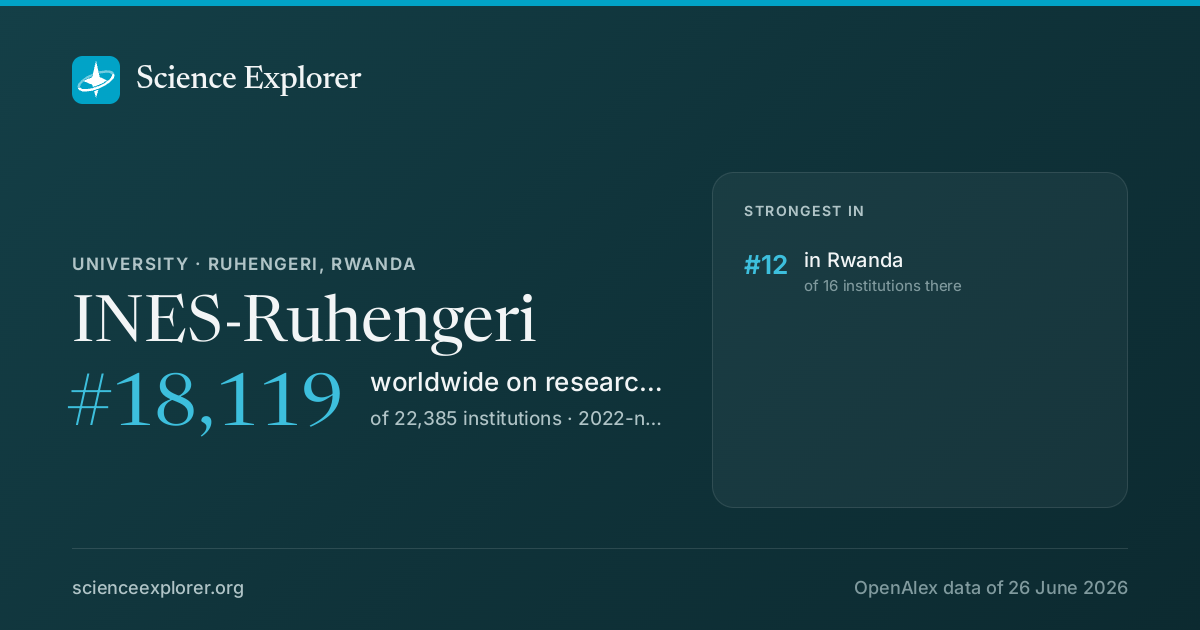
INES-Ruhengeri on Science Explorer

A card with INES-Ruhengeri's standing and the fields it leads in, for a post or a slide. A link to this page previews as the same card.

Download the card

1200 × 630 PNG, sized for social posts, drawn from the latest snapshot.

Badges for a website1Each links back here and updates with every snapshot

Research measures only: rankings here say nothing about teaching, admissions or student experience. Comparable institutions and collaboration partners have tabs of their own, above.

Discussion

Ask a question or share a note about INES-Ruhengeri. Posts are plain text and can be reported.