 Science in Rwanda
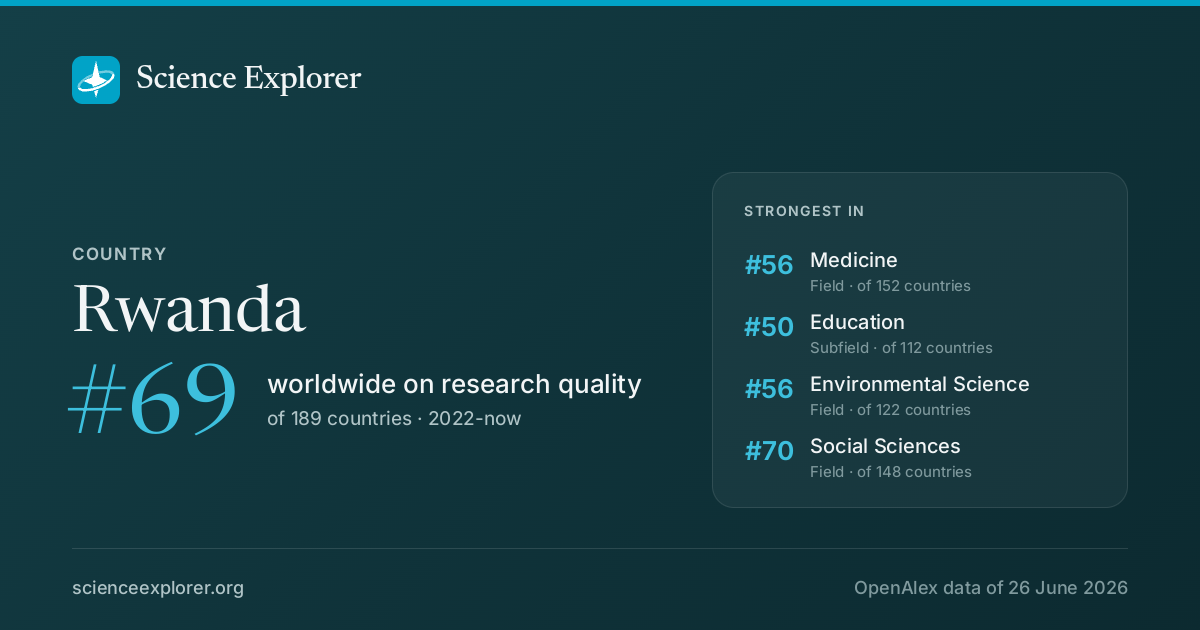
Rwanda ranks #69 of 189 countries on research quality in 2022-now (#72 all time), with 4.6k research works and 10.2% of them in the world's top 10%.
- World rank, 2022-now
- #69 of 189 · #72 all time
- Works, 2022-now
- 4.6k ▲ 111% vs 2018-21
- Citations
- 87k 8.2 per fractional work, all time
- Top-10% rate
- 10.2% all institutions 10.0%
- vs its own fields
- 0.99× 1.00× is exactly expected
- In the world top 100
- 0 0 in the top 1,000
- Open access
- 73% world 40%
- International
- 57% world 18%
RwandaWhat is Rwanda strongest at in science?
On research quality in 2022-now, Rwanda ranks highest in Medicine (#56 of 152), Education (#50 of 112) and Environmental Science (#56 of 122). Relative to its size it is most specialised in Chemical Health and Safety, Applied Microbiology and Biotechnology and Developmental Biology.
| Field | World rank | Where that sits | Top-10% rate | Works | All time | Institutions |
|---|---|---|---|---|---|---|
| MedicineField | #56 of 152 | 10.4% | 890 | #61 | Institutions | |
| EducationSubfield | #50 of 112 | 15.8% | 295 | #52 | Institutions | |
| Environmental ScienceField | #56 of 122 | 9.0% | 374 | #60 | Institutions | |
| Social SciencesField | #70 of 148 | 11.6% | 799 | #76 | Institutions | |
| Agricultural and Biological SciencesField | #68 of 124 | 13.9% | 263 | #77 | Institutions | |
| Computer ScienceField | #75 of 128 | 9.3% | 301 | #79 | Institutions | |
| EngineeringField | #81 of 131 | 8.8% | 331 | #88 | Institutions | |
| Business, Management and AccountingField | #78 of 110 | 5.4% | 221 | #85 | Institutions | |
| Sociology and Political ScienceSubfield | #87 of 119 | 6.9% | 261 | #86 | Institutions |
Where its research is concentrated
Location quotient: how much more (or less) of each node it does than its size predicts. Drawn around 1×, where "twice the world share" and "half of it" are the same distance apart in opposite directions. A volume reading, which on a country axis is largely population and industrial structure.
- Chemical Health and SafetySubfield · 2.0 works · #73 of 139 active here5.6×
- Applied Microbiology and BiotechnologySubfield · 12.9 works · #86 of 202 active here4.7×
- Developmental BiologySubfield · 5.3 works · #69 of 195 active here4.3×
- OceanographySubfield · 53.6 works · #72 of 215 active here3.5×
- Nutrition and DieteticsSubfield · 76.9 works · #83 of 220 active here3.2×
- VirologySubfield · 10.2 works · #87 of 204 active here3.1×
- Tourism, Leisure and Hospitality ManagementSubfield · 3.9 works · #91 of 165 active here3.1×
- Infectious DiseasesSubfield · 115.5 works · #88 of 221 active here3.1×
The whole field profile
All 26 fields at once. A specialist and a generalist produce the same ranked list and a completely different shape.
Rings at 0.5×, 1× and 2×. Widest outward: Nursing, 3.0×. Every wedge is a field page.
All 26 fields, with their numbers
- Nursing2.97×80 works
- Environmental Science1.78×489 works
- Earth and Planetary Sciences1.74×151 works
- Economics, Econometrics and Finance1.60×189 works
- Decision Sciences1.45×77 works
- Health Professions1.44×210 works
- Business, Management and Accounting1.37×245 works
- Social Sciences1.34×937 works
- Agricultural and Biological Sciences1.23×324 works
- Veterinary1.23×9 works
- Psychology1.21×203 works
- Immunology and Microbiology1.09×61 works
- Energy1.03×52 works
- Medicine1.03×1,094 works
- Mathematics0.90×58 works
- Neuroscience0.89×80 works
- Computer Science0.85×365 works
- Chemistry0.73×63 works
- Dentistry0.71×19 works
- Pharmacology, Toxicology and Pharmaceutics0.64×13 works
- Chemical Engineering0.61×12 works
- Arts and Humanities0.59×94 works
- Biochemistry, Genetics and Molecular Biology0.58×170 works
- Engineering0.49×404 works
- Materials Science0.49×94 works
- Physics and Astronomy0.30×37 works
Which fields of science does Rwanda work in?
In 2022-now, 32% of research in Rwanda is in Social Sciences, 31% in Physical Sciences. Its largest fields are Medicine (20%), Social Sciences (17%), Environmental Science (9%). It does 1.3× the world's share of Social Sciences.
Each ring splits the one inside it: the four domains of science, their fields, their subfields. Size is fractional works in 2022-now. Every slice is a page; the interactive view zooms down to single topics and colours each by how much more of it this country does than the world.
Its 4 domains and 26 fields, with their numbers
- Social Sciences1,74531.6%
- Social Sciences93716.9%
- Business, Management and Accounting2454.4%
- Psychology2033.7%
- Economics, Econometrics and Finance1893.4%
- Arts and Humanities931.7%
- Decision Sciences771.4%
- Physical Sciences1,72631.2%
- Environmental Science4898.8%
- Engineering4047.3%
- Computer Science3656.6%
- Earth and Planetary Sciences1512.7%
- Materials Science941.7%
- Chemistry631.1%
- Mathematics581.1%
- Energy531.0%
- Physics and Astronomy370.7%
- Chemical Engineering120.2%
- Health Sciences1,41225.5%
- Medicine1,09419.8%
- Health Professions2093.8%
- Nursing801.5%
- Dentistry190.3%
- Veterinary90.2%
- Life Sciences64711.7%
Which keywords describe research in Rwanda?
By fractional works in 2022-now, weighted toward what it does more of than the world: Climate Change, Genocide, Politics, Epidemiology, Maternal Mortality, Media, Middle East and Qatar.
- Surgical Care
- Water Sanitation Hygiene
- Global Health
- Technology Integration
- Student Engagement
- Ethical Considerations
- Higher Education
- Health Systems
- Socio-economic Factors
- Risk Management
- Rwanda
- Middle East
- Risk Factors
- Politics
- Supply Chain Management
- Globalization
- Public Health
- Education
- Sustainability
- Epidemiology
- Climate Change
- Machine Learning
- Deep Learning
- Environmental Impact
- Educational Technology
- Remote Sensing
- Genocide
- Maternal Mortality
- Media
- Qatar
- Community Health Workers
- Health Inequalities
- Child Mortality
- Teaching Strategies
- Child Development
- Global Burden of Disease
- Medical Education
- Vaccine
- Maternal and Child Undernutrition
- Poverty Reduction
Size is fractional works in 2022-now in the topics tagged with each word; colour is the word's share of this country's work against its share of the world's. The 40 words are chosen for being large and distinctive. Each links to the topic it comes from most.
All 40 words, with their numbers
- Climate Change299▲ 1.99×10⁴ topics
- Epidemiology291▲ 1.32×127 topics
- Machine Learning221▲ 1.20×84 topics
- Sustainability200▲ 1.48×92 topics
- Deep Learning169◆ 0.88×79 topics
- Education164▲ 1.73×70 topics
- Environmental Impact144▲ 1.53×58 topics
- Public Health141▲ 1.75×56 topics
- Educational Technology133▲ 2.0×30 topics
- Globalization129▲ 1.19×75 topics
- Remote Sensing123▲ 1.82×40 topics
- Supply Chain Management122▲ 2.5×21 topics
- Genocide120▲ 41×3 topics
- Politics114▲ 7.9×12 topics
- Maternal Mortality108▲ 8.7×5 topics
- Risk Factors106▲ 1.74×35 topics
- Media105▲ 13×5 topics
- Middle East105▲ 31×2 topics
- Qatar104▲ 104×1 topic
- Rwanda104▲ 104×1 topic
- Community Health Workers100▲ 20×2 topics
- Risk Management94▲ 3.6×14 topics
- Health Inequalities92▲ 14×5 topics
- Socio-economic Factors89▲ 14×3 topics
- Child Mortality89▲ 22×1 topic
- Health Systems89▲ 22×1 topic
- Teaching Strategies84▲ 5.4×5 topics
- Higher Education82▲ 2.8×22 topics
- Child Development82▲ 3.6×8 topics
- Ethical Considerations75▲ 3.9×15 topics
- Global Burden of Disease75▲ 5.5×4 topics
- Student Engagement74▲ 3.4×16 topics
- Medical Education71▲ 4.8×11 topics
- Technology Integration70▲ 4.0×10 topics
- Vaccine69▲ 3.1×11 topics
- Global Health68▲ 7.9×7 topics
- Maternal and Child Undernutrition63▲ 14×1 topic
- Water Sanitation Hygiene63▲ 14×1 topic
- Poverty Reduction60▲ 8.4×5 topics
- Surgical Care46▲ 15×2 topics
Which research topics does Rwanda publish the most in?
Its largest topics in 2022-now are Middle East and Rwanda Conflicts, Global Maternal and Child Health, Child Nutrition and Water Access.
Area is fractional works in 2022-now; colour is the subfield each topic belongs to. Every tile is a topic page.
- 1 Middle East and Rwanda Conflicts Sociology and Political Science 105 works
- 2 Global Maternal and Child Health Pediatrics, Perinatology and Child Health 89 works
- 3 Child Nutrition and Water Access Nutrition and Dietetics 63 works
- 4 Global Health and Surgery Public Health, Environmental and Occupational Health 44 works
- 5 Education and Critical Thinking Development Education 35 works
- 6 Islamic Finance and Banking Studies Accounting 35 works
- 7 Science Education and Pedagogy Education 30 works
- 8 Transboundary Water Resource Management Sociology and Political Science 29 works
- 9 Viral Infections and Outbreaks Research Infectious Diseases 29 works
- 10 Economic Growth and Development Information Systems 28 works
- 11 Construction Project Management and Performance Management Science and Operations Research 27 works
- 12 Organizational and Employee Performance Artificial Intelligence 27 works
Which universities in Rwanda lead research?
University of Rwanda, University of Kigali and Ministry of Natural Resources rank highest in Rwanda on research quality in 2022-now.
One dot per institution in the list below. The upper left is the interesting corner.
- 1University of RwandaUniversity · Butare · #2,053 worldwide11.0% top 10% · 1.6k works
- 2University of KigaliUniversity · Kigali · #3,402 worldwide6.7% top 10% · 612 works
- 3Ministry of Natural ResourcesGovernment institution · Kigali · #4,914 worldwide12.5% top 10% · 458 works
- 4Rwanda Biomedical CenterHospital / health system · Kigali · #6,876 worldwide13.9% top 10% · 207 works
- 5University of Global Health EquityUniversity · Butaro · #8,830 worldwide13.5% top 10% · 218 works
- 6Ministry of EducationGovernment institution · Kigali · #9,688 worldwide12.9% top 10% · 231 works
- 7African Institute for Mathematical SciencesUniversity · Kigali · #12,271 worldwide14.7% top 10% · 98 works
- 8University of Lay Adventists of KigaliUniversity · Kigali · #14,259 worldwide2.4% top 10% · 164 works
- 9Rwanda Agriculture BoardGovernment institution · Kigali · #14,739 worldwide14.3% top 10% · 90 works
- 10Rwanda Development BoardGovernment institution · Kigali · #16,131 worldwide14.1% top 10% · 81 works
- 11Mahatma Gandhi UniversityUniversity · Kigali · #17,289 worldwide5.0% top 10% · 133 works
- 12INES-RuhengeriUniversity · Ruhengeri · #18,119 worldwide5.8% top 10% · 87 works
- 13Ministry of HealthGovernment institution · Kigali · #18,385 worldwide10.5% top 10% · 76 works
- 14Kigali Independent UniversityUniversity · Kigali · #19,190 worldwide6.7% top 10% · 76 works
- 15Centre Hospitalier Universitaire de KigaliHospital / health system · Kigali · #20,102 worldwide8.7% top 10% · 67 works
The track on each row is its top-10% rate; the tick is the average of all institutions, 10.0% (how it is set): teal above it, red below.
All ranked institutions in RwandaWho are the top researchers in Rwanda?
Corine Karema, Claude Mambo Muvunyi and Agnès Binagwaho rank highest among researchers based in Rwanda.
- 1 Corine Karema #100,026 worldwide 84k citations · 83 works
- 2 Claude Mambo Muvunyi #103,506 worldwide 4.7k citations · 224 works
- 3 Agnès Binagwaho #112,520 worldwide 24k citations · 297 works
- 4 Ainhoa Costas‐Chavarri #144,195 worldwide 4.1k citations · 51 works
- 5 Pierre Gashema #164,832 worldwide 531 citations · 71 works
- 6 Alemayehu Amberbir #168,871 worldwide 19k citations · 113 works
- 7 Pacifique Ndishimye #174,889 worldwide 4.9k citations · 71 works
- 8 JC Allen Ingabire #189,099 worldwide 4.6k citations · 69 works
- 9 Jean-Baptiste Mazarati #190,536 worldwide 3.3k citations · 41 works
- 10 Patrick Gad Iradukunda #198,878 worldwide 548 citations · 50 works
How open and international is Rwanda's research?
73% of its research is openly available (world: 40%), and 57% is written with international co-authors (world: 18%).
World: 40% of research is openly available.
World: 18% is written across borders.
In 2022-now, 75% of its research is openly available (world 63%) and 56% is written with co-authors abroad (world 22%). Against what its own mix of topics predicts, that is 1.12× the expected open access and 2.28× the expected international share, which puts it #42 of 173 countries on openness.
How has Rwanda's research grown?
Output in 2022-2025 was 111% higher than in 2018-2021.
The same series as a ribbon: one cell per year, darker for more. The line above answers how much; this answers when.
Its share of all research
Growing output can still be a shrinking share: all of science grows. This is Rwanda as a percentage of every work published that year, 0.023% in 2024.
Fractional works of Rwanda over all fractional works that year. How the balance of science has shifted.
How much of it reaches the world top 10%
Over the whole record, 9.1% of its 11k works since 1951 reached the world top 10% for their field and year.
Of each year's output, the share that reached the world's 10% most cited for its field and year. Peak 16.1% in 1993.
Which countries have research most like Rwanda's?
Malawi is Rwanda's closest research twin: of all countries, its research is spread across the fields most like Rwanda's, with both strong in Nursing.
- 1
 MalawiBoth strong in Nursing, Environmental Science, Economics, Econometrics and Finance
0.81 Compare
- 2
 TanzaniaBoth strong in Nursing, Environmental Science, Economics, Econometrics and Finance
0.81 Compare
- 3
 GhanaBoth strong in Nursing, Economics, Econometrics and Finance, Environmental Science
0.80 Compare
- 4
 FijiBoth strong in Nursing, Environmental Science, Economics, Econometrics and Finance
0.77 Compare
- 5
 Sierra LeoneBoth strong in Nursing, Economics, Econometrics and Finance, Health Professions
0.76 Compare
Similarity is the correlation of each side's location quotients across every field it publishes in, on a log scale: 1 is the same shape of research, 0 is unrelated. It ignores size. How it is measured.
Compare Rwanda with
 Philippines
 Egypt
 Panama
 Latvia
 Vietnam
 Pakistan
Share Rwanda's ranking
Badges for a website1Each links back here and updates with every snapshot

Research fields in Rwanda
Discussion
Ask a question or share a note about Rwanda. Posts are plain text and can be reported.