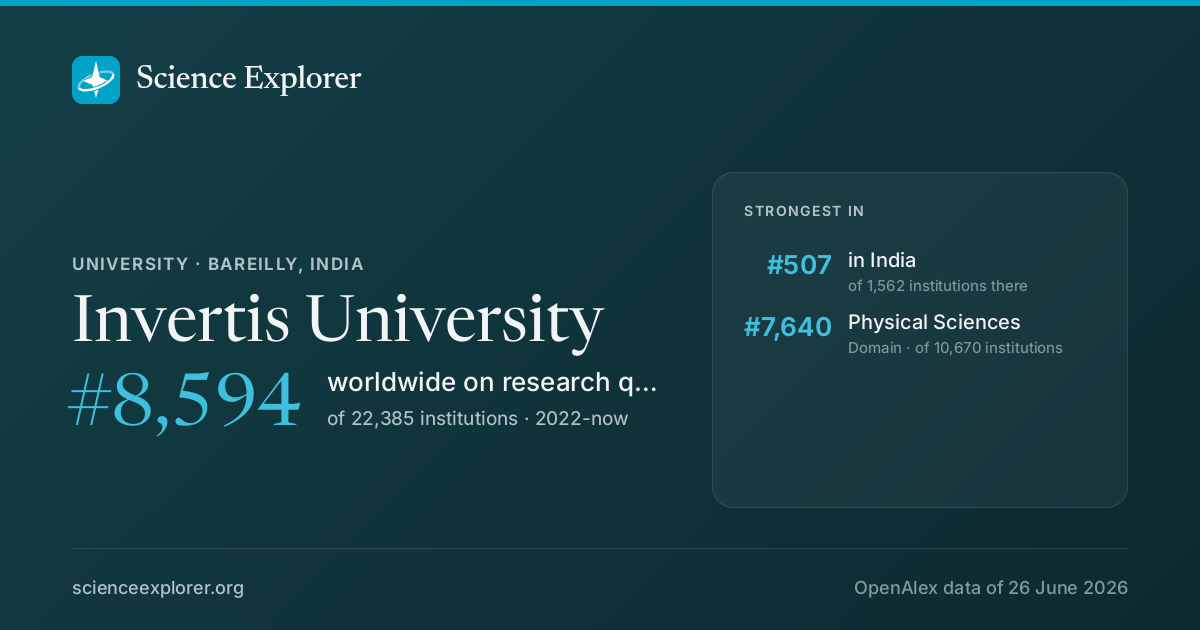
World rank, 2022-now #8,594
of 22,385 · #15,916 all time
Rank in India #507
of 1,562 Research works 572
▲ 129% vs 2018-21
Citations 3.8k 6.6 per fractional work
Top-10% rate 6.5%
all institutions 10.0%
vs its own fields 0.87×
1.00× is exactly expected
Open access 52%
world 40%
International 15%
world 18%
What is Invertis University known for in research?
The fields where it stands highest, 2022-now, ranked among every institution above the floor in each field.
Field World rank Where that sits Top-10% rate Works All time Domain #7,640 of 10,670 6.8% 146
#12415
Which fields of science does Invertis University work in?
In 2022-now, 50% of research at Invertis University is in Physical Sciences , 20% in Life Sciences . Its largest fields are Computer Science (16%), Engineering (15%), Agricultural and Biological Sciences (10%). It does 1.5× the world's share of Life Sciences.
Physical Sciences: 160 fractional works · 50.0% of its work Computer Science: 52 fractional works · 16.3% of its work Artificial Intelligence: 16 fractional works · 4.9% of its work Information Systems: 13 fractional works · 4.2% of its work Computer Networks and Communications: 10 fractional works · 3.2% of its work Computer Vision and Pattern Recognition: 5 fractional works · 1.5% of its work Computational Theory and Mathematics: 3 fractional works · 0.9% of its work Signal Processing: 3 fractional works · 0.9% of its work Software: 1 fractional works · 0.3% of its work Human-Computer Interaction: 1 fractional works · 0.2% of its work Smaller subfields together: 1 fractional works · 0.2% of its work Engineering: 49 fractional works · 15.4% of its work Electrical and Electronic Engineering: 12 fractional works · 3.6% of its work Biomedical Engineering: 8 fractional works · 2.4% of its work Mechanical Engineering: 6 fractional works · 2.0% of its work Civil and Structural Engineering: 5 fractional works · 1.7% of its work Control and Systems Engineering: 4 fractional works · 1.4% of its work Building and Construction: 3 fractional works · 0.8% of its work Industrial and Manufacturing Engineering: 2 fractional works · 0.7% of its work Aerospace Engineering: 2 fractional works · 0.6% of its work Mechanics of Materials: 2 fractional works · 0.6% of its work Automotive Engineering: 1 fractional works · 0.5% of its work Computational Mechanics: 1 fractional works · 0.3% of its work Media Technology: 1 fractional works · 0.3% of its work Ocean Engineering: 1 fractional works · 0.3% of its work Smaller subfields together: 1 fractional works · 0.2% of its work Environmental Science: 21 fractional works · 6.6% of its work Ecology: 5 fractional works · 1.6% of its work Industrial and Manufacturing Engineering: 3 fractional works · 1.1% of its work Environmental Engineering: 3 fractional works · 1.0% of its work Water Science and Technology: 2 fractional works · 0.7% of its work Pollution: 2 fractional works · 0.7% of its work Health, Toxicology and Mutagenesis: 1 fractional works · 0.5% of its work Global and Planetary Change: 1 fractional works · 0.4% of its work Environmental Chemistry: 1 fractional works · 0.2% of its work Ecological Modeling: 1 fractional works · 0.2% of its work Smaller subfields together: 0 fractional works · 0.1% of its work Materials Science: 17 fractional works · 5.2% of its work Materials Chemistry: 9 fractional works · 2.8% of its work Biomaterials: 4 fractional works · 1.3% of its work Polymers and Plastics: 2 fractional works · 0.7% of its work Electronic, Optical and Magnetic Materials: 1 fractional works · 0.4% of its work Chemistry: 9 fractional works · 2.8% of its work Organic Chemistry: 5 fractional works · 1.5% of its work Analytical Chemistry: 2 fractional works · 0.7% of its work Spectroscopy: 1 fractional works · 0.4% of its work Inorganic Chemistry: 1 fractional works · 0.2% of its work Smaller subfields together: 0 fractional works · 0.1% of its work Energy: 3 fractional works · 1.1% of its work Renewable Energy, Sustainability and the Environment: 3 fractional works · 0.8% of its work Energy Engineering and Power Technology: 1 fractional works · 0.3% of its work Physics and Astronomy: 3 fractional works · 1.1% of its work Astronomy and Astrophysics: 2 fractional works · 0.5% of its work Smaller subfields together: 2 fractional works · 0.6% of its work Mathematics: 2 fractional works · 0.7% of its work Geometry and Topology: 1 fractional works · 0.3% of its work Applied Mathematics: 1 fractional works · 0.2% of its work Smaller subfields together: 1 fractional works · 0.2% of its work Earth and Planetary Sciences: 2 fractional works · 0.5% of its work Chemical Engineering: 1 fractional works · 0.3% of its work Life Sciences: 65 fractional works · 20.1% of its work Agricultural and Biological Sciences: 31 fractional works · 9.7% of its work Plant Science: 19 fractional works · 5.9% of its work Food Science: 4 fractional works · 1.3% of its work Soil Science: 3 fractional works · 0.9% of its work Agronomy and Crop Science: 2 fractional works · 0.6% of its work Ecology, Evolution, Behavior and Systematics: 1 fractional works · 0.4% of its work Smaller subfields together: 2 fractional works · 0.6% of its work Biochemistry, Genetics and Molecular Biology: 23 fractional works · 7.2% of its work Molecular Biology: 15 fractional works · 4.8% of its work Genetics: 2 fractional works · 0.7% of its work Biotechnology: 1 fractional works · 0.4% of its work Biophysics: 1 fractional works · 0.4% of its work Molecular Medicine: 1 fractional works · 0.4% of its work Cancer Research: 1 fractional works · 0.2% of its work Endocrinology: 1 fractional works · 0.2% of its work Cell Biology: 1 fractional works · 0.2% of its work Smaller subfields together: 0 fractional works · 0.1% of its work Pharmacology, Toxicology and Pharmaceutics: 5 fractional works · 1.4% of its work Pharmaceutical Science: 3 fractional works · 0.9% of its work Toxicology: 1 fractional works · 0.4% of its work Smaller subfields together: 0 fractional works · 0.2% of its work Neuroscience: 3 fractional works · 1.0% of its work Cognitive Neuroscience: 2 fractional works · 0.5% of its work Smaller subfields together: 1 fractional works · 0.4% of its work Immunology and Microbiology: 2 fractional works · 0.8% of its work Immunology: 1 fractional works · 0.4% of its work Virology: 1 fractional works · 0.3% of its work Smaller subfields together: 0 fractional works · 0.1% of its work Social Sciences: 54 fractional works · 16.8% of its work Social Sciences: 23 fractional works · 7.0% of its work Sociology and Political Science: 8 fractional works · 2.4% of its work Safety Research: 3 fractional works · 0.9% of its work Education: 3 fractional works · 0.9% of its work Demography: 3 fractional works · 0.8% of its work Political Science and International Relations: 2 fractional works · 0.7% of its work Gender Studies: 2 fractional works · 0.5% of its work Law: 1 fractional works · 0.2% of its work Public Administration: 1 fractional works · 0.2% of its work Smaller subfields together: 1 fractional works · 0.4% of its work Business, Management and Accounting: 13 fractional works · 4.0% of its work Management Information Systems: 3 fractional works · 0.9% of its work Strategy and Management: 2 fractional works · 0.8% of its work Marketing: 2 fractional works · 0.7% of its work Organizational Behavior and Human Resource Management: 2 fractional works · 0.7% of its work Accounting: 2 fractional works · 0.6% of its work Management of Technology and Innovation: 1 fractional works · 0.2% of its work Smaller subfields together: 0 fractional works · 0.2% of its work Economics, Econometrics and Finance: 6 fractional works · 2.0% of its work Economics and Econometrics: 4 fractional works · 1.2% of its work Finance: 1 fractional works · 0.4% of its work General Economics, Econometrics and Finance: 1 fractional works · 0.4% of its work Decision Sciences: 5 fractional works · 1.7% of its work Management Science and Operations Research: 4 fractional works · 1.3% of its work Information Systems and Management: 1 fractional works · 0.3% of its work Smaller subfields together: 1 fractional works · 0.2% of its work Psychology: 4 fractional works · 1.2% of its work Social Psychology: 2 fractional works · 0.5% of its work Experimental and Cognitive Psychology: 1 fractional works · 0.2% of its work Smaller subfields together: 2 fractional works · 0.5% of its work Arts and Humanities: 3 fractional works · 0.8% of its work Philosophy: 1 fractional works · 0.4% of its work Smaller subfields together: 1 fractional works · 0.4% of its work Health Sciences: 42 fractional works · 13.1% of its work Medicine: 31 fractional works · 9.6% of its work Complementary and alternative medicine: 5 fractional works · 1.5% of its work Public Health, Environmental and Occupational Health: 3 fractional works · 1.0% of its work Pharmacology: 2 fractional works · 0.7% of its work Endocrinology, Diabetes and Metabolism: 2 fractional works · 0.7% of its work Radiology, Nuclear Medicine and Imaging: 2 fractional works · 0.6% of its work Infectious Diseases: 2 fractional works · 0.5% of its work Epidemiology: 2 fractional works · 0.5% of its work Oncology: 2 fractional works · 0.5% of its work Health Informatics: 2 fractional works · 0.5% of its work Surgery: 1 fractional works · 0.3% of its work Rheumatology: 1 fractional works · 0.3% of its work Reproductive Medicine: 1 fractional works · 0.3% of its work Physiology: 1 fractional works · 0.3% of its work Cardiology and Cardiovascular Medicine: 1 fractional works · 0.2% of its work Neurology: 1 fractional works · 0.2% of its work Pulmonary and Respiratory Medicine: 1 fractional works · 0.2% of its work Smaller subfields together: 4 fractional works · 1.2% of its work Health Professions: 7 fractional works · 2.3% of its work General Health Professions: 3 fractional works · 0.9% of its work Health Information Management: 2 fractional works · 0.7% of its work Pharmacy: 1 fractional works · 0.3% of its work Smaller subfields together: 1 fractional works · 0.3% of its work Dentistry: 2 fractional works · 0.7% of its work Oral Surgery: 2 fractional works · 0.5% of its work Smaller subfields together: 1 fractional works · 0.2% of its work Nursing: 1 fractional works · 0.4% of its work Nutrition and Dietetics: 1 fractional works · 0.3% of its work Smaller subfields together: 0 fractional works · 0.0% of its work Veterinary: 0 fractional works · 0.1% of its work Physical Sciences Computer Science Engineering Environme… Materials… Chemistry Life Sciences Agricultural an… Biochemist… Pharmacol… Social Sciences Social Sciences Business Economics Decision… Health Sciences Medicine Health Pr… ALL ITS WORK Invertis University 321 fractional works, 2022-now 20% 50% 13% 17%
Each ring splits the one inside it: the four domains of science, their fields, their subfields. Size is fractional works in 2022-now. Every slice is a page; the interactive view zooms down to single topics and colours each by how much more of it this institution does than the world.
Its 4 domains and 26 fields, with their numbers 52 16.3% 49 15.4% 21 6.6% 17 5.2% 9 2.8% 3 1.1% 3 1.1% 2 0.7% 2 0.5% 1 0.3% 31 9.7% 23 7.2% 5 1.4% 3 1.0% 2 0.8% 23 7.0% 13 4.0% 6 2.0% 5 1.7% 4 1.2% 3 0.8% 31 9.6% 7 2.3% 2 0.7% 1 0.4% 0 0.1% All of science, and how each field's share has moved since 1950: the Science domain explorer
Field profile
Location quotient across every field it publishes in: outside the ring is more than an institution of this size would be expected to publish, inside it is less.
Agricultural and Biological Sciences: 2.04× its world share, 31 works Agricultural and Bio… Biochemistry, Genetics and Molecular Biology: 1.36× its world share, 23 works Biochemistry, Geneti… Immunology and Microbiology: 0.76× its world share, 2 works Immunology and Micro… Neuroscience: 0.61× its world share, 3 works Neuroscience Pharmacology, Toxicology and Pharmaceutics: 4.12× its world share, 5 works Pharmacology, Toxico… Chemical Engineering: 0.82× its world share, 1 works Chemical Engineering Chemistry: 1.82× its world share, 9 works Chemistry Computer Science: 2.10× its world share, 52 works Computer Science Earth and Planetary Sciences: 0.31× its world share, 2 works Earth and Planetary … Energy: 1.18× its world share, 4 works Energy Engineering: 1.02× its world share, 49 works Engineering Environmental Science: 1.32× its world share, 21 works Environmental Science Materials Science: 1.50× its world share, 17 works Materials Science Mathematics: 0.64× its world share, 2 works Mathematics Physics and Astronomy: 0.48× its world share, 3 works Physics and Astronomy Dentistry: 1.53× its world share, 2 works Dentistry Health Professions: 0.87× its world share, 7 works Health Professions Medicine: 0.50× its world share, 31 works Medicine Nursing: 0.72× its world share, 1 works Nursing Veterinary: 0.38× its world share, 0 works Veterinary Arts and Humanities: 0.28× its world share, 3 works Arts and Humanities Business, Management and Accounting: 1.24× its world share, 13 works Business, Management… Decision Sciences: 1.77× its world share, 6 works Decision Sciences Economics, Econometrics and Finance: 0.94× its world share, 6 works Economics, Econometr… Psychology: 0.40× its world share, 4 works Psychology Social Sciences: 0.56× its world share, 23 works Social Sciences 1× world share
Rings at 0.5×, 1× and 2×. Widest outward: Pharmacology, Toxicology and Pharmaceutics , 4.1×. Every wedge is a field page.
All 26 fields, with their numbers Pharmacology, Toxicology and Pharmaceutics 4.12× 5 works Computer Science 2.10× 52 works Agricultural and Biological Sciences 2.04× 31 works Chemistry 1.82× 9 works Decision Sciences 1.77× 6 works Dentistry 1.53× 2 works Materials Science 1.50× 17 works Biochemistry, Genetics and Molecular Biology 1.36× 23 works Environmental Science 1.32× 21 works Business, Management and Accounting 1.24× 13 works Energy 1.18× 4 works Engineering 1.02× 49 works Economics, Econometrics and Finance 0.94× 6 works Health Professions 0.87× 7 works Chemical Engineering 0.82× 1 works Immunology and Microbiology 0.76× 2 works Nursing 0.72× 1 works Mathematics 0.64× 2 works Neuroscience 0.61× 3 works Social Sciences 0.56× 23 works Medicine 0.50× 31 works Physics and Astronomy 0.48× 3 works Psychology 0.40× 4 works Veterinary 0.38× 0 works Earth and Planetary Sciences 0.31× 2 works Arts and Humanities 0.28× 3 works
Who are the top researchers at Invertis University?
Ranked on the quality score, Kishor Kalauni , Ajitanshu Vedrtnam and Dheeraj Gunwant lead among researchers whose main affiliation is Invertis University.
1
Kishor Kalauni
India · #801,773 worldwide740 citations · 42 works
2
Ajitanshu Vedrtnam
India · #969,614 worldwide1.8k citations · 98 works
3
Dheeraj Gunwant
India · #1,587,316 worldwide534 citations · 31 works
4
Sakshi Tomar
India · #1,620,260 worldwide215 citations · 19 works
5
Anumoy Pathak
India · #2,019,624 worldwide134 citations · 69 works
6
Pankaj Kumar
India · #2,489,080 worldwide1.4k citations · 83 works
7
Manali Singh
India · #2,672,203 worldwide903 citations · 81 works
8
Keshawanand Tripathi
India · #2,747,537 worldwide997 citations · 94 works
9
Amit Kumar Srivastava
India · #3,105,079 worldwide234 citations · 20 works
10
Richa Saxena
India · #3,124,903 worldwide3.7k citations · 126 works
All ranked researchers at Invertis University
What are the most cited papers from Invertis University?
The most cited paper from Invertis University is "Tails, Fears, and Risk Premia" (Tim Bollerslev, Viktor Todorov, 2011), with 876 citations. Next come "The International Soil Moisture Network: serving Earth system science for over a decade" (474) and "Beneficial microbiomes for bioremediation of diverse contaminated environments for environmental sustainability: present status and future challenges" (329).
Most cited papers
# Paper Released Citations 1
Tails, Fears, and Risk Premia
Tim Bollerslev, Viktor Todorov · The Journal of Finance
14 Nov 2011
876 2
The International Soil Moisture Network: serving Earth system science for over a decade
Wouter Arnoud Dorigo et al. · Hydrology and earth system sciences
Open access 9 Nov 2021
474 3
Beneficial microbiomes for bioremediation of diverse contaminated environments for environmental sustainability: present status and future challenges
Divjot Kour, Tanvir Kaur, Rubee Devi et al. · Environmental Science and Pollution Research
25 Mar 2021
329 4
Removal of Malachite Green, a hazardous dye from aqueous solutions using Avena sativa (oat) hull as a potential adsorbent
Sushmita Banerjee, Gopesh Chandra Sharma, Ravindra Kumar Gautam et al. · Journal of Molecular Liquids
5 Dec 2015
175 5
Biodiversity of methylotrophic microbial communities and their potential role in mitigation of abiotic stresses in plants
Manish Kumar, Divjot Kour, Ajar Nath Yadav et al. · Biologia
Open access 29 Jan 2019
173
All 61 most cited papers, with filters and sorting
Which keywords describe research at Invertis University?
By fractional works in 2022-now, weighted toward what it does more of than the world: Machine Learning, Deep Learning, Artificial Intelligence , Internet of Things, Healthcare, Wireless Sensor Networks, Nanoparticles and Big Data.
Size is fractional works in 2022-now in the topics tagged with each word; colour is the word's share of this institution's work against its share of the world's. The 40 words are chosen for being large and distinctive. Each links to the topic it comes from most.
All 40 words, with their numbers Machine Learning 37 ▲ 3.5× 51 topics Deep Learning 25 ▲ 2.3× 42 topics Artificial Intelligence 15 ▲ 3.4× 22 topics Healthcare 13 ▲ 3.5× 10 topics Internet of Things 12 ▲ 4.4× 15 topics Nanoparticles 12 ▲ 3.0× 20 topics Big Data 11 ▲ 3.5× 17 topics Environmental Impact 11 ▲ 1.93× 20 topics Neural Networks 10 ▲ 2.1× 23 topics Sustainability 10 ▲ 1.33× 33 topics Wireless Sensor Networks 10 ▲ 6.6× 9 topics Security 9 ▲ 4.2× 11 topics Supply Chain Management 7 ▲ 2.5× 8 topics Biomedical Applications 7 ▲ 1.82× 17 topics Antioxidant 7 ▲ 3.0× 23 topics Data Mining 7 ▲ 2.8× 8 topics Smart Cities 7 ▲ 7.8× 4 topics IoT Security 6 ▲ 6.3× 3 topics Environmental Monitoring 6 ▲ 4.9× 6 topics Drug Delivery 6 ▲ 3.3× 12 topics Big Data Analytics 6 ▲ 8.1× 4 topics Cybersecurity 5 ▲ 6.7× 6 topics Image Processing 5 ▲ 3.8× 6 topics Cloud Computing 5 ▲ 5.7× 6 topics Precision Medicine 5 ▲ 3.0× 6 topics Antimicrobial 5 ▲ 5.2× 7 topics Toxicity 4 ▲ 3.2× 9 topics Privacy 4 ▲ 4.8× 5 topics Organizational Performance 4 ▲ 5.1× 7 topics Smart Farming 4 ▲ 11× 2 topics Green Synthesis 4 ▲ 6.8× 3 topics Synthesis 4 ▲ 3.4× 15 topics Security Analysis 4 ▲ 7.2× 4 topics Behavioral Analysis 4 ▲ 10× 2 topics Internet of Things (IoT) 4 ▲ 9.7× 1 topic Plant Disease Detection 4 ▲ 11× 1 topic Neuroprotective 3 ▲ 6.8× 6 topics Biosynthesis 3 ▲ 6.2× 5 topics Magnetic Nanoparticles 3 ▲ 8.2× 3 topics Predictive Analytics 3 ▲ 8.4× 2 topics
How open and international is its research?
Against the world's own shares: the tick on each track. Both are shares of its output, so they
sit on one scale and can be read against each other as well as against the world.
52% 48%
52.4% 47.6%
World: 40% of research is openly available.
15% 85%
15.2% 84.8%
World: 18% is written across borders.
How has Invertis University's research output changed?
Output in 2022-2025 was 129% higher than in 2018-2021.
still counting 1990 2000 2010 2020
The same series as a ribbon: one cell per year, darker for more. The line above answers how much ; this answers when .
Its share of all research
still counting 0.0010% 0.0020% 0.0030% Invertis University 0.0021% in 2025 1980 1990 2000 2010 2020 Fractional works of Invertis University over all fractional works that year. How the balance of science has shifted .
How much of it reaches the world top 10%
still counting 5% 10% 15% all institutions 10.0% in 2025 Invertis University 6.1% in 2025 2020 Of each year's output, the share that reached the world's 10% most cited for its field and year. Peak 9.7% in 2019.
Share Invertis University's ranking
A card with Invertis University's standing and the fields it leads in, for a post or a slide. A link to this page previews as the same card.
Badges for a website 1 Each links back here and updates with every snapshot
 India · #801,773 worldwide
740 citations · 42 works