Jakarta State Polytechnic
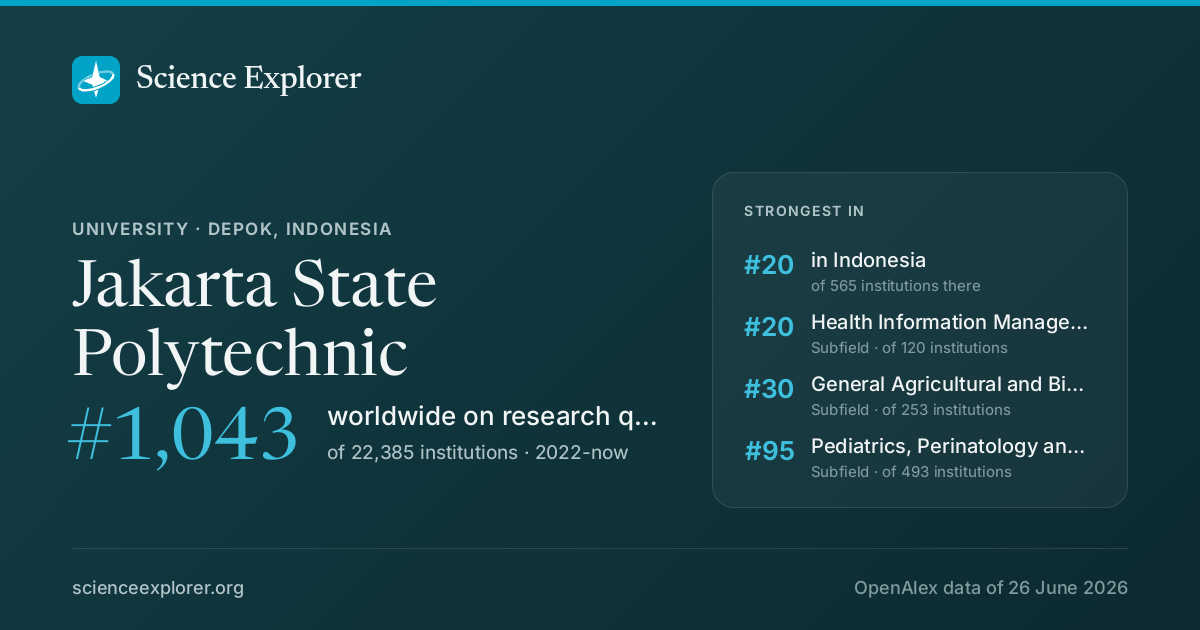
In research, Jakarta State Polytechnic stands highest in Social Sciences (#758 of 9,585 worldwide), Business, Management and Accounting (#218 of 2,581 worldwide) and Social Sciences (#638 of 5,988 worldwide), 2022-now. Relative to its size it is most specialised in Human Factors and Ergonomics, Demography and General Agricultural and Biological Sciences (Human Factors and Ergonomics is 11.2× its share of world research).
- World rank, 2022-now
- #1,043 of 22,385 · #2,030 all time
- Rank in Indonesia
- #20 of 565
- Research works
- 11k ▲ 54% vs 2018-21
- Citations
- 20k 1.8 per fractional work
- Top-10% rate
- 6.3% all institutions 10.0%
- vs its own fields
- 0.72× 1.00× is exactly expected
- Open access
- 84% world 40%
- International
- 4% world 18%
What is Jakarta State Polytechnic known for in research?
The fields where it stands highest, 2022-now, ranked among every institution above the floor in each field.
| Field | World rank | Where that sits | Top-10% rate | Works | All time |
|---|---|---|---|---|---|
| Social SciencesDomain | #758 of 9,585 | 7.5% | 2,680 | #1326 | |
| Business, Management and AccountingField | #218 of 2,581 | 8.0% | 893 | #587 | |
| Social SciencesField | #638 of 5,988 | 7.5% | 1,420 | #1130 | |
| General Agricultural and Biological SciencesSubfield | #30 of 253 | 10.9% | 208 | #136 | |
| Health SciencesDomain | #1,389 of 9,902 | 7.4% | 447 | #3043 | |
| Health Information ManagementSubfield | #20 of 120 | 10.5% | 70 | - | |
| Strategy and ManagementSubfield | #122 of 668 | 8.6% | 324 | #346 | |
| Pediatrics, Perinatology and Child HealthSubfield | #95 of 493 | 11.1% | 106 | #241 | |
| DemographySubfield | #85 of 434 | 10.0% | 354 | #212 | |
| Physical SciencesDomain | #2,184 of 10,670 | 4.3% | 1,947 | #3209 |
Each strip is that field's whole ranked pool, with the notch where Jakarta State Polytechnic sits in it, in the colour of the band that rank falls in. The track under the rate is the rate itself: it carries no average mark, because the average differs by field (from about 6% in Dentistry to 21% in Economics).
Which of those standings moved
The same fields on both windows: where it stood over the whole record, and where it stands in 2022-now. The distance is the story, and it is the one thing the two rank columns above cannot show.
- Social Sciences#1,326 #758
- Business, Management and Accounting#587 #218
- Social Sciences#1,130 #638
- General Agricultural and Biological Sciences#136 #30
- Health Sciences#3,043 #1,389
- Strategy and Management#346 #122
- Pediatrics, Perinatology and Child Health#241 #95
- Demography#212 #85
- Physical Sciences#3,209 #2,184
A dot further right is a better standing. Fields it was not ranked in over the whole record are left out.
Which fields of science does Jakarta State Polytechnic work in?
In 2022-now, 47% of research at Jakarta State Polytechnic is in Social Sciences, 34% in Physical Sciences. Its largest fields are Social Sciences (25%), Business, Management and Accounting (16%), Computer Science (14%). It does 1.9× the world's share of Social Sciences.
Each ring splits the one inside it: the four domains of science, their fields, their subfields. Size is fractional works in 2022-now. Every slice is a page; the interactive view zooms down to single topics and colours each by how much more of it this institution does than the world.
Its 4 domains and 26 fields, with their numbers
- Social Sciences2,95347.2%
- Social Sciences1,55724.9%
- Business, Management and Accounting97915.6%
- Economics, Econometrics and Finance1702.7%
- Arts and Humanities941.5%
- Psychology901.4%
- Decision Sciences631.0%
- Physical Sciences2,14934.3%
- Computer Science85313.6%
- Engineering84613.5%
- Environmental Science2714.3%
- Materials Science871.4%
- Energy240.4%
- Earth and Planetary Sciences230.4%
- Chemistry200.3%
- Mathematics120.2%
- Physics and Astronomy70.1%
- Chemical Engineering60.1%
- Life Sciences66410.6%
- Health Sciences4967.9%
- Health Professions2664.2%
- Medicine1983.2%
- Nursing200.3%
- Dentistry100.2%
- Veterinary10.0%
What does Jakarta State Polytechnic specialise in?
Where its research is concentrated relative to its size: Human Factors and Ergonomics takes 11.2× the share of its output that it takes of world research.
- Human Factors and ErgonomicsSubfield · 77.7 works11×
- DemographySubfield · 369.9 works8.7×
- General Agricultural and Biological SciencesSubfield · 231.4 works8.4×
- Occupational TherapySubfield · 85.6 works8.2×
- Strategy and ManagementSubfield · 343.7 works6.3×
- MarketingSubfield · 153.2 works5.8×
- Health Information ManagementSubfield · 83.7 works5.2×
Location quotient, a volume reading rather than an impact one. It surfaces small, lopsided specialities.
Field profile
Location quotient across every field it publishes in: outside the ring is more than an institution of this size would be expected to publish, inside it is less.
Rings at 0.5×, 1× and 2×. Widest outward: Business, Management and Accounting, 4.8×. Every wedge is a field page.
All 26 fields, with their numbers
- Business, Management and Accounting4.85×979 works
- Agricultural and Biological Sciences2.07×616 works
- Social Sciences1.97×1,557 works
- Computer Science1.75×853 works
- Health Professions1.61×266 works
- Economics, Econometrics and Finance1.27×170 works
- Decision Sciences1.04×63 works
- Engineering0.90×846 works
- Environmental Science0.87×271 works
- Nursing0.66×20 works
- Arts and Humanities0.52×94 works
- Psychology0.47×90 works
- Pharmacology, Toxicology and Pharmaceutics0.43×10 works
- Energy0.41×24 works
- Materials Science0.40×87 works
- Dentistry0.34×10 works
- Chemical Engineering0.28×6 works
- Earth and Planetary Sciences0.23×23 works
- Chemistry0.20×20 works
- Mathematics0.16×12 works
- Medicine0.16×198 works
- Veterinary0.13×1 works
- Immunology and Microbiology0.09×6 works
- Biochemistry, Genetics and Molecular Biology0.08×26 works
- Neuroscience0.07×7 works
- Physics and Astronomy0.05×7 works
- Business, Management and Accounting 4.8×
- Agricultural and Biological Sciences 2.1×
- Social Sciences 2.0×
- Computer Science 1.8×
- Health Professions 1.6×
- Economics, Econometrics and Finance 1.3×
- Decision Sciences 1.0×
- Engineering 0.9×
- Environmental Science 0.9×
- Nursing 0.7×
- Arts and Humanities 0.5×
- Psychology 0.5×
- Pharmacology, Toxicology and Pharmaceutics 0.4×
- Energy 0.4×
- Materials Science 0.4×
- Dentistry 0.3×
- Chemical Engineering 0.3×
- Earth and Planetary Sciences 0.2×
- Chemistry 0.2×
- Mathematics 0.2×
- Medicine 0.2×
- Veterinary 0.1×
- Immunology and Microbiology 0.1×
- Biochemistry, Genetics and Molecular Biology 0.1×
- Neuroscience 0.1×
- Physics and Astronomy 0.1×
Who are the top researchers at Jakarta State Polytechnic?
Ranked on the quality score, Hamid Ramadhan Nur, Edi Syafri and Enny Diah Astuti lead among researchers whose main affiliation is Jakarta State Polytechnic.
- 1
Hamid Ramadhan Nur
 Indonesia · #1,372,436 worldwide
73 citations · 16 works
- 2
Edi Syafri
Indonesia · #1,795,817 worldwide
2.7k citations · 86 works
- 3
Enny Diah Astuti
Indonesia · #2,051,706 worldwide
119 citations · 38 works
- 4
Muhammad Alvi Syahrin
Indonesia · #2,059,444 worldwide
368 citations · 85 works
- 5
Alih Aji Nugroho
Indonesia · #2,332,460 worldwide
103 citations · 34 works
- 6
Fatimah Malini Lubis
Indonesia · #2,334,660 worldwide
170 citations · 68 works
- 7
Imas Chandra Pratiwi
Indonesia · #2,635,976 worldwide
27 citations · 15 works
- 8
Dingot Hamonangan Ismail
Indonesia · #2,713,734 worldwide
80 citations · 30 works
- 9
Anindito Rizki Wiraputra
Indonesia · #2,748,988 worldwide
108 citations · 35 works
- 10
Wayan G. Santika
Indonesia · #2,750,791 worldwide
501 citations · 20 works
Which keywords describe research at Jakarta State Polytechnic?
By fractional works in 2022-now, weighted toward what it does more of than the world: E-commerce, Supply Chain Management, Social Media, Financial Performance, Indonesia, Community Empowerment, Economic Impact and Information Technology.
- Pandemic Response
- Islamic Banking
- Health Education
- Media Literacy
- Service Quality
- Digital Literacy
- Quality Control
- Operations Research
- Corporate Governance
- Artificial Intelligence
- Consumer Behavior
- Performance Measurement
- Education
- UMKM
- SMEs
- Economic Impact
- Community Empowerment
- Indonesia
- Financial Performance
- E-commerce
- Social Media
- Supply Chain Management
- E-Learning
- COVID-19
- Pandemic
- Information Technology
- Digital Marketing
- Sustainability
- Sustainable Development
- Risk Assessment
- Lean Manufacturing
- Educational Technology
- Decision Making
- Production Management
- Customer Satisfaction
- Data Mining
- Local Wisdom
- Fuzzy Logic
- Decision Support System
- Organizational Culture
Size is fractional works in 2022-now in the topics tagged with each word; colour is the word's share of this institution's work against its share of the world's. The 40 words are chosen for being large and distinctive. Each links to the topic it comes from most.
All 40 words, with their numbers
- Social Media488▲ 5.6×25 topics
- E-commerce480▲ 13×9 topics
- Supply Chain Management433▲ 7.7×24 topics
- Financial Performance407▲ 12×11 topics
- E-Learning400▲ 6.6×17 topics
- Indonesia392▲ 14×5 topics
- COVID-19391▲ 4.8×19 topics
- Community Empowerment388▲ 8.6×12 topics
- Pandemic379▲ 6.1×9 topics
- Economic Impact375▲ 11×9 topics
- Information Technology372▲ 13×13 topics
- SMEs340▲ 17×3 topics
- Digital Marketing339▲ 14×4 topics
- UMKM332▲ 20×1 topic
- Sustainability331▲ 2.2×69 topics
- Education290▲ 2.7×48 topics
- Sustainable Development280▲ 2.9×49 topics
- Performance Measurement267▲ 16×7 topics
- Risk Assessment262▲ 6.3×17 topics
- Consumer Behavior259▲ 6.7×16 topics
- Lean Manufacturing258▲ 23×2 topics
- Artificial Intelligence252▲ 2.8×38 topics
- Educational Technology251▲ 3.4×34 topics
- Corporate Governance250▲ 5.4×19 topics
- Decision Making248▲ 14×7 topics
- Operations Research246▲ 24×2 topics
- Production Management244▲ 29×1 topic
- Quality Control244▲ 21×1 topic
- Customer Satisfaction226▲ 11×8 topics
- Digital Literacy222▲ 6.2×10 topics
- Data Mining211▲ 4.6×17 topics
- Service Quality202▲ 12×7 topics
- Local Wisdom195▲ 6.7×9 topics
- Media Literacy185▲ 5.6×5 topics
- Fuzzy Logic170▲ 12×7 topics
- Health Education167▲ 6.1×8 topics
- Decision Support System165▲ 15×4 topics
- Islamic Banking158▲ 6.8×3 topics
- Organizational Culture156▲ 6.5×10 topics
- Pandemic Response147▲ 10×2 topics
Which research topics does Jakarta State Polytechnic publish most on?
By volume in 2022-now: SMEs Development and Digital Marketing, Management and Optimization Techniques, Blockchain Technology in Education and Learning and Public Health and Nutrition.
Area is fractional works; colour is the subfield each topic belongs to.
- 1 SMEs Development and Digital Marketing Demography 332 works
- 2 Management and Optimization Techniques Strategy and Management 244 works
- 3 Blockchain Technology in Education and Learning Information Systems 121 works
- 4 Public Health and Nutrition Pediatrics, Perinatology and Child Health 106 works
- 5 Consumer Behavior and Marketing Influence Marketing 95 works
- 6 Agriculture and Agroindustry Studies General Agricultural and Biological Sciences 94 works
- 7 Food and Agricultural Sciences Food Science 91 works
- 8 Edcuational Technology Systems Artificial Intelligence 89 works
- 9 Occupational Health and Safety Management Occupational Therapy 85 works
- 10 Islamic Finance and Communication Sociology and Political Science 83 works
How open and international is its research?
Against the world's own shares: the tick on each track. Both are shares of its output, so they sit on one scale and can be read against each other as well as against the world.
World: 40% of research is openly available.
World: 18% is written across borders.
How has Jakarta State Polytechnic's research output changed?
Output in 2022-2025 was 54% higher than in 2018-2021.
The same series as a ribbon: one cell per year, darker for more. The line above answers how much; this answers when.
Its share of all research
Growing output can still be a shrinking share: all of science grows. This is Jakarta State Polytechnic as a percentage of every work published that year, 0.024% in 2024.
Fractional works of Jakarta State Polytechnic over all fractional works that year. How the balance of science has shifted.
How much of it reaches the world top 10%
Year by year, against all institutions in the same year.
Of each year's output, the share that reached the world's 10% most cited for its field and year. Peak 8.4% in 2011.
Other research institutions in Depok
- University of Indonesia
- Gunadarma University
- Indonesian Coral Reef Foundation
- Center for Research on Inter-group Relations and Conflict Resolution
- Public Interest Research and Advocacy Center
Share Jakarta State Polytechnic's ranking



Research measures only: rankings here say nothing about teaching, admissions or student experience. Comparable institutions and collaboration partners have tabs of their own, above.
Discussion
Ask a question or share a note about Jakarta State Polytechnic. Posts are plain text and can be reported.