Komatsu (Japan)
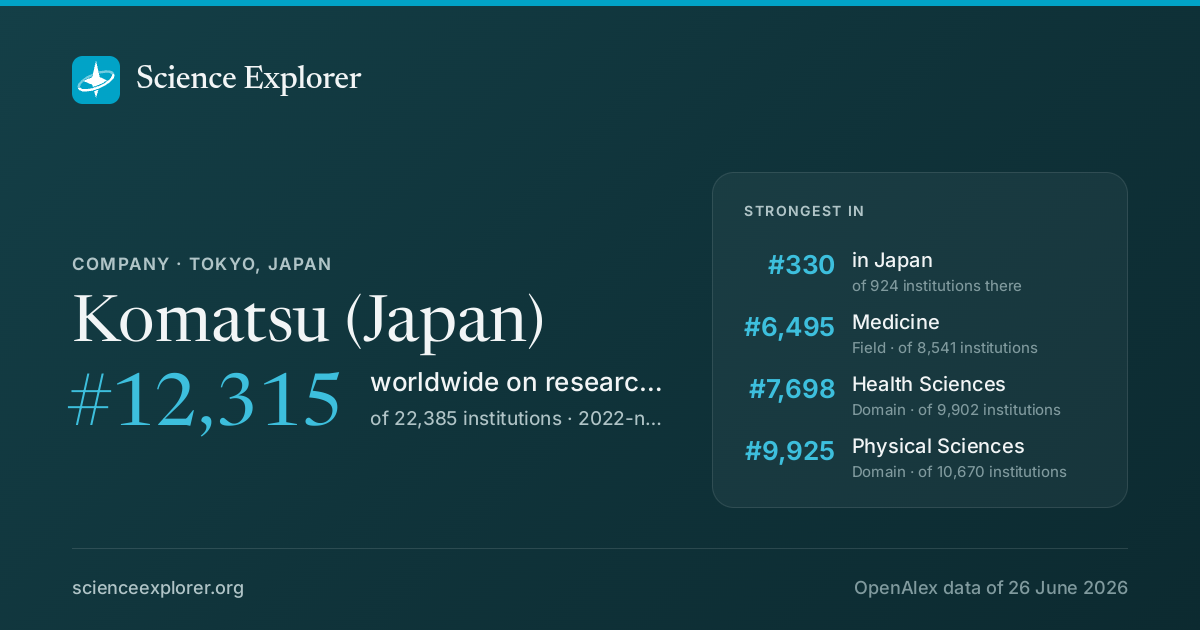
In research, Komatsu (Japan) stands highest in Medicine (#6,495 of 8,541 worldwide), Health Sciences (#7,698 of 9,902 worldwide) and Physical Sciences (#9,925 of 10,670 worldwide), 2022-now.
- World rank, 2022-now
- #12,315 of 22,385 · #11,221 all time
- Rank in Japan
- #330 of 924
- Research works
- 2k ▼ 5% vs 2018-21
- Citations
- 28k 13.9 per fractional work
- Top-10% rate
- 5.7% all institutions 10.0%
- vs its own fields
- 0.81× 1.00× is exactly expected
- Open access
- 43% world 40%
- International
- 13% world 18%
What is Komatsu (Japan) known for in research?
The fields where it stands highest, 2022-now, ranked among every institution above the floor in each field.
| Field | World rank | Where that sits | Top-10% rate | Works | All time |
|---|---|---|---|---|---|
| MedicineField | #6,495 of 8,541 | 5.0% | 75 | #7796 | |
| Health SciencesDomain | #7,698 of 9,902 | 5.4% | 86 | #9818 | |
| Physical SciencesDomain | #9,925 of 10,670 | 4.5% | 86 | #9363 |
Each strip is that field's whole ranked pool, with the notch where Komatsu (Japan) sits in it, in the colour of the band that rank falls in. The track under the rate is the rate itself: it carries no average mark, because the average differs by field (from about 6% in Dentistry to 21% in Economics).
Which of those standings moved
The same fields on both windows: where it stood over the whole record, and where it stands in 2022-now. The distance is the story, and it is the one thing the two rank columns above cannot show.
- Medicine#7,796 #6,495
- Health Sciences#9,818 #7,698
- Physical Sciences#9,363 #9,925
A dot further right is a better standing. Fields it was not ranked in over the whole record are left out.
Which fields of science does Komatsu (Japan) work in?
In 2022-now, 38% of research at Komatsu (Japan) is in Health Sciences, 38% in Physical Sciences. Its largest fields are Medicine (33%), Engineering (25%), Biochemistry, Genetics and Molecular Biology (7%). It does 1.6× the world's share of Health Sciences.
Each ring splits the one inside it: the four domains of science, their fields, their subfields. Size is fractional works in 2022-now. Every slice is a page; the interactive view zooms down to single topics and colours each by how much more of it this institution does than the world.
Its 4 domains and 26 fields, with their numbers
- Health Sciences9438.3%
- Medicine8233.4%
- Health Professions83.4%
- Nursing20.6%
- Dentistry10.6%
- Veterinary00.2%
- Physical Sciences9438.1%
- Engineering6124.8%
- Computer Science114.3%
- Environmental Science52.2%
- Chemistry52.1%
- Materials Science52.1%
- Chemical Engineering20.7%
- Mathematics10.6%
- Earth and Planetary Sciences10.5%
- Energy10.5%
- Physics and Astronomy10.3%
- Life Sciences3313.2%
- Social Sciences2610.5%
Field profile
Location quotient across every field it publishes in: outside the ring is more than an institution of this size would be expected to publish, inside it is less.
Rings at 0.5×, 1× and 2×. Widest outward: Chemical Engineering, 2.1×. Every wedge is a field page.
All 26 fields, with their numbers
- Chemical Engineering2.09×2 works
- Medicine1.74×82 works
- Engineering1.65×61 works
- Neuroscience1.52×6 works
- Veterinary1.49×0 works
- Pharmacology, Toxicology and Pharmaceutics1.37×1 works
- Chemistry1.34×5 works
- Health Professions1.30×8 works
- Nursing1.29×2 works
- Biochemistry, Genetics and Molecular Biology1.26×16 works
- Dentistry1.18×1 works
- Immunology and Microbiology1.16×3 works
- Psychology0.76×6 works
- Economics, Econometrics and Finance0.69×4 works
- Decision Sciences0.63×2 works
- Materials Science0.60×5 works
- Computer Science0.55×11 works
- Agricultural and Biological Sciences0.50×6 works
- Energy0.50×1 works
- Mathematics0.47×1 works
- Environmental Science0.45×6 works
- Earth and Planetary Sciences0.34×1 works
- Social Sciences0.34×10 works
- Arts and Humanities0.32×2 works
- Business, Management and Accounting0.27×2 works
- Physics and Astronomy0.13×1 works
- Chemical Engineering 2.1×
- Medicine 1.7×
- Engineering 1.6×
- Neuroscience 1.5×
- Veterinary 1.5×
- Pharmacology, Toxicology and Pharmaceutics 1.4×
- Chemistry 1.3×
- Health Professions 1.3×
- Nursing 1.3×
- Biochemistry, Genetics and Molecular Biology 1.3×
- Dentistry 1.2×
- Immunology and Microbiology 1.2×
- Psychology 0.8×
- Economics, Econometrics and Finance 0.7×
- Decision Sciences 0.6×
- Materials Science 0.6×
- Computer Science 0.6×
- Agricultural and Biological Sciences 0.5×
- Energy 0.5×
- Mathematics 0.5×
- Environmental Science 0.5×
- Earth and Planetary Sciences 0.3×
- Social Sciences 0.3×
- Arts and Humanities 0.3×
- Business, Management and Accounting 0.3×
- Physics and Astronomy 0.1×
Who are the top researchers at Komatsu (Japan)?
Ranked on the quality score, Y. Yatsurugi, Kousei Ueda and Hiroyuki Mizukami lead among researchers whose main affiliation is Komatsu (Japan).
- 1
Y. Yatsurugi
 Japan · #4,191,320 worldwide
532 citations · 21 works
- 2
Kousei Ueda
Japan · #4,344,679 worldwide
529 citations · 15 works
- 3
Hiroyuki Mizukami
Japan · #4,653,692 worldwide
773 citations · 34 works
- 4
Tatsuhiko Katayama
Japan · #5,022,514 worldwide
214 citations · 18 works
- 5
Yasuhito Okubo
Japan · #5,347,281 worldwide
307 citations · 21 works
- 6
Yutaka Matano
Japan · #5,381,866 worldwide
184 citations · 17 works
- 7
R. Ando
Japan · #5,474,267 worldwide
261 citations · 19 works
- 8
K. Sajiki
Japan · #5,546,510 worldwide
223 citations · 22 works
- 9
Izumi NISHIZAWA
Japan · #5,557,827 worldwide
310 citations · 26 works
- 10
Kenji Mihara
Japan · #5,626,595 worldwide
282 citations · 22 works
Which keywords describe research at Komatsu (Japan)?
By fractional works in 2022-now, weighted toward what it does more of than the world: Epidemiology, Inflammation, Treatment, Mechanical Properties, Diagnosis, Simulation, Control and Actuators.
- Nanoindentation
- Endoscopic Resection
- Molecular Profiling
- Mucins
- Glycosylation
- Health-related Quality of Life
- Survival Analysis
- Tool Wear
- Immune System
- Neuroinflammation
- Complications
- Prognostic Factors
- Modeling
- Actuators
- Simulation
- Chemotherapy
- Cancer
- Diagnosis
- Mechanical Properties
- Inflammation
- Epidemiology
- Treatment
- Machine Learning
- Oxidative Stress
- Quality of Life
- Pathogenesis
- Management
- Control
- Microstructure
- Genetic Mutations
- Adaptive
- Hydraulic Systems
- Robust
- Prognosis
- Grain Refinement
- Microstructural Evolution
- Glycans
- Tribological Performance
- Surface Roughness
- High Temperature
Size is fractional works in 2022-now in the topics tagged with each word; colour is the word's share of this institution's work against its share of the world's. The 40 words are chosen for being large and distinctive. Each links to the topic it comes from most.
All 40 words, with their numbers
- Epidemiology19▲ 1.93×66 topics
- Inflammation10▲ 1.85×40 topics
- Treatment8▲ 2.6×25 topics
- Mechanical Properties7▲ 3.0×16 topics
- Machine Learning7◆ 0.87×32 topics
- Diagnosis7▲ 3.0×22 topics
- Oxidative Stress7▲ 1.63×27 topics
- Cancer6▲ 1.80×23 topics
- Quality of Life5▲ 1.41×20 topics
- Chemotherapy5▲ 2.8×17 topics
- Pathogenesis4▲ 3.5×13 topics
- Simulation4▲ 6.8×6 topics
- Management4▲ 2.0×18 topics
- Actuators4▲ 9.5×3 topics
- Control4▲ 12×3 topics
- Modeling4▲ 6.0×5 topics
- Microstructure4▲ 2.8×6 topics
- Prognostic Factors4▲ 3.3×10 topics
- Genetic Mutations3▲ 3.2×10 topics
- Complications3▲ 2.7×9 topics
- Adaptive3▲ 28×2 topics
- Neuroinflammation3▲ 4.6×6 topics
- Hydraulic Systems3▲ 21×1 topic
- Immune System3▲ 5.0×4 topics
- Robust3▲ 31×1 topic
- Tool Wear3▲ 9.2×2 topics
- Prognosis3▲ 3.4×6 topics
- Survival Analysis3▲ 4.1×5 topics
- Grain Refinement3▲ 9.4×4 topics
- Health-related Quality of Life3▲ 4.6×4 topics
- Microstructural Evolution3▲ 7.5×4 topics
- Glycosylation2▲ 9.0×2 topics
- Glycans2▲ 26×1 topic
- Mucins2▲ 26×1 topic
- Tribological Performance2▲ 15×2 topics
- Molecular Profiling2▲ 8.6×3 topics
- Surface Roughness2▲ 6.1×3 topics
- Endoscopic Resection2▲ 7.7×2 topics
- High Temperature2▲ 11×2 topics
- Nanoindentation2▲ 13×1 topic
Which research topics does Komatsu (Japan) publish most on?
By volume in 2022-now: Hydraulic and Pneumatic Systems, Glycosylation and Glycoproteins Research, Metal and Thin Film Mechanics and Metallurgy and Material Forming.
Area is fractional works; colour is the subfield each topic belongs to.
- 1 Hydraulic and Pneumatic Systems Mechanical Engineering 3 works
- 2 Glycosylation and Glycoproteins Research Molecular Biology 2 works
- 3 Metal and Thin Film Mechanics Mechanics of Materials 2 works
- 4 Metallurgy and Material Forming Mechanics of Materials 2 works
- 5 Advanced machining processes and optimization Mechanical Engineering 2 works
- 6 Tribology and Lubrication Engineering Mechanical Engineering 1 works
- 7 Advanced Surface Polishing Techniques Biomedical Engineering 1 works
- 8 Soil Mechanics and Vehicle Dynamics Civil and Structural Engineering 1 works
- 9 Microstructure and Mechanical Properties of Steels Mechanical Engineering 1 works
- 10 Ergonomics and Musculoskeletal Disorders Social Psychology 1 works
How open and international is its research?
Against the world's own shares: the tick on each track. Both are shares of its output, so they sit on one scale and can be read against each other as well as against the world.
World: 40% of research is openly available.
World: 18% is written across borders.
How has Komatsu (Japan)'s research output changed?
Output in 2022-2025 was 5% lower than in 2018-2021.
The same series as a ribbon: one cell per year, darker for more. The line above answers how much; this answers when.
Its share of all research
Growing output can still be a shrinking share: all of science grows. This is Komatsu (Japan) as a percentage of every work published that year, 0.0011% in 2024.
Fractional works of Komatsu (Japan) over all fractional works that year. How the balance of science has shifted.
How much of it reaches the world top 10%
Year by year, against all institutions in the same year.
Of each year's output, the share that reached the world's 10% most cited for its field and year. Peak 11.4% in 1993.
Other research institutions in Tokyo
- The University of Tokyo
- Tokyo Institute of Technology
- Keio University
- Waseda University
- Tokyo University of Science
- Nihon University
- Hitachi (Japan)
- NTT (Japan)


Share Komatsu (Japan)'s ranking
Badges for a website1Each links back here and updates with every snapshot

Research measures only: rankings here say nothing about teaching, admissions or student experience. Comparable institutions and collaboration partners have tabs of their own, above.
Discussion
Ask a question or share a note about Komatsu (Japan). Keep it to the research: no personal attacks, advertising or links. Any reader can report a post, which collapses it for everyone until it is opened.