Laguna State Polytechnic University
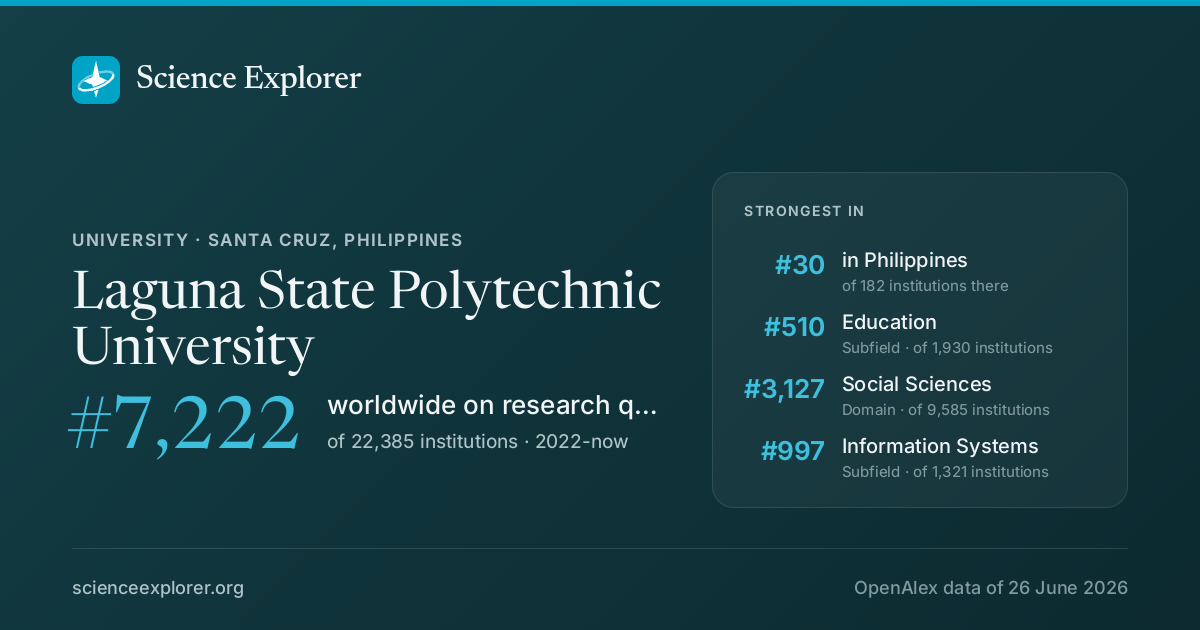
In research, Laguna State Polytechnic University stands highest in Education (#510 of 1,930 worldwide), Social Sciences (#3,127 of 9,585 worldwide) and Social Sciences (#2,782 of 5,988 worldwide), 2022-now. Relative to its size it is most specialised in Physical Therapy, Sports Therapy and Rehabilitation, Education and Developmental and Educational Psychology (Physical Therapy, Sports Therapy and Rehabilitation is 15.4× its share of world research).
- World rank, 2022-now
- #7,222 of 22,385 · #12,442 all time
- Rank in Philippines
- #30 of 182
- Research works
- 1.6k ▲ 155% vs 2018-21
- Citations
- 2.3k 1.5 per fractional work
- Top-10% rate
- 4.5% all institutions 10.0%
- vs its own fields
- 0.49× 1.00× is exactly expected
- Open access
- 93% world 40%
- International
- 4% world 18%
What is Laguna State Polytechnic University known for in research?
The fields where it stands highest, 2022-now, ranked among every institution above the floor in each field.
| Field | World rank | Where that sits | Top-10% rate | Works | All time |
|---|---|---|---|---|---|
| EducationSubfield | #510 of 1,930 | 4.9% | 430 | #1240 | |
| Social SciencesDomain | #3,127 of 9,585 | 4.2% | 704 | #4927 | |
| Social SciencesField | #2,782 of 5,988 | 5.0% | 512 | #5636 | |
| Information SystemsSubfield | #997 of 1,321 | 5.5% | 112 | #2028 | |
| Physical SciencesDomain | #8,468 of 10,670 | 4.2% | 223 | #14994 | |
| PsychologyField | #1,753 of 2,121 | 1.9% | 92 | #2184 | |
| Computer ScienceField | #4,151 of 4,417 | 4.5% | 153 | #6002 | |
| Health SciencesDomain | #9,652 of 9,902 | 10.3% | 64 | - |
Each strip is that field's whole ranked pool, with the notch where Laguna State Polytechnic University sits in it, in the colour of the band that rank falls in. The track under the rate is the rate itself: it carries no average mark, because the average differs by field (from about 6% in Dentistry to 21% in Economics).
Which of those standings moved
The same fields on both windows: where it stood over the whole record, and where it stands in 2022-now. The distance is the story, and it is the one thing the two rank columns above cannot show.
- Education#1,240 #510
- Social Sciences#4,927 #3,127
- Social Sciences#5,636 #2,782
- Information Systems#2,028 #997
- Physical Sciences#14,994 #8,468
- Psychology#2,184 #1,753
- Computer Science#6,002 #4,151
A dot further right is a better standing. Fields it was not ranked in over the whole record are left out.
Which fields of science does Laguna State Polytechnic University work in?
In 2022-now, 68% of research at Laguna State Polytechnic University is in Social Sciences, 22% in Physical Sciences. Its largest fields are Social Sciences (49%), Computer Science (14%), Psychology (9%). It does 2.7× the world's share of Social Sciences.
Each ring splits the one inside it: the four domains of science, their fields, their subfields. Size is fractional works in 2022-now. Every slice is a page; the interactive view zooms down to single topics and colours each by how much more of it this institution does than the world.
Its 4 domains and 24 fields, with their numbers
- Social Sciences76467.8%
- Social Sciences55148.9%
- Psychology1018.9%
- Business, Management and Accounting575.0%
- Arts and Humanities302.7%
- Economics, Econometrics and Finance141.3%
- Decision Sciences110.9%
- Physical Sciences24321.5%
- Computer Science16114.3%
- Mathematics282.5%
- Engineering242.1%
- Environmental Science191.7%
- Chemistry40.4%
- Materials Science30.3%
- Energy20.2%
- Earth and Planetary Sciences10.1%
- Health Sciences716.3%
- Health Professions524.6%
- Medicine161.4%
- Nursing30.3%
- Veterinary00.0%
- Dentistry00.0%
- Life Sciences494.3%
What does Laguna State Polytechnic University specialise in?
Where its research is concentrated relative to its size: Physical Therapy, Sports Therapy and Rehabilitation takes 15.4× the share of its output that it takes of world research.
- Physical Therapy, Sports Therapy and RehabilitationSubfield · 31.6 works15×
- EducationSubfield · 452.0 works13×
- Developmental and Educational PsychologySubfield · 39.0 works7.6×
- Applied MathematicsSubfield · 23.8 works7.4×
- Information SystemsSubfield · 115.6 works5.8×
Location quotient, a volume reading rather than an impact one. It surfaces small, lopsided specialities.
Field profile
Location quotient across every field it publishes in: outside the ring is more than an institution of this size would be expected to publish, inside it is less.
Rings at 0.5×, 1× and 2×. Widest outward: Social Sciences, 3.9×. Every wedge is a field page.
All 24 fields, with their numbers
- Social Sciences3.87×551 works
- Psychology2.93×101 works
- Mathematics2.14×28 works
- Computer Science1.83×161 works
- Health Professions1.74×52 works
- Business, Management and Accounting1.56×57 works
- Decision Sciences0.97×11 works
- Arts and Humanities0.93×30 works
- Agricultural and Biological Sciences0.72×38 works
- Nursing0.62×3 works
- Economics, Econometrics and Finance0.59×14 works
- Environmental Science0.34×19 works
- Pharmacology, Toxicology and Pharmaceutics0.27×1 works
- Chemistry0.25×4 works
- Veterinary0.22×0 works
- Neuroscience0.21×4 works
- Energy0.17×2 works
- Engineering0.14×24 works
- Biochemistry, Genetics and Molecular Biology0.08×4 works
- Materials Science0.08×3 works
- Medicine0.07×16 works
- Immunology and Microbiology0.06×1 works
- Earth and Planetary Sciences0.06×1 works
- Dentistry0.03×0 works
- Social Sciences 3.9×
- Psychology 2.9×
- Mathematics 2.1×
- Computer Science 1.8×
- Health Professions 1.7×
- Business, Management and Accounting 1.6×
- Decision Sciences 1.0×
- Arts and Humanities 0.9×
- Agricultural and Biological Sciences 0.7×
- Nursing 0.6×
- Economics, Econometrics and Finance 0.6×
- Environmental Science 0.3×
- Pharmacology, Toxicology and Pharmaceutics 0.3×
- Chemistry 0.2×
- Veterinary 0.2×
- Neuroscience 0.2×
- Energy 0.2×
- Engineering 0.1×
- Biochemistry, Genetics and Molecular Biology 0.1×
- Materials Science 0.1×
- Medicine 0.1×
- Immunology and Microbiology 0.1×
- Earth and Planetary Sciences 0.1×
- Dentistry 0.0×
Who are the top researchers at Laguna State Polytechnic University?
Ranked on the quality score, John Michael Aquino, John Vincent Aliazas and Albert Andry E. Panergayo lead among researchers whose main affiliation is Laguna State Polytechnic University.
- 1
John Michael Aquino
 Philippines · #1,074,789 worldwide
120 citations · 40 works
- 2
John Vincent Aliazas
Philippines · #1,322,222 worldwide
153 citations · 37 works
- 3
Albert Andry E. Panergayo
Philippines · #1,911,218 worldwide
127 citations · 17 works
- 4
Jérôme Nicolas
Philippines · #2,600,076 worldwide
0 citations · 34 works
- 5
John Frederick B. Tesoro
Philippines · #2,884,812 worldwide
173 citations · 16 works
- 6
Karen A. Manaig
Philippines · #3,043,263 worldwide
276 citations · 44 works
- 7
Chester Alexis C. Buama
Philippines · #3,058,242 worldwide
155 citations · 20 works
- 8
Adriel G. Roman
Philippines · #3,303,841 worldwide
58 citations · 24 works
- 9
Alberto D. Yazon
Philippines · #3,350,285 worldwide
449 citations · 55 works
- 10
Cecilia Q. Velasco
Philippines · #3,394,752 worldwide
15 citations · 23 works
Which keywords describe research at Laguna State Polytechnic University?
By fractional works in 2022-now, weighted toward what it does more of than the world: Educational Technology, E-Learning, Technology Integration, Online Learning, Mobile Learning, Education, Student Satisfaction and Google Classroom.
- Work Motivation
- Metacognition
- Professional Development
- Instructional Interventions
- Nursing Education
- Reading Interest
- Teacher Performance
- Inclusive Education
- Information Literacy
- Meta-Analysis
- Critical Thinking Skills
- Media Literacy
- Digital Literacy
- Digital Learning
- 21st Century Skills
- Teaching Strategies
- Google Classroom
- Education
- Online Learning
- E-Learning
- Educational Technology
- Technology Integration
- Mobile Learning
- Student Satisfaction
- Teacher Perception
- Teacher Professional Development
- Motivation
- STEM Education
- Student Motivation
- Innovation
- Student Engagement
- Educational Leadership
- Organizational Commitment
- Higher Education
- School Improvement
- School Literacy Movement
- Higher-Order Thinking
- Transformational Leadership
- Quality Management
- Digital Education
Size is fractional works in 2022-now in the topics tagged with each word; colour is the word's share of this institution's work against its share of the world's. The 40 words are chosen for being large and distinctive. Each links to the topic it comes from most.
All 40 words, with their numbers
- Educational Technology211▲ 16×29 topics
- E-Learning191▲ 18×17 topics
- Technology Integration162▲ 46×10 topics
- Online Learning152▲ 16×19 topics
- Mobile Learning139▲ 36×5 topics
- Education124▲ 6.4×43 topics
- Student Satisfaction110▲ 53×3 topics
- Google Classroom92▲ 79×1 topic
- Teacher Perception92▲ 74×1 topic
- Teaching Strategies78▲ 25×5 topics
- Teacher Professional Development75▲ 41×5 topics
- 21st Century Skills60▲ 18×6 topics
- Motivation59▲ 13×7 topics
- Digital Learning58▲ 10×11 topics
- STEM Education57▲ 11×9 topics
- Digital Literacy55▲ 8.6×10 topics
- Student Motivation53▲ 24×7 topics
- Media Literacy51▲ 8.6×5 topics
- Innovation50▲ 4.3×30 topics
- Critical Thinking Skills50▲ 25×2 topics
- Student Engagement50▲ 11×14 topics
- Meta-Analysis48▲ 7.2×8 topics
- Educational Leadership47▲ 33×3 topics
- Information Literacy47▲ 16×3 topics
- Organizational Commitment46▲ 21×4 topics
- Inclusive Education46▲ 11×7 topics
- Higher Education45▲ 7.4×18 topics
- Teacher Performance43▲ 27×2 topics
- School Improvement41▲ 44×2 topics
- Reading Interest38▲ 17×1 topic
- School Literacy Movement38▲ 17×1 topic
- Nursing Education38▲ 26×2 topics
- Higher-Order Thinking37▲ 43×1 topic
- Instructional Interventions37▲ 43×1 topic
- Transformational Leadership36▲ 19×3 topics
- Professional Development33▲ 14×11 topics
- Quality Management33▲ 21×5 topics
- Metacognition31▲ 18×3 topics
- Digital Education31▲ 19×3 topics
- Work Motivation31▲ 38×3 topics
Which research topics does Laguna State Polytechnic University publish most on?
By volume in 2022-now: Technology-Enhanced Education Studies, Educational Methods and Media Use, Education and Critical Thinking Development and School Leadership and Teacher Performance.
Area is fractional works; colour is the subfield each topic belongs to.
- 1 Technology-Enhanced Education Studies Education 92 works
- 2 Educational Methods and Media Use Information Systems 38 works
- 3 Education and Critical Thinking Development Education 37 works
- 4 School Leadership and Teacher Performance Education 30 works
- 5 Education and Communication Studies Education 29 works
- 6 Educational Methods and Outcomes Education 27 works
- 7 Mathematics Education and Pedagogy Applied Mathematics 24 works
- 8 Educational Practices and Challenges Education 23 works
- 9 Sports and Physical Education Research Physical Therapy, Sports Therapy and Rehabilitation 23 works
- 10 Online and Blended Learning Education 14 works
How open and international is its research?
Against the world's own shares: the tick on each track. Both are shares of its output, so they sit on one scale and can be read against each other as well as against the world.
World: 40% of research is openly available.
World: 18% is written across borders.
How has Laguna State Polytechnic University's research output changed?
Output in 2022-2025 was 155% higher than in 2018-2021.
The same series as a ribbon: one cell per year, darker for more. The line above answers how much; this answers when.
Its share of all research
Growing output can still be a shrinking share: all of science grows. This is Laguna State Polytechnic University as a percentage of every work published that year, 0.0045% in 2024.
Fractional works of Laguna State Polytechnic University over all fractional works that year. How the balance of science has shifted.
How much of it reaches the world top 10%
Year by year, against all institutions in the same year.
Of each year's output, the share that reached the world's 10% most cited for its field and year. Peak 4.8% in 2023.
Other research institutions in Santa Cruz
Share Laguna State Polytechnic University's ranking
Badges for a website1Each links back here and updates with every snapshot

Research measures only: rankings here say nothing about teaching, admissions or student experience. Comparable institutions and collaboration partners have tabs of their own, above.
Discussion
Ask a question or share a note about Laguna State Polytechnic University. Posts are plain text and can be reported.