- World rank, all time
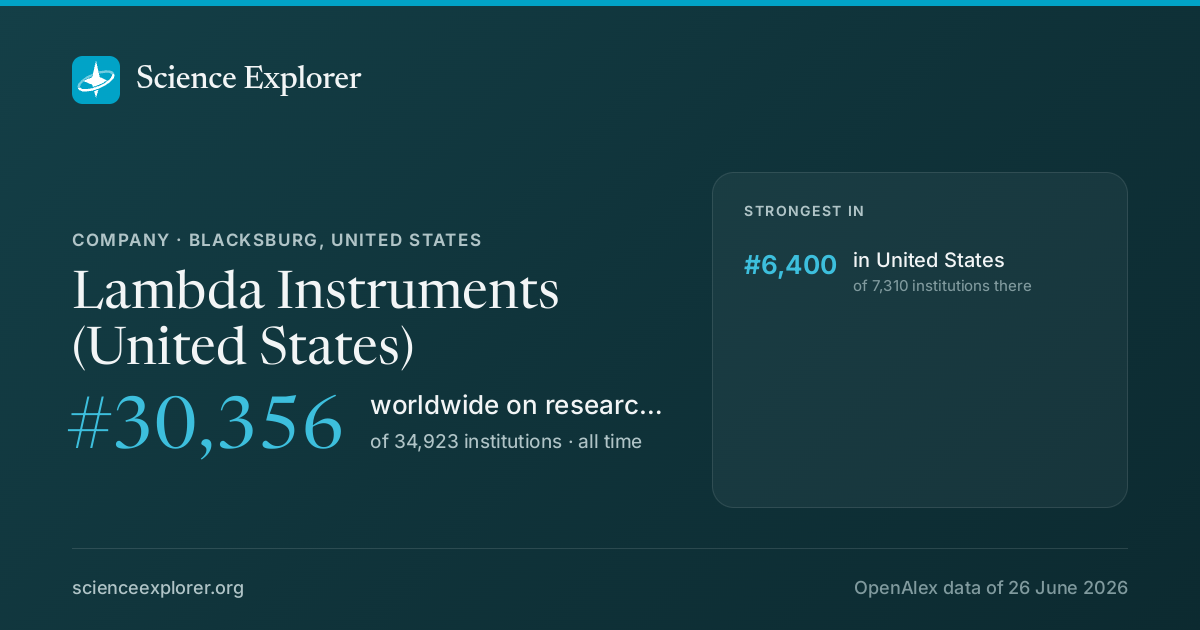
- #30,356 of 34,923
- Rank in United States
- #6,400 of 7,310
- Research works
- 168 ▲ 10% vs 2018-21
- Citations
- 3.4k 20.3 per fractional work
- Top-10% rate
- 11.8% all institutions 10.0%
- vs its own fields
- 0.92× 1.00× is exactly expected
- Open access
- 15% world 40%
- International
- 17% world 18%
Which fields of science does Lambda Instruments (United States) work in?
In all years, 45% of research at Lambda Instruments (United States) is in Physical Sciences, 31% in Health Sciences. Its largest fields are Medicine (31%), Engineering (26%), Immunology and Microbiology (12%). It does 1.3× the world's share of Health Sciences.
Each ring splits the one inside it: the four domains of science, their fields, their subfields. Size is fractional works in all years. Every slice is a page; the interactive view zooms down to single topics and colours each by how much more of it this institution does than the world.
Its 4 domains and 22 fields, with their numbers
- Physical Sciences7645.1%
- Engineering4426.2%
- Materials Science95.4%
- Physics and Astronomy74.1%
- Computer Science63.8%
- Chemistry42.6%
- Mathematics31.6%
- Environmental Science21.1%
- Energy00.2%
- Health Sciences5331.2%
- Medicine5231.0%
- Nursing00.2%
- Veterinary00.0%
- Life Sciences3017.6%
- Social Sciences106.1%
Field profile
Location quotient across every field it publishes in: outside the ring is more than an institution of this size would be expected to publish, inside it is less.
Rings at 0.5×, 1× and 2×. Widest outward: Physics and Astronomy, 9.7×. Every wedge is a field page.
All 13 fields, with their numbers
- Physics and Astronomy9.73×3 works
- Immunology and Microbiology4.08×1 works
- Computer Science1.98×2 works
- Mathematics1.95×0 works
- Decision Sciences1.59×0 works
- Social Sciences1.30×2 works
- Medicine0.96×3 works
- Engineering0.86×2 works
- Chemistry0.73×0 works
- Business, Management and Accounting0.48×0 works
- Biochemistry, Genetics and Molecular Biology0.44×0 works
- Materials Science0.38×0 works
- Psychology0.30×0 works
- Physics and Astronomy 9.7×
- Immunology and Microbiology 4.1×
- Computer Science 2.0×
- Mathematics 1.9×
- Decision Sciences 1.6×
- Social Sciences 1.3×
- Medicine 1.0×
- Engineering 0.9×
- Chemistry 0.7×
- Business, Management and Accounting 0.5×
- Biochemistry, Genetics and Molecular Biology 0.4×
- Materials Science 0.4×
- Psychology 0.3×
Who are the top researchers at Lambda Instruments (United States)?
Ranked on the quality score, Jar-How Lee, Paul S. Prevéy and Mikki Ozawa lead among researchers whose main affiliation is Lambda Instruments (United States).
- 1
Jar-How Lee
 United States · #940,449 worldwide
2.4k citations · 67 works
- 2
Paul S. Prevéy
United States · #1,856,453 worldwide
2.1k citations · 63 works
- 3
Mikki Ozawa
United States · #1,977,845 worldwide
498 citations · 16 works
- 4
Adam Idica
United States · #2,472,522 worldwide
727 citations · 42 works
- 5
Thoa Nong
United States · #2,765,166 worldwide
396 citations · 21 works
- 6
Nadim R. El-Awar
United States · #3,187,483 worldwide
1.5k citations · 43 works
- 7
Nori Sasaki
United States · #3,299,244 worldwide
523 citations · 22 works
- 8
Douglas J. Hornbach
United States · #4,704,380 worldwide
405 citations · 18 works
- 9
N. Jayaraman
United States · #5,481,294 worldwide
289 citations · 31 works
Which keywords describe research at Lambda Instruments (United States)?
By fractional works in all years, weighted toward what it does more of than the world: Graft Survival, Kidney Transplantation, Immunosuppressive Drugs, Antibody-Mediated Rejection, Renal Allograft, Autoimmunity, TGF-ß and CD4+CD25+.
- Blood Groups
- Polybenzoxazines
- Anemia
- Microwave Chemistry
- Organic Synthesis
- Polymerization
- Heart Transplant
- Ischemia-Reperfusion Injury
- Dendritic Cells
- Electromigration
- Immunity
- Immunosuppressive Therapy
- Fc Receptors
- Transplantation
- Monoclonal Antibodies
- Foxp3
- TGF-ß
- Autoimmunity
- Antibody-Mediated Rejection
- Kidney Transplantation
- Graft Survival
- Immunosuppressive Drugs
- Renal Allograft
- Mechanical Properties
- CD4+CD25+
- Innate Immunity
- Therapeutic Antibodies
- Antibody Engineering
- Antigen Presentation
- Energy Efficiency
- Cancer Immunotherapy
- Rejection
- Tumor Antigen
- Liver Transplantation
- Lung Transplant
- Corrosion
- Green Chemistry
- Nonthermal Effects
- Epoxy Resins
- Alloimmunization
Size is fractional works in all years in the topics tagged with each word; colour is the word's share of this institution's work against its share of the world's. The 40 words are chosen for being large and distinctive. Each links to the topic it comes from most.
All 40 words, with their numbers
- Graft Survival19▲ 107×3 topics
- Kidney Transplantation16▲ 135×2 topics
- Immunosuppressive Drugs15▲ 143×2 topics
- Antibody-Mediated Rejection14▲ 205×1 topic
- Renal Allograft14▲ 205×1 topic
- Autoimmunity8▲ 23×3 topics
- Mechanical Properties8▲ 4.8×10 topics
- TGF-ß8▲ 26×2 topics
- CD4+CD25+7▲ 59×1 topic
- Foxp37▲ 59×1 topic
- Innate Immunity7▲ 12×3 topics
- Monoclonal Antibodies7▲ 28×3 topics
- Therapeutic Antibodies7▲ 30×2 topics
- Transplantation6▲ 32×3 topics
- Antibody Engineering6▲ 34×1 topic
- Fc Receptors6▲ 34×1 topic
- Antigen Presentation5▲ 31×2 topics
- Immunosuppressive Therapy5▲ 16×4 topics
- Energy Efficiency5▲ 3.8×6 topics
- Immunity5▲ 8.9×4 topics
- Cancer Immunotherapy5▲ 20×2 topics
- Electromigration5▲ 53×2 topics
- Rejection5▲ 58×2 topics
- Dendritic Cells5▲ 24×1 topic
- Tumor Antigen5▲ 34×1 topic
- Ischemia-Reperfusion Injury4▲ 28×1 topic
- Liver Transplantation4▲ 17×1 topic
- Heart Transplant4▲ 69×1 topic
- Lung Transplant4▲ 69×1 topic
- Polymerization4▲ 12×2 topics
- Corrosion4▲ 18×6 topics
- Organic Synthesis3▲ 9.5×3 topics
- Green Chemistry3▲ 6.7×2 topics
- Microwave Chemistry3▲ 168×1 topic
- Nonthermal Effects3▲ 168×1 topic
- Anemia3▲ 16×2 topics
- Epoxy Resins3▲ 53×1 topic
- Polybenzoxazines3▲ 94×1 topic
- Alloimmunization3▲ 48×1 topic
- Blood Groups3▲ 48×1 topic
Which research topics does Lambda Instruments (United States) publish most on?
By volume in 2022-now: Particle Detector Development and Performance, Radiation Detection and Scintillator Technologies, Renal Transplantation Outcomes and Treatments and Global Peace and Security Dynamics.
Area is fractional works; colour is the subfield each topic belongs to.
- 1 Particle Detector Development and Performance Nuclear and High Energy Physics 1 works
- 2 Radiation Detection and Scintillator Technologies Radiation 1 works
- 3 Renal Transplantation Outcomes and Treatments Transplantation 1 works
- 4 Global Peace and Security Dynamics Political Science and International Relations 0 works
- 5 STEM Education Education 0 works
- 6 Organ Donation and Transplantation Public Health, Environmental and Occupational Health 0 works
- 7 Human Rights and Development Sociology and Political Science 0 works
- 8 CCD and CMOS Imaging Sensors Electrical and Electronic Engineering 0 works
- 9 Immune Cell Function and Interaction Immunology 0 works
- 10 Neutrino Physics Research Nuclear and High Energy Physics 0 works
How open and international is its research?
Against the world's own shares: the tick on each track. Both are shares of its output, so they sit on one scale and can be read against each other as well as against the world.
World: 40% of research is openly available.
World: 18% is written across borders.
How has Lambda Instruments (United States)'s research output changed?
Output in 2022-2025 was 10% higher than in 2018-2021.
The same series as a ribbon: one cell per year, darker for more. The line above answers how much; this answers when.
Its share of all research
Growing output can still be a shrinking share: all of science grows. This is Lambda Instruments (United States) as a percentage of every work published that year, 0.000026% in 2024.
Fractional works of Lambda Instruments (United States) over all fractional works that year. How the balance of science has shifted.
Other research institutions in Blacksburg
- Virginia Tech
- Virginia Cooperative Extension
- Edward Via College of Osteopathic Medicine
- Electrical Distribution Design (United States)
- TechLab (United States)
- Graf Research (United States)
- Molecular Sciences Software Institute
- Torc Robotics (United States)


Share Lambda Instruments (United States)'s ranking
Badges for a website1Each links back here and updates with every snapshot

Research measures only: rankings here say nothing about teaching, admissions or student experience. Comparable institutions and collaboration partners have tabs of their own, above.
Discussion
Ask a question or share a note about Lambda Instruments (United States). Posts are plain text and can be reported.