Leipzig University

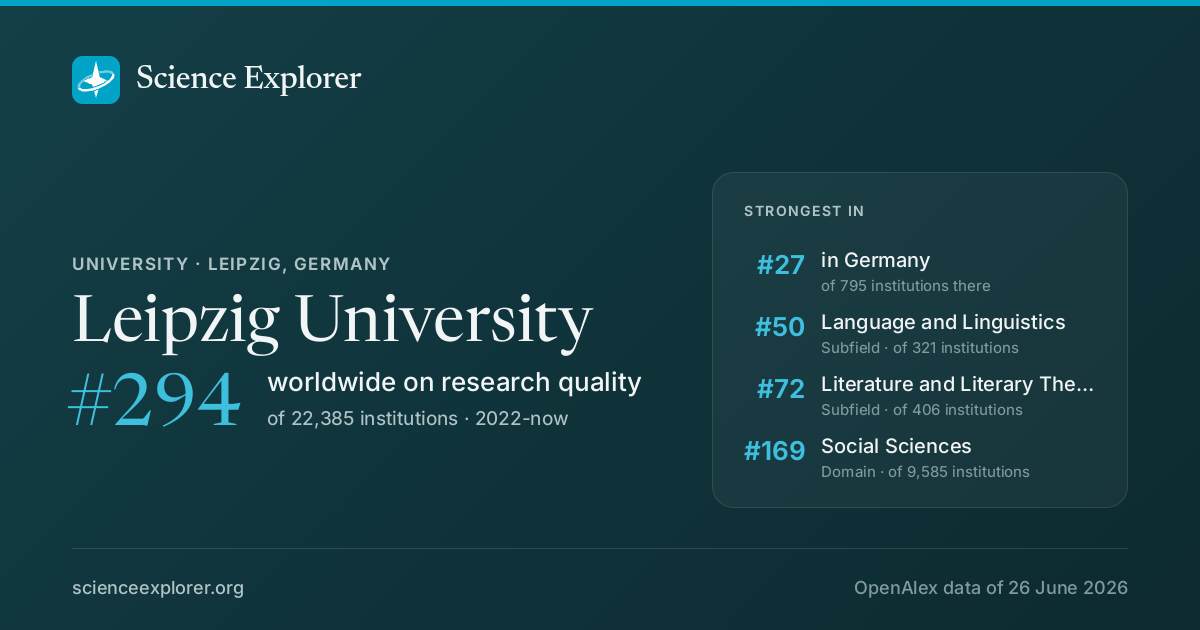
In research, Leipzig University stands highest in Social Sciences (#169 of 9,585 worldwide), Health Sciences (#267 of 9,902 worldwide) and Medicine (#252 of 8,541 worldwide), 2022-now. Relative to its size it is most specialised in Veterinary, Language and Linguistics and Small Animals (Veterinary is 4.5× its share of world research).
- World rank, 2022-now
- #294 of 22,385 · #449 all time
- Rank in Germany
- #27 of 795
- Research works
- 54k ▼ 4% vs 2018-21
- Citations
- 1M 19.2 per fractional work
- Top-10% rate
- 10.6% all institutions 10.0%
- vs its own fields
- 1.08× 1.00× is exactly expected
- Open access
- 31% world 40%
- International
- 18% world 18%
What is Leipzig University known for in research?
The fields where it stands highest, 2022-now, ranked among every institution above the floor in each field.
| Field | World rank | Where that sits | Top-10% rate | Works | All time |
|---|---|---|---|---|---|
| Social SciencesDomain | #169 of 9,585 | 12.4% | 2,266 | #310 | |
| Health SciencesDomain | #267 of 9,902 | 10.3% | 2,550 | #303 | |
| MedicineField | #252 of 8,541 | 10.2% | 2,224 | #281 | |
| Social SciencesField | #206 of 5,988 | 11.3% | 1,004 | #363 | |
| Life SciencesDomain | #333 of 6,403 | 10.6% | 1,033 | #438 | |
| Arts and HumanitiesField | #105 of 1,896 | 11.9% | 520 | #186 | |
| PsychologyField | #123 of 2,121 | 15.7% | 406 | #220 | |
| Physical SciencesDomain | #622 of 10,670 | 8.8% | 1,483 | #711 | |
| Sociology and Political ScienceSubfield | #164 of 2,526 | 11.3% | 417 | #308 | |
| Environmental ScienceField | #243 of 3,334 | 15.7% | 218 | #405 |
Each strip is that field's whole ranked pool, with the notch where Leipzig University sits in it, in the colour of the band that rank falls in. The track under the rate is the rate itself: it carries no average mark, because the average differs by field (from about 6% in Dentistry to 21% in Economics).
Which of those standings moved
The same fields on both windows: where it stood over the whole record, and where it stands in 2022-now. The distance is the story, and it is the one thing the two rank columns above cannot show.
- Social Sciences#310 #169
- Health Sciences#303 #267
- Medicine#281 #252
- Social Sciences#363 #206
- Life Sciences#438 #333
- Arts and Humanities#186 #105
- Psychology#220 #123
- Physical Sciences#711 #622
- Sociology and Political Science#308 #164
- Environmental Science#405 #243
A dot further right is a better standing. Fields it was not ranked in over the whole record are left out.
Which fields of science does Leipzig University work in?
In 2022-now, 35% of research at Leipzig University is in Health Sciences, 30% in Social Sciences. Its largest fields are Medicine (30%), Social Sciences (13%), Biochemistry, Genetics and Molecular Biology (7%). It does 1.5× the world's share of Health Sciences.
Each ring splits the one inside it: the four domains of science, their fields, their subfields. Size is fractional works in 2022-now. Every slice is a page; the interactive view zooms down to single topics and colours each by how much more of it this institution does than the world.
Its 4 domains and 26 fields, with their numbers
- Health Sciences2,90834.8%
- Medicine2,52930.3%
- Health Professions2412.9%
- Dentistry610.7%
- Veterinary510.6%
- Nursing260.3%
- Social Sciences2,53930.4%
- Social Sciences1,12713.5%
- Arts and Humanities5766.9%
- Psychology4665.6%
- Business, Management and Accounting2002.4%
- Economics, Econometrics and Finance1141.4%
- Decision Sciences570.7%
- Physical Sciences1,72520.6%
- Computer Science3504.2%
- Engineering3344.0%
- Environmental Science2833.4%
- Physics and Astronomy1792.1%
- Materials Science1732.1%
- Chemistry1461.7%
- Mathematics1131.3%
- Earth and Planetary Sciences1091.3%
- Energy210.3%
- Chemical Engineering170.2%
- Life Sciences1,18214.1%
What does Leipzig University specialise in?
Where its research is concentrated relative to its size: Veterinary takes 4.5× the share of its output that it takes of world research.
- VeterinaryField · 51.0 works4.5×
- Language and LinguisticsSubfield · 139.0 works3.8×
- Small AnimalsSubfield · 37.8 works3.7×
- Religious studiesSubfield · 49.9 works3.6×
- OtorhinolaryngologySubfield · 26.3 works3.2×
- Applied PsychologySubfield · 37.8 works3.2×
Location quotient, a volume reading rather than an impact one. It surfaces small, lopsided specialities.
Field profile
Location quotient across every field it publishes in: outside the ring is more than an institution of this size would be expected to publish, inside it is less.
Rings at 0.5×, 1× and 2×. Widest outward: Veterinary, 4.5×. Every wedge is a field page.
All 26 fields, with their numbers
- Veterinary4.49×51 works
- Arts and Humanities2.39×576 works
- Neuroscience1.97×267 works
- Psychology1.83×466 works
- Medicine1.57×2,529 works
- Immunology and Microbiology1.55×130 works
- Dentistry1.51×61 works
- Biochemistry, Genetics and Molecular Biology1.39×619 works
- Mathematics1.15×113 works
- Chemistry1.11×146 works
- Health Professions1.09×241 works
- Social Sciences1.07×1,127 works
- Physics and Astronomy0.97×179 works
- Earth and Planetary Sciences0.84×110 works
- Pharmacology, Toxicology and Pharmaceutics0.75×22 works
- Business, Management and Accounting0.74×200 works
- Decision Sciences0.70×57 works
- Environmental Science0.68×283 works
- Economics, Econometrics and Finance0.64×114 works
- Nursing0.63×26 works
- Materials Science0.59×173 works
- Chemical Engineering0.57×17 works
- Computer Science0.54×350 works
- Agricultural and Biological Sciences0.36×143 works
- Energy0.28×21 works
- Engineering0.27×334 works
- Veterinary 4.5×
- Arts and Humanities 2.4×
- Neuroscience 2.0×
- Psychology 1.8×
- Medicine 1.6×
- Immunology and Microbiology 1.6×
- Dentistry 1.5×
- Biochemistry, Genetics and Molecular Biology 1.4×
- Mathematics 1.1×
- Chemistry 1.1×
- Health Professions 1.1×
- Social Sciences 1.1×
- Physics and Astronomy 1.0×
- Earth and Planetary Sciences 0.8×
- Pharmacology, Toxicology and Pharmaceutics 0.8×
- Business, Management and Accounting 0.7×
- Decision Sciences 0.7×
- Environmental Science 0.7×
- Economics, Econometrics and Finance 0.6×
- Nursing 0.6×
- Materials Science 0.6×
- Chemical Engineering 0.6×
- Computer Science 0.5×
- Agricultural and Biological Sciences 0.4×
- Energy 0.3×
- Engineering 0.3×
Who are the top researchers at Leipzig University?
Ranked on the quality score, Fons van der Plas, Hannes Zacher and Alexandra Weigelt lead among researchers whose main affiliation is Leipzig University.
- 1
Fons van der Plas
 Germany · #7,690 worldwide
15k citations · 154 works
- 2
Hannes Zacher
Germany · #8,796 worldwide
23k citations · 529 works
- 3
Alexandra Weigelt
Germany · #12,363 worldwide
25k citations · 346 works
- 4
Christian Wirth
Germany · #12,396 worldwide
35k citations · 440 works
- 5
Cort W. Rudolph
Germany · #18,677 worldwide
12k citations · 264 works
- 6
Markus W. Loeffler
Germany · #29,943 worldwide
60k citations · 790 works
- 7
Ingo Bechmann
Germany · #39,661 worldwide
29k citations · 312 works
- 8
Markus Kreuz
Germany · #47,956 worldwide
19k citations · 206 works
- 9
Anke Tönjes
Germany · #51,254 worldwide
52k citations · 410 works
- 10
Christoph Engel
Germany · #52,731 worldwide
38k citations · 688 works
Which keywords describe research at Leipzig University?
By fractional works in 2022-now, weighted toward what it does more of than the world: Epidemiology, Inflammation, Identity, Nationalism, Gender, Qualitative Inhaltsanalyse, Depression and Governance.
- Language Variation
- Bildung
- Ethnografisches Schreiben
- Emotion Regulation
- Radiotherapy
- Cultural Studies
- Religion
- Clinical Practice Guidelines
- Anxiety
- Governance
- Metabolic Syndrome
- Immunotherapy
- Cardiovascular Disease
- Gender
- Nationalism
- Mental Health
- Depression
- Treatment
- Globalization
- Inflammation
- Epidemiology
- Climate Change
- Identity
- Public Health
- Quality of Life
- Obesity
- Cancer
- Risk Factors
- Diagnosis
- History
- Chemotherapy
- Genetics
- Literature
- Global Burden
- Prognostic Factors
- Qualitative Inhaltsanalyse
- Adolescents
- Bildungsungleichheit
- Cultural Memory
- Political Communication
Size is fractional works in 2022-now in the topics tagged with each word; colour is the word's share of this institution's work against its share of the world's. The 40 words are chosen for being large and distinctive. Each links to the topic it comes from most.
All 40 words, with their numbers
- Epidemiology472▲ 1.42×129 topics
- Inflammation274▲ 1.54×81 topics
- Climate Change188▼ 0.83×91 topics
- Globalization171◆ 1.04×96 topics
- Identity165▲ 2.7×61 topics
- Treatment165▲ 1.62×50 topics
- Public Health153▲ 1.26×54 topics
- Depression147▲ 2.0×23 topics
- Quality of Life145▲ 1.20×51 topics
- Mental Health143▲ 1.19×40 topics
- Obesity137▲ 2.1×24 topics
- Nationalism134▲ 3.6×29 topics
- Cancer132▲ 1.18×51 topics
- Gender132▲ 2.9×43 topics
- Risk Factors130▲ 1.42×37 topics
- Cardiovascular Disease130▲ 1.36×37 topics
- Diagnosis123▲ 1.58×41 topics
- Immunotherapy118▲ 1.96×19 topics
- History118▲ 2.0×53 topics
- Metabolic Syndrome108▲ 1.59×23 topics
- Chemotherapy107▲ 1.80×25 topics
- Governance102▲ 3.8×15 topics
- Genetics101▲ 1.71×26 topics
- Anxiety98▲ 2.5×12 topics
- Literature93▲ 2.0×51 topics
- Clinical Practice Guidelines89▲ 1.94×14 topics
- Global Burden89▲ 1.96×12 topics
- Religion86▲ 2.2×32 topics
- Prognostic Factors85▲ 2.3×14 topics
- Cultural Studies80▲ 2.6×30 topics
- Qualitative Inhaltsanalyse76▲ 23×2 topics
- Radiotherapy75▲ 2.3×13 topics
- Adolescents73▲ 2.4×9 topics
- Emotion Regulation69▲ 2.6×9 topics
- Bildungsungleichheit54▲ 24×1 topic
- Ethnografisches Schreiben54▲ 24×1 topic
- Cultural Memory46▲ 11×4 topics
- Bildung46▲ 18×3 topics
- Political Communication42▲ 9.2×2 topics
- Language Variation40▲ 8.6×3 topics
Which research topics does Leipzig University publish most on?
By volume in 2022-now: Sociology and Education Studies, German Literature and Culture Studies, German legal, social, and political studies and Health and Medical Studies.
Area is fractional works; colour is the subfield each topic belongs to.
- 1 Sociology and Education Studies Sociology and Political Science 54 works
- 2 German Literature and Culture Studies Literature and Literary Theory 36 works
- 3 German legal, social, and political studies Sociology and Political Science 35 works
- 4 Health and Medical Studies General Health Professions 33 works
- 5 Linguistic research and analysis Language and Linguistics 31 works
- 6 Public Administration and Political Analysis Political Science and International Relations 28 works
- 7 Acute Myeloid Leukemia Research Hematology 25 works
- 8 Atmospheric aerosols and clouds Global and Planetary Change 24 works
- 9 Media Studies and Communication Communication 23 works
- 10 Linguistic Education and Pedagogy Language and Linguistics 23 works
How open and international is its research?
Against the world's own shares: the tick on each track. Both are shares of its output, so they sit on one scale and can be read against each other as well as against the world.
World: 40% of research is openly available.
World: 18% is written across borders.
How has Leipzig University's research output changed?
Output in 2022-2025 was 4% lower than in 2018-2021.
The same series as a ribbon: one cell per year, darker for more. The line above answers how much; this answers when.
Its share of all research
Growing output can still be a shrinking share: all of science grows. This is Leipzig University as a percentage of every work published that year, 0.031% in 2024.
Fractional works of Leipzig University over all fractional works that year. How the balance of science has shifted.
How much of it reaches the world top 10%
Year by year, against all institutions in the same year.
Of each year's output, the share that reached the world's 10% most cited for its field and year. Peak 11.1% in 2022.
Other research institutions in Leipzig
- Klinik und Poliklinik für Psychosomatische Medizin und Psychotherapie
- Leipzig University of Applied Sciences
- Leipzig Heart Institute
- Klinikum St. Georg
- HHL Leipzig Graduate School of Management
- Deutsches Biomasseforschungszentrum
- Saxon Academy of Sciences and Humanities in Leipzig
- Klinik und Poliklinik für Hals-, Nasen-, Ohrenheilkunde
Which institutions have research most like Leipzig University's?
Among the world's leading institutions, University of Zurich has the research profile closest to Leipzig University's, with both strong in Veterinary.
- 1
University of Zurich
 Switzerland · Both strong in Veterinary, Neuroscience, Psychology
0.89 Compare
- 2
Ludwig-Maximilians-Universität MünchenGermany · Both strong in Veterinary, Arts and Humanities, Neuroscience
0.89 Compare
- 3
University of BaselSwitzerland · Both strong in Veterinary, Neuroscience, Arts and Humanities
0.87 Compare
- 4
University of BernSwitzerland · Both strong in Veterinary, Neuroscience, Arts and Humanities
0.87 Compare
- 5
University of WürzburgGermany · Both strong in Veterinary, Neuroscience, Arts and Humanities
0.84 Compare



Similarity is the correlation of each side's location quotients across every field it publishes in, on a log scale: 1 is the same shape of research, 0 is unrelated. It ignores size. How it is measured.
Compare Leipzig University with
- vs
 Microsoft (United States)
- vs
 Czech Academy of Sciences
- vs
 Anhui University
- vs University of Iowa
- vs Ocean University of China
- vs Nanchang University
Share Leipzig University's ranking



Research measures only: rankings here say nothing about teaching, admissions or student experience. Comparable institutions and collaboration partners have tabs of their own, above.
Discussion
Ask a question or share a note about Leipzig University. Posts are plain text and can be reported.