Science Explorer Back to mapMap
Discussion
University · Daejeon · South Korea

Mokwon University

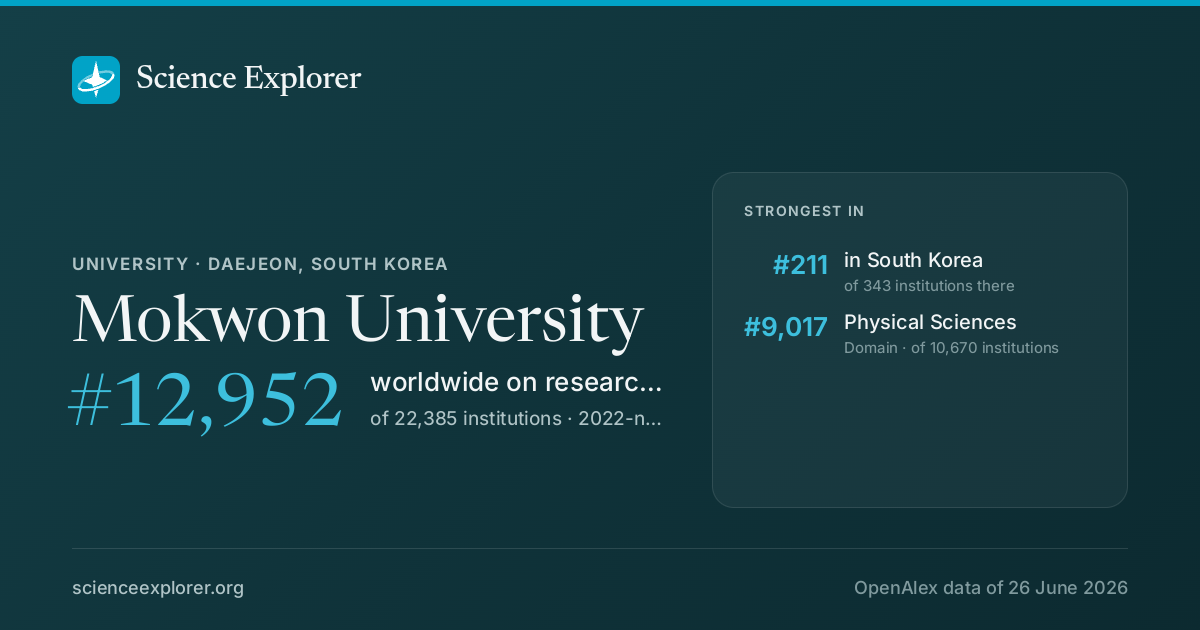
In research, Mokwon University stands highest in Physical Sciences (#9,017 of 10,670 worldwide), 2022-now.

World rank, 2022-now
#12,952
of 22,385 · #19,084 all time
Rank in South Korea
#211
of 343
Research works
1.1k
▼ 6% vs 2018-21
Citations
9.2k
8.7 per fractional work
Top-10% rate
7.1%
all institutions 10.0%
vs its own fields
0.88×
1.00× is exactly expected
Open access
46%
world 40%
International
12%
world 18%

What is Mokwon University known for in research?

The fields where it stands highest, 2022-now, ranked among every institution above the floor in each field.

FieldWorld rankWhere that sitsTop-10% rateWorksAll time
Physical SciencesDomain #9,017 of 10,670 3.6%73 #15853

Each strip is that field's whole ranked pool, with the notch where Mokwon University sits in it, in the colour of the band that rank falls in. The track under the rate is the rate itself: it carries no average mark, because the average differs by field (from about 6% in Dentistry to 21% in Economics).

Which fields of science does Mokwon University work in?

In 2022-now, 54% of research at Mokwon University is in Physical Sciences, 20% in Social Sciences. Its largest fields are Engineering (19%), Computer Science (13%), Medicine (11%). It does 1.4× the world's share of Physical Sciences.

Physical Sciences: 86 fractional works · 54.2% of its workEngineering: 31 fractional works · 19.4% of its workElectrical and Electronic Engineering: 5 fractional works · 3.5% of its workMechanical Engineering: 4 fractional works · 2.8% of its workCivil and Structural Engineering: 4 fractional works · 2.4% of its workBuilding and Construction: 4 fractional works · 2.3% of its workAerospace Engineering: 2 fractional works · 1.3% of its workBiomedical Engineering: 2 fractional works · 1.0% of its workIndustrial and Manufacturing Engineering: 2 fractional works · 1.0% of its workComputational Mechanics: 1 fractional works · 0.9% of its workSafety, Risk, Reliability and Quality: 1 fractional works · 0.9% of its workControl and Systems Engineering: 1 fractional works · 0.8% of its workOcean Engineering: 1 fractional works · 0.7% of its workAutomotive Engineering: 1 fractional works · 0.6% of its workMedia Technology: 1 fractional works · 0.6% of its workMechanics of Materials: 1 fractional works · 0.5% of its workArchitecture: 0 fractional works · 0.2% of its workComputer Science: 21 fractional works · 13.3% of its workInformation Systems: 5 fractional works · 2.9% of its workComputer Vision and Pattern Recognition: 4 fractional works · 2.8% of its workArtificial Intelligence: 4 fractional works · 2.6% of its workComputer Networks and Communications: 3 fractional works · 2.1% of its workComputer Graphics and Computer-Aided Design: 2 fractional works · 1.5% of its workSignal Processing: 1 fractional works · 0.6% of its workComputer Science Applications: 1 fractional works · 0.4% of its workComputational Theory and Mathematics: 1 fractional works · 0.4% of its workSmaller subfields together: 0 fractional works · 0.1% of its workMathematics: 11 fractional works · 6.7% of its workMathematical Physics: 4 fractional works · 2.7% of its workApplied Mathematics: 2 fractional works · 1.5% of its workGeometry and Topology: 2 fractional works · 1.4% of its workStatistics and Probability: 1 fractional works · 0.4% of its workAlgebra and Number Theory: 0 fractional works · 0.3% of its workDiscrete Mathematics and Combinatorics: 0 fractional works · 0.2% of its workSmaller subfields together: 0 fractional works · 0.3% of its workEnvironmental Science: 9 fractional works · 5.9% of its workEcology: 3 fractional works · 2.0% of its workHealth, Toxicology and Mutagenesis: 1 fractional works · 0.9% of its workEnvironmental Engineering: 1 fractional works · 0.6% of its workManagement, Monitoring, Policy and Law: 1 fractional works · 0.6% of its workPollution: 1 fractional works · 0.5% of its workGlobal and Planetary Change: 1 fractional works · 0.5% of its workEnvironmental Chemistry: 1 fractional works · 0.3% of its workEcological Modeling: 0 fractional works · 0.2% of its workSmaller subfields together: 0 fractional works · 0.3% of its workEarth and Planetary Sciences: 5 fractional works · 3.3% of its workOceanography: 5 fractional works · 3.0% of its workPaleontology: 0 fractional works · 0.3% of its workSmaller subfields together: 0 fractional works · 0.1% of its workMaterials Science: 3 fractional works · 2.0% of its workMaterials Chemistry: 2 fractional works · 1.3% of its workBiomaterials: 1 fractional works · 0.5% of its workSmaller subfields together: 0 fractional works · 0.1% of its workPhysics and Astronomy: 2 fractional works · 1.5% of its workStatistical and Nonlinear Physics: 2 fractional works · 1.5% of its workChemistry: 2 fractional works · 1.5% of its workOrganic Chemistry: 2 fractional works · 1.5% of its workEnergy: 1 fractional works · 0.6% of its workRenewable Energy, Sustainability and the Environment: 1 fractional works · 0.6% of its workSocial Sciences: 32 fractional works · 20.3% of its workSocial Sciences: 11 fractional works · 6.8% of its workSociology and Political Science: 4 fractional works · 2.4% of its workCultural Studies: 2 fractional works · 1.0% of its workSafety Research: 1 fractional works · 0.7% of its workCommunication: 1 fractional works · 0.6% of its workEducation: 1 fractional works · 0.4% of its workTransportation: 1 fractional works · 0.4% of its workDemography: 0 fractional works · 0.3% of its workHealth: 0 fractional works · 0.3% of its workSmaller subfields together: 1 fractional works · 0.6% of its workBusiness, Management and Accounting: 9 fractional works · 5.6% of its workMarketing: 3 fractional works · 2.0% of its workStrategy and Management: 3 fractional works · 1.7% of its workManagement of Technology and Innovation: 1 fractional works · 0.7% of its workBusiness and International Management: 1 fractional works · 0.5% of its workManagement Information Systems: 0 fractional works · 0.3% of its workAccounting: 0 fractional works · 0.3% of its workOrganizational Behavior and Human Resource Management: 0 fractional works · 0.2% of its workPsychology: 5 fractional works · 3.2% of its workClinical Psychology: 2 fractional works · 1.5% of its workSocial Psychology: 1 fractional works · 0.9% of its workExperimental and Cognitive Psychology: 1 fractional works · 0.5% of its workSmaller subfields together: 0 fractional works · 0.2% of its workDecision Sciences: 3 fractional works · 2.1% of its workManagement Science and Operations Research: 2 fractional works · 1.0% of its workInformation Systems and Management: 1 fractional works · 0.9% of its workSmaller subfields together: 0 fractional works · 0.1% of its workEconomics, Econometrics and Finance: 3 fractional works · 1.8% of its workEconomics and Econometrics: 3 fractional works · 1.7% of its workSmaller subfields together: 0 fractional works · 0.2% of its workArts and Humanities: 1 fractional works · 0.8% of its workVisual Arts and Performing Arts: 1 fractional works · 0.7% of its workSmaller subfields together: 0 fractional works · 0.1% of its workHealth Sciences: 21 fractional works · 13.3% of its workMedicine: 18 fractional works · 11.2% of its workEpidemiology: 3 fractional works · 1.9% of its workPublic Health, Environmental and Occupational Health: 2 fractional works · 1.4% of its workBiochemistry: 2 fractional works · 1.0% of its workPhysiology: 1 fractional works · 0.8% of its workOrthopedics and Sports Medicine: 1 fractional works · 0.8% of its workComplementary and alternative medicine: 1 fractional works · 0.6% of its workPulmonary and Respiratory Medicine: 1 fractional works · 0.6% of its workDermatology: 1 fractional works · 0.6% of its workEndocrinology, Diabetes and Metabolism: 1 fractional works · 0.4% of its workOncology: 1 fractional works · 0.4% of its workGastroenterology: 1 fractional works · 0.4% of its workPharmacology: 1 fractional works · 0.4% of its workSurgery: 0 fractional works · 0.3% of its workCardiology and Cardiovascular Medicine: 0 fractional works · 0.3% of its workFamily Practice: 0 fractional works · 0.2% of its workHepatology: 0 fractional works · 0.2% of its workMicrobiology: 0 fractional works · 0.2% of its workSmaller subfields together: 1 fractional works · 0.7% of its workHealth Professions: 3 fractional works · 1.6% of its workHealth Information Management: 1 fractional works · 0.5% of its workGeneral Health Professions: 1 fractional works · 0.4% of its workRadiological and Ultrasound Technology: 0 fractional works · 0.2% of its workComplementary and Manual Therapy: 0 fractional works · 0.2% of its workSpeech and Hearing: 0 fractional works · 0.2% of its workSmaller subfields together: 0 fractional works · 0.1% of its workNursing: 1 fractional works · 0.4% of its workNutrition and Dietetics: 0 fractional works · 0.2% of its workSmaller subfields together: 0 fractional works · 0.2% of its workVeterinary: 0 fractional works · 0.0% of its workLife Sciences: 19 fractional works · 12.1% of its workBiochemistry, Genetics and Molecular Biology: 10 fractional works · 6.1% of its workMolecular Biology: 8 fractional works · 5.0% of its workBiotechnology: 1 fractional works · 0.5% of its workCell Biology: 0 fractional works · 0.2% of its workAging: 0 fractional works · 0.2% of its workSmaller subfields together: 0 fractional works · 0.1% of its workAgricultural and Biological Sciences: 7 fractional works · 4.4% of its workEcology, Evolution, Behavior and Systematics: 2 fractional works · 1.3% of its workFood Science: 2 fractional works · 1.3% of its workPlant Science: 2 fractional works · 1.2% of its workInsect Science: 1 fractional works · 0.6% of its workImmunology and Microbiology: 1 fractional works · 0.8% of its workImmunology: 1 fractional works · 0.6% of its workApplied Microbiology and Biotechnology: 0 fractional works · 0.2% of its workNeuroscience: 1 fractional works · 0.5% of its workCognitive Neuroscience: 0 fractional works · 0.2% of its workSensory Systems: 0 fractional works · 0.2% of its workSmaller subfields together: 0 fractional works · 0.1% of its workPharmacology, Toxicology and Pharmaceutics: 0 fractional works · 0.3% of its workPharmacology: 0 fractional works · 0.3% of its workALL ITS WORKMokwon University158fractional works, 2022-now
Life Sciences12%Physical Sciences54%Health Sciences13%Social Sciences20%

Each ring splits the one inside it: the four domains of science, their fields, their subfields. Size is fractional works in 2022-now. Every slice is a page; the interactive view zooms down to single topics and colours each by how much more of it this institution does than the world.

Its 4 domains and 24 fields, with their numbers
    1. Engineering3119.4%
    2. Computer Science2113.3%
    3. Mathematics116.7%
    4. Environmental Science95.9%
    5. Earth and Planetary Sciences53.3%
    6. Materials Science32.0%
    7. Physics and Astronomy21.5%
    8. Chemistry21.5%
    9. Energy10.6%
    1. Social Sciences116.8%
    2. Business, Management and Accounting95.6%
    3. Psychology53.2%
    4. Decision Sciences32.1%
    5. Economics, Econometrics and Finance31.8%
    6. Arts and Humanities10.8%
    1. Medicine1811.2%
    2. Health Professions31.6%
    3. Nursing10.4%
    4. Veterinary00.0%
    1. Biochemistry, Genetics and Molecular Biology106.1%
    2. Agricultural and Biological Sciences74.4%
    3. Immunology and Microbiology10.8%
    4. Neuroscience10.5%
    5. Pharmacology, Toxicology and Pharmaceutics00.3%
All of science, and how each field's share has moved since 1950: the Science domain explorer

Field profile

Location quotient across every field it publishes in: outside the ring is more than an institution of this size would be expected to publish, inside it is less.

Agricultural and Biological Sciences: 0.93× its world share, 7 worksAgricultural and Bio…Biochemistry, Genetics and Molecular Biology: 1.14× its world share, 10 worksBiochemistry, Geneti…Immunology and Microbiology: 0.83× its world share, 1 worksImmunology and Micro…Neuroscience: 0.32× its world share, 1 worksNeurosciencePharmacology, Toxicology and Pharmaceutics: 0.80× its world share, 0 worksPharmacology, Toxico…Chemistry: 0.94× its world share, 2 worksChemistryComputer Science: 1.72× its world share, 21 worksComputer ScienceEarth and Planetary Sciences: 2.12× its world share, 5 worksEarth and Planetary …Energy: 0.64× its world share, 1 worksEnergyEngineering: 1.29× its world share, 30 worksEngineeringEnvironmental Science: 1.18× its world share, 9 worksEnvironmental ScienceMaterials Science: 0.57× its world share, 3 worksMaterials ScienceMathematics: 5.72× its world share, 11 worksMathematicsPhysics and Astronomy: 0.70× its world share, 2 worksPhysics and AstronomyHealth Professions: 0.62× its world share, 3 worksHealth ProfessionsMedicine: 0.58× its world share, 18 worksMedicineNursing: 0.79× its world share, 1 worksNursingVeterinary: 0.31× its world share, 0 worksVeterinaryArts and Humanities: 0.28× its world share, 1 worksArts and HumanitiesBusiness, Management and Accounting: 1.74× its world share, 9 worksBusiness, Management…Decision Sciences: 2.13× its world share, 3 worksDecision SciencesEconomics, Econometrics and Finance: 0.86× its world share, 3 worksEconomics, Econometr…Psychology: 1.05× its world share, 5 worksPsychologySocial Sciences: 0.54× its world share, 11 worksSocial Sciences1×world share
more than its size predictsabout as predictedless

Rings at 0.5×, 1× and 2×. Widest outward: Mathematics, 5.7×. Every wedge is a field page.

All 24 fields, with their numbers
  1. Mathematics5.72×11 works
  2. Decision Sciences2.13×3 works
  3. Earth and Planetary Sciences2.12×5 works
  4. Business, Management and Accounting1.74×9 works
  5. Computer Science1.72×21 works
  6. Engineering1.29×30 works
  7. Environmental Science1.18×9 works
  8. Biochemistry, Genetics and Molecular Biology1.14×10 works
  9. Psychology1.05×5 works
  10. Chemistry0.94×2 works
  11. Agricultural and Biological Sciences0.93×7 works
  12. Economics, Econometrics and Finance0.86×3 works
  13. Immunology and Microbiology0.83×1 works
  14. Pharmacology, Toxicology and Pharmaceutics0.80×0 works
  15. Nursing0.79×1 works
  16. Physics and Astronomy0.70×2 works
  17. Energy0.64×1 works
  18. Health Professions0.62×3 works
  19. Medicine0.58×18 works
  20. Materials Science0.57×3 works
  21. Social Sciences0.54×11 works
  22. Neuroscience0.32×1 works
  23. Veterinary0.31×0 works
  24. Arts and Humanities0.28×1 works

Who are the top researchers at Mokwon University?

Ranked on the quality score, Min‐Jae Lee, Saebom Jeon and Hye-Young Kwon lead among researchers whose main affiliation is Mokwon University.

  1. 1 Min‐Jae Lee South Korea · #1,330,719 worldwide 1k citations · 96 works
  2. 2 Saebom Jeon South Korea · #2,720,804 worldwide 177 citations · 54 works
  3. 3 Hye-Young Kwon South Korea · #3,503,540 worldwide 1.4k citations · 91 works
  4. 4 Hyunghee Lee South Korea · #4,194,107 worldwide 768 citations · 27 works
  5. 5 Eun-Sok Won South Korea · #4,800,176 worldwide 320 citations · 19 works
  6. 6 Yong Dae Choi South Korea · #4,993,786 worldwide 516 citations · 30 works
  7. 7 Sun-Gyu Park South Korea · #5,254,487 worldwide 468 citations · 91 works
  8. 8 Hyun Woo Bang South Korea · #5,410,660 worldwide 228 citations · 30 works
  9. 9 Sunhyo Jeong South Korea · #5,435,180 worldwide 778 citations · 47 works
  10. 10 Nayoung Ku South Korea · #5,441,271 worldwide 42 citations · 27 works
All ranked researchers at Mokwon University

What are the most cited papers from Mokwon University?

The most cited paper from Mokwon University is "University students' behavioral intention to use mobile learning: Evaluating the technology acceptance model" (Sung Youl Park, Minwoo Nam, Seungbong Cha, 2011), with 763 citations. Next come "AMPK activation increases fatty acid oxidation in skeletal muscle by activating PPARα and PGC-1" (422) and "Characterization of Korean Red Ginseng (Panax ginseng Meyer): History, preparation method, and chemical composition" (379).

Most cited papers
#PaperReleasedCitations
1 University students' behavioral intention to use mobile learning: Evaluating the technology acceptance model Sung Youl Park, Minwoo Nam, Seungbong Cha · British Journal of Educational Technology 4 Oct 2011 763
2 AMPK activation increases fatty acid oxidation in skeletal muscle by activating PPARα and PGC-1 Woo Je Lee, Mi‐Na Kim, Hye Sun Park et al. · Biochemical and Biophysical Research Communications 13 Dec 2005 422
3 Characterization of Korean Red Ginseng (Panax ginseng Meyer): History, preparation method, and chemical composition Sang Myung Lee, Bong-Seok Bae, Hee-Weon Park et al. · Journal of Ginseng Research Open access 12 May 2015 379
4 The role of PPARα in lipid metabolism and obesity: Focusing on the effects of estrogen on PPARα actions Michung Yoon · Pharmacological Research 15 Feb 2009 336
5 Robust anonymous authentication protocol for health-care applications using wireless medical sensor networks Debiao He, Neeraj Kumar, Jianhua Chen et al. · Multimedia Systems 9 Dec 2013 329
All 60 most cited papers, with filters and sorting

Which keywords describe research at Mokwon University?

By fractional works in 2022-now, weighted toward what it does more of than the world: Deep Learning, Dynamical Systems, Benthic Communities, Marine Biodiversity, Convolutional Neural Networks, Virtual Reality, Phylogenetic Analysis and Biogeography.

▲ more of its work than of the world's◆ about the world's share▼ less than the world's

Size is fractional works in 2022-now in the topics tagged with each word; colour is the word's share of this institution's work against its share of the world's. The 40 words are chosen for being large and distinctive. Each links to the topic it comes from most.

All 40 words, with their numbers
  1. Deep Learning12▲ 2.2×41 topics
  2. Machine Learning6▲ 1.22×28 topics
  3. Artificial Intelligence5▲ 2.4×11 topics
  4. Convolutional Neural Networks5▲ 4.4×11 topics
  5. Dynamical Systems5▲ 47×2 topics
  6. Social Media5▲ 2.2×11 topics
  7. Mechanical Properties4▲ 2.8×9 topics
  8. Virtual Reality4▲ 5.6×3 topics
  9. Healthcare4▲ 2.2×7 topics
  10. Internet of Things4▲ 2.9×13 topics
  11. Benthic Communities4▲ 40×2 topics
  12. Marine Biodiversity4▲ 40×2 topics
  13. Metabolic Syndrome4▲ 3.0×9 topics
  14. Phylogenetic Analysis4▲ 7.7×4 topics
  15. Biogeography4▲ 8.0×5 topics
  16. Insulin Resistance3▲ 4.8×5 topics
  17. Chaos3▲ 28×3 topics
  18. Ergodic Theory3▲ 75×2 topics
  19. RNA-Seq3▲ 16×1 topic
  20. sequence alignment3▲ 29×1 topic
  21. Environmental Management3▲ 4.5×4 topics
  22. Text Mining3▲ 14×4 topics
  23. Fractals3▲ 104×1 topic
  24. Lyapunov Exponents3▲ 104×1 topic
  25. Human-Computer Interaction3▲ 9.7×3 topics
  26. Ecosystem Functioning3▲ 8.0×2 topics
  27. Structural Equation Modeling3▲ 8.5×4 topics
  28. Cancer Prevention2▲ 6.1×5 topics
  29. Computer Vision2▲ 5.7×4 topics
  30. Ethical Consumption2▲ 15×2 topics
  31. Deep-Sea Ecology2▲ 50×1 topic
  32. Estuarine Quality2▲ 50×1 topic
  33. Digital Media Technology2▲ 39×1 topic
  34. Visual Communication Design2▲ 39×1 topic
  35. Banach Spaces2▲ 47×2 topics
  36. Lagrangian Coherent Structures2▲ 59×1 topic
  37. Quantum Chaos2▲ 59×1 topic
  38. Fashion2▲ 33×2 topics
  39. Functional Equations2▲ 179×1 topic
  40. Lifestyle2▲ 42×2 topics

Which research topics does Mokwon University publish most on?

By volume in 2022-now: Genomics and Phylogenetic Studies, Mathematical Dynamics and Fractals, Marine Biology and Ecology Research and Digital Media and Visual Art.

  1. 1 Genomics and Phylogenetic Studies Molecular Biology 3 works
  2. 2 Mathematical Dynamics and Fractals Mathematical Physics 3 works
  3. 3 Marine Biology and Ecology Research Oceanography 2 works
  4. 4 Digital Media and Visual Art Computer Graphics and Computer-Aided Design 2 works
  5. 5 Quantum chaos and dynamical systems Statistical and Nonlinear Physics 2 works
  6. 6 Functional Equations Stability Results Applied Mathematics 2 works
  7. 7 Microbial Community Ecology and Physiology Ecology 2 works
  8. 8 Marine and coastal plant biology Oceanography 2 works
  9. 9 Korean Peninsula Historical and Political Studies Sociology and Political Science 2 works
  10. 10 Environmental Sustainability in Business Marketing 2 works

How open and international is its research?

Against the world's own shares: the tick on each track. Both are shares of its output, so they sit on one scale and can be read against each other as well as against the world.

openly available46.0%not open54.0%

World: 40% of research is openly available.

with international co-authors11.9%domestic only88.1%

World: 18% is written across borders.

How has Mokwon University's research output changed?

Output in 2022-2025 was 6% lower than in 2018-2021.

still counting1990200020102020
grewheldshrank

The same series as a ribbon: one cell per year, darker for more. The line above answers how much; this answers when.

Its share of all research

Growing output can still be a shrinking share: all of science grows. This is Mokwon University as a percentage of every work published that year, 0.00076% in 2024.

still counting0.0010%0.0020%0.0030%Mokwon University0.00056% in 202519801990200020102020

Fractional works of Mokwon University over all fractional works that year. How the balance of science has shifted.

How much of it reaches the world top 10%

Year by year, against all institutions in the same year.

still counting5%10%15%all institutions10.0% in 2025Mokwon University7.8% in 202520102020

Of each year's output, the share that reached the world's 10% most cited for its field and year. Peak 9.4% in 2024.

Other research institutions in Daejeon

All research institutions in Daejeon

Share Mokwon University's ranking

Mokwon University on Science Explorer

A card with Mokwon University's standing and the fields it leads in, for a post or a slide. A link to this page previews as the same card.

Download the card

1200 × 630 PNG, sized for social posts, drawn from the latest snapshot.

Badges for a website1Each links back here and updates with every snapshot

Research measures only: rankings here say nothing about teaching, admissions or student experience. Comparable institutions and collaboration partners have tabs of their own, above.

Discussion

Ask a question or share a note about Mokwon University. Posts are plain text and can be reported.