Nahrain University
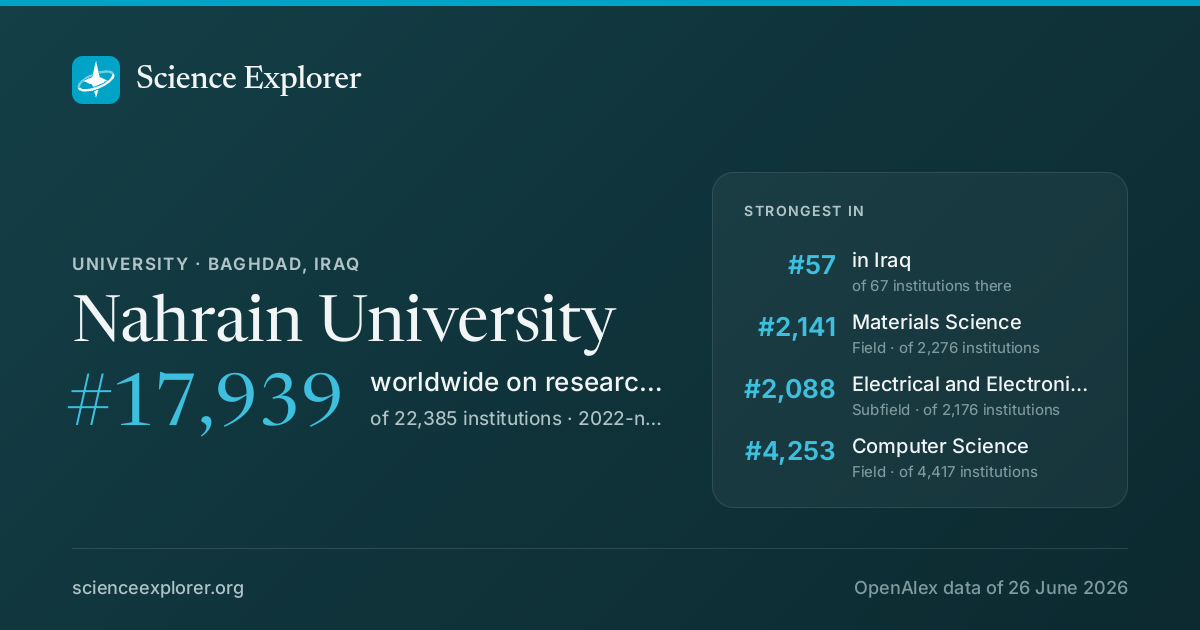
In research, Nahrain University stands highest in Materials Science (#2,141 of 2,276 worldwide), Electrical and Electronic Engineering (#2,088 of 2,176 worldwide) and Computer Science (#4,253 of 4,417 worldwide), 2022-now. Relative to its size it is most specialised in Reproductive Medicine and Civil and Structural Engineering (Reproductive Medicine is 5.3× its share of world research).
- World rank, 2022-now
- #17,939 of 22,385 · #30,001 all time
- Rank in Iraq
- #57 of 67
- Research works
- 6.2k ▲ 59% vs 2018-21
- Citations
- 35k 5.7 per fractional work
- Top-10% rate
- 4.2% all institutions 10.0%
- vs its own fields
- 0.44× 1.00× is exactly expected
- Open access
- 77% world 40%
- International
- 15% world 18%
What is Nahrain University known for in research?
The fields where it stands highest, 2022-now, ranked among every institution above the floor in each field.
| Field | World rank | Where that sits | Top-10% rate | Works | All time |
|---|---|---|---|---|---|
| Materials ScienceField | #2,141 of 2,276 | 6.5% | 134 | #3654 | |
| Electrical and Electronic EngineeringSubfield | #2,088 of 2,176 | 5.3% | 143 | #3510 | |
| Computer ScienceField | #4,253 of 4,417 | 5.9% | 276 | #5763 | |
| EngineeringField | #5,693 of 5,901 | 4.1% | 683 | #8402 | |
| ChemistryField | #1,269 of 1,299 | 2.2% | 77 | #2665 | |
| Biomedical EngineeringSubfield | #1,518 of 1,539 | 2.9% | 96 | #2483 | |
| Social SciencesDomain | #9,464 of 9,585 | 3.9% | 264 | #14587 | |
| Molecular BiologySubfield | #1,857 of 1,880 | 2.9% | 84 | #3690 | |
| Civil and Structural EngineeringSubfield | #898 of 908 | 2.5% | 153 | #1641 | |
| Artificial IntelligenceSubfield | #1,842 of 1,862 | 5.3% | 69 | #2731 |
Each strip is that field's whole ranked pool, with the notch where Nahrain University sits in it, in the colour of the band that rank falls in. The track under the rate is the rate itself: it carries no average mark, because the average differs by field (from about 6% in Dentistry to 21% in Economics).
Which of those standings moved
The same fields on both windows: where it stood over the whole record, and where it stands in 2022-now. The distance is the story, and it is the one thing the two rank columns above cannot show.
- Materials Science#3,654 #2,141
- Electrical and Electronic Engineering#3,510 #2,088
- Computer Science#5,763 #4,253
- Engineering#8,402 #5,693
- Chemistry#2,665 #1,269
- Biomedical Engineering#2,483 #1,518
- Social Sciences#14,587 #9,464
- Molecular Biology#3,690 #1,857
- Civil and Structural Engineering#1,641 #898
- Artificial Intelligence#2,731 #1,842
A dot further right is a better standing. Fields it was not ranked in over the whole record are left out.
Which fields of science does Nahrain University work in?
In 2022-now, 51% of research at Nahrain University is in Physical Sciences, 25% in Health Sciences. Its largest fields are Engineering (25%), Medicine (22%), Computer Science (10%). It does 1.3× the world's share of Physical Sciences.
Each ring splits the one inside it: the four domains of science, their fields, their subfields. Size is fractional works in 2022-now. Every slice is a page; the interactive view zooms down to single topics and colours each by how much more of it this institution does than the world.
Its 4 domains and 26 fields, with their numbers
- Physical Sciences1,54151.4%
- Engineering74424.8%
- Computer Science30310.1%
- Materials Science1555.2%
- Environmental Science1023.4%
- Chemistry852.8%
- Energy531.8%
- Physics and Astronomy391.3%
- Mathematics381.3%
- Earth and Planetary Sciences120.4%
- Chemical Engineering110.4%
- Health Sciences74724.9%
- Medicine65121.7%
- Health Professions531.8%
- Nursing230.8%
- Dentistry190.6%
- Veterinary10.0%
- Life Sciences41613.9%
- Social Sciences2959.8%
- Social Sciences1645.5%
- Business, Management and Accounting321.1%
- Economics, Econometrics and Finance291.0%
- Arts and Humanities260.9%
- Decision Sciences250.8%
- Psychology190.6%
What does Nahrain University specialise in?
Where its research is concentrated relative to its size: Reproductive Medicine takes 5.3× the share of its output that it takes of world research.
- Reproductive MedicineSubfield · 35.7 works5.3×
- Civil and Structural EngineeringSubfield · 168.2 works4.8×
Location quotient, a volume reading rather than an impact one. It surfaces small, lopsided specialities.
Field profile
Location quotient across every field it publishes in: outside the ring is more than an institution of this size would be expected to publish, inside it is less.
Rings at 0.5×, 1× and 2×. Widest outward: Pharmacology, Toxicology and Pharmaceutics, 2.2×. Every wedge is a field page.
All 26 fields, with their numbers
- Pharmacology, Toxicology and Pharmaceutics2.25×24 works
- Energy1.92×53 works
- Chemistry1.81×85 works
- Engineering1.65×744 works
- Immunology and Microbiology1.59×48 works
- Nursing1.54×23 works
- Materials Science1.48×155 works
- Dentistry1.33×19 works
- Computer Science1.30×303 works
- Biochemistry, Genetics and Molecular Biology1.24×199 works
- Medicine1.13×650 works
- Mathematics1.08×38 works
- Neuroscience1.07×52 works
- Chemical Engineering1.01×10 works
- Decision Sciences0.86×25 works
- Environmental Science0.68×102 works
- Health Professions0.67×53 works
- Agricultural and Biological Sciences0.65×93 works
- Physics and Astronomy0.58×39 works
- Economics, Econometrics and Finance0.46×29 works
- Social Sciences0.43×164 works
- Business, Management and Accounting0.33×32 works
- Arts and Humanities0.30×26 works
- Earth and Planetary Sciences0.26×12 works
- Veterinary0.26×1 works
- Psychology0.21×19 works
- Pharmacology, Toxicology and Pharmaceutics 2.2×
- Energy 1.9×
- Chemistry 1.8×
- Engineering 1.6×
- Immunology and Microbiology 1.6×
- Nursing 1.5×
- Materials Science 1.5×
- Dentistry 1.3×
- Computer Science 1.3×
- Biochemistry, Genetics and Molecular Biology 1.2×
- Medicine 1.1×
- Mathematics 1.1×
- Neuroscience 1.1×
- Chemical Engineering 1.0×
- Decision Sciences 0.9×
- Environmental Science 0.7×
- Health Professions 0.7×
- Agricultural and Biological Sciences 0.7×
- Physics and Astronomy 0.6×
- Economics, Econometrics and Finance 0.5×
- Social Sciences 0.4×
- Business, Management and Accounting 0.3×
- Arts and Humanities 0.3×
- Earth and Planetary Sciences 0.3×
- Veterinary 0.3×
- Psychology 0.2×
Who are the top researchers at Nahrain University?
Ranked on the quality score, Osamah Ibrahim Khalaf, Rapheal Ajiri Opiti and Saad H. Ammar lead among researchers whose main affiliation is Nahrain University.
- 1
Osamah Ibrahim Khalaf
 Iraq · #152,502 worldwide
8.8k citations · 196 works
- 2
Rapheal Ajiri Opiti
Iraq · #1,517,072 worldwide
648 citations · 21 works
- 3
Saad H. Ammar
Iraq · #1,552,012 worldwide
3.6k citations · 134 works
- 4
Ghaida Muttashar Abdulsahib
Iraq · #1,621,493 worldwide
1.7k citations · 39 works
- 5
Ahmed Rahmah Abu-Raghif
Iraq · #2,427,110 worldwide
786 citations · 54 works
- 6
Hamzah mohammed Marhoon
Iraq · #3,236,949 worldwide
943 citations · 59 works
- 7
Abdul Jabbar N. Khalifa
Iraq · #3,413,550 worldwide
2.2k citations · 38 works
- 8
Raghda S. Makia
Iraq · #3,623,368 worldwide
618 citations · 54 works
- 9
Shahad Z. Al-Najjar
Iraq · #4,362,858 worldwide
429 citations · 15 works
- 10
Ali Abdulhafidh Ibrahim
Iraq · #4,743,514 worldwide
156 citations · 19 works
Which keywords describe research at Nahrain University?
By fractional works in 2022-now, weighted toward what it does more of than the world: Deep Learning, Machine Learning, Nanoparticles, Inflammation, Nanomaterials, Metabolic Syndrome, Epidemiology and Insulin Resistance.
- Ultra-High Performance Concrete
- Green Synthesis
- Cytotoxicity
- Fiber-Reinforced Polymer Composites
- Smart Cities
- Construction
- Feature Extraction
- IoT Security
- Synthesis
- Artificial Neural Networks
- Antioxidant Activity
- Internet of Things
- Obesity
- Antioxidant
- Convolutional Neural Networks
- Environmental Impact
- Cardiovascular Disease
- Oxidative Stress
- Inflammation
- Machine Learning
- Deep Learning
- Epidemiology
- Nanoparticles
- Nanomaterials
- Metabolic Syndrome
- Cancer
- Mechanical Properties
- Insulin Resistance
- Security
- Toxicity
- Finite Element Analysis
- Diabetes
- Recycled Materials
- Antimicrobial
- Durability Performance
- SARS-CoV-2
- Concrete Strengthening
- Biosynthesis
- 5G Networks
- Fiber Reinforced Concrete
Size is fractional works in 2022-now in the topics tagged with each word; colour is the word's share of this institution's work against its share of the world's. The 40 words are chosen for being large and distinctive. Each links to the topic it comes from most.
All 40 words, with their numbers
- Deep Learning198▲ 1.91×72 topics
- Machine Learning148▲ 1.49×71 topics
- Epidemiology131◆ 1.09×10⁶ topics
- Inflammation122▲ 1.91×81 topics
- Nanoparticles102▲ 2.7×42 topics
- Oxidative Stress84▲ 1.70×61 topics
- Nanomaterials79▲ 2.5×17 topics
- Cardiovascular Disease72▲ 2.1×38 topics
- Metabolic Syndrome72▲ 3.0×22 topics
- Environmental Impact70▲ 1.38×44 topics
- Cancer65▲ 1.62×55 topics
- Convolutional Neural Networks56▲ 2.5×14 topics
- Mechanical Properties56▲ 1.89×30 topics
- Antioxidant55▲ 2.7×46 topics
- Insulin Resistance54▲ 4.0×10 topics
- Obesity53▲ 2.3×22 topics
- Security50▲ 2.5×23 topics
- Internet of Things48▲ 1.85×20 topics
- Toxicity44▲ 3.3×17 topics
- Antioxidant Activity42▲ 2.3×29 topics
- Finite Element Analysis41▲ 6.0×8 topics
- Artificial Neural Networks40▲ 2.9×8 topics
- Diabetes40▲ 2.6×22 topics
- Synthesis40▲ 3.5×32 topics
- Recycled Materials37▲ 11×2 topics
- IoT Security36▲ 3.9×3 topics
- Antimicrobial36▲ 4.2×14 topics
- Feature Extraction35▲ 2.5×10 topics
- Durability Performance34▲ 12×2 topics
- Construction33▲ 8.3×2 topics
- SARS-CoV-230▲ 3.3×6 topics
- Smart Cities29▲ 3.7×7 topics
- Concrete Strengthening28▲ 15×1 topic
- Fiber-Reinforced Polymer Composites28▲ 15×1 topic
- Biosynthesis28▲ 5.8×8 topics
- Cytotoxicity27▲ 6.7×9 topics
- 5G Networks26▲ 4.4×5 topics
- Green Synthesis26▲ 4.7×5 topics
- Fiber Reinforced Concrete24▲ 10×1 topic
- Ultra-High Performance Concrete24▲ 10×1 topic
Which research topics does Nahrain University publish most on?
By volume in 2022-now: Structural Behavior of Reinforced Concrete, Innovative concrete reinforcement materials, Linguistic, Cultural, and Literary Studies and Nanoparticles: synthesis and applications.
Area is fractional works; colour is the subfield each topic belongs to.
- 1 Structural Behavior of Reinforced Concrete Building and Construction 28 works
- 2 Innovative concrete reinforcement materials Civil and Structural Engineering 24 works
- 3 Linguistic, Cultural, and Literary Studies Sociology and Political Science 20 works
- 4 Nanoparticles: synthesis and applications Materials Chemistry 20 works
- 5 Legal and Regulatory Analysis Transportation 20 works
- 6 Military Technology and Strategies Aerospace Engineering 19 works
- 7 Ovarian function and disorders Reproductive Medicine 17 works
- 8 IoT and Edge/Fog Computing Computer Networks and Communications 16 works
- 9 Reproductive Biology and Fertility Public Health, Environmental and Occupational Health 16 works
- 10 Prosthetics and Rehabilitation Robotics Biomedical Engineering 14 works
How open and international is its research?
Against the world's own shares: the tick on each track. Both are shares of its output, so they sit on one scale and can be read against each other as well as against the world.
World: 40% of research is openly available.
World: 18% is written across borders.
How has Nahrain University's research output changed?
Output in 2022-2025 was 59% higher than in 2018-2021.
The same series as a ribbon: one cell per year, darker for more. The line above answers how much; this answers when.
Its share of all research
Growing output can still be a shrinking share: all of science grows. This is Nahrain University as a percentage of every work published that year, 0.013% in 2024.
Fractional works of Nahrain University over all fractional works that year. How the balance of science has shifted.
How much of it reaches the world top 10%
Year by year, against all institutions in the same year.
Of each year's output, the share that reached the world's 10% most cited for its field and year. Peak 4.8% in 2019.
Other research institutions in Baghdad
- University of Baghdad
- Mustansiriyah University
- University of Technology - Iraq
- Iraqi University
- Middle Technical University
- Baghdad Medical City
- Ministry of Higher Education and Scientific Research
- Alsalam University College
Share Nahrain University's ranking
Badges for a website1Each links back here and updates with every snapshot

Research measures only: rankings here say nothing about teaching, admissions or student experience. Comparable institutions and collaboration partners have tabs of their own, above.
Discussion
Ask a question or share a note about Nahrain University. Posts are plain text and can be reported.