Science Explorer Back to mapMap
Discussion
University · Najrān · Saudi Arabia

Najran University

In research, Najran University stands highest in Engineering (#1,516 of 5,901 worldwide), Physical Sciences (#3,274 of 10,670 worldwide) and Health Sciences (#3,054 of 9,902 worldwide), 2022-now. Relative to its size it is most specialised in Orthodontics, Oral Surgery and Dentistry (Orthodontics is 9.2× its share of world research).

World rank, 2022-now
#2,483
of 22,385 · #3,762 all time
Rank in Saudi Arabia
#16
of 91
Research works
3.6k
▲ 149% vs 2018-21
Citations
57k
15.7 per fractional work
Top-10% rate
17.2%
all institutions 10.0%
vs its own fields
1.27×
1.00× is exactly expected
Open access
64%
world 40%
International
49%
world 18%

What is Najran University known for in research?

The fields where it stands highest, 2022-now, ranked among every institution above the floor in each field.

FieldWorld rankWhere that sitsTop-10% rateWorksAll time
EngineeringField #1,516 of 5,901 22.5%351 #2531
Physical SciencesDomain #3,274 of 10,670 20.8%977 #4203
Health SciencesDomain #3,054 of 9,902 12.7%495 #5673
MedicineField #2,922 of 8,541 13.0%354 #5179
Computer ScienceField #1,727 of 4,417 26.4%215 #2288
Materials ScienceField #1,071 of 2,276 18.2%155 #1635
Electrical and Electronic EngineeringSubfield #1,140 of 2,176 18.5%108 #1770
Social SciencesDomain #6,005 of 9,585 15.6%361 #6582
Social SciencesField #3,898 of 5,988 15.5%166 #6321
Biomedical EngineeringSubfield #1,062 of 1,539 21.1%63 -

Each strip is that field's whole ranked pool, with the notch where Najran University sits in it, in the colour of the band that rank falls in. The track under the rate is the rate itself: it carries no average mark, because the average differs by field (from about 6% in Dentistry to 21% in Economics).

Which of those standings moved

The same fields on both windows: where it stood over the whole record, and where it stands in 2022-now. The distance is the story, and it is the one thing the two rank columns above cannot show.

  1. Engineering#2,531 #1,516
  2. Physical Sciences#4,203 #3,274
  3. Health Sciences#5,673 #3,054
  4. Medicine#5,179 #2,922
  5. Computer Science#2,288 #1,727
  6. Materials Science#1,635 #1,071
  7. Electrical and Electronic Engineering#1,770 #1,140
  8. Social Sciences#6,582 #6,005
  9. Social Sciences#6,321 #3,898
all time2022-now, better2022-now, worse

A dot further right is a better standing. Fields it was not ranked in over the whole record are left out.

Which fields of science does Najran University work in?

In 2022-now, 48% of research at Najran University is in Physical Sciences, 25% in Health Sciences. Its largest fields are Medicine (18%), Engineering (17%), Computer Science (10%).

Physical Sciences: 1,063 fractional works · 48.1% of its workEngineering: 384 fractional works · 17.4% of its workElectrical and Electronic Engineering: 118 fractional works · 5.3% of its workBiomedical Engineering: 69 fractional works · 3.1% of its workCivil and Structural Engineering: 46 fractional works · 2.1% of its workBuilding and Construction: 38 fractional works · 1.7% of its workMechanical Engineering: 30 fractional works · 1.3% of its workControl and Systems Engineering: 19 fractional works · 0.8% of its workAerospace Engineering: 17 fractional works · 0.8% of its workAutomotive Engineering: 15 fractional works · 0.7% of its workMechanics of Materials: 9 fractional works · 0.4% of its workMedia Technology: 7 fractional works · 0.3% of its workComputational Mechanics: 6 fractional works · 0.3% of its workSmaller subfields together: 10 fractional works · 0.5% of its workComputer Science: 229 fractional works · 10.3% of its workArtificial Intelligence: 80 fractional works · 3.6% of its workInformation Systems: 40 fractional works · 1.8% of its workComputer Networks and Communications: 33 fractional works · 1.5% of its workComputer Vision and Pattern Recognition: 31 fractional works · 1.4% of its workComputational Theory and Mathematics: 15 fractional works · 0.7% of its workComputer Science Applications: 11 fractional works · 0.5% of its workSignal Processing: 10 fractional works · 0.5% of its workHuman-Computer Interaction: 7 fractional works · 0.3% of its workSmaller subfields together: 1 fractional works · 0.1% of its workMaterials Science: 170 fractional works · 7.7% of its workMaterials Chemistry: 88 fractional works · 4.0% of its workPolymers and Plastics: 30 fractional works · 1.4% of its workElectronic, Optical and Magnetic Materials: 25 fractional works · 1.1% of its workBiomaterials: 20 fractional works · 0.9% of its workSmaller subfields together: 6 fractional works · 0.3% of its workEnvironmental Science: 76 fractional works · 3.5% of its workEnvironmental Engineering: 19 fractional works · 0.8% of its workWater Science and Technology: 15 fractional works · 0.7% of its workGlobal and Planetary Change: 13 fractional works · 0.6% of its workPollution: 8 fractional works · 0.4% of its workHealth, Toxicology and Mutagenesis: 7 fractional works · 0.3% of its workIndustrial and Manufacturing Engineering: 6 fractional works · 0.3% of its workSmaller subfields together: 10 fractional works · 0.4% of its workEnergy: 58 fractional works · 2.6% of its workRenewable Energy, Sustainability and the Environment: 52 fractional works · 2.4% of its workSmaller subfields together: 5 fractional works · 0.2% of its workChemistry: 56 fractional works · 2.6% of its workOrganic Chemistry: 23 fractional works · 1.0% of its workElectrochemistry: 13 fractional works · 0.6% of its workSpectroscopy: 8 fractional works · 0.4% of its workAnalytical Chemistry: 7 fractional works · 0.3% of its workInorganic Chemistry: 5 fractional works · 0.2% of its workSmaller subfields together: 1 fractional works · 0.0% of its workMathematics: 40 fractional works · 1.8% of its workApplied Mathematics: 10 fractional works · 0.5% of its workModeling and Simulation: 9 fractional works · 0.4% of its workStatistics and Probability: 7 fractional works · 0.3% of its workNumerical Analysis: 5 fractional works · 0.2% of its workSmaller subfields together: 10 fractional works · 0.4% of its workPhysics and Astronomy: 30 fractional works · 1.3% of its workAtomic and Molecular Physics, and Optics: 11 fractional works · 0.5% of its workRadiation: 8 fractional works · 0.3% of its workStatistical and Nonlinear Physics: 7 fractional works · 0.3% of its workSmaller subfields together: 4 fractional works · 0.2% of its workChemical Engineering: 11 fractional works · 0.5% of its workBioengineering: 8 fractional works · 0.4% of its workSmaller subfields together: 3 fractional works · 0.1% of its workEarth and Planetary Sciences: 10 fractional works · 0.4% of its workHealth Sciences: 552 fractional works · 24.9% of its workMedicine: 393 fractional works · 17.8% of its workRadiology, Nuclear Medicine and Imaging: 41 fractional works · 1.8% of its workSurgery: 38 fractional works · 1.7% of its workPublic Health, Environmental and Occupational Health: 31 fractional works · 1.4% of its workPulmonary and Respiratory Medicine: 24 fractional works · 1.1% of its workEpidemiology: 22 fractional works · 1.0% of its workOncology: 19 fractional works · 0.9% of its workInfectious Diseases: 16 fractional works · 0.7% of its workPharmacology: 16 fractional works · 0.7% of its workPhysiology: 14 fractional works · 0.6% of its workEndocrinology, Diabetes and Metabolism: 14 fractional works · 0.6% of its workCardiology and Cardiovascular Medicine: 10 fractional works · 0.5% of its workRheumatology: 10 fractional works · 0.5% of its workPediatrics, Perinatology and Child Health: 10 fractional works · 0.4% of its workPsychiatry and Mental health: 10 fractional works · 0.4% of its workHealth Informatics: 9 fractional works · 0.4% of its workPathology and Forensic Medicine: 9 fractional works · 0.4% of its workComplementary and alternative medicine: 8 fractional works · 0.3% of its workObstetrics and Gynecology: 7 fractional works · 0.3% of its workOphthalmology: 6 fractional works · 0.3% of its workNeurology: 6 fractional works · 0.3% of its workOrthopedics and Sports Medicine: 6 fractional works · 0.3% of its workHematology: 6 fractional works · 0.3% of its workEmergency Medicine: 6 fractional works · 0.3% of its workRehabilitation: 6 fractional works · 0.3% of its workDermatology: 6 fractional works · 0.3% of its workGenetics: 5 fractional works · 0.2% of its workOtorhinolaryngology: 5 fractional works · 0.2% of its workSmaller subfields together: 32 fractional works · 1.5% of its workDentistry: 78 fractional works · 3.5% of its workOral Surgery: 31 fractional works · 1.4% of its workOrthodontics: 23 fractional works · 1.0% of its workPeriodontics: 17 fractional works · 0.8% of its workGeneral Dentistry: 7 fractional works · 0.3% of its workHealth Professions: 70 fractional works · 3.2% of its workGeneral Health Professions: 26 fractional works · 1.2% of its workHealth Information Management: 11 fractional works · 0.5% of its workEmergency Medical Services: 6 fractional works · 0.3% of its workRadiological and Ultrasound Technology: 6 fractional works · 0.3% of its workPharmacy: 5 fractional works · 0.2% of its workSpeech and Hearing: 4 fractional works · 0.2% of its workSmaller subfields together: 12 fractional works · 0.5% of its workNursing: 9 fractional works · 0.4% of its workNutrition and Dietetics: 8 fractional works · 0.4% of its workSmaller subfields together: 1 fractional works · 0.0% of its workVeterinary: 1 fractional works · 0.1% of its workSocial Sciences: 386 fractional works · 17.4% of its workSocial Sciences: 177 fractional works · 8.0% of its workEducation: 79 fractional works · 3.6% of its workSociology and Political Science: 53 fractional works · 2.4% of its workTransportation: 10 fractional works · 0.4% of its workPolitical Science and International Relations: 8 fractional works · 0.4% of its workLinguistics and Language: 5 fractional works · 0.2% of its workSmaller subfields together: 23 fractional works · 1.0% of its workPsychology: 79 fractional works · 3.6% of its workClinical Psychology: 26 fractional works · 1.2% of its workDevelopmental and Educational Psychology: 24 fractional works · 1.1% of its workSocial Psychology: 13 fractional works · 0.6% of its workExperimental and Cognitive Psychology: 12 fractional works · 0.5% of its workSmaller subfields together: 3 fractional works · 0.1% of its workArts and Humanities: 59 fractional works · 2.7% of its workLanguage and Linguistics: 34 fractional works · 1.5% of its workLiterature and Literary Theory: 16 fractional works · 0.7% of its workArcheology: 5 fractional works · 0.2% of its workSmaller subfields together: 4 fractional works · 0.2% of its workBusiness, Management and Accounting: 36 fractional works · 1.6% of its workAccounting: 13 fractional works · 0.6% of its workStrategy and Management: 7 fractional works · 0.3% of its workManagement Information Systems: 5 fractional works · 0.2% of its workOrganizational Behavior and Human Resource Management: 5 fractional works · 0.2% of its workSmaller subfields together: 6 fractional works · 0.3% of its workEconomics, Econometrics and Finance: 18 fractional works · 0.8% of its workEconomics and Econometrics: 14 fractional works · 0.6% of its workSmaller subfields together: 4 fractional works · 0.2% of its workDecision Sciences: 17 fractional works · 0.8% of its workManagement Science and Operations Research: 11 fractional works · 0.5% of its workSmaller subfields together: 5 fractional works · 0.2% of its workLife Sciences: 211 fractional works · 9.6% of its workBiochemistry, Genetics and Molecular Biology: 96 fractional works · 4.4% of its workMolecular Biology: 61 fractional works · 2.8% of its workGenetics: 11 fractional works · 0.5% of its workCancer Research: 7 fractional works · 0.3% of its workSmaller subfields together: 17 fractional works · 0.8% of its workAgricultural and Biological Sciences: 52 fractional works · 2.4% of its workPlant Science: 29 fractional works · 1.3% of its workFood Science: 13 fractional works · 0.6% of its workInsect Science: 6 fractional works · 0.3% of its workSmaller subfields together: 4 fractional works · 0.2% of its workNeuroscience: 26 fractional works · 1.2% of its workCognitive Neuroscience: 10 fractional works · 0.4% of its workNeurology: 10 fractional works · 0.4% of its workSmaller subfields together: 6 fractional works · 0.3% of its workPharmacology, Toxicology and Pharmaceutics: 21 fractional works · 1.0% of its workPharmaceutical Science: 9 fractional works · 0.4% of its workPharmacology: 8 fractional works · 0.4% of its workSmaller subfields together: 4 fractional works · 0.2% of its workImmunology and Microbiology: 16 fractional works · 0.7% of its workImmunology: 7 fractional works · 0.3% of its workSmaller subfields together: 9 fractional works · 0.4% of its workALL ITS WORKNajran University2,212fractional works, 2022-now
Life Sciences10%Physical Sciences48%Health Sciences25%Social Sciences17%

Each ring splits the one inside it: the four domains of science, their fields, their subfields. Size is fractional works in 2022-now. Every slice is a page; the interactive view zooms down to single topics and colours each by how much more of it this institution does than the world.

Its 4 domains and 26 fields, with their numbers
    1. Engineering38417.4%
    2. Computer Science22910.3%
    3. Materials Science1707.7%
    4. Environmental Science763.5%
    5. Energy582.6%
    6. Chemistry562.6%
    7. Mathematics401.8%
    8. Physics and Astronomy301.3%
    9. Chemical Engineering110.5%
    10. Earth and Planetary Sciences100.4%
    1. Medicine39317.8%
    2. Dentistry783.5%
    3. Health Professions703.2%
    4. Nursing90.4%
    5. Veterinary10.1%
    1. Social Sciences1778.0%
    2. Psychology793.6%
    3. Arts and Humanities592.7%
    4. Business, Management and Accounting361.6%
    5. Economics, Econometrics and Finance180.8%
    6. Decision Sciences170.8%
    1. Biochemistry, Genetics and Molecular Biology964.4%
    2. Agricultural and Biological Sciences522.4%
    3. Neuroscience261.2%
    4. Pharmacology, Toxicology and Pharmaceutics211.0%
    5. Immunology and Microbiology160.7%
All of science, and how each field's share has moved since 1950: the Science domain explorer

What does Najran University specialise in?

Where its research is concentrated relative to its size: Orthodontics takes 9.2× the share of its output that it takes of world research.

  1. OrthodonticsSubfield · 22.9 works9.2×
  2. Oral SurgerySubfield · 31.2 works7.3×
  3. DentistryField · 77.9 works7.3×
← less than its size predicts1×more →

Location quotient, a volume reading rather than an impact one. It surfaces small, lopsided specialities.

Field profile

Location quotient across every field it publishes in: outside the ring is more than an institution of this size would be expected to publish, inside it is less.

Agricultural and Biological Sciences: 0.50× its world share, 52 worksAgricultural and Bio…Biochemistry, Genetics and Molecular Biology: 0.82× its world share, 96 worksBiochemistry, Geneti…Immunology and Microbiology: 0.71× its world share, 16 worksImmunology and Micro…Neuroscience: 0.71× its world share, 26 worksNeurosciencePharmacology, Toxicology and Pharmaceutics: 2.74× its world share, 21 worksPharmacology, Toxico…Chemical Engineering: 1.46× its world share, 11 worksChemical EngineeringChemistry: 1.63× its world share, 56 worksChemistryComputer Science: 1.33× its world share, 229 worksComputer ScienceEarth and Planetary Sciences: 0.28× its world share, 10 worksEarth and Planetary …Energy: 2.83× its world share, 58 worksEnergyEngineering: 1.16× its world share, 384 worksEngineeringEnvironmental Science: 0.70× its world share, 76 worksEnvironmental ScienceMaterials Science: 2.20× its world share, 170 worksMaterials ScienceMathematics: 1.53× its world share, 40 worksMathematicsPhysics and Astronomy: 0.60× its world share, 30 worksPhysics and AstronomyDentistry: 7.26× its world share, 78 worksDentistryHealth Professions: 1.20× its world share, 70 worksHealth ProfessionsMedicine: 0.93× its world share, 394 worksMedicineNursing: 0.82× its world share, 9 worksNursingVeterinary: 0.45× its world share, 1 worksVeterinaryArts and Humanities: 0.92× its world share, 59 worksArts and HumanitiesBusiness, Management and Accounting: 0.51× its world share, 36 worksBusiness, Management…Decision Sciences: 0.79× its world share, 17 worksDecision SciencesEconomics, Econometrics and Finance: 0.37× its world share, 18 worksEconomics, Econometr…Psychology: 1.17× its world share, 79 worksPsychologySocial Sciences: 0.63× its world share, 177 worksSocial Sciences1×world share
more than its size predictsabout as predictedless

Rings at 0.5×, 1× and 2×. Widest outward: Dentistry, 7.3×. Every wedge is a field page.

All 26 fields, with their numbers
  1. Dentistry7.26×78 works
  2. Energy2.83×58 works
  3. Pharmacology, Toxicology and Pharmaceutics2.74×21 works
  4. Materials Science2.20×170 works
  5. Chemistry1.63×56 works
  6. Mathematics1.53×40 works
  7. Chemical Engineering1.46×11 works
  8. Computer Science1.33×229 works
  9. Health Professions1.20×70 works
  10. Psychology1.17×79 works
  11. Engineering1.16×384 works
  12. Medicine0.93×394 works
  13. Arts and Humanities0.92×59 works
  14. Biochemistry, Genetics and Molecular Biology0.82×96 works
  15. Nursing0.82×9 works
  16. Decision Sciences0.79×17 works
  17. Immunology and Microbiology0.71×16 works
  18. Neuroscience0.71×26 works
  19. Environmental Science0.70×76 works
  20. Social Sciences0.63×177 works
  21. Physics and Astronomy0.60×30 works
  22. Business, Management and Accounting0.51×36 works
  23. Agricultural and Biological Sciences0.50×52 works
  24. Veterinary0.45×1 works
  25. Economics, Econometrics and Finance0.37×18 works
  26. Earth and Planetary Sciences0.28×10 works

Who are the top researchers at Najran University?

Ranked on the quality score, Hassan Algadi, Naif Al Mudawi and Ahmed M. Maglad lead among researchers whose main affiliation is Najran University.

  1. 1 Hassan Algadi Saudi Arabia · #29,764 worldwide 9.3k citations · 214 works
  2. 2 Naif Al Mudawi Saudi Arabia · #219,109 worldwide 2k citations · 62 works
  3. 3 Ahmed M. Maglad Saudi Arabia · #287,475 worldwide 1.2k citations · 23 works
  4. 4 Mohammed S. Alshehri Saudi Arabia · #317,708 worldwide 1.7k citations · 81 works
  5. 5 Ibrahim Y. Hakeem Saudi Arabia · #320,101 worldwide 2.5k citations · 68 works
  6. 6 Mounir Belloumi Saudi Arabia · #361,676 worldwide 3.5k citations · 51 works
  7. 7 Ahmad Umar Saudi Arabia · #411,229 worldwide 38k citations · 957 works
  8. 8 Fadi Althoey Saudi Arabia · #421,960 worldwide 4.7k citations · 127 works
  9. 9 Abdulwahab Alazeb Saudi Arabia · #426,460 worldwide 1.5k citations · 64 works
  10. 10 Mohammad Alharthai Saudi Arabia · #505,606 worldwide 814 citations · 34 works
All ranked researchers at Najran University

What are the most cited papers from Najran University?

The most cited paper from Najran University is "Zinc Oxide Nanostructures for NO2 Gas–Sensor Applications: A Review" (Rajesh Kumar, Omar Marzook Al-Dossary, Girish Kumar et al., 2014), with 898 citations. Next come "Photochemical splitting of water for hydrogen production by photocatalysis: A review" (729) and "Biomass-derived nitrogen-doped carbon quantum dots: highly selective fluorescent probe for detecting Fe3+ ions and tetracyclines" (641).

Most cited papers
#PaperReleasedCitations
1 Zinc Oxide Nanostructures for NO2 Gas–Sensor Applications: A Review Rajesh Kumar, Omar Marzook Al-Dossary, Girish Kumar et al. · Nano-Micro Letters Open access 14 Dec 2014 898
2 Photochemical splitting of water for hydrogen production by photocatalysis: A review Adel Ali Ismail, Detlef Werner Bahnemann · Solar Energy Materials and Solar Cells 2 Jun 2014 729
3 Biomass-derived nitrogen-doped carbon quantum dots: highly selective fluorescent probe for detecting Fe3+ ions and tetracyclines Houjuan Qi, Min Teng, Miao Liu et al. · Journal of Colloid and Interface Science 13 Dec 2018 641
4 Hierarchical porous carbon aerogel derived from bagasse for high performance supercapacitor electrode Pin Hao, Zhenhuan Zhao, Jian Tian et al. · Nanoscale 2014 638
5 Ag Nanowire Reinforced Highly Stretchable Conductive Fibers for Wearable Electronics Seulah Lee, Sera Shin, Sang-Geun Lee et al. · Advanced Functional Materials 20 Apr 2015 611
All 60 most cited papers, with filters and sorting

Which keywords describe research at Najran University?

By fractional works in 2022-now, weighted toward what it does more of than the world: Machine Learning, Nanomaterials, Deep Learning, Graphene, Epidemiology, Biomedical Applications, Artificial Neural Networks and Nanostructures.

▲ more of its work than of the world's◆ about the world's share▼ less than the world's

Size is fractional works in 2022-now in the topics tagged with each word; colour is the word's share of this institution's work against its share of the world's. The 40 words are chosen for being large and distinctive. Each links to the topic it comes from most.

All 40 words, with their numbers
  1. Machine Learning152▲ 2.1×73 topics
  2. Deep Learning132▲ 1.73×71 topics
  3. Epidemiology98◆ 1.12×117 topics
  4. Nanomaterials92▲ 4.0×18 topics
  5. Graphene62▲ 4.2×11 topics
  6. Biomedical Applications60▲ 2.3×32 topics
  7. Environmental Impact56▲ 1.47×36 topics
  8. Nanoparticles53▲ 1.90×39 topics
  9. Healthcare51▲ 2.0×19 topics
  10. Quality of Life50▲ 1.55×41 topics
  11. Renewable Energy46▲ 1.42×32 topics
  12. Artificial Intelligence46▲ 1.44×25 topics
  13. Educational Technology46▲ 1.74×24 topics
  14. Online Learning42▲ 2.3×15 topics
  15. Mechanical Properties41▲ 1.91×26 topics
  16. Nanocomposites40▲ 2.3×19 topics
  17. E-Learning38▲ 1.79×13 topics
  18. Medical Imaging38▲ 3.2×9 topics
  19. Artificial Neural Networks37▲ 3.7×7 topics
  20. Convolutional Neural Networks37▲ 2.3×13 topics
  21. Nanostructures35▲ 3.9×16 topics
  22. Biosensors33▲ 3.0×12 topics
  23. Technology Integration32▲ 4.6×10 topics
  24. Solar Energy31▲ 4.5×5 topics
  25. Water Splitting29▲ 3.5×4 topics
  26. Carbon Nanotubes29▲ 3.9×8 topics
  27. Electrochemistry29▲ 5.9×3 topics
  28. IoT Security28▲ 4.1×3 topics
  29. Corpus Linguistics26▲ 5.7×5 topics
  30. Social Networks26▲ 4.3×5 topics
  31. Smart Cities24▲ 4.1×8 topics
  32. Student Satisfaction24▲ 6.0×2 topics
  33. Language Teaching24▲ 4.1×5 topics
  34. Visible Light23▲ 4.4×3 topics
  35. Human Resource Management23▲ 6.7×4 topics
  36. Localization23▲ 8.6×4 topics
  37. Guanxi21▲ 45×1 topic
  38. Wasta21▲ 45×1 topic
  39. Google Classroom18▲ 7.7×1 topic
  40. Biosensor Applications18▲ 7.6×3 topics

Which research topics does Najran University publish most on?

By volume in 2022-now: Socioeconomic Development in MENA, Technology-Enhanced Education Studies, Electrochemical sensors and biosensors and Innovative concrete reinforcement materials.

  1. 1 Socioeconomic Development in MENA Sociology and Political Science 21 works
  2. 2 Technology-Enhanced Education Studies Education 18 works
  3. 3 Electrochemical sensors and biosensors Electrical and Electronic Engineering 17 works
  4. 4 Innovative concrete reinforcement materials Civil and Structural Engineering 16 works
  5. 5 Advanced Photocatalysis Techniques Renewable Energy, Sustainability and the Environment 14 works
  6. 6 EFL/ESL Teaching and Learning Language and Linguistics 14 works
  7. 7 Electrochemical Analysis and Applications Electrochemistry 13 works
  8. 8 Concrete and Cement Materials Research Civil and Structural Engineering 13 works
  9. 9 Dental materials and restorations Orthodontics 12 works
  10. 10 Building Energy and Comfort Optimization Building and Construction 12 works

How open and international is its research?

Against the world's own shares: the tick on each track. Both are shares of its output, so they sit on one scale and can be read against each other as well as against the world.

openly available64.5%not open35.5%

World: 40% of research is openly available.

with international co-authors49.0%domestic only51.0%

World: 18% is written across borders.

How has Najran University's research output changed?

Output in 2022-2025 was 149% higher than in 2018-2021.

still counting200020052010201520202025
grewheldshrank

The same series as a ribbon: one cell per year, darker for more. The line above answers how much; this answers when.

Its share of all research

Growing output can still be a shrinking share: all of science grows. This is Najran University as a percentage of every work published that year, 0.0093% in 2024.

still counting0.0050%0.010%0.015%Najran University0.0079% in 2025200020102020

Fractional works of Najran University over all fractional works that year. How the balance of science has shifted.

How much of it reaches the world top 10%

Year by year, against all institutions in the same year.

still counting20%40%Najran University13.4% in 2025all institutions10.0% in 20252020

Of each year's output, the share that reached the world's 10% most cited for its field and year. Peak 31.7% in 2011.

Share Najran University's ranking
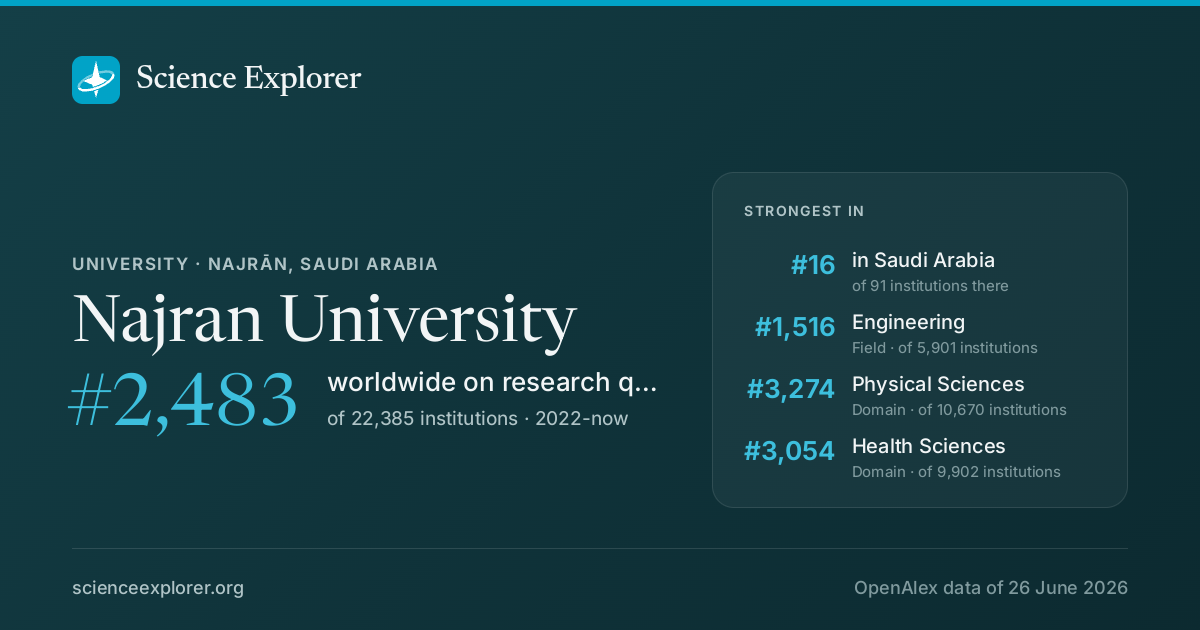
Najran University on Science Explorer

A card with Najran University's standing and the fields it leads in, for a post or a slide. A link to this page previews as the same card.

Download the card

1200 × 630 PNG, sized for social posts, drawn from the latest snapshot.

Badges for a website1Each links back here and updates with every snapshot

Research measures only: rankings here say nothing about teaching, admissions or student experience. Comparable institutions and collaboration partners have tabs of their own, above.

Discussion

Ask a question or share a note about Najran University. Posts are plain text and can be reported.