Otsuma Women's University
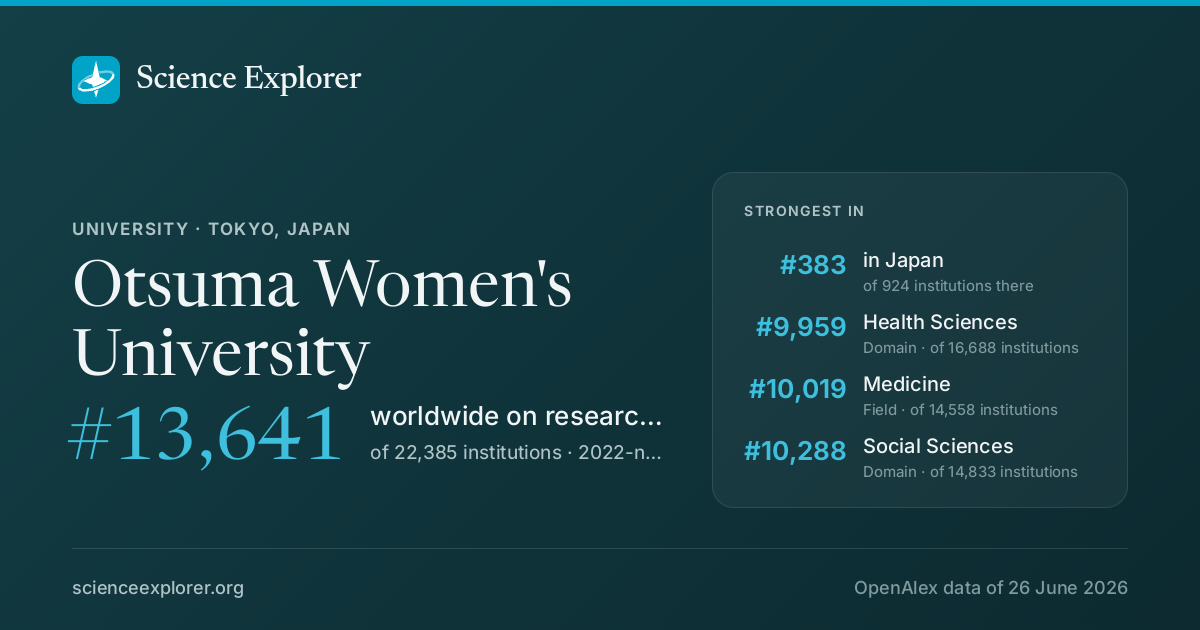
In research, Otsuma Women's University stands highest in Health Sciences (#9,959 of 16,688 worldwide), Medicine (#10,019 of 14,558 worldwide) and Social Sciences (#10,288 of 14,833 worldwide), over all time.
- World rank, 2022-now
- #13,641 of 22,385 · #13,791 all time
- Rank in Japan
- #383 of 924
- Research works
- 1.1k ▼ 50% vs 2018-21
- Citations
- 7.6k 6.7 per fractional work
- Top-10% rate
- 3.7% all institutions 10.0%
- vs its own fields
- 0.94× 1.00× is exactly expected
- Open access
- 62% world 40%
- International
- 8% world 18%
What is Otsuma Women's University known for in research?
The fields where it stands highest, over all time, ranked among every institution above the floor in each field.
| Field | World rank | Where that sits | Top-10% rate | Works |
|---|---|---|---|---|
| Health SciencesDomain | #9,959 of 16,688 | 4.1% | 254 | |
| MedicineField | #10,019 of 14,558 | 4.9% | 162 | |
| Social SciencesDomain | #10,288 of 14,833 | 2.7% | 395 | |
| Physical SciencesDomain | #13,613 of 17,446 | 2.7% | 309 | |
| Social SciencesField | #7,353 of 9,330 | 3.4% | 193 | |
| Life SciencesDomain | #10,093 of 11,023 | 2.2% | 186 |
Each strip is that field's whole ranked pool, with the notch where Otsuma Women's University sits in it, in the colour of the band that rank falls in. The track under the rate is the rate itself: it carries no average mark, because the average differs by field (from about 6% in Dentistry to 21% in Economics).
Which fields of science does Otsuma Women's University work in?
In 2022-now, 42% of research at Otsuma Women's University is in Social Sciences, 31% in Health Sciences. Its largest fields are Medicine (21%), Social Sciences (20%), Psychology (9%). It does 1.6× the world's share of Social Sciences.
Each ring splits the one inside it: the four domains of science, their fields, their subfields. Size is fractional works in 2022-now. Every slice is a page; the interactive view zooms down to single topics and colours each by how much more of it this institution does than the world.
Its 4 domains and 23 fields, with their numbers
- Social Sciences5342.4%
- Social Sciences2519.8%
- Psychology119.2%
- Arts and Humanities107.8%
- Business, Management and Accounting53.9%
- Economics, Econometrics and Finance21.2%
- Decision Sciences10.5%
- Health Sciences3930.8%
- Medicine2721.3%
- Health Professions65.0%
- Nursing64.5%
- Physical Sciences2016.3%
- Engineering65.0%
- Computer Science54.3%
- Environmental Science21.6%
- Physics and Astronomy21.4%
- Chemistry21.4%
- Materials Science11.0%
- Earth and Planetary Sciences10.5%
- Energy10.5%
- Mathematics10.5%
- Life Sciences1310.5%
Field profile
Location quotient across every field it publishes in: outside the ring is more than an institution of this size would be expected to publish, inside it is less.
Rings at 0.5×, 1× and 2×. Widest outward: Nursing, 9.2×. Every wedge is a field page.
All 23 fields, with their numbers
- Nursing9.21×6 works
- Psychology3.01×12 works
- Arts and Humanities2.69×10 works
- Neuroscience1.95×4 works
- Health Professions1.90×6 works
- Social Sciences1.56×25 works
- Pharmacology, Toxicology and Pharmaceutics1.51×1 works
- Business, Management and Accounting1.22×5 works
- Medicine1.11×27 works
- Agricultural and Biological Sciences0.86×5 works
- Chemistry0.86×2 works
- Physics and Astronomy0.65×2 works
- Energy0.58×1 works
- Computer Science0.56×5 works
- Economics, Econometrics and Finance0.56×2 works
- Decision Sciences0.55×1 works
- Biochemistry, Genetics and Molecular Biology0.49×3 works
- Mathematics0.44×1 works
- Earth and Planetary Sciences0.34×1 works
- Engineering0.33×6 works
- Environmental Science0.31×2 works
- Materials Science0.29×1 works
- Immunology and Microbiology0.13×0 works
- Nursing 9.2×
- Psychology 3.0×
- Arts and Humanities 2.7×
- Neuroscience 1.9×
- Health Professions 1.9×
- Social Sciences 1.6×
- Pharmacology, Toxicology and Pharmaceutics 1.5×
- Business, Management and Accounting 1.2×
- Medicine 1.1×
- Agricultural and Biological Sciences 0.9×
- Chemistry 0.9×
- Physics and Astronomy 0.7×
- Energy 0.6×
- Computer Science 0.6×
- Economics, Econometrics and Finance 0.6×
- Decision Sciences 0.6×
- Biochemistry, Genetics and Molecular Biology 0.5×
- Mathematics 0.4×
- Earth and Planetary Sciences 0.3×
- Engineering 0.3×
- Environmental Science 0.3×
- Materials Science 0.3×
- Immunology and Microbiology 0.1×
Who are the top researchers at Otsuma Women's University?
Ranked on the quality score, Minatsu Kobayashi, Yoshikazu Takanami and Taeko Okitsu lead among researchers whose main affiliation is Otsuma Women's University.
- 1
Minatsu Kobayashi
 Japan · #2,185,260 worldwide
4.5k citations · 91 works
- 2
Yoshikazu Takanami
Japan · #2,429,896 worldwide
1.4k citations · 32 works
- 3
Taeko Okitsu
Japan · #2,519,155 worldwide
106 citations · 23 works
- 4
Haruka Shida
Japan · #2,602,282 worldwide
311 citations · 27 works
- 5
Mika Iijima
Japan · #2,855,340 worldwide
1.8k citations · 58 works
- 6
Michiko Miyazaki
Japan · #2,991,273 worldwide
363 citations · 32 works
- 7
Tetsuo Fukushima
Japan · #3,649,154 worldwide
431 citations · 30 works
- 8
Shiro Sakurai
Japan · #3,727,090 worldwide
377 citations · 29 works
- 9
Midori Ito
Japan · #4,230,956 worldwide
100 citations · 19 works
- 10
Kana Murakami
Japan · #4,273,429 worldwide
747 citations · 55 works
Which keywords describe research at Otsuma Women's University?
By fractional works in 2022-now, weighted toward what it does more of than the world: Colonialism, Health Benefits, History, Culture, Resuscitation, Self-Efficacy, Dietary Fiber and Politics.
- Prebiotics
- Ketogenic Diet
- Race
- Society
- Weight Loss
- Rheological Properties
- Metabolic Health
- Alzheimer's Disease
- Insulin Resistance
- Academic Achievement
- Hypothermia
- Politics
- Self-Efficacy
- Consumer Behavior
- Innovation
- Identity
- Quality of Life
- Metabolic Syndrome
- Inflammation
- Globalization
- Epidemiology
- Colonialism
- History
- Culture
- Health Benefits
- Mental Health
- Resuscitation
- Dietary Fiber
- Gender
- Cardiac Arrest
- Nationalism
- Gut Microbiota
- Religion
- Parental Involvement
- Private Tutoring
- Shadow Education
- Circadian Rhythms
- Glycemic Index
- Starch
- Low-Carbohydrate Diet
Size is fractional works in 2022-now in the topics tagged with each word; colour is the word's share of this institution's work against its share of the world's. The 40 words are chosen for being large and distinctive. Each links to the topic it comes from most.
All 40 words, with their numbers
- Epidemiology6▲ 1.18×23 topics
- Globalization5▲ 2.1×13 topics
- Colonialism5▲ 8.2×10 topics
- Inflammation4▲ 1.64×12 topics
- History4▲ 4.9×9 topics
- Metabolic Syndrome4▲ 3.9×10 topics
- Culture4▲ 5.9×8 topics
- Quality of Life4▲ 2.2×11 topics
- Health Benefits4▲ 8.9×4 topics
- Identity4▲ 4.1×8 topics
- Mental Health4▲ 1.95×13 topics
- Innovation3▲ 2.6×8 topics
- Resuscitation3▲ 20×2 topics
- Consumer Behavior3▲ 4.2×7 topics
- Dietary Fiber3▲ 23×2 topics
- Self-Efficacy3▲ 9.8×6 topics
- Gender3▲ 4.6×7 topics
- Politics3▲ 9.5×6 topics
- Cardiac Arrest3▲ 43×1 topic
- Hypothermia3▲ 32×1 topic
- Nationalism3▲ 4.8×6 topics
- Academic Achievement3▲ 12×3 topics
- Gut Microbiota3▲ 5.9×4 topics
- Insulin Resistance3▲ 4.5×7 topics
- Religion3▲ 4.4×6 topics
- Alzheimer's Disease2▲ 6.9×3 topics
- Parental Involvement2▲ 11×2 topics
- Metabolic Health2▲ 9.2×3 topics
- Private Tutoring2▲ 137×1 topic
- Rheological Properties2▲ 9.4×2 topics
- Shadow Education2▲ 137×1 topic
- Weight Loss2▲ 10×3 topics
- Circadian Rhythms2▲ 14×2 topics
- Society2▲ 8.1×3 topics
- Glycemic Index2▲ 25×1 topic
- Race2▲ 12×4 topics
- Starch2▲ 25×1 topic
- Ketogenic Diet2▲ 15×1 topic
- Low-Carbohydrate Diet2▲ 17×1 topic
- Prebiotics2▲ 15×2 topics
Which research topics does Otsuma Women's University publish most on?
By volume in 2022-now: Cardiac Arrest and Resuscitation, Global Educational Reforms and Inequalities, Food composition and properties and Diet and metabolism studies.
Area is fractional works; colour is the subfield each topic belongs to.
- 1 Cardiac Arrest and Resuscitation Emergency Medicine 3 works
- 2 Global Educational Reforms and Inequalities Demography 2 works
- 3 Food composition and properties Nutrition and Dietetics 2 works
- 4 Diet and metabolism studies Physiology 2 works
- 5 Dietetics, Nutrition, and Education Health Information Management 2 works
- 6 Microbial Metabolites in Food Biotechnology Nutrition and Dietetics 1 works
- 7 Political Theory and Influence Political Science and International Relations 1 works
- 8 Healthcare Education and Workforce Issues Leadership and Management 1 works
- 9 Trauma and Emergency Care Studies Emergency Medicine 1 works
- 10 Olfactory and Sensory Function Studies Sensory Systems 1 works
How open and international is its research?
Against the world's own shares: the tick on each track. Both are shares of its output, so they sit on one scale and can be read against each other as well as against the world.
World: 40% of research is openly available.
World: 18% is written across borders.
How has Otsuma Women's University's research output changed?
Output in 2022-2025 was 50% lower than in 2018-2021.
The same series as a ribbon: one cell per year, darker for more. The line above answers how much; this answers when.
Its share of all research
Growing output can still be a shrinking share: all of science grows. This is Otsuma Women's University as a percentage of every work published that year, 0.00054% in 2024.
Fractional works of Otsuma Women's University over all fractional works that year. How the balance of science has shifted.
How much of it reaches the world top 10%
Year by year, against all institutions in the same year.
Of each year's output, the share that reached the world's 10% most cited for its field and year. Peak 8.9% in 1998.
Other research institutions in Tokyo
- The University of Tokyo
- Tokyo Institute of Technology
- Keio University
- Waseda University
- Tokyo University of Science
- Nihon University
- Hitachi (Japan)
- NTT (Japan)


Share Otsuma Women's University's ranking
Badges for a website1Each links back here and updates with every snapshot

Research measures only: rankings here say nothing about teaching, admissions or student experience. Comparable institutions and collaboration partners have tabs of their own, above.
Discussion
Ask a question or share a note about Otsuma Women's University. Keep it to the research: no personal attacks, advertising or links. Any reader can report a post, which collapses it for everyone until it is opened.