Science Explorer Back to mapMap
University · Augusta · United States

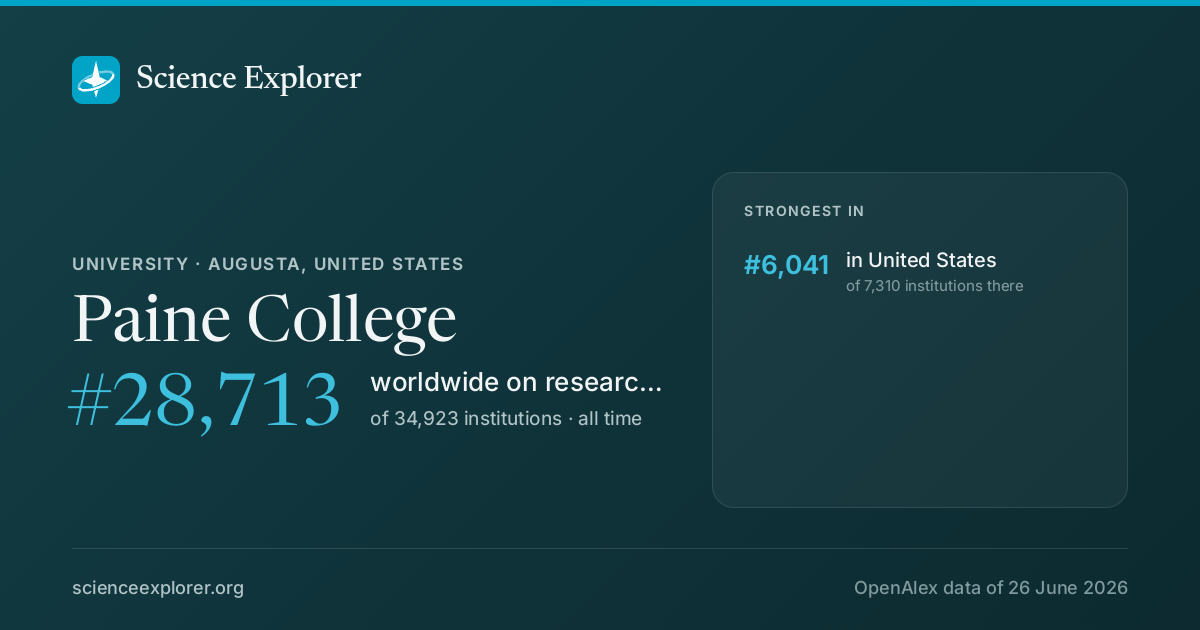
Paine College

World rank, all time
#28,713
of 34,923
Rank in United States
#6,041
of 7,310
Research works
165
▼ 15% vs 2018-21
Citations
1.3k
7.9 per fractional work
Top-10% rate
3.5%
all institutions 10.0%
vs its own fields
0.97×
1.00× is exactly expected
Open access
26%
world 40%
International
12%
world 18%

Which fields of science does Paine College work in?

In all years, 60% of research at Paine College is in Social Sciences, 28% in Physical Sciences. Its largest fields are Social Sciences (38%), Decision Sciences (11%), Computer Science (11%). It does 2.7× the world's share of Social Sciences.

Social Sciences: 99 fractional works · 60.3% of its workSocial Sciences: 63 fractional works · 38.3% of its workSociology and Political Science: 34 fractional works · 20.7% of its workEducation: 12 fractional works · 7.5% of its workPolitical Science and International Relations: 5 fractional works · 3.1% of its workGender Studies: 3 fractional works · 1.7% of its workLibrary and Information Sciences: 2 fractional works · 1.3% of its workCommunication: 1 fractional works · 0.6% of its workGeography, Planning and Development: 1 fractional works · 0.6% of its workPublic Administration: 1 fractional works · 0.5% of its workDemography: 1 fractional works · 0.4% of its workHealth: 1 fractional works · 0.4% of its workSafety Research: 1 fractional works · 0.4% of its workCultural Studies: 0 fractional works · 0.3% of its workGeneral Social Sciences: 0 fractional works · 0.3% of its workLaw: 0 fractional works · 0.3% of its workLinguistics and Language: 0 fractional works · 0.2% of its workDecision Sciences: 19 fractional works · 11.3% of its workManagement Science and Operations Research: 17 fractional works · 10.2% of its workInformation Systems and Management: 1 fractional works · 0.9% of its workStatistics, Probability and Uncertainty: 0 fractional works · 0.2% of its workArts and Humanities: 7 fractional works · 4.1% of its workHistory: 2 fractional works · 1.0% of its workClassics: 1 fractional works · 0.8% of its workLiterature and Literary Theory: 1 fractional works · 0.8% of its workVisual Arts and Performing Arts: 1 fractional works · 0.4% of its workHistory and Philosophy of Science: 0 fractional works · 0.3% of its workPhilosophy: 0 fractional works · 0.2% of its workLanguage and Linguistics: 0 fractional works · 0.2% of its workMuseology: 0 fractional works · 0.2% of its workReligious studies: 0 fractional works · 0.2% of its workPsychology: 5 fractional works · 3.2% of its workSocial Psychology: 2 fractional works · 1.1% of its workDevelopmental and Educational Psychology: 1 fractional works · 0.7% of its workExperimental and Cognitive Psychology: 1 fractional works · 0.6% of its workClinical Psychology: 1 fractional works · 0.6% of its workNeuropsychology and Physiological Psychology: 0 fractional works · 0.2% of its workSmaller subfields together: 0 fractional works · 0.1% of its workBusiness, Management and Accounting: 4 fractional works · 2.5% of its workManagement Information Systems: 2 fractional works · 1.1% of its workStrategy and Management: 2 fractional works · 0.9% of its workOrganizational Behavior and Human Resource Management: 1 fractional works · 0.4% of its workSmaller subfields together: 0 fractional works · 0.1% of its workEconomics, Econometrics and Finance: 1 fractional works · 0.9% of its workFinance: 1 fractional works · 0.6% of its workEconomics and Econometrics: 0 fractional works · 0.2% of its workPhysical Sciences: 46 fractional works · 28.1% of its workComputer Science: 18 fractional works · 10.7% of its workComputer Networks and Communications: 6 fractional works · 3.7% of its workArtificial Intelligence: 5 fractional works · 2.9% of its workInformation Systems: 4 fractional works · 2.3% of its workComputer Science Applications: 1 fractional works · 0.6% of its workComputational Theory and Mathematics: 1 fractional works · 0.4% of its workHuman-Computer Interaction: 0 fractional works · 0.3% of its workComputer Vision and Pattern Recognition: 0 fractional works · 0.2% of its workSmaller subfields together: 1 fractional works · 0.4% of its workEnvironmental Science: 15 fractional works · 9.2% of its workGlobal and Planetary Change: 11 fractional works · 6.4% of its workManagement, Monitoring, Policy and Law: 2 fractional works · 1.0% of its workHealth, Toxicology and Mutagenesis: 1 fractional works · 0.6% of its workWater Science and Technology: 1 fractional works · 0.5% of its workEcological Modeling: 0 fractional works · 0.2% of its workSmaller subfields together: 1 fractional works · 0.5% of its workEngineering: 4 fractional works · 2.5% of its workElectrical and Electronic Engineering: 1 fractional works · 0.8% of its workBiomedical Engineering: 1 fractional works · 0.5% of its workControl and Systems Engineering: 1 fractional works · 0.4% of its workOcean Engineering: 1 fractional works · 0.4% of its workSafety, Risk, Reliability and Quality: 0 fractional works · 0.3% of its workSmaller subfields together: 0 fractional works · 0.2% of its workPhysics and Astronomy: 2 fractional works · 1.4% of its workStatistical and Nonlinear Physics: 1 fractional works · 0.5% of its workAstronomy and Astrophysics: 0 fractional works · 0.3% of its workAtomic and Molecular Physics, and Optics: 0 fractional works · 0.2% of its workNuclear and High Energy Physics: 0 fractional works · 0.2% of its workRadiation: 0 fractional works · 0.2% of its workMaterials Science: 2 fractional works · 1.3% of its workMaterials Chemistry: 1 fractional works · 0.7% of its workGeneral Materials Science: 0 fractional works · 0.3% of its workSmaller subfields together: 0 fractional works · 0.3% of its workMathematics: 2 fractional works · 1.3% of its workMathematical Physics: 1 fractional works · 0.6% of its workTheoretical Computer Science: 0 fractional works · 0.3% of its workApplied Mathematics: 0 fractional works · 0.3% of its workSmaller subfields together: 0 fractional works · 0.1% of its workChemistry: 2 fractional works · 1.2% of its workAnalytical Chemistry: 1 fractional works · 0.6% of its workSpectroscopy: 1 fractional works · 0.6% of its workSmaller subfields together: 0 fractional works · 0.0% of its workEarth and Planetary Sciences: 1 fractional works · 0.4% of its workAtmospheric Science: 0 fractional works · 0.2% of its workSmaller subfields together: 0 fractional works · 0.2% of its workEnergy: 0 fractional works · 0.1% of its workHealth Sciences: 11 fractional works · 6.8% of its workMedicine: 7 fractional works · 4.4% of its workPublic Health, Environmental and Occupational Health: 1 fractional works · 0.7% of its workPhysiology: 1 fractional works · 0.5% of its workEpidemiology: 1 fractional works · 0.4% of its workPharmacology: 1 fractional works · 0.4% of its workAnesthesiology and Pain Medicine: 1 fractional works · 0.3% of its workPathology and Forensic Medicine: 1 fractional works · 0.3% of its workPsychiatry and Mental health: 1 fractional works · 0.3% of its workOncology: 0 fractional works · 0.3% of its workSurgery: 0 fractional works · 0.3% of its workEmergency Medicine: 0 fractional works · 0.2% of its workSmaller subfields together: 1 fractional works · 0.6% of its workHealth Professions: 3 fractional works · 2.0% of its workGeneral Health Professions: 1 fractional works · 0.8% of its workEmergency Medical Services: 1 fractional works · 0.3% of its workHealth Information Management: 0 fractional works · 0.2% of its workRadiological and Ultrasound Technology: 0 fractional works · 0.2% of its workSpeech and Hearing: 0 fractional works · 0.2% of its workSmaller subfields together: 0 fractional works · 0.2% of its workDentistry: 0 fractional works · 0.3% of its workOrthodontics: 0 fractional works · 0.2% of its workSmaller subfields together: 0 fractional works · 0.1% of its workNursing: 0 fractional works · 0.1% of its workLife Sciences: 8 fractional works · 4.8% of its workAgricultural and Biological Sciences: 3 fractional works · 1.9% of its workGeneral Agricultural and Biological Sciences: 2 fractional works · 1.0% of its workEcology, Evolution, Behavior and Systematics: 1 fractional works · 0.5% of its workPlant Science: 1 fractional works · 0.4% of its workSmaller subfields together: 0 fractional works · 0.1% of its workNeuroscience: 3 fractional works · 1.6% of its workCognitive Neuroscience: 3 fractional works · 1.6% of its workSmaller subfields together: 0 fractional works · 0.0% of its workBiochemistry, Genetics and Molecular Biology: 2 fractional works · 1.1% of its workEndocrinology: 1 fractional works · 0.4% of its workMolecular Biology: 1 fractional works · 0.4% of its workBiochemistry: 0 fractional works · 0.2% of its workSmaller subfields together: 0 fractional works · 0.2% of its workImmunology and Microbiology: 0 fractional works · 0.1% of its workALL ITS WORKPaine College165fractional works, all years
Life Sciences5%Physical Sciences28%Health Sciences7%Social Sciences60%

Each ring splits the one inside it: the four domains of science, their fields, their subfields. Size is fractional works in all years. Every slice is a page; the interactive view zooms down to single topics and colours each by how much more of it this institution does than the world.

Its 4 domains and 23 fields, with their numbers
    1. Social Sciences6338.3%
    2. Decision Sciences1911.3%
    3. Arts and Humanities74.1%
    4. Psychology53.2%
    5. Business, Management and Accounting42.5%
    6. Economics, Econometrics and Finance10.9%
    1. Computer Science1810.7%
    2. Environmental Science159.2%
    3. Engineering42.5%
    4. Physics and Astronomy21.4%
    5. Materials Science21.3%
    6. Mathematics21.3%
    7. Chemistry21.2%
    8. Earth and Planetary Sciences10.4%
    9. Energy00.1%
    1. Medicine74.4%
    2. Health Professions32.0%
    3. Dentistry00.3%
    4. Nursing00.1%
    1. Agricultural and Biological Sciences31.9%
    2. Neuroscience31.6%
    3. Biochemistry, Genetics and Molecular Biology21.1%
    4. Immunology and Microbiology00.1%
All of science, and how each field's share has moved since 1950: the Science domain explorer

Field profile

Location quotient across every field it publishes in: outside the ring is more than an institution of this size would be expected to publish, inside it is less.

Agricultural and Biological Sciences: 1.38× its world share, 1 worksAgricultural and Bio…Biochemistry, Genetics and Molecular Biology: 0.33× its world share, 0 worksBiochemistry, Geneti…Neuroscience: 2.33× its world share, 1 worksNeuroscienceComputer Science: 0.52× its world share, 1 worksComputer ScienceEarth and Planetary Sciences: 1.11× its world share, 0 worksEarth and Planetary …Engineering: 0.17× its world share, 0 worksEngineeringEnvironmental Science: 3.16× its world share, 3 worksEnvironmental ScienceMathematics: 0.30× its world share, 0 worksMathematicsHealth Professions: 0.88× its world share, 0 worksHealth ProfessionsMedicine: 0.40× its world share, 2 worksMedicineNursing: 1.78× its world share, 0 worksNursingDecision Sciences: 15.51× its world share, 3 worksDecision SciencesPsychology: 1.69× its world share, 1 worksPsychologySocial Sciences: 2.55× its world share, 6 worksSocial Sciences1×world share
more than its size predictsabout as predictedless

Rings at 0.5×, 1× and 2×. Widest outward: Decision Sciences, 15.5×. Every wedge is a field page.

All 14 fields, with their numbers
  1. Decision Sciences15.51×3 works
  2. Environmental Science3.16×3 works
  3. Social Sciences2.55×6 works
  4. Neuroscience2.33×1 works
  5. Nursing1.78×0 works
  6. Psychology1.69×1 works
  7. Agricultural and Biological Sciences1.38×1 works
  8. Earth and Planetary Sciences1.11×0 works
  9. Health Professions0.88×0 works
  10. Computer Science0.52×1 works
  11. Medicine0.40×2 works
  12. Biochemistry, Genetics and Molecular Biology0.33×0 works
  13. Mathematics0.30×0 works
  14. Engineering0.17×0 works

Who are the top researchers at Paine College?

Ranked on the quality score, JOSEPH C. WOOD, Lily Hardy Hammond and Alan Paisey lead among researchers whose main affiliation is Paine College.

  1. 1 JOSEPH C. WOOD United States · #2,200,448 worldwide 1.5k citations · 77 works
  2. 2 Lily Hardy Hammond United States · #2,717,038 worldwide 5 citations · 22 works
  3. 3 Alan Paisey United States · #3,049,145 worldwide 79 citations · 89 works
  4. 4 David J. Keep United States · #3,148,351 worldwide 158 citations · 23 works
  5. 5 Hui‐Lien Tung United States · #4,282,197 worldwide 135 citations · 43 works
  6. 6 de Jong Rh United States · #4,564,005 worldwide 138 citations · 16 works
  7. 7 William F. Lawless United States · #4,635,536 worldwide 1.1k citations · 207 works
  8. 8 Samuel H. Day United States · #4,785,583 worldwide 34 citations · 41 works
  9. 9 Margo Bergman United States · #6,553,636 worldwide 143 citations · 81 works
All ranked researchers at Paine College

What are the most cited papers from Paine College?

The most cited paper from Paine College is "Teacher Characteristics for Culturally Responsive Pedagogy" (Laura Rychly, Emily Graves, 2012), with 209 citations. Next come "Black Feminist-Womanist Research Paradigm" (119) and "Effect of pH on element release from dental casting alloys" (107).

Most cited papers
#PaperReleasedCitations
1 Teacher Characteristics for Culturally Responsive Pedagogy Laura Rychly, Emily Graves · Multicultural Perspectives 2012 209
2 Black Feminist-Womanist Research Paradigm LaShawnda Lindsay-Dennis · Journal of Black Studies 23 Apr 2015 119
3 Effect of pH on element release from dental casting alloys John C. Wataha, Petra E. Lockwood b, Sharukh Soli KHAJOTIA et al. · Journal of Prosthetic Dentistry Dec 1998 107
4 Variables Associated With Human Papillomavirus (HPV) Vaccine Acceptance by Men Daron G. Ferris, Jennifer L. Waller, J. K. MILLER et al. · The Journal of the American Board of Family Medicine Open access 2009 89
5 TEACHING APPROACH AND THE DEVELOPMENT OF DIVERGENT THINKING ABILITIES IN PRIMARY SCHOOLS F. A. HADDON, Hugh Lytton · British Journal of Educational Psychology Jun 1968 71
All 60 most cited papers, with filters and sorting

Which keywords describe research at Paine College?

By fractional works in all years, weighted toward what it does more of than the world: Sustainability, Biodiversity, Team Science, Artificial Intelligence, Organizational Performance, Human Population, Interdependence and Climate Change.

▲ more of its work than of the world's◆ about the world's share▼ less than the world's

Size is fractional works in all years in the topics tagged with each word; colour is the word's share of this institution's work against its share of the world's. The 40 words are chosen for being large and distinctive. Each links to the topic it comes from most.

All 40 words, with their numbers
  1. Sustainability41▲ 14×7 topics
  2. Biodiversity25▲ 20×5 topics
  3. Climate Change23▲ 5.3×7 topics
  4. Team Science23▲ 815×2 topics
  5. Artificial Intelligence23▲ 17×6 topics
  6. Organizational Performance22▲ 93×2 topics
  7. Human Population22▲ 2231×1 topic
  8. Interdependence22▲ 2231×1 topic
  9. Modeling19▲ 45×3 topics
  10. Complex Systems16▲ 66×2 topics
  11. Soft Systems Methodology16▲ 278×1 topic
  12. System Dynamics16▲ 140×1 topic
  13. Self-Organization11▲ 137×2 topics
  14. Early-warning Signals10▲ 703×1 topic
  15. Regime Shifts10▲ 703×1 topic
  16. Feminism6▲ 14×3 topics
  17. Education6▲ 2.7×10 topics
  18. Social Movements5▲ 9.7×2 topics
  19. Black Studies5▲ 95×1 topic
  20. Civil Rights Movement5▲ 95×1 topic
  21. Gender4▲ 4.2×8 topics
  22. Multi-Criteria Analysis4▲ 36×2 topics
  23. Power Control4▲ 19×2 topics
  24. Knowledge Representation3▲ 15×3 topics
  25. Social-Ecological Systems3▲ 21×3 topics
  26. Technology Integration3▲ 10×3 topics
  27. Learning Outcomes3▲ 8.6×4 topics
  28. Decision Support3▲ 33×1 topic
  29. Fuzzy Cognitive Maps3▲ 121×1 topic
  30. Student Engagement3▲ 7.2×7 topics
  31. Trust3▲ 7.2×4 topics
  32. Mobile Ad Hoc Networks3▲ 26×2 topics
  33. Mobility Models3▲ 26×2 topics
  34. Public Opinion3▲ 9.7×3 topics
  35. Cultural Competence3▲ 13×4 topics
  36. Digital Divide3▲ 8.5×3 topics
  37. Risk Perception3▲ 7.9×4 topics
  38. American founding2▲ 21×1 topic
  39. Channel Assignment2▲ 14×2 topics
  40. Constitutional government2▲ 21×1 topic

Which research topics does Paine College publish most on?

By volume in 2022-now: Innovation, Sustainability, Human-Machine Systems, Complex Systems and Decision Making, Ecosystem dynamics and resilience and Food Security and Socioeconomic Dynamics.

  1. 1 Innovation, Sustainability, Human-Machine Systems Sociology and Political Science 4 works
  2. 2 Complex Systems and Decision Making Management Science and Operations Research 3 works
  3. 3 Ecosystem dynamics and resilience Global and Planetary Change 3 works
  4. 4 Food Security and Socioeconomic Dynamics General Agricultural and Biological Sciences 1 works
  5. 5 Risk Perception and Management Sociology and Political Science 1 works
  6. 6 Chaos, Complexity, and Education Computational Theory and Mathematics 1 works
  7. 7 Systems Engineering Methodologies and Applications Control and Systems Engineering 0 works
  8. 8 Education and Critical Thinking Development Education 0 works
  9. 9 Species Distribution and Climate Change Ecological Modeling 0 works
  10. 10 Psychology of Moral and Emotional Judgment Cognitive Neuroscience 0 works

How open and international is its research?

Against the world's own shares: the tick on each track. Both are shares of its output, so they sit on one scale and can be read against each other as well as against the world.

openly available26.5%not open73.5%

World: 40% of research is openly available.

with international co-authors12.1%domestic only87.9%

World: 18% is written across borders.

How has Paine College's research output changed?

Output in 2022-2025 was 15% lower than in 2018-2021.

still counting1990200020102020
grewheldshrank

The same series as a ribbon: one cell per year, darker for more. The line above answers how much; this answers when.

Its share of all research

Growing output can still be a shrinking share: all of science grows. This is Paine College as a percentage of every work published that year, 0.000054% in 2024.

still counting0.00050%0.0010%0.0015%Paine College0.00013% in 202519801990200020102020

Fractional works of Paine College over all fractional works that year. How the balance of science has shifted.

Other research institutions in Augusta

All research institutions in Augusta

Share Paine College's ranking

Paine College on Science Explorer

A card with Paine College's standing and the fields it leads in, for a post or a slide. A link to this page previews as the same card.

Download the card

1200 × 630 PNG, sized for social posts, drawn from the latest snapshot.

Badges for a website1Each links back here and updates with every snapshot

Research measures only: rankings here say nothing about teaching, admissions or student experience. Comparable institutions and collaboration partners have tabs of their own, above.

Discussion

Ask a question or share a note about Paine College. Posts are plain text and can be reported.