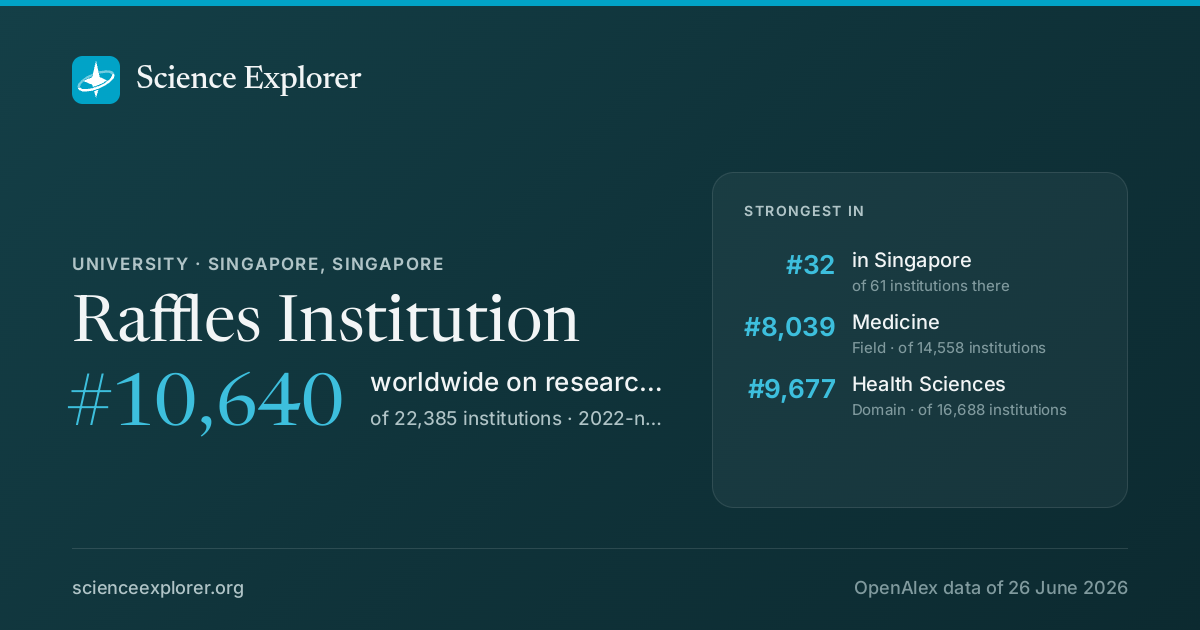
In research, Raffles Institution stands highest in Medicine (#8,039 of 14,558 worldwide) and Health Sciences (#9,677 of 16,688 worldwide), over all time.
Each strip is that field's whole ranked pool, with the notch where Raffles Institution sits in it, in the colour
of the band that rank falls in. The track under the rate is the rate itself: it carries no average mark, because the average
differs by field (from about 6% in Dentistry to 21% in Economics).
Which fields of science does Raffles Institution work in?
Life Sciences12%Physical Sciences37%Health Sciences31%Social Sciences19%
Each ring splits the one inside it: the four domains of science, their fields, their subfields. Size is fractional works in 2022-now. Every slice is a page; the interactive view zooms down to single topics and colours each by how much more of it this institution does than the world.
Location quotient across every field it publishes in: outside the ring is more than an institution of this size would be expected to publish, inside it is less.
more than its size predictsabout as predictedless
Rings at 0.5×, 1× and 2×. Widest outward: Neuroscience, 2.3×. Every wedge is a field page.
All 25 fields, with their numbers
Neuroscience2.34×5 works
Medicine1.51×37 works
Arts and Humanities1.48×5 works
Chemistry1.47×3 works
Computer Science1.45×14 works
Decision Sciences1.31×2 works
Energy1.29×2 works
Pharmacology, Toxicology and Pharmaceutics1.14×0 works
Chemical Engineering1.00×0 works
Mathematics0.96×1 works
Economics, Econometrics and Finance0.95×3 works
Materials Science0.88×4 works
Engineering0.87×17 works
Biochemistry, Genetics and Molecular Biology0.81×6 works
What are the most cited papers from Raffles Institution?
The most cited paper from Raffles Institution is "Global Burden of Hypertension and Systolic Blood Pressure of at Least 110 to 115 mm Hg, 1990-2015" (Mohammad Hossein Forouzanfar et al., 2017), with 2,464 citations. Next come "Global, regional, and national levels and causes of maternal mortality during 1990–2013: a systematic analysis for the Global Burden of Disease Study 2013" (1,682) and "Global, regional, and national incidence and mortality for HIV, tuberculosis, and malaria during 1990–2013: a systematic analysis for the Global Burden of Disease Study 2013" (998).
Which keywords describe research at Raffles Institution?
By fractional works in 2022-now, weighted toward what it does more of than the world: Neuroprotection, Ischemic Stroke, Revascularization, Global Burden, Clinical Outcomes, Endovascular Therapy, Thrombolysis and Risk Factors.
▲ more of its work than of the world's◆ about the world's share▼ less than the world's
Size is fractional works in 2022-now in the topics tagged with each word; colour is the word's share of this institution's work against its share of the world's. The 40 words are chosen for being large and distinctive. Each links to the topic it comes from most.
All 40 words, with their numbers
Deep Learning7▲ 1.69×27 topics
Machine Learning6▲ 1.29×16 topics
Neuroprotection6▲ 12×5 topics
Risk Factors5▲ 3.9×9 topics
Ischemic Stroke5▲ 26×4 topics
Global Burden5▲ 6.7×7 topics
Oxidative Stress5▲ 2.2×17 topics
Revascularization4▲ 22×2 topics
Aging4▲ 5.9×8 topics
Clinical Outcomes4▲ 15×2 topics
Endovascular Therapy4▲ 46×1 topic
Neural Networks4▲ 2.0×12 topics
Thrombolysis4▲ 46×1 topic
Alzheimer's Disease4▲ 10×4 topics
Social Media4▲ 2.1×7 topics
Neuroimaging3▲ 9.2×5 topics
Biomarkers3▲ 3.5×6 topics
Cardiovascular Disease3▲ 2.0×18 topics
Dementia3▲ 23×1 topic
Mild Cognitive Impairment3▲ 25×1 topic
Convolutional Neural Networks3▲ 3.0×9 topics
Music Education2▲ 56×2 topics
Neuroinflammation2▲ 5.8×5 topics
Stroke Prevention2▲ 14×2 topics
Constraint-Induced Therapy2▲ 20×1 topic
Functional Recovery2▲ 10×2 topics
Motor Recovery2▲ 20×1 topic
Neural Plasticity2▲ 8.8×2 topics
Cardiovascular Events2▲ 13×4 topics
Cerebrovascular Events2▲ 28×2 topics
Human-Computer Interaction2▲ 8.1×3 topics
Nanostructured Materials2▲ 8.2×2 topics
Heavy Metals2▲ 5.5×2 topics
Magnetic Resonance Imaging2▲ 5.4×2 topics
Carotid Artery Stenosis2▲ 26×1 topic
Endarterectomy2▲ 26×1 topic
White Matter Lesions2▲ 37×2 topics
Digital Media Technology1▲ 29×1 topic
Visual Communication Design1▲ 29×1 topic
Informal Learning1▲ 8.1×1 topic
Which research topics does Raffles Institution publish most on?
Against the world's own shares: the tick on each track. Both are shares of its output, so they
sit on one scale and can be read against each other as well as against the world.
49%51%
openly available48.8%not open51.2%
World: 40% of research is openly available.
29%71%
with international co-authors29.1%domestic only70.9%
World: 18% is written across borders.
How has Raffles Institution's research output changed?
Output in 2022-2025 was 41% higher than in 2018-2021.
grewheldshrank
The same series as a ribbon: one cell per year, darker for more. The line above answers how much; this answers when.
Its share of all research
Growing output can still be a shrinking share: all of science grows. This is Raffles Institution as a percentage of every work published that year, 0.00033% in 2024.
Research measures only: rankings here say nothing about teaching, admissions or student experience. Comparable institutions and collaboration partners have tabs of their own, above.
Discussion
Ask a question or share a note about Raffles Institution. Posts are plain text and can be reported.
 Singapore · #30,387 worldwide
252k citations · 600 works