Science Explorer Back to mapMap
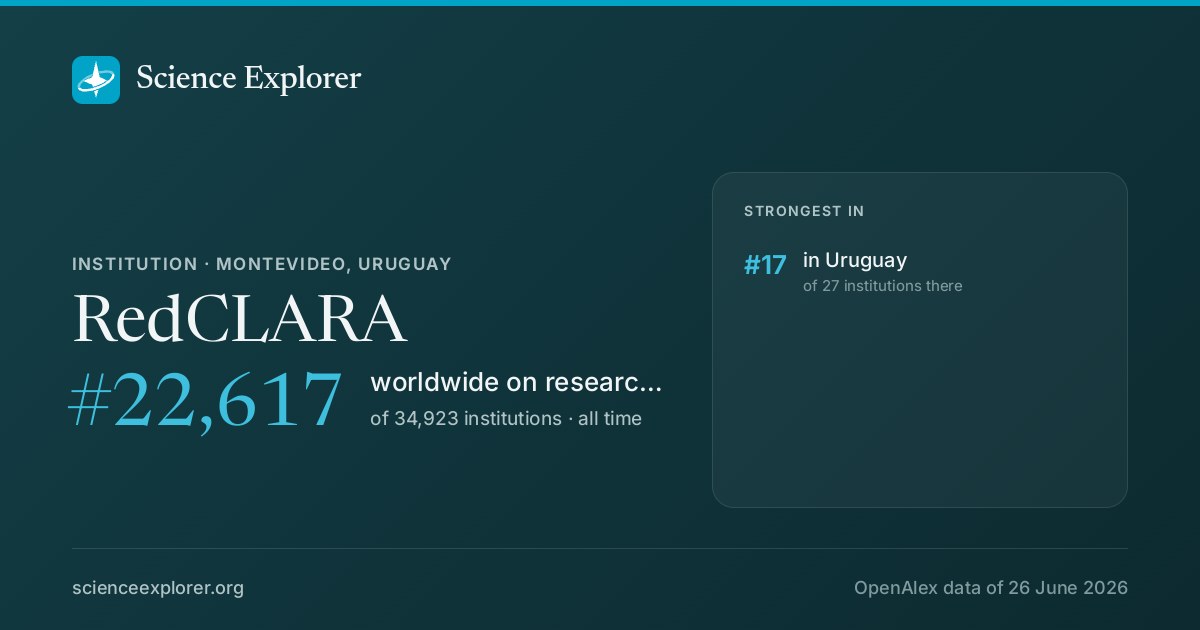
World rank, all time
#22,617
of 34,923
Rank in Uruguay
#17
of 27
Research works
196
▼ 14% vs 2018-21
Citations
1.4k
7.2 per fractional work
Top-10% rate
12.2%
all institutions 10.0%
vs its own fields
0.96×
1.00× is exactly expected
Open access
60%
world 40%
International
46%
world 18%

Which fields of science does RedCLARA work in?

In 2022-now, 31% of research at RedCLARA is in Health Sciences, 28% in Physical Sciences. Its largest fields are Medicine (24%), Agricultural and Biological Sciences (14%), Social Sciences (13%). It does 1.3× the world's share of Life Sciences.

Health Sciences: 13 fractional works · 30.9% of its workMedicine: 10 fractional works · 23.7% of its workPublic Health, Environmental and Occupational Health: 2 fractional works · 3.7% of its workPediatrics, Perinatology and Child Health: 1 fractional works · 2.1% of its workPulmonary and Respiratory Medicine: 1 fractional works · 2.0% of its workSurgery: 1 fractional works · 1.6% of its workEpidemiology: 1 fractional works · 1.6% of its workOncology: 1 fractional works · 1.4% of its workEndocrinology, Diabetes and Metabolism: 1 fractional works · 1.3% of its workPsychiatry and Mental health: 1 fractional works · 1.3% of its workCritical Care and Intensive Care Medicine: 0 fractional works · 1.0% of its workNeurology: 0 fractional works · 0.8% of its workObstetrics and Gynecology: 0 fractional works · 0.8% of its workFamily Practice: 0 fractional works · 0.8% of its workInfectious Diseases: 0 fractional works · 0.7% of its workReproductive Medicine: 0 fractional works · 0.6% of its workPhysiology: 0 fractional works · 0.6% of its workCardiology and Cardiovascular Medicine: 0 fractional works · 0.6% of its workHematology: 0 fractional works · 0.5% of its workNephrology: 0 fractional works · 0.5% of its workImmunology and Allergy: 0 fractional works · 0.4% of its workTransplantation: 0 fractional works · 0.4% of its workDermatology: 0 fractional works · 0.3% of its workEmergency Medicine: 0 fractional works · 0.3% of its workSmaller subfields together: 0 fractional works · 0.3% of its workHealth Professions: 2 fractional works · 5.9% of its workGeneral Health Professions: 2 fractional works · 4.4% of its workHealth Information Management: 0 fractional works · 1.1% of its workEmergency Medical Services: 0 fractional works · 0.4% of its workNursing: 1 fractional works · 1.3% of its workNutrition and Dietetics: 1 fractional works · 1.3% of its workPhysical Sciences: 12 fractional works · 28.3% of its workComputer Science: 4 fractional works · 10.7% of its workArtificial Intelligence: 2 fractional works · 4.0% of its workComputer Networks and Communications: 1 fractional works · 2.9% of its workInformation Systems: 1 fractional works · 2.1% of its workComputer Science Applications: 0 fractional works · 0.8% of its workSignal Processing: 0 fractional works · 0.8% of its workEnvironmental Science: 3 fractional works · 6.8% of its workHealth, Toxicology and Mutagenesis: 1 fractional works · 2.3% of its workNature and Landscape Conservation: 1 fractional works · 1.3% of its workEcology: 0 fractional works · 1.1% of its workGlobal and Planetary Change: 0 fractional works · 0.7% of its workManagement, Monitoring, Policy and Law: 0 fractional works · 0.7% of its workPollution: 0 fractional works · 0.3% of its workSmaller subfields together: 0 fractional works · 0.4% of its workEngineering: 2 fractional works · 5.8% of its workElectrical and Electronic Engineering: 1 fractional works · 2.4% of its workBiomedical Engineering: 1 fractional works · 1.7% of its workSafety, Risk, Reliability and Quality: 0 fractional works · 0.6% of its workMechanical Engineering: 0 fractional works · 0.5% of its workAerospace Engineering: 0 fractional works · 0.3% of its workSmaller subfields together: 0 fractional works · 0.3% of its workEarth and Planetary Sciences: 1 fractional works · 1.7% of its workGeophysics: 1 fractional works · 1.6% of its workSmaller subfields together: 0 fractional works · 0.1% of its workChemistry: 1 fractional works · 1.4% of its workAnalytical Chemistry: 0 fractional works · 1.1% of its workOrganic Chemistry: 0 fractional works · 0.3% of its workPhysics and Astronomy: 0 fractional works · 1.1% of its workAstronomy and Astrophysics: 0 fractional works · 0.8% of its workStatistical and Nonlinear Physics: 0 fractional works · 0.3% of its workSmaller subfields together: 0 fractional works · 0.1% of its workEnergy: 0 fractional works · 0.6% of its workRenewable Energy, Sustainability and the Environment: 0 fractional works · 0.6% of its workMaterials Science: 0 fractional works · 0.2% of its workSocial Sciences: 9 fractional works · 21.9% of its workSocial Sciences: 5 fractional works · 12.8% of its workSociology and Political Science: 1 fractional works · 3.2% of its workEducation: 1 fractional works · 2.2% of its workPolitical Science and International Relations: 1 fractional works · 1.9% of its workLaw: 1 fractional works · 1.9% of its workAnthropology: 0 fractional works · 0.8% of its workCultural Studies: 0 fractional works · 0.7% of its workUrban Studies: 0 fractional works · 0.6% of its workDemography: 0 fractional works · 0.5% of its workHealth: 0 fractional works · 0.4% of its workDevelopment: 0 fractional works · 0.3% of its workGeneral Social Sciences: 0 fractional works · 0.3% of its workSmaller subfields together: 0 fractional works · 0.1% of its workPsychology: 2 fractional works · 4.5% of its workClinical Psychology: 1 fractional works · 2.6% of its workSocial Psychology: 0 fractional works · 1.0% of its workExperimental and Cognitive Psychology: 0 fractional works · 0.8% of its workSmaller subfields together: 0 fractional works · 0.1% of its workBusiness, Management and Accounting: 1 fractional works · 2.0% of its workStrategy and Management: 0 fractional works · 1.1% of its workMarketing: 0 fractional works · 0.8% of its workSmaller subfields together: 0 fractional works · 0.1% of its workArts and Humanities: 1 fractional works · 1.2% of its workLiterature and Literary Theory: 0 fractional works · 0.4% of its workHistory: 0 fractional works · 0.3% of its workMusic: 0 fractional works · 0.3% of its workPhilosophy: 0 fractional works · 0.3% of its workSmaller subfields together: 0 fractional works · 0.1% of its workDecision Sciences: 0 fractional works · 0.8% of its workInformation Systems and Management: 0 fractional works · 0.8% of its workSmaller subfields together: 0 fractional works · 0.0% of its workEconomics, Econometrics and Finance: 0 fractional works · 0.6% of its workEconomics and Econometrics: 0 fractional works · 0.6% of its workLife Sciences: 8 fractional works · 18.9% of its workAgricultural and Biological Sciences: 6 fractional works · 13.5% of its workForestry: 2 fractional works · 4.0% of its workAquatic Science: 1 fractional works · 2.4% of its workPlant Science: 1 fractional works · 2.3% of its workSoil Science: 1 fractional works · 1.9% of its workFood Science: 1 fractional works · 1.5% of its workInsect Science: 0 fractional works · 0.6% of its workEcology, Evolution, Behavior and Systematics: 0 fractional works · 0.3% of its workSmaller subfields together: 0 fractional works · 0.3% of its workBiochemistry, Genetics and Molecular Biology: 2 fractional works · 3.8% of its workMolecular Biology: 1 fractional works · 2.8% of its workGenetics: 0 fractional works · 0.5% of its workBiophysics: 0 fractional works · 0.3% of its workSmaller subfields together: 0 fractional works · 0.2% of its workNeuroscience: 1 fractional works · 1.2% of its workCognitive Neuroscience: 0 fractional works · 1.1% of its workSmaller subfields together: 0 fractional works · 0.1% of its workImmunology and Microbiology: 0 fractional works · 0.4% of its workApplied Microbiology and Biotechnology: 0 fractional works · 0.4% of its workALL ITS WORKRedCLARA42fractional works, 2022-now
Life Sciences19%Physical Sciences28%Health Sciences31%Social Sciences22%

Each ring splits the one inside it: the four domains of science, their fields, their subfields. Size is fractional works in 2022-now. Every slice is a page; the interactive view zooms down to single topics and colours each by how much more of it this institution does than the world.

Its 4 domains and 21 fields, with their numbers
    1. Medicine1023.7%
    2. Health Professions25.9%
    3. Nursing11.3%
    1. Computer Science410.7%
    2. Environmental Science36.8%
    3. Engineering25.8%
    4. Earth and Planetary Sciences11.7%
    5. Chemistry11.4%
    6. Physics and Astronomy01.1%
    7. Energy00.6%
    8. Materials Science00.2%
    1. Social Sciences512.8%
    2. Psychology24.5%
    3. Business, Management and Accounting12.0%
    4. Arts and Humanities11.2%
    5. Decision Sciences00.8%
    6. Economics, Econometrics and Finance00.6%
    1. Agricultural and Biological Sciences613.5%
    2. Biochemistry, Genetics and Molecular Biology23.8%
    3. Neuroscience11.2%
    4. Immunology and Microbiology00.4%
All of science, and how each field's share has moved since 1950: the Science domain explorer

Field profile

Location quotient across every field it publishes in: outside the ring is more than an institution of this size would be expected to publish, inside it is less.

Agricultural and Biological Sciences: 2.84× its world share, 6 worksAgricultural and Bio…Biochemistry, Genetics and Molecular Biology: 0.71× its world share, 2 worksBiochemistry, Geneti…Immunology and Microbiology: 0.35× its world share, 0 worksImmunology and Micro…Neuroscience: 0.75× its world share, 0 worksNeuroscienceChemistry: 0.87× its world share, 1 worksChemistryComputer Science: 1.37× its world share, 4 worksComputer ScienceEarth and Planetary Sciences: 1.07× its world share, 1 worksEarth and Planetary …Energy: 0.65× its world share, 0 worksEnergyEngineering: 0.39× its world share, 2 worksEngineeringEnvironmental Science: 1.38× its world share, 3 worksEnvironmental ScienceMaterials Science: 0.06× its world share, 0 worksMaterials SciencePhysics and Astronomy: 0.50× its world share, 0 worksPhysics and AstronomyHealth Professions: 2.23× its world share, 2 worksHealth ProfessionsMedicine: 1.23× its world share, 10 worksMedicineNursing: 2.72× its world share, 1 worksNursingArts and Humanities: 0.43× its world share, 0 worksArts and HumanitiesBusiness, Management and Accounting: 0.61× its world share, 1 worksBusiness, Management…Decision Sciences: 0.88× its world share, 0 worksDecision SciencesEconomics, Econometrics and Finance: 0.30× its world share, 0 worksEconomics, Econometr…Psychology: 1.48× its world share, 2 worksPsychologySocial Sciences: 1.01× its world share, 5 worksSocial Sciences1×world share
more than its size predictsabout as predictedless

Rings at 0.5×, 1× and 2×. Widest outward: Agricultural and Biological Sciences, 2.8×. Every wedge is a field page.

All 21 fields, with their numbers
  1. Agricultural and Biological Sciences2.84×6 works
  2. Nursing2.72×1 works
  3. Health Professions2.23×2 works
  4. Psychology1.48×2 works
  5. Environmental Science1.38×3 works
  6. Computer Science1.37×4 works
  7. Medicine1.23×10 works
  8. Earth and Planetary Sciences1.07×1 works
  9. Social Sciences1.01×5 works
  10. Decision Sciences0.88×0 works
  11. Chemistry0.87×1 works
  12. Neuroscience0.75×0 works
  13. Biochemistry, Genetics and Molecular Biology0.71×2 works
  14. Energy0.65×0 works
  15. Business, Management and Accounting0.61×1 works
  16. Physics and Astronomy0.50×0 works
  17. Arts and Humanities0.43×0 works
  18. Engineering0.39×2 works
  19. Immunology and Microbiology0.35×0 works
  20. Economics, Econometrics and Finance0.30×0 works
  21. Materials Science0.06×0 works

Who are the top researchers at RedCLARA?

Ranked on the quality score, Sebastián González‐Dambrauskas, Eduardo Gudynas and Daniela Osorio Cabrera lead among researchers whose main affiliation is RedCLARA.

  1. 1 Sebastián González‐Dambrauskas Uruguay · #508,326 worldwide 1.4k citations · 120 works
  2. 2 Eduardo Gudynas Uruguay · #1,966,289 worldwide 3k citations · 155 works
  3. 3 Daniela Osorio Cabrera Uruguay · #3,232,261 worldwide 23 citations · 16 works
  4. 4 Ana Zavala Uruguay · #4,774,220 worldwide 19 citations · 27 works
  5. 5 Coriún Aharonián Uruguay · #5,422,934 worldwide 52 citations · 57 works
All ranked researchers at RedCLARA

What are the most cited papers from RedCLARA?

The most cited paper from RedCLARA is "Schools Closures During the COVID-19 Pandemic" (Danilo Buonsenso, Damian Roland, Cristina De Rose et al., 2021), with 154 citations. Next come "Methodological aspects of the 1993 Pelotas (Brazil) birth cohort study" (134) and "Not So Natural an Alliance? Degrowth and Environmental Justice Movements in the Global South" (119).

Most cited papers
#PaperReleasedCitations
1 Schools Closures During the COVID-19 Pandemic Danilo Buonsenso, Damian Roland, Cristina De Rose et al. · The Pediatric Infectious Disease Journal 12 Jan 2021 154
2 Methodological aspects of the 1993 Pelotas (Brazil) birth cohort study Cesar Gomes Victora, Cora Luíza Araújo, Ana Maria B. Menezes et al. · Revista de Saúde Pública Open access 16 Jan 2006 134
3 Not So Natural an Alliance? Degrowth and Environmental Justice Movements in the Global South Beatriz Rodríguez‐Labajos, Ivonne Yánez, Patrick H. Bond et al. · Ecological Economics Open access 29 Nov 2018 119
4 Pediatric Critical Care and COVID-19 Sebastián González‐Dambrauskas, Pablo Vásquez‐Hoyos, Anna Camporesi et al. · PEDIATRICS Open access 9 Jun 2020 103
5 Gobernanza: una mirada desde América Latina Cristina Zurbriggen · Perfiles Latinoamericanos Open access Jul 2011 99
All 58 most cited papers, with filters and sorting

Which keywords describe research at RedCLARA?

By fractional works in 2022-now, weighted toward what it does more of than the world: Economic Analysis, Value-Added Products, Water Quality, Forest Biomass, Wood Residues, Public Health, Environmental Impact and Wireless Sensor Networks.

▲ more of its work than of the world's◆ about the world's share▼ less than the world's

Size is fractional works in 2022-now in the topics tagged with each word; colour is the word's share of this institution's work against its share of the world's. The 25 words are chosen for being large and distinctive. Each links to the topic it comes from most.

All 25 words, with their numbers
  1. Epidemiology2▲ 1.34×17 topics
  2. Public Health2▲ 3.5×13 topics
  3. Environmental Impact2▲ 3.0×6 topics
  4. Machine Learning2▲ 1.42×10 topics
  5. Sustainability2▲ 2.0×9 topics
  6. Economic Analysis2▲ 33×2 topics
  7. Value-Added Products2▲ 66×2 topics
  8. Deep Learning2▲ 1.23×11 topics
  9. Water Quality2▲ 11×2 topics
  10. Forest Biomass2▲ 124×1 topic
  11. Wood Residues2▲ 124×1 topic
  12. COVID-192▲ 2.9×7 topics
  13. Healthcare2▲ 3.3×8 topics
  14. Climate Change1▲ 1.18×8 topics
  15. Globalization1▲ 1.54×7 topics
  16. Pandemic1▲ 2.9×4 topics
  17. Wireless Sensor Networks1▲ 6.2×4 topics
  18. Depression1▲ 3.0×4 topics
  19. Metabolic Syndrome1▲ 3.3×6 topics
  20. Aquaponics1▲ 147×1 topic
  21. Education1▲ 1.41×8 topics
  22. Hydroponics1▲ 36×1 topic
  23. Mental Health1▲ 1.75×5 topics
  24. Microbial Communities1▲ 5.7×2 topics
  25. Sustainable Development1▲ 1.57×4 topics

Which research topics does RedCLARA publish most on?

By volume in 2022-now: Agricultural and Food Sciences, Innovations in Aquaponics and Hydroponics Systems, Public Health and Environmental Issues and Soil Management and Crop Yield.

  1. 1 Agricultural and Food Sciences Forestry 2 works
  2. 2 Innovations in Aquaponics and Hydroponics Systems Aquatic Science 1 works
  3. 3 Public Health and Environmental Issues Health, Toxicology and Mutagenesis 1 works
  4. 4 Soil Management and Crop Yield Soil Science 1 works
  5. 5 Respiratory Support and Mechanisms Pulmonary and Respiratory Medicine 0 works
  6. 6 COVID-19 and healthcare impacts Oncology 0 works
  7. 7 Hormonal Regulation and Hypertension Endocrinology, Diabetes and Metabolism 0 works
  8. 8 Growth and nutrition in plants Plant Science 0 works
  9. 9 Forest ecology and management Nature and Landscape Conservation 0 works
  10. 10 Healthcare professionals’ stress and burnout General Health Professions 0 works

How open and international is its research?

Against the world's own shares: the tick on each track. Both are shares of its output, so they sit on one scale and can be read against each other as well as against the world.

openly available59.5%not open40.5%

World: 40% of research is openly available.

with international co-authors45.5%domestic only54.5%

World: 18% is written across borders.

How has RedCLARA's research output changed?

Output in 2022-2025 was 14% lower than in 2018-2021.

still counting1990200020102020
grewheldshrank

The same series as a ribbon: one cell per year, darker for more. The line above answers how much; this answers when.

Its share of all research

Growing output can still be a shrinking share: all of science grows. This is RedCLARA as a percentage of every work published that year, 0.00014% in 2024.

still counting0.00050%0.0010%0.0015%RedCLARA0.00015% in 202519801990200020102020

Fractional works of RedCLARA over all fractional works that year. How the balance of science has shifted.

Other research institutions in Montevideo

All research institutions in Montevideo

Share RedCLARA's ranking

RedCLARA on Science Explorer

A card with RedCLARA's standing and the fields it leads in, for a post or a slide. A link to this page previews as the same card.

Download the card

1200 × 630 PNG, sized for social posts, drawn from the latest snapshot.

Badges for a website1Each links back here and updates with every snapshot

Research measures only: rankings here say nothing about teaching, admissions or student experience. Comparable institutions and collaboration partners have tabs of their own, above.

Discussion

Ask a question or share a note about RedCLARA. Posts are plain text and can be reported.