 Science in Uruguay
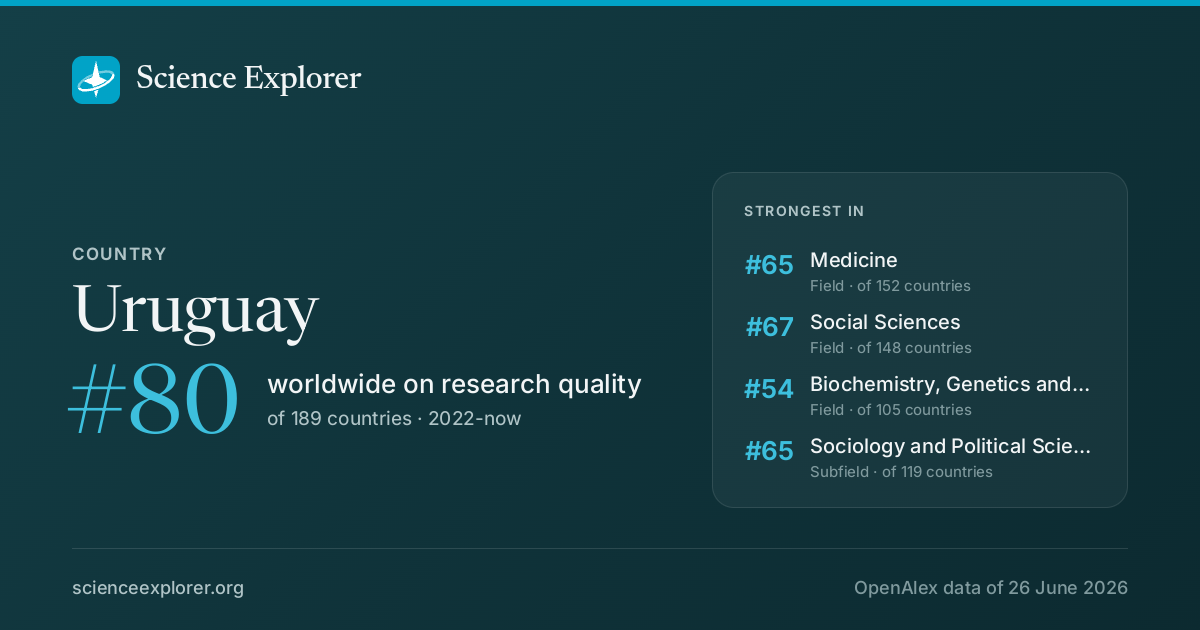
Uruguay ranks #80 of 189 countries on research quality in 2022-now (#73 all time), with 10k research works and 5.7% of them in the world's top 10%.
- World rank, 2022-now
- #80 of 189 · #73 all time
- Works, 2022-now
- 10k ▲ 6% vs 2018-21
- Citations
- 428k 9.6 per fractional work, all time
- Top-10% rate
- 5.7% all institutions 10.0%
- vs its own fields
- 0.70× 1.00× is exactly expected
- In the world top 100
- 0 0 in the top 1,000
- Open access
- 58% world 40%
- International
- 36% world 18%
UruguayWhat is Uruguay strongest at in science?
On research quality in 2022-now, Uruguay ranks highest in Medicine (#65 of 152), Social Sciences (#67 of 148) and Biochemistry, Genetics and Molecular Biology (#54 of 105). Relative to its size it is most specialised in Life-span and Life-course Studies, Paleontology and General Social Sciences.
| Field | World rank | Where that sits | Top-10% rate | Works | All time | Institutions |
|---|---|---|---|---|---|---|
| MedicineField | #65 of 152 | 4.1% | 2,157 | #72 | Institutions | |
| Social SciencesField | #67 of 148 | 7.6% | 2,197 | #70 | Institutions | |
| Biochemistry, Genetics and Molecular BiologyField | #54 of 105 | 5.2% | 624 | #50 | Institutions | |
| Sociology and Political ScienceSubfield | #65 of 119 | 7.9% | 523 | #69 | Institutions | |
| Health ProfessionsField | #60 of 106 | 4.9% | 460 | #73 | Institutions | |
| Arts and HumanitiesField | #60 of 103 | 8.3% | 354 | #63 | Institutions | |
| Political Science and International RelationsSubfield | #59 of 95 | 7.4% | 298 | #59 | Institutions | |
| PsychologyField | #68 of 106 | 4.8% | 333 | #62 | Institutions | |
| Molecular BiologySubfield | #54 of 84 | 5.3% | 276 | #54 | Institutions | |
| Public Health, Environmental and Occupational HealthSubfield | #55 of 84 | 6.2% | 300 | #58 | Institutions | |
| General Health ProfessionsSubfield | #56 of 84 | 5.3% | 238 | #68 | Institutions | |
| Agricultural and Biological SciencesField | #83 of 124 | 6.1% | 914 | #71 | Institutions |
Where its research is concentrated
Location quotient: how much more (or less) of each node it does than its size predicts. Drawn around 1×, where "twice the world share" and "half of it" are the same distance apart in opposite directions. A volume reading, which on a country axis is largely population and industrial structure.
- Life-span and Life-course StudiesSubfield · 15.6 works · #40 of 144 active here8.0×
- PaleontologySubfield · 98.1 works · #47 of 212 active here6.9×
- General Social SciencesSubfield · 79.0 works · #43 of 191 active here6.1×
- EquineSubfield · 7.4 works · #52 of 135 active here4.8×
- ForestrySubfield · 57.6 works · #54 of 204 active here4.7×
- Agronomy and Crop ScienceSubfield · 124.1 works · #58 of 206 active here4.4×
- VeterinaryField · 69.5 works · #56 of 198 active here4.3×
- Small AnimalsSubfield · 62.1 works4.3×
The whole field profile
All 26 fields at once. A specialist and a generalist produce the same ranked list and a completely different shape.
Rings at 0.5×, 1× and 2×. Widest outward: Veterinary, 4.3×. Every wedge is a field page.
All 26 fields, with their numbers
- Veterinary4.33×70 works
- Agricultural and Biological Sciences1.98×1,114 works
- Health Professions1.66×518 works
- Social Sciences1.62×2,421 works
- Dentistry1.53×88 works
- Environmental Science1.44×847 works
- Nursing1.21×70 works
- Earth and Planetary Sciences1.20×222 works
- Biochemistry, Genetics and Molecular Biology1.19×751 works
- Arts and Humanities1.13×386 works
- Immunology and Microbiology1.09×130 works
- Medicine1.07×2,444 works
- Psychology1.07×384 works
- Economics, Econometrics and Finance1.03×262 works
- Decision Sciences0.91×104 works
- Neuroscience0.80×153 works
- Pharmacology, Toxicology and Pharmaceutics0.71×29 works
- Mathematics0.69×97 works
- Business, Management and Accounting0.66×252 works
- Computer Science0.61×563 works
- Chemistry0.57×107 works
- Physics and Astronomy0.56×148 works
- Energy0.46×50 works
- Engineering0.29×513 works
- Chemical Engineering0.27×11 works
- Materials Science0.24×98 works
Which fields of science does Uruguay work in?
In 2022-now, 32% of research in Uruguay is in Social Sciences, 27% in Health Sciences. Its largest fields are Medicine (21%), Social Sciences (20%), Agricultural and Biological Sciences (9%). It does 1.4× the world's share of Life Sciences.
Each ring splits the one inside it: the four domains of science, their fields, their subfields. Size is fractional works in 2022-now. Every slice is a page; the interactive view zooms down to single topics and colours each by how much more of it this country does than the world.
Its 4 domains and 26 fields, with their numbers
- Social Sciences3,80932.2%
- Social Sciences2,42120.5%
- Arts and Humanities3863.3%
- Psychology3843.2%
- Economics, Econometrics and Finance2622.2%
- Business, Management and Accounting2522.1%
- Decision Sciences1040.9%
- Health Sciences3,18927.0%
- Medicine2,44420.7%
- Health Professions5184.4%
- Dentistry880.7%
- Nursing700.6%
- Veterinary700.6%
- Physical Sciences2,65522.4%
- Environmental Science8477.2%
- Computer Science5634.8%
- Engineering5134.3%
- Earth and Planetary Sciences2221.9%
- Physics and Astronomy1471.2%
- Chemistry1070.9%
- Materials Science980.8%
- Mathematics970.8%
- Energy500.4%
- Chemical Engineering110.1%
- Life Sciences2,17718.4%
Which keywords describe research in Uruguay?
By fractional works in 2022-now, weighted toward what it does more of than the world: Epidemiology, Public Health, Latin America, Globalization, Climate Change, Education, Healthcare Access and Biodiversity.
- Aging Population
- Legal Philosophy
- Research
- Welfare State
- Chronic Diseases
- Inclusive Education
- Health Policy
- Invasive Species
- Social Determinants
- Teacher Training
- Healthcare Access
- Qualitative Research
- Healthcare
- Innovation
- Mental Health
- Biodiversity
- Latin America
- Sustainability
- Public Health
- Climate Change
- Epidemiology
- Globalization
- Education
- Quality of Life
- Educational Technology
- Human Rights
- Oxidative Stress
- Sustainable Development
- Public Policy
- Treatment
- Knowledge Management
- Social Movements
- Social Inequality
- Drug Resistance
- Communication
- Evolution
- Inequality
- Constitutional Law
- Legal Theory
- Dairy Cattle
Size is fractional works in 2022-now in the topics tagged with each word; colour is the word's share of this country's work against its share of the world's. The 40 words are chosen for being large and distinctive. Each links to the topic it comes from most.
All 40 words, with their numbers
- Epidemiology790▲ 1.68×137 topics
- Climate Change549▲ 1.71×10⁷ topics
- Globalization529▲ 2.3×120 topics
- Public Health505▲ 2.9×68 topics
- Education416▲ 2.0×10⁴ topics
- Sustainability402▲ 1.39×101 topics
- Quality of Life357▲ 2.1×58 topics
- Latin America301▲ 13×23 topics
- Educational Technology292▲ 2.1×37 topics
- Biodiversity287▲ 3.2×33 topics
- Human Rights286▲ 2.4×58 topics
- Mental Health259▲ 1.53×47 topics
- Oxidative Stress258▲ 1.32×60 topics
- Innovation246▲ 2.0×56 topics
- Sustainable Development245▲ 1.32×66 topics
- Healthcare238▲ 1.76×29 topics
- Public Policy231▲ 4.1×23 topics
- Qualitative Research220▲ 2.2×31 topics
- Treatment218▲ 1.52×51 topics
- Healthcare Access205▲ 6.4×12 topics
- Knowledge Management196▲ 3.0×29 topics
- Teacher Training196▲ 2.7×23 topics
- Social Movements192▲ 5.5×29 topics
- Social Determinants181▲ 7.4×8 topics
- Social Inequality169▲ 5.3×16 topics
- Invasive Species160▲ 3.2×20 topics
- Drug Resistance157▲ 4.6×9 topics
- Health Policy156▲ 8.6×7 topics
- Communication144▲ 3.9×23 topics
- Inclusive Education138▲ 3.2×18 topics
- Evolution135▲ 4.2×17 topics
- Chronic Diseases127▲ 4.2×9 topics
- Inequality117▲ 4.3×15 topics
- Welfare State106▲ 11×4 topics
- Constitutional Law102▲ 6.6×7 topics
- Research99▲ 6.7×10 topics
- Legal Theory98▲ 12×3 topics
- Legal Philosophy96▲ 13×2 topics
- Dairy Cattle95▲ 15×2 topics
- Aging Population95▲ 9.1×4 topics
Which research topics does Uruguay publish the most in?
Its largest topics in 2022-now are Healthcare during COVID-19 Pandemic, Healthcare Regulation, Social Sciences and Policies.
Area is fractional works in 2022-now; colour is the subfield each topic belongs to. Every tile is a topic page.
- 1 Healthcare during COVID-19 Pandemic Information Systems 71 works
- 2 Healthcare Regulation Health Information Management 71 works
- 3 Social Sciences and Policies General Social Sciences 61 works
- 4 Academic Research in Diverse Fields Education 60 works
- 5 Health, Nursing, Elderly Care General Health Professions 57 works
- 6 Reproductive Physiology in Livestock Agronomy and Crop Science 56 works
- 7 Brazilian Legal Issues Law 56 works
- 8 Maternal and Neonatal Healthcare General Health Professions 56 works
- 9 E-Learning and Knowledge Management Computer Science Applications 52 works
- 10 Business and Management Studies Information Systems and Management 52 works
- 11 Genetic and phenotypic traits in livestock Genetics 51 works
- 12 Educational Innovations and Technology Information Systems 51 works
Which universities in Uruguay lead research?
Universidad de la República de Uruguay, Universitario Francisco de Asís and Universidad de Montevideo rank highest in Uruguay on research quality in 2022-now.
One dot per institution in the list below. The upper left is the interesting corner.
- 1Universidad de la República de UruguayUniversity · Montevideo · #1,783 worldwide5.3% top 10% · 5.3k works
- 2Universitario Francisco de AsísUniversity · Maldonado · #1,811 worldwide4.0% top 10% · 1.6k works
- 3Universidad de MontevideoUniversity · Montevideo · #4,690 worldwide5.6% top 10% · 567 works
- 4Universidad Católica del UruguayUniversity · Montevideo · #6,513 worldwide9.4% top 10% · 277 works
- 5Universidad ORT UruguayUniversity · Montevideo · #6,784 worldwide10.3% top 10% · 276 works
- 6Ministerio de Educación y CulturaGovernment institution · Montevideo · #9,519 worldwide9.5% top 10% · 195 works
- 7Universidad de la EmpresaUniversity · Montevideo · #10,884 worldwide5.6% top 10% · 171 works
- 8Instituto Nacional de Investigación AgropecuariaGovernment institution · Tacuarembó · #12,854 worldwide7.3% top 10% · 310 works
- 9Centro Uruguayo de Imagenología MolecularResearch facility · Montevideo · #16,217 worldwide6.9% top 10% · 146 works
- 10Universidad CLAEHUniversity · Montevideo · #16,322 worldwide7.9% top 10% · 87 works
- 11Instituto de Investigaciones Biológicas Clemente EstableNonprofit · Montevideo · #16,974 worldwide5.9% top 10% · 166 works
- 12Hospital BritánicoHospital / health system · Montevideo · #17,678 worldwide2.5% top 10% · 122 works
- 13Hospital Central de las Fuerzas ArmadasHospital / health system · Montevideo · #18,313 worldwide2.7% top 10% · 75 works
- 14Centro Hospitalario Pereira RossellHospital / health system · Montevideo · #21,320 worldwide5.8% top 10% · 67 works
- 15Hospital MacielHospital / health system · Montevideo · #21,497 worldwide3.8% top 10% · 74 works



The track on each row is its top-10% rate; the tick is the average of all institutions, 10.0% (how it is set): teal above it, red below.
All ranked institutions in UruguayWho are the top researchers in Uruguay?
Rafael Radí, Valentina Colistro and Gustavo J. Nagy rank highest among researchers based in Uruguay.
- 1 Rafael Radí #57,480 worldwide 48k citations · 529 works
- 2 Valentina Colistro #96,125 worldwide 24k citations · 76 works
- 3 Gustavo J. Nagy #150,922 worldwide 3.4k citations · 101 works
- 4 José Luis Badano #151,123 worldwide 8.5k citations · 73 works
- 5 Gastón Ares #170,491 worldwide 24k citations · 521 works
- 6 Juan Pablo Tosar #173,486 worldwide 19k citations · 91 works
- 7 Ana Giménez #178,776 worldwide 11k citations · 187 works
- 8 Ana Denicola #257,054 worldwide 8.3k citations · 142 works
- 9 Gerardo Ferrer‐Sueta #294,309 worldwide 6.3k citations · 101 works
- 10 Claudia Etchebehere #312,066 worldwide 5.8k citations · 108 works
Which cities in Uruguay are research hubs?
- 1
MontevideoUruguay
38k works
How open and international is Uruguay's research?
58% of its research is openly available (world: 40%), and 36% is written with international co-authors (world: 18%).
World: 40% of research is openly available.
World: 18% is written across borders.
In 2022-now, 74% of its research is openly available (world 63%) and 40% is written with co-authors abroad (world 22%). Against what its own mix of topics predicts, that is 1.00× the expected open access and 1.80× the expected international share, which puts it #123 of 173 countries on openness.
How has Uruguay's research grown?
Output in 2022-2025 was 6% higher than in 2018-2021.
The same series as a ribbon: one cell per year, darker for more. The line above answers how much; this answers when.
Its share of all research
Growing output can still be a shrinking share: all of science grows. This is Uruguay as a percentage of every work published that year, 0.047% in 2024.
Fractional works of Uruguay over all fractional works that year. How the balance of science has shifted.
How much of it reaches the world top 10%
Over the whole record, 6.1% of its 44k works since 1950 reached the world top 10% for their field and year.
Of each year's output, the share that reached the world's 10% most cited for its field and year. Peak 9.9% in 1999.
Which countries have research most like Uruguay's?
New Zealand is Uruguay's closest research twin: of all countries, its research is spread across the fields most like Uruguay's, with both strong in Veterinary.
- 1
 New ZealandBoth strong in Veterinary, Health Professions, Environmental Science
0.85 Compare
- 2
 Costa RicaBoth strong in Agricultural and Biological Sciences, Social Sciences, Health Professions
0.81 Compare
- 3
 BrazilBoth strong in Veterinary, Health Professions, Social Sciences
0.79 Compare
- 4
 GuatemalaBoth strong in Health Professions, Social Sciences, Nursing
0.79 Compare
- 5
 French GuianaBoth strong in Veterinary, Agricultural and Biological Sciences, Health Professions
0.78 Compare
Similarity is the correlation of each side's location quotients across every field it publishes in, on a log scale: 1 is the same shape of research, 0 is unrelated. It ignores size. How it is measured.
Compare Uruguay with
 Laos
 Zambia
 Mozambique
 Nicaragua
 Bulgaria
 Brunei
Share Uruguay's ranking
Badges for a website1Each links back here and updates with every snapshot

Research fields in Uruguay
- Health Sciences
- Medicine
- Social Sciences
- Social Sciences
- Life Sciences
- Biochemistry, Genetics and Molecular Biology
- Sociology and Political Science
- Health Professions
- Arts and Humanities
- Political Science and International Relations
- Psychology
- Molecular Biology
- Public Health, Environmental and Occupational Health
- Physical Sciences
- General Health Professions
- Agricultural and Biological Sciences
- Education
- Economics, Econometrics and Finance
- Environmental Science
- Engineering
- Computer Science
- Surgery
- Business, Management and Accounting
- Plant Science
Discussion
Ask a question or share a note about Uruguay. Posts are plain text and can be reported.