Science Explorer Back to mapMap
Discussion
Company · Södertälje · Sweden

Scania (Sweden)

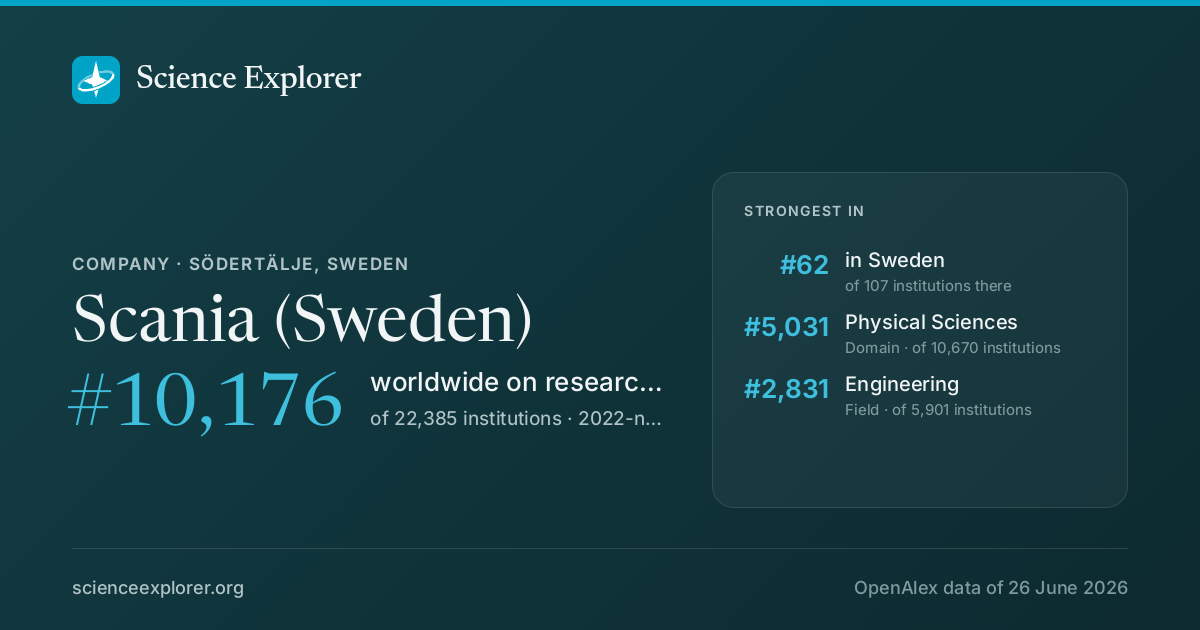
In research, Scania (Sweden) stands highest in Physical Sciences (#5,031 of 10,670 worldwide) and Engineering (#2,831 of 5,901 worldwide), 2022-now.

World rank, 2022-now
#10,176
of 22,385 · #4,364 all time
Rank in Sweden
#62
of 107
Research works
822
▼ 11% vs 2018-21
Citations
16k
19.8 per fractional work
Top-10% rate
11.9%
all institutions 10.0%
vs its own fields
1.08×
1.00× is exactly expected
Open access
37%
world 40%
International
17%
world 18%

What is Scania (Sweden) known for in research?

The fields where it stands highest, 2022-now, ranked among every institution above the floor in each field.

FieldWorld rankWhere that sitsTop-10% rateWorksAll time
Physical SciencesDomain #5,031 of 10,670 10.0%103 #3422
EngineeringField #2,831 of 5,901 10.1%71 #1852

Each strip is that field's whole ranked pool, with the notch where Scania (Sweden) sits in it, in the colour of the band that rank falls in. The track under the rate is the rate itself: it carries no average mark, because the average differs by field (from about 6% in Dentistry to 21% in Economics).

Which fields of science does Scania (Sweden) work in?

In 2022-now, 71% of research at Scania (Sweden) is in Physical Sciences, 11% in Social Sciences. Its largest fields are Engineering (48%), Computer Science (13%), Medicine (10%). It does 1.8× the world's share of Physical Sciences.

Physical Sciences: 107 fractional works · 70.7% of its workEngineering: 73 fractional works · 48.3% of its workAutomotive Engineering: 14 fractional works · 9.5% of its workElectrical and Electronic Engineering: 12 fractional works · 8.0% of its workMechanical Engineering: 9 fractional works · 6.0% of its workIndustrial and Manufacturing Engineering: 9 fractional works · 5.8% of its workControl and Systems Engineering: 6 fractional works · 4.2% of its workBiomedical Engineering: 4 fractional works · 3.0% of its workAerospace Engineering: 4 fractional works · 2.6% of its workMechanics of Materials: 3 fractional works · 2.1% of its workComputational Mechanics: 3 fractional works · 2.0% of its workSafety, Risk, Reliability and Quality: 3 fractional works · 1.7% of its workBuilding and Construction: 2 fractional works · 1.5% of its workCivil and Structural Engineering: 2 fractional works · 1.3% of its workMedia Technology: 1 fractional works · 0.4% of its workOcean Engineering: 0 fractional works · 0.3% of its workComputer Science: 20 fractional works · 13.0% of its workComputer Vision and Pattern Recognition: 5 fractional works · 3.5% of its workArtificial Intelligence: 5 fractional works · 3.2% of its workSoftware: 2 fractional works · 1.4% of its workComputational Theory and Mathematics: 2 fractional works · 1.2% of its workInformation Systems: 2 fractional works · 1.1% of its workHardware and Architecture: 1 fractional works · 0.7% of its workComputer Networks and Communications: 1 fractional works · 0.7% of its workHuman-Computer Interaction: 1 fractional works · 0.5% of its workComputer Graphics and Computer-Aided Design: 1 fractional works · 0.3% of its workComputer Science Applications: 0 fractional works · 0.3% of its workSignal Processing: 0 fractional works · 0.2% of its workMaterials Science: 5 fractional works · 3.2% of its workMaterials Chemistry: 3 fractional works · 2.2% of its workElectronic, Optical and Magnetic Materials: 1 fractional works · 0.4% of its workBiomaterials: 0 fractional works · 0.3% of its workSmaller subfields together: 0 fractional works · 0.3% of its workChemical Engineering: 4 fractional works · 2.5% of its workFluid Flow and Transfer Processes: 3 fractional works · 2.0% of its workCatalysis: 1 fractional works · 0.4% of its workSmaller subfields together: 0 fractional works · 0.0% of its workEnvironmental Science: 3 fractional works · 1.8% of its workEnvironmental Engineering: 1 fractional works · 0.4% of its workIndustrial and Manufacturing Engineering: 1 fractional works · 0.3% of its workPollution: 0 fractional works · 0.3% of its workGlobal and Planetary Change: 0 fractional works · 0.3% of its workSmaller subfields together: 1 fractional works · 0.4% of its workEnergy: 1 fractional works · 0.9% of its workRenewable Energy, Sustainability and the Environment: 1 fractional works · 0.9% of its workPhysics and Astronomy: 1 fractional works · 0.6% of its workInstrumentation: 0 fractional works · 0.3% of its workSmaller subfields together: 0 fractional works · 0.3% of its workChemistry: 0 fractional works · 0.3% of its workEarth and Planetary Sciences: 0 fractional works · 0.2% of its workSocial Sciences: 17 fractional works · 11.1% of its workPsychology: 5 fractional works · 3.4% of its workSocial Psychology: 5 fractional works · 3.1% of its workClinical Psychology: 0 fractional works · 0.2% of its workSmaller subfields together: 0 fractional works · 0.1% of its workBusiness, Management and Accounting: 5 fractional works · 3.4% of its workStrategy and Management: 2 fractional works · 1.1% of its workAccounting: 1 fractional works · 0.9% of its workManagement Information Systems: 1 fractional works · 0.7% of its workManagement of Technology and Innovation: 0 fractional works · 0.3% of its workOrganizational Behavior and Human Resource Management: 0 fractional works · 0.2% of its workSmaller subfields together: 0 fractional works · 0.2% of its workSocial Sciences: 4 fractional works · 2.8% of its workSociology and Political Science: 1 fractional works · 0.7% of its workTransportation: 1 fractional works · 0.5% of its workEducation: 1 fractional works · 0.4% of its workDevelopment: 0 fractional works · 0.3% of its workPolitical Science and International Relations: 0 fractional works · 0.3% of its workSmaller subfields together: 1 fractional works · 0.6% of its workDecision Sciences: 1 fractional works · 0.7% of its workStatistics, Probability and Uncertainty: 1 fractional works · 0.4% of its workInformation Systems and Management: 0 fractional works · 0.2% of its workSmaller subfields together: 0 fractional works · 0.1% of its workArts and Humanities: 1 fractional works · 0.5% of its workLanguage and Linguistics: 1 fractional works · 0.4% of its workSmaller subfields together: 0 fractional works · 0.0% of its workEconomics, Econometrics and Finance: 0 fractional works · 0.2% of its workEconomics and Econometrics: 0 fractional works · 0.2% of its workHealth Sciences: 17 fractional works · 10.9% of its workMedicine: 15 fractional works · 9.8% of its workSurgery: 2 fractional works · 1.4% of its workEpidemiology: 2 fractional works · 1.2% of its workPhysiology: 1 fractional works · 0.8% of its workPsychiatry and Mental health: 1 fractional works · 0.7% of its workEmergency Medicine: 1 fractional works · 0.7% of its workEndocrinology, Diabetes and Metabolism: 1 fractional works · 0.6% of its workRadiology, Nuclear Medicine and Imaging: 1 fractional works · 0.5% of its workReproductive Medicine: 1 fractional works · 0.4% of its workCardiology and Cardiovascular Medicine: 1 fractional works · 0.3% of its workPharmacology: 1 fractional works · 0.3% of its workOncology: 1 fractional works · 0.3% of its workOphthalmology: 0 fractional works · 0.3% of its workInfectious Diseases: 0 fractional works · 0.3% of its workPediatrics, Perinatology and Child Health: 0 fractional works · 0.3% of its workPulmonary and Respiratory Medicine: 0 fractional works · 0.3% of its workSmaller subfields together: 2 fractional works · 1.1% of its workHealth Professions: 2 fractional works · 1.1% of its workRadiological and Ultrasound Technology: 0 fractional works · 0.3% of its workOccupational Therapy: 0 fractional works · 0.2% of its workSmaller subfields together: 1 fractional works · 0.6% of its workLife Sciences: 11 fractional works · 7.3% of its workBiochemistry, Genetics and Molecular Biology: 5 fractional works · 3.5% of its workMolecular Biology: 3 fractional works · 1.9% of its workGenetics: 1 fractional works · 0.9% of its workCancer Research: 0 fractional works · 0.3% of its workBiotechnology: 0 fractional works · 0.2% of its workSmaller subfields together: 0 fractional works · 0.2% of its workAgricultural and Biological Sciences: 3 fractional works · 1.7% of its workPlant Science: 1 fractional works · 0.8% of its workSoil Science: 1 fractional works · 0.4% of its workSmaller subfields together: 1 fractional works · 0.5% of its workNeuroscience: 3 fractional works · 1.7% of its workNeurology: 2 fractional works · 1.2% of its workCognitive Neuroscience: 0 fractional works · 0.2% of its workSmaller subfields together: 0 fractional works · 0.3% of its workImmunology and Microbiology: 1 fractional works · 0.4% of its workImmunology: 1 fractional works · 0.4% of its workALL ITS WORKScania (Sweden)151fractional works, 2022-now
Life Sciences7%Physical Sciences71%Health Sciences11%Social Sciences11%

Each ring splits the one inside it: the four domains of science, their fields, their subfields. Size is fractional works in 2022-now. Every slice is a page; the interactive view zooms down to single topics and colours each by how much more of it this institution does than the world.

Its 4 domains and 22 fields, with their numbers
    1. Engineering7348.3%
    2. Computer Science2013.0%
    3. Materials Science53.2%
    4. Chemical Engineering42.5%
    5. Environmental Science31.8%
    6. Energy10.9%
    7. Physics and Astronomy10.6%
    8. Chemistry00.3%
    9. Earth and Planetary Sciences00.2%
    1. Psychology53.4%
    2. Business, Management and Accounting53.4%
    3. Social Sciences42.8%
    4. Decision Sciences10.7%
    5. Arts and Humanities10.5%
    6. Economics, Econometrics and Finance00.2%
    1. Medicine159.8%
    2. Health Professions21.1%
    3. Dentistry00.0%
    1. Biochemistry, Genetics and Molecular Biology53.5%
    2. Agricultural and Biological Sciences31.7%
    3. Neuroscience31.7%
    4. Immunology and Microbiology10.4%
All of science, and how each field's share has moved since 1950: the Science domain explorer

Field profile

Location quotient across every field it publishes in: outside the ring is more than an institution of this size would be expected to publish, inside it is less.

Agricultural and Biological Sciences: 0.36× its world share, 3 worksAgricultural and Bio…Biochemistry, Genetics and Molecular Biology: 0.65× its world share, 5 worksBiochemistry, Geneti…Immunology and Microbiology: 0.39× its world share, 1 worksImmunology and Micro…Neuroscience: 1.05× its world share, 3 worksNeuroscienceChemical Engineering: 7.23× its world share, 4 worksChemical EngineeringChemistry: 0.16× its world share, 0 worksChemistryComputer Science: 1.67× its world share, 20 worksComputer ScienceEarth and Planetary Sciences: 0.14× its world share, 0 worksEarth and Planetary …Energy: 0.94× its world share, 1 worksEnergyEngineering: 3.22× its world share, 73 worksEngineeringEnvironmental Science: 0.36× its world share, 3 worksEnvironmental ScienceMaterials Science: 0.91× its world share, 5 worksMaterials SciencePhysics and Astronomy: 0.27× its world share, 1 worksPhysics and AstronomyDentistry: 0.04× its world share, 0 worksDentistryHealth Professions: 0.44× its world share, 2 worksHealth ProfessionsMedicine: 0.51× its world share, 15 worksMedicineArts and Humanities: 0.16× its world share, 1 worksArts and HumanitiesBusiness, Management and Accounting: 1.06× its world share, 5 worksBusiness, Management…Decision Sciences: 0.75× its world share, 1 worksDecision SciencesEconomics, Econometrics and Finance: 0.10× its world share, 0 worksEconomics, Econometr…Psychology: 1.13× its world share, 5 worksPsychologySocial Sciences: 0.22× its world share, 4 worksSocial Sciences1×world share
more than its size predictsabout as predictedless

Rings at 0.5×, 1× and 2×. Widest outward: Chemical Engineering, 7.2×. Every wedge is a field page.

All 22 fields, with their numbers
  1. Chemical Engineering7.23×4 works
  2. Engineering3.22×73 works
  3. Computer Science1.67×20 works
  4. Psychology1.13×5 works
  5. Business, Management and Accounting1.06×5 works
  6. Neuroscience1.05×3 works
  7. Energy0.94×1 works
  8. Materials Science0.91×5 works
  9. Decision Sciences0.75×1 works
  10. Biochemistry, Genetics and Molecular Biology0.65×5 works
  11. Medicine0.51×15 works
  12. Health Professions0.44×2 works
  13. Immunology and Microbiology0.39×1 works
  14. Agricultural and Biological Sciences0.36×3 works
  15. Environmental Science0.36×3 works
  16. Physics and Astronomy0.27×1 works
  17. Social Sciences0.22×4 works
  18. Chemistry0.16×0 works
  19. Arts and Humanities0.16×1 works
  20. Earth and Planetary Sciences0.14×0 works
  21. Economics, Econometrics and Finance0.10×0 works
  22. Dentistry0.04×0 works

Who are the top researchers at Scania (Sweden)?

Ranked on the quality score, Carl Tengstedt, Per Elofsson and Olle Dahl lead among researchers whose main affiliation is Scania (Sweden).

  1. 1 Carl Tengstedt Sweden · #1,000,773 worldwide 1.7k citations · 48 works
  2. 2 Per Elofsson Sweden · #1,958,341 worldwide 411 citations · 28 works
  3. 3 Olle Dahl Sweden · #2,351,607 worldwide 1.6k citations · 34 works
  4. 4 Stas Simon Krupenia Sweden · #2,454,623 worldwide 773 citations · 37 works
  5. 5 Elaine Weidman Grunewald Sweden · #2,790,882 worldwide 23 citations · 16 works
  6. 6 Bernt Järmark Sweden · #2,927,697 worldwide 128 citations · 16 works
  7. 7 Rickard Österlöf Sweden · #3,089,945 worldwide 181 citations · 15 works
  8. 8 Anna Sirkka Sweden · #3,142,359 worldwide 558 citations · 16 works
  9. 9 Valter J. E. Stark Sweden · #3,220,783 worldwide 228 citations · 19 works
  10. 10 Henrik Henriksson Sweden · #3,380,502 worldwide 25 citations · 30 works
All ranked researchers at Scania (Sweden)

What are the most cited papers from Scania (Sweden)?

The most cited paper from Scania (Sweden) is "Discovery and refinement of loci associated with lipid levels" (Cristen J. Willer et al., 2013), with 3,319 citations. Next come "Large-scale association analysis provides insights into the genetic architecture and pathophysiology of type 2 diabetes" (2,021) and "Large-scale association analysis identifies 13 new susceptibility loci for coronary artery disease" (1,959).

Most cited papers
#PaperReleasedCitations
1 Discovery and refinement of loci associated with lipid levels Cristen J. Willer et al. · Nature Genetics Open access259 authors 6 Oct 2013 3,319
2 Large-scale association analysis provides insights into the genetic architecture and pathophysiology of type 2 diabetes Andrew Paul Morris et al. · Nature Genetics Open access204 authors 12 Aug 2012 2,021
3 Large-scale association analysis identifies 13 new susceptibility loci for coronary artery disease Cardiogenics et al. · Nature Genetics Open access167 authors 6 Mar 2011 1,959
4 2013 Practice guidelines for the management of arterial hypertension of the European Society of Hypertension (ESH) and the European Society of Cardiology (ESC) Giuseppe Mancia et al. · Journal of Hypertension 29 Aug 2013 1,203
5 Association of Plasma Neurofilament Light With Neurodegeneration in Patients With Alzheimer Disease Niklas Mattsson, Ulf Andréasson, Henrik Zetterberg et al. · JAMA Neurology Open access 27 Mar 2017 1,114
All 60 most cited papers, with filters and sorting

Which keywords describe research at Scania (Sweden)?

By fractional works in 2022-now, weighted toward what it does more of than the world: Electric Vehicles, Lithium-ion Batteries, Autonomous Vehicles, Deep Learning, Cathode Materials, Thermal Management, Battery Management Systems and Thermal Runaway.

▲ more of its work than of the world's◆ about the world's share▼ less than the world's

Size is fractional works in 2022-now in the topics tagged with each word; colour is the word's share of this institution's work against its share of the world's. The 40 words are chosen for being large and distinctive. Each links to the topic it comes from most.

All 40 words, with their numbers
  1. Deep Learning12▲ 2.4×34 topics
  2. Electric Vehicles10▲ 22×4 topics
  3. Lithium-ion Batteries9▲ 15×3 topics
  4. Machine Learning8▲ 1.52×19 topics
  5. Autonomous Vehicles7▲ 23×4 topics
  6. Sustainability7▲ 1.89×15 topics
  7. Cathode Materials6▲ 10×3 topics
  8. Thermal Management6▲ 12×4 topics
  9. Battery Management Systems5▲ 24×1 topic
  10. Battery Technology5▲ 12×2 topics
  11. Thermal Runaway5▲ 24×1 topic
  12. Emissions5▲ 16×3 topics
  13. Neural Networks5▲ 1.99×16 topics
  14. Chemical Kinetics4▲ 32×2 topics
  15. Model Predictive Control4▲ 11×5 topics
  16. Energy Storage4▲ 4.2×4 topics
  17. Battery Materials4▲ 14×1 topic
  18. Nanostructured Anodes4▲ 14×1 topic
  19. Rechargeable Batteries4▲ 9.1×2 topics
  20. Collision Avoidance3▲ 12×2 topics
  21. Combustion3▲ 36×2 topics
  22. Internal Combustion Engines3▲ 45×1 topic
  23. Soot Formation3▲ 45×1 topic
  24. Sensor Fusion3▲ 18×3 topics
  25. Driver Assistance Systems2▲ 28×1 topic
  26. Human Factors2▲ 21×2 topics
  27. Lithium-Sulfur Batteries2▲ 11×1 topic
  28. Solid-State Electrolytes2▲ 13×1 topic
  29. Trajectory Prediction2▲ 28×1 topic
  30. Control Systems2▲ 8.7×4 topics
  31. Driver Behavior2▲ 19×2 topics
  32. Virtual Prototyping2▲ 17×2 topics
  33. Finite Element Analysis2▲ 6.5×4 topics
  34. Fuel Consumption2▲ 20×2 topics
  35. Vehicle Dynamics2▲ 26×2 topics
  36. Machine Vision2▲ 6.7×3 topics
  37. Neural Network2▲ 7.7×5 topics
  38. Eco-Driving2▲ 28×1 topic
  39. Vehicle Emissions2▲ 28×1 topic
  40. Assembly Planning2▲ 18×1 topic

Which research topics does Scania (Sweden) publish most on?

By volume in 2022-now: Advanced Battery Technologies Research, Advancements in Battery Materials, Advanced Combustion Engine Technologies and Advanced Battery Materials and Technologies.

  1. 1 Advanced Battery Technologies Research Automotive Engineering 5 works
  2. 2 Advancements in Battery Materials Electrical and Electronic Engineering 4 works
  3. 3 Advanced Combustion Engine Technologies Fluid Flow and Transfer Processes 3 works
  4. 4 Advanced Battery Materials and Technologies Electrical and Electronic Engineering 2 works
  5. 5 Autonomous Vehicle Technology and Safety Automotive Engineering 2 works
  6. 6 Vehicle emissions and performance Automotive Engineering 2 works
  7. 7 Vehicle Dynamics and Control Systems Automotive Engineering 2 works
  8. 8 Human-Automation Interaction and Safety Social Psychology 2 works
  9. 9 Ergonomics and Musculoskeletal Disorders Social Psychology 2 works
  10. 10 Manufacturing Process and Optimization Industrial and Manufacturing Engineering 2 works

How open and international is its research?

Against the world's own shares: the tick on each track. Both are shares of its output, so they sit on one scale and can be read against each other as well as against the world.

openly available37.4%not open62.6%

World: 40% of research is openly available.

with international co-authors17.3%domestic only82.7%

World: 18% is written across borders.

How has Scania (Sweden)'s research output changed?

Output in 2022-2025 was 11% lower than in 2018-2021.

still counting1990200020102020
grewheldshrank

The same series as a ribbon: one cell per year, darker for more. The line above answers how much; this answers when.

Its share of all research

Growing output can still be a shrinking share: all of science grows. This is Scania (Sweden) as a percentage of every work published that year, 0.00068% in 2024.

still counting0.0010%0.0020%0.0030%Scania (Sweden)0.00051% in 202519801990200020102020

Fractional works of Scania (Sweden) over all fractional works that year. How the balance of science has shifted.

How much of it reaches the world top 10%

Year by year, against all institutions in the same year.

still counting10%20%Scania (Sweden)10.4% in 2025all institutions10.0% in 20252020

Of each year's output, the share that reached the world's 10% most cited for its field and year. Peak 19.7% in 2013.

Other research institutions in Södertälje

All research institutions in Södertälje

Share Scania (Sweden)'s ranking

Scania (Sweden) on Science Explorer

A card with Scania (Sweden)'s standing and the fields it leads in, for a post or a slide. A link to this page previews as the same card.

Download the card

1200 × 630 PNG, sized for social posts, drawn from the latest snapshot.

Badges for a website1Each links back here and updates with every snapshot

Research measures only: rankings here say nothing about teaching, admissions or student experience. Comparable institutions and collaboration partners have tabs of their own, above.

Discussion

Ask a question or share a note about Scania (Sweden). Posts are plain text and can be reported.