Science Explorer Back to mapMap
Discussion
University · Shendi · Sudan

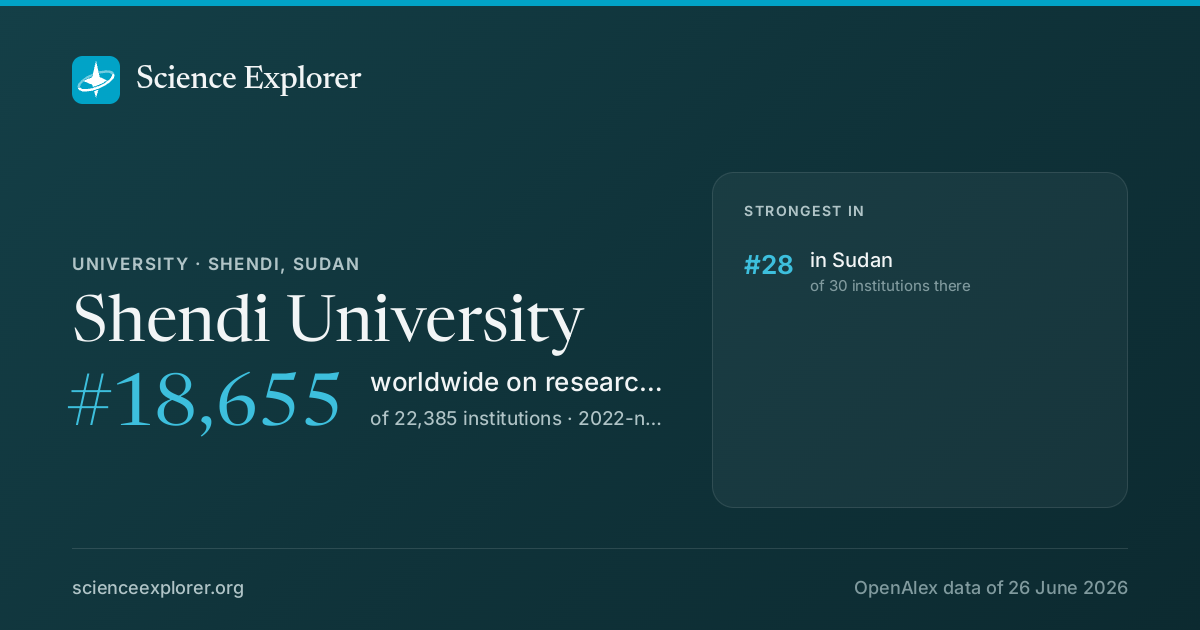
Shendi University

World rank, 2022-now
#18,655
of 22,385 · #28,130 all time
Rank in Sudan
#28
of 30
Research works
214
▲ 68% vs 2018-21
Citations
961
4.5 per fractional work
Top-10% rate
7.7%
all institutions 10.0%
vs its own fields
0.91×
1.00× is exactly expected
Open access
86%
world 40%
International
39%
world 18%

Which fields of science does Shendi University work in?

In 2022-now, 59% of research at Shendi University is in Health Sciences, 17% in Life Sciences. Its largest fields are Medicine (52%), Agricultural and Biological Sciences (6%), Biochemistry, Genetics and Molecular Biology (5%). It does 2.4× the world's share of Health Sciences.

Health Sciences: 59 fractional works · 59.1% of its workMedicine: 53 fractional works · 52.4% of its workEpidemiology: 6 fractional works · 5.8% of its workOncology: 6 fractional works · 5.7% of its workSurgery: 5 fractional works · 5.5% of its workInfectious Diseases: 5 fractional works · 4.9% of its workEndocrinology, Diabetes and Metabolism: 4 fractional works · 3.8% of its workPublic Health, Environmental and Occupational Health: 4 fractional works · 3.8% of its workPulmonary and Respiratory Medicine: 3 fractional works · 3.4% of its workPediatrics, Perinatology and Child Health: 2 fractional works · 1.9% of its workObstetrics and Gynecology: 2 fractional works · 1.8% of its workCardiology and Cardiovascular Medicine: 2 fractional works · 1.7% of its workGenetics: 2 fractional works · 1.7% of its workHematology: 2 fractional works · 1.6% of its workPharmacology: 1 fractional works · 1.1% of its workEmergency Medicine: 1 fractional works · 1.0% of its workPhysiology: 1 fractional works · 1.0% of its workRadiology, Nuclear Medicine and Imaging: 1 fractional works · 1.0% of its workCritical Care and Intensive Care Medicine: 1 fractional works · 0.7% of its workRheumatology: 1 fractional works · 0.6% of its workHepatology: 1 fractional works · 0.5% of its workOphthalmology: 1 fractional works · 0.5% of its workOrthopedics and Sports Medicine: 0 fractional works · 0.5% of its workNeurology: 0 fractional works · 0.5% of its workPsychiatry and Mental health: 0 fractional works · 0.4% of its workPathology and Forensic Medicine: 0 fractional works · 0.4% of its workBiochemistry: 0 fractional works · 0.4% of its workDermatology: 0 fractional works · 0.4% of its workRehabilitation: 0 fractional works · 0.3% of its workNephrology: 0 fractional works · 0.3% of its workReproductive Medicine: 0 fractional works · 0.2% of its workSmaller subfields together: 1 fractional works · 1.3% of its workHealth Professions: 3 fractional works · 3.0% of its workGeneral Health Professions: 2 fractional works · 2.0% of its workHealth Information Management: 1 fractional works · 0.7% of its workSmaller subfields together: 0 fractional works · 0.2% of its workDentistry: 2 fractional works · 2.2% of its workGeneral Dentistry: 2 fractional works · 1.5% of its workPeriodontics: 1 fractional works · 0.7% of its workNursing: 1 fractional works · 1.2% of its workNutrition and Dietetics: 1 fractional works · 1.2% of its workVeterinary: 0 fractional works · 0.3% of its workSmall Animals: 0 fractional works · 0.3% of its workLife Sciences: 17 fractional works · 17.0% of its workAgricultural and Biological Sciences: 6 fractional works · 6.1% of its workPlant Science: 3 fractional works · 3.0% of its workInsect Science: 1 fractional works · 1.2% of its workFood Science: 1 fractional works · 0.9% of its workEcology, Evolution, Behavior and Systematics: 1 fractional works · 0.8% of its workSmaller subfields together: 0 fractional works · 0.2% of its workBiochemistry, Genetics and Molecular Biology: 5 fractional works · 5.0% of its workMolecular Biology: 2 fractional works · 2.4% of its workGenetics: 1 fractional works · 1.3% of its workMolecular Medicine: 1 fractional works · 0.5% of its workSmaller subfields together: 1 fractional works · 0.7% of its workImmunology and Microbiology: 4 fractional works · 3.7% of its workParasitology: 1 fractional works · 1.3% of its workImmunology: 1 fractional works · 1.2% of its workApplied Microbiology and Biotechnology: 1 fractional works · 0.6% of its workMicrobiology: 1 fractional works · 0.5% of its workSmaller subfields together: 0 fractional works · 0.0% of its workPharmacology, Toxicology and Pharmaceutics: 2 fractional works · 1.6% of its workPharmacology: 1 fractional works · 1.4% of its workSmaller subfields together: 0 fractional works · 0.1% of its workNeuroscience: 1 fractional works · 0.7% of its workNeurology: 0 fractional works · 0.3% of its workCellular and Molecular Neuroscience: 0 fractional works · 0.3% of its workSmaller subfields together: 0 fractional works · 0.0% of its workPhysical Sciences: 16 fractional works · 15.9% of its workComputer Science: 5 fractional works · 5.0% of its workComputational Theory and Mathematics: 1 fractional works · 1.2% of its workInformation Systems: 1 fractional works · 1.1% of its workArtificial Intelligence: 1 fractional works · 1.0% of its workComputer Vision and Pattern Recognition: 1 fractional works · 0.9% of its workComputer Networks and Communications: 0 fractional works · 0.4% of its workComputer Graphics and Computer-Aided Design: 0 fractional works · 0.3% of its workSmaller subfields together: 0 fractional works · 0.1% of its workEnvironmental Science: 3 fractional works · 3.3% of its workWater Science and Technology: 1 fractional works · 0.7% of its workHealth, Toxicology and Mutagenesis: 1 fractional works · 0.6% of its workGlobal and Planetary Change: 0 fractional works · 0.4% of its workPollution: 0 fractional works · 0.4% of its workEcology: 0 fractional works · 0.2% of its workEnvironmental Engineering: 0 fractional works · 0.2% of its workManagement, Monitoring, Policy and Law: 0 fractional works · 0.2% of its workEcological Modeling: 0 fractional works · 0.2% of its workNature and Landscape Conservation: 0 fractional works · 0.2% of its workEngineering: 3 fractional works · 2.6% of its workBiomedical Engineering: 1 fractional works · 1.2% of its workElectrical and Electronic Engineering: 1 fractional works · 0.7% of its workMechanical Engineering: 0 fractional works · 0.2% of its workSmaller subfields together: 0 fractional works · 0.4% of its workMaterials Science: 2 fractional works · 1.9% of its workBiomaterials: 1 fractional works · 1.1% of its workMaterials Chemistry: 1 fractional works · 0.8% of its workChemistry: 1 fractional works · 1.5% of its workOrganic Chemistry: 1 fractional works · 1.1% of its workInorganic Chemistry: 0 fractional works · 0.2% of its workSmaller subfields together: 0 fractional works · 0.1% of its workMathematics: 1 fractional works · 1.3% of its workMathematical Physics: 1 fractional works · 0.6% of its workModeling and Simulation: 0 fractional works · 0.3% of its workApplied Mathematics: 0 fractional works · 0.3% of its workSmaller subfields together: 0 fractional works · 0.2% of its workEnergy: 0 fractional works · 0.4% of its workRenewable Energy, Sustainability and the Environment: 0 fractional works · 0.3% of its workSmaller subfields together: 0 fractional works · 0.1% of its workEarth and Planetary Sciences: 0 fractional works · 0.1% of its workSocial Sciences: 8 fractional works · 7.9% of its workSocial Sciences: 4 fractional works · 4.1% of its workEducation: 2 fractional works · 1.7% of its workPolitical Science and International Relations: 1 fractional works · 0.8% of its workHealth: 1 fractional works · 0.6% of its workSociology and Political Science: 0 fractional works · 0.4% of its workHuman Factors and Ergonomics: 0 fractional works · 0.3% of its workSmaller subfields together: 0 fractional works · 0.2% of its workPsychology: 2 fractional works · 2.2% of its workClinical Psychology: 2 fractional works · 1.7% of its workSocial Psychology: 0 fractional works · 0.4% of its workSmaller subfields together: 0 fractional works · 0.1% of its workBusiness, Management and Accounting: 1 fractional works · 1.1% of its workAccounting: 1 fractional works · 0.8% of its workSmaller subfields together: 0 fractional works · 0.3% of its workArts and Humanities: 0 fractional works · 0.2% of its workEconomics, Econometrics and Finance: 0 fractional works · 0.2% of its workDecision Sciences: 0 fractional works · 0.2% of its workALL ITS WORKShendi University101fractional works, 2022-now
Life Sciences17%Physical Sciences16%Health Sciences59%Social Sciences8%

Each ring splits the one inside it: the four domains of science, their fields, their subfields. Size is fractional works in 2022-now. Every slice is a page; the interactive view zooms down to single topics and colours each by how much more of it this institution does than the world.

Its 4 domains and 24 fields, with their numbers
    1. Medicine5352.4%
    2. Health Professions33.0%
    3. Dentistry22.2%
    4. Nursing11.2%
    5. Veterinary00.3%
    1. Agricultural and Biological Sciences66.1%
    2. Biochemistry, Genetics and Molecular Biology55.0%
    3. Immunology and Microbiology43.7%
    4. Pharmacology, Toxicology and Pharmaceutics21.6%
    5. Neuroscience10.7%
    1. Computer Science55.0%
    2. Environmental Science33.3%
    3. Engineering32.6%
    4. Materials Science21.9%
    5. Chemistry11.5%
    6. Mathematics11.3%
    7. Energy00.4%
    8. Earth and Planetary Sciences00.1%
    1. Social Sciences44.1%
    2. Psychology22.2%
    3. Business, Management and Accounting11.1%
    4. Arts and Humanities00.2%
    5. Economics, Econometrics and Finance00.2%
    6. Decision Sciences00.2%
All of science, and how each field's share has moved since 1950: the Science domain explorer

Field profile

Location quotient across every field it publishes in: outside the ring is more than an institution of this size would be expected to publish, inside it is less.

Agricultural and Biological Sciences: 1.29× its world share, 6 worksAgricultural and Bio…Biochemistry, Genetics and Molecular Biology: 0.93× its world share, 5 worksBiochemistry, Geneti…Immunology and Microbiology: 3.65× its world share, 4 worksImmunology and Micro…Neuroscience: 0.44× its world share, 1 worksNeurosciencePharmacology, Toxicology and Pharmaceutics: 4.45× its world share, 2 worksPharmacology, Toxico…Chemistry: 0.93× its world share, 2 worksChemistryComputer Science: 0.64× its world share, 5 worksComputer ScienceEarth and Planetary Sciences: 0.07× its world share, 0 worksEarth and Planetary …Energy: 0.43× its world share, 0 worksEnergyEngineering: 0.17× its world share, 3 worksEngineeringEnvironmental Science: 0.66× its world share, 3 worksEnvironmental ScienceMaterials Science: 0.53× its world share, 2 worksMaterials ScienceMathematics: 1.07× its world share, 1 worksMathematicsDentistry: 4.50× its world share, 2 worksDentistryHealth Professions: 1.12× its world share, 3 worksHealth ProfessionsMedicine: 2.73× its world share, 53 worksMedicineNursing: 2.53× its world share, 1 worksNursingVeterinary: 2.12× its world share, 0 worksVeterinaryArts and Humanities: 0.07× its world share, 0 worksArts and HumanitiesBusiness, Management and Accounting: 0.34× its world share, 1 worksBusiness, Management…Decision Sciences: 0.18× its world share, 0 worksDecision SciencesEconomics, Econometrics and Finance: 0.09× its world share, 0 worksEconomics, Econometr…Psychology: 0.73× its world share, 2 worksPsychologySocial Sciences: 0.32× its world share, 4 worksSocial Sciences1×world share
more than its size predictsabout as predictedless

Rings at 0.5×, 1× and 2×. Widest outward: Dentistry, 4.5×. Every wedge is a field page.

All 24 fields, with their numbers
  1. Dentistry4.50×2 works
  2. Pharmacology, Toxicology and Pharmaceutics4.45×2 works
  3. Immunology and Microbiology3.65×4 works
  4. Medicine2.73×53 works
  5. Nursing2.53×1 works
  6. Veterinary2.12×0 works
  7. Agricultural and Biological Sciences1.29×6 works
  8. Health Professions1.12×3 works
  9. Mathematics1.07×1 works
  10. Biochemistry, Genetics and Molecular Biology0.93×5 works
  11. Chemistry0.93×2 works
  12. Psychology0.73×2 works
  13. Environmental Science0.66×3 works
  14. Computer Science0.64×5 works
  15. Materials Science0.53×2 works
  16. Neuroscience0.44×1 works
  17. Energy0.43×0 works
  18. Business, Management and Accounting0.34×1 works
  19. Social Sciences0.32×4 works
  20. Decision Sciences0.18×0 works
  21. Engineering0.17×3 works
  22. Economics, Econometrics and Finance0.09×0 works
  23. Earth and Planetary Sciences0.07×0 works
  24. Arts and Humanities0.07×0 works

Who are the top researchers at Shendi University?

Ranked on the quality score, Wafa Ali Eltayb, Mohammed Bakri Bashir and Randa Elsir Elsayed Eltayeb lead among researchers whose main affiliation is Shendi University.

  1. 1 Wafa Ali Eltayb Sudan · #1,754,236 worldwide 1.3k citations · 62 works
  2. 2 Mohammed Bakri Bashir Sudan · #2,519,619 worldwide 304 citations · 30 works
  3. 3 Randa Elsir Elsayed Eltayeb Sudan · #2,883,434 worldwide 31 citations · 22 works
  4. 4 Leila Mohamed A. Abdelgader Sudan · #4,362,331 worldwide 13 citations · 22 works
  5. 5 Faroug Bakheit Mohamed Ahmed Sudan · #4,850,594 worldwide 39 citations · 18 works
  6. 6 Mutaz Ibrahim Hassan Sudan · #5,086,960 worldwide 4 citations · 15 works
  7. 7 Ibrahim Bakhit Yousif Elemam Sudan · #5,182,941 worldwide 11 citations · 13 works
  8. 8 Yassir A. Sulieman Sudan · #5,881,085 worldwide 127 citations · 33 works
  9. 9 Tibyan Abd Almajed Altaher Sudan · #6,120,445 worldwide 16 citations · 31 works
  10. 10 Ghanem Mohammed Mahjaf Sudan · #7,337,983 worldwide 35 citations · 86 works
All ranked researchers at Shendi University

What are the most cited papers from Shendi University?

The most cited paper from Shendi University is "Knowledge, attitude, and practice of artificial intelligence among doctors and medical students in Syria: A cross-sectional online survey" (Sarya Swed, Hidar Alibrahim, Nashaat Kamal Hamdy Elkalagi et al., 2022), with 188 citations. Next come "Dual synergistic inhibition of COX and LOX by potential chemicals from Indian daily spices investigated through detailed computational studies" (170) and "Twitter Sentiment Analysis Based on Ordinal Regression" (165).

Most cited papers
#PaperReleasedCitations
1 Knowledge, attitude, and practice of artificial intelligence among doctors and medical students in Syria: A cross-sectional online survey Sarya Swed, Hidar Alibrahim, Nashaat Kamal Hamdy Elkalagi et al. · Frontiers in Artificial Intelligence Open access 29 Sep 2022 188
2 Dual synergistic inhibition of COX and LOX by potential chemicals from Indian daily spices investigated through detailed computational studies Mithun Rudrapal, Wafa Ali Eltayb, Gourav Rakshit et al. · Scientific Reports Open access 27 May 2023 170
3 Twitter Sentiment Analysis Based on Ordinal Regression Shihab Elbagir Saad, Jing Yang · IEEE Access Open access 2019 165
4 Absence of themecA Gene in Methicillin ResistantStaphylococcus aureusIsolated from Different Clinical Specimens in Shendi City, Sudan Mogahid M. Elhassan, Hani A. Ozbak, Hassan A. Hemeg et al. · BioMed Research International Open access 2015 84
5 Axillary Lymph Node Dissection for Breast Cancer: Efficacy and Complication in Developing Countries Mohaned O. Abass, Mohamed Daffalla Awadalla Gismalla, Ahmed A. Alsheikh et al. · Journal of Global Oncology Open access 3 Oct 2018 80
All 60 most cited papers, with filters and sorting

Which keywords describe research at Shendi University?

By fractional works in 2022-now, weighted toward what it does more of than the world: Epidemiology, Antioxidant, Inflammation, Insulin Resistance, Infection Control, Guidelines, Diabetes and Healthcare-Associated Infections.

▲ more of its work than of the world's◆ about the world's share▼ less than the world's

Size is fractional works in 2022-now in the topics tagged with each word; colour is the word's share of this institution's work against its share of the world's. The 40 words are chosen for being large and distinctive. Each links to the topic it comes from most.

All 40 words, with their numbers
  1. Epidemiology13▲ 3.2×51 topics
  2. Inflammation6▲ 3.0×35 topics
  3. Antioxidant4▲ 6.3×18 topics
  4. Cancer4▲ 3.1×20 topics
  5. COVID-194▲ 3.0×13 topics
  6. Oxidative Stress4▲ 2.4×18 topics
  7. Cardiovascular Disease4▲ 3.3×17 topics
  8. Treatment3▲ 2.8×16 topics
  9. Insulin Resistance3▲ 7.2×7 topics
  10. Diabetes3▲ 6.3×9 topics
  11. Guidelines3▲ 6.7×6 topics
  12. Immune Response3▲ 5.4×10 topics
  13. Infection Control3▲ 37×2 topics
  14. Metabolic Syndrome3▲ 3.8×14 topics
  15. Antibiotic Resistance3▲ 7.4×9 topics
  16. Healthcare-Associated Infections3▲ 22×4 topics
  17. Obesity3▲ 3.8×9 topics
  18. Diagnosis3▲ 3.0×15 topics
  19. Global Burden3▲ 5.0×7 topics
  20. Clinical Practice Guidelines3▲ 4.7×5 topics
  21. Medicinal Plants2▲ 6.2×7 topics
  22. Thrombosis2▲ 8.5×4 topics
  23. Anti-inflammatory2▲ 8.1×9 topics
  24. Mortality2▲ 4.0×6 topics
  25. Prevention Strategies2▲ 22×3 topics
  26. Pathogenesis2▲ 4.2×8 topics
  27. Bioactive Compounds2▲ 8.3×7 topics
  28. Flavonoids2▲ 8.0×5 topics
  29. Immunity2▲ 5.3×3 topics
  30. Gastric Cancer2▲ 18×3 topics
  31. Survival Analysis2▲ 7.3×3 topics
  32. SARS-CoV-22▲ 6.4×5 topics
  33. Healthcare Workers2▲ 7.5×3 topics
  34. Pulmonary Hypertension2▲ 12×2 topics
  35. Cervical Cancer2▲ 15×2 topics
  36. Environmental Contamination2▲ 42×1 topic
  37. Patient Safety2▲ 10×2 topics
  38. Sickle-cell Disease2▲ 39×1 topic
  39. Thalassemia2▲ 39×1 topic
  40. Viral Oncoproteins2▲ 26×2 topics

Which research topics does Shendi University publish most on?

By volume in 2022-now: Infection Control in Healthcare, Hemoglobinopathies and Related Disorders, Dental Research and COVID-19 and Inflammatory Biomarkers in Disease Prognosis.

  1. 1 Infection Control in Healthcare Infectious Diseases 2 works
  2. 2 Hemoglobinopathies and Related Disorders Genetics 2 works
  3. 3 Dental Research and COVID-19 General Dentistry 2 works
  4. 4 Inflammatory Biomarkers in Disease Prognosis Oncology 1 works
  5. 5 Computational Drug Discovery Methods Computational Theory and Mathematics 1 works
  6. 6 Natural Antidiabetic Agents Studies Endocrinology, Diabetes and Metabolism 1 works
  7. 7 Endometrial and Cervical Cancer Treatments Obstetrics and Gynecology 1 works
  8. 8 Polyomavirus and related diseases Oncology 1 works
  9. 9 Phytochemistry and Bioactive Compounds Biomaterials 1 works
  10. 10 Biomedical and Engineering Education Biomedical Engineering 1 works

How open and international is its research?

Against the world's own shares: the tick on each track. Both are shares of its output, so they sit on one scale and can be read against each other as well as against the world.

openly available86.5%not open13.5%

World: 40% of research is openly available.

with international co-authors39.4%domestic only60.6%

World: 18% is written across borders.

How has Shendi University's research output changed?

Output in 2022-2025 was 68% higher than in 2018-2021.

still counting200020102020
grewheldshrank

The same series as a ribbon: one cell per year, darker for more. The line above answers how much; this answers when.

Its share of all research

Growing output can still be a shrinking share: all of science grows. This is Shendi University as a percentage of every work published that year, 0.00036% in 2024.

still counting0.00020%0.00040%0.00060%Shendi University0.00039% in 2025200020102020

Fractional works of Shendi University over all fractional works that year. How the balance of science has shifted.

Share Shendi University's ranking

Shendi University on Science Explorer

A card with Shendi University's standing and the fields it leads in, for a post or a slide. A link to this page previews as the same card.

Download the card

1200 × 630 PNG, sized for social posts, drawn from the latest snapshot.

Badges for a website1Each links back here and updates with every snapshot

Research measures only: rankings here say nothing about teaching, admissions or student experience. Comparable institutions and collaboration partners have tabs of their own, above.

Discussion

Ask a question or share a note about Shendi University. Posts are plain text and can be reported.