Science Explorer Back to mapMap
Discussion
Company · Biel/Bienne · Switzerland

Systems, Applications & Products in Data Processing (Switzerland)

World rank, all time
#21,715
of 34,923
Rank in Switzerland
#270
of 378
Research works
222
▼ 11% vs 2018-21
Citations
3.3k
14.7 per fractional work
Top-10% rate
13.8%
all institutions 10.0%
vs its own fields
1.08×
1.00× is exactly expected
Open access
23%
world 40%
International
42%
world 18%
Systems, Applications & Products in Data Processing (Switzerland)

Which fields of science does Systems, Applications & Products in Data Processing (Switzerland) work in?

In 2022-now, 49% of research at Systems, Applications & Products in Data Processing (Switzerland) is in Physical Sciences, 37% in Social Sciences. Its largest fields are Engineering (28%), Business, Management and Accounting (15%), Computer Science (14%). It does 1.3× the world's share of Social Sciences.

Physical Sciences: 14 fractional works · 49.4% of its workEngineering: 8 fractional works · 28.0% of its workAerospace Engineering: 2 fractional works · 6.0% of its workElectrical and Electronic Engineering: 1 fractional works · 4.7% of its workMechanical Engineering: 1 fractional works · 4.3% of its workBiomedical Engineering: 1 fractional works · 3.0% of its workMedia Technology: 1 fractional works · 2.7% of its workIndustrial and Manufacturing Engineering: 1 fractional works · 2.6% of its workAutomotive Engineering: 0 fractional works · 1.5% of its workCivil and Structural Engineering: 0 fractional works · 1.0% of its workOcean Engineering: 0 fractional works · 0.9% of its workMechanics of Materials: 0 fractional works · 0.6% of its workBuilding and Construction: 0 fractional works · 0.4% of its workComputational Mechanics: 0 fractional works · 0.3% of its workSafety, Risk, Reliability and Quality: 0 fractional works · 0.2% of its workComputer Science: 4 fractional works · 13.9% of its workInformation Systems: 1 fractional works · 5.1% of its workArtificial Intelligence: 1 fractional works · 3.5% of its workHardware and Architecture: 1 fractional works · 2.4% of its workComputer Networks and Communications: 1 fractional works · 2.0% of its workHuman-Computer Interaction: 0 fractional works · 0.6% of its workSignal Processing: 0 fractional works · 0.3% of its workSmaller subfields together: 0 fractional works · 0.1% of its workMaterials Science: 1 fractional works · 2.2% of its workMaterials Chemistry: 0 fractional works · 1.2% of its workElectronic, Optical and Magnetic Materials: 0 fractional works · 0.4% of its workGeneral Materials Science: 0 fractional works · 0.4% of its workCeramics and Composites: 0 fractional works · 0.3% of its workSmaller subfields together: 0 fractional works · 0.0% of its workEnvironmental Science: 0 fractional works · 1.5% of its workEcology: 0 fractional works · 0.6% of its workHealth, Toxicology and Mutagenesis: 0 fractional works · 0.6% of its workEnvironmental Engineering: 0 fractional works · 0.4% of its workChemistry: 0 fractional works · 1.2% of its workAnalytical Chemistry: 0 fractional works · 1.2% of its workEarth and Planetary Sciences: 0 fractional works · 1.2% of its workAtmospheric Science: 0 fractional works · 1.2% of its workPhysics and Astronomy: 0 fractional works · 0.7% of its workCondensed Matter Physics: 0 fractional works · 0.4% of its workAstronomy and Astrophysics: 0 fractional works · 0.3% of its workChemical Engineering: 0 fractional works · 0.6% of its workProcess Chemistry and Technology: 0 fractional works · 0.6% of its workSocial Sciences: 10 fractional works · 36.5% of its workBusiness, Management and Accounting: 4 fractional works · 15.4% of its workManagement Information Systems: 2 fractional works · 7.4% of its workManagement of Technology and Innovation: 1 fractional works · 5.1% of its workOrganizational Behavior and Human Resource Management: 0 fractional works · 1.8% of its workStrategy and Management: 0 fractional works · 0.9% of its workAccounting: 0 fractional works · 0.4% of its workSocial Sciences: 2 fractional works · 8.8% of its workGeography, Planning and Development: 1 fractional works · 3.5% of its workEducation: 1 fractional works · 2.9% of its workPolitical Science and International Relations: 0 fractional works · 1.2% of its workTransportation: 0 fractional works · 1.2% of its workDecision Sciences: 2 fractional works · 5.4% of its workManagement Science and Operations Research: 1 fractional works · 3.0% of its workStatistics, Probability and Uncertainty: 1 fractional works · 2.4% of its workPsychology: 2 fractional works · 5.4% of its workClinical Psychology: 1 fractional works · 2.9% of its workSocial Psychology: 0 fractional works · 1.3% of its workDevelopmental and Educational Psychology: 0 fractional works · 0.6% of its workExperimental and Cognitive Psychology: 0 fractional works · 0.6% of its workEconomics, Econometrics and Finance: 0 fractional works · 1.5% of its workFinance: 0 fractional works · 0.9% of its workGeneral Economics, Econometrics and Finance: 0 fractional works · 0.6% of its workLife Sciences: 2 fractional works · 8.2% of its workBiochemistry, Genetics and Molecular Biology: 1 fractional works · 4.7% of its workMolecular Biology: 1 fractional works · 2.4% of its workBiophysics: 0 fractional works · 1.2% of its workEndocrinology: 0 fractional works · 0.6% of its workMolecular Medicine: 0 fractional works · 0.6% of its workAgricultural and Biological Sciences: 0 fractional works · 1.8% of its workPlant Science: 0 fractional works · 1.2% of its workAgronomy and Crop Science: 0 fractional works · 0.6% of its workNeuroscience: 0 fractional works · 1.8% of its workCognitive Neuroscience: 0 fractional works · 1.2% of its workCellular and Molecular Neuroscience: 0 fractional works · 0.6% of its workImmunology and Microbiology: 0 fractional works · 0.1% of its workHealth Sciences: 2 fractional works · 5.9% of its workMedicine: 2 fractional works · 5.6% of its workPsychiatry and Mental health: 0 fractional works · 1.4% of its workHealth Informatics: 0 fractional works · 0.6% of its workInfectious Diseases: 0 fractional works · 0.6% of its workRheumatology: 0 fractional works · 0.4% of its workEpidemiology: 0 fractional works · 0.4% of its workPulmonary and Respiratory Medicine: 0 fractional works · 0.4% of its workObstetrics and Gynecology: 0 fractional works · 0.3% of its workPublic Health, Environmental and Occupational Health: 0 fractional works · 0.3% of its workRehabilitation: 0 fractional works · 0.3% of its workReproductive Medicine: 0 fractional works · 0.3% of its workSmaller subfields together: 0 fractional works · 0.8% of its workVeterinary: 0 fractional works · 0.3% of its workEquine: 0 fractional works · 0.3% of its workALL ITS WORKSystems,Applications &…28fractional works, 2022-now
Life Sciences8%Physical Sciences49%Health Sciences6%Social Sciences37%

Each ring splits the one inside it: the four domains of science, their fields, their subfields. Size is fractional works in 2022-now. Every slice is a page; the interactive view zooms down to single topics and colours each by how much more of it this institution does than the world.

Its 4 domains and 19 fields, with their numbers
    1. Engineering828.0%
    2. Computer Science413.9%
    3. Materials Science12.2%
    4. Environmental Science01.5%
    5. Chemistry01.2%
    6. Earth and Planetary Sciences01.2%
    7. Physics and Astronomy00.7%
    8. Chemical Engineering00.6%
    1. Business, Management and Accounting415.4%
    2. Social Sciences28.8%
    3. Decision Sciences25.4%
    4. Psychology25.4%
    5. Economics, Econometrics and Finance01.5%
    1. Biochemistry, Genetics and Molecular Biology14.7%
    2. Agricultural and Biological Sciences01.8%
    3. Neuroscience01.8%
    4. Immunology and Microbiology00.1%
    1. Medicine25.6%
    2. Veterinary00.3%
All of science, and how each field's share has moved since 1950: the Science domain explorer

Field profile

Location quotient across every field it publishes in: outside the ring is more than an institution of this size would be expected to publish, inside it is less.

Agricultural and Biological Sciences: 0.37× its world share, 0 worksAgricultural and Bio…Biochemistry, Genetics and Molecular Biology: 0.88× its world share, 1 worksBiochemistry, Geneti…Immunology and Microbiology: 0.07× its world share, 0 worksImmunology and Micro…Neuroscience: 1.08× its world share, 0 worksNeuroscienceChemical Engineering: 1.67× its world share, 0 worksChemical EngineeringChemistry: 0.75× its world share, 0 worksChemistryComputer Science: 1.79× its world share, 4 worksComputer ScienceEarth and Planetary Sciences: 0.75× its world share, 0 worksEarth and Planetary …Engineering: 1.87× its world share, 8 worksEngineeringEnvironmental Science: 0.31× its world share, 0 worksEnvironmental ScienceMaterials Science: 0.64× its world share, 1 worksMaterials SciencePhysics and Astronomy: 0.32× its world share, 0 worksPhysics and AstronomyMedicine: 0.29× its world share, 2 worksMedicineVeterinary: 2.15× its world share, 0 worksVeterinaryBusiness, Management and Accounting: 4.79× its world share, 4 worksBusiness, Management…Decision Sciences: 5.59× its world share, 2 worksDecision SciencesEconomics, Econometrics and Finance: 0.70× its world share, 0 worksEconomics, Econometr…Psychology: 1.76× its world share, 2 worksPsychologySocial Sciences: 0.69× its world share, 2 worksSocial Sciences1×world share
more than its size predictsabout as predictedless

Rings at 0.5×, 1× and 2×. Widest outward: Decision Sciences, 5.6×. Every wedge is a field page.

All 19 fields, with their numbers
  1. Decision Sciences5.59×2 works
  2. Business, Management and Accounting4.79×4 works
  3. Veterinary2.15×0 works
  4. Engineering1.87×8 works
  5. Computer Science1.79×4 works
  6. Psychology1.76×2 works
  7. Chemical Engineering1.67×0 works
  8. Neuroscience1.08×0 works
  9. Biochemistry, Genetics and Molecular Biology0.88×1 works
  10. Chemistry0.75×0 works
  11. Earth and Planetary Sciences0.75×0 works
  12. Economics, Econometrics and Finance0.70×0 works
  13. Social Sciences0.69×2 works
  14. Materials Science0.64×1 works
  15. Agricultural and Biological Sciences0.37×0 works
  16. Physics and Astronomy0.32×0 works
  17. Environmental Science0.31×0 works
  18. Medicine0.29×2 works
  19. Immunology and Microbiology0.07×0 works

Who are the top researchers at Systems, Applications & Products in Data Processing (Switzerland)?

Ranked on the quality score, Stephan Kolassa, Carsten Magerkurth and Barbara Flügge lead among researchers whose main affiliation is Systems, Applications & Products in Data Processing (Switzerland).

  1. 1 Stephan Kolassa Switzerland · #599,076 worldwide 4.7k citations · 112 works
  2. 2 Carsten Magerkurth Switzerland · #986,758 worldwide 2.3k citations · 70 works
  3. 3 Barbara Flügge Switzerland · #2,008,548 worldwide 145 citations · 62 works
  4. 4 Jörg Thomas Dickersbach Switzerland · #2,514,895 worldwide 136 citations · 71 works
  5. 5 Robert Kepczynski Switzerland · #2,852,192 worldwide 51 citations · 31 works
  6. 6 Raghav Jandhyala Switzerland · #3,010,760 worldwide 48 citations · 23 works
All ranked researchers at Systems, Applications & Products in Data Processing (Switzerland)

What are the most cited papers from Systems, Applications & Products in Data Processing (Switzerland)?

The most cited paper from Systems, Applications & Products in Data Processing (Switzerland) is "The Internet of Things in an Enterprise Context" (Stephan Haller, Stamatis Karnouskos, Christoph Schroth, 2009), with 483 citations. Next come "From the Internet of Things to the Web of Things: Resource-oriented Architecture and Best Practices" (462) and "Towards Systematic Business Model Innovation: Lessons from Product Innovation Management" (428).

Most cited papers
#PaperReleasedCitations
1 The Internet of Things in an Enterprise Context Stephan Haller, Stamatis Karnouskos, Christoph Schroth · Lecture notes in computer science Conference paper 2009 483
2 From the Internet of Things to the Web of Things: Resource-oriented Architecture and Best Practices Dominique Guinard, Vlad Trifa, Friedemann Mattern et al. Book chapter 2011 462
3 Towards Systematic Business Model Innovation: Lessons from Product Innovation Management Eva Bucherer, Uli Eisert, Oliver Gassmann · Creativity and Innovation Management 10 May 2012 428
4 Retail forecasting: Research and practice Robert A. Fildes, Shaohui Ma, Stephan Kolassa · International Journal of Forecasting 5 Dec 2019 346
5 Supply chain forecasting: Theory, practice, their gap and the future Aris A Syntetos, Zied Babai, John E. Boylan et al. · European Journal of Operational Research Open access 17 Nov 2015 330
All 61 most cited papers, with filters and sorting

Which keywords describe research at Systems, Applications & Products in Data Processing (Switzerland)?

By fractional works in 2022-now, weighted toward what it does more of than the world: Big Data, Supply Chain Management, Sustainability, Artificial Intelligence, Machine Learning, Digital Transformation, Customer Experience and Knowledge Management.

▲ more of its work than of the world's◆ about the world's share▼ less than the world's

Size is fractional works in 2022-now in the topics tagged with each word; colour is the word's share of this institution's work against its share of the world's. The 25 words are chosen for being large and distinctive. Each links to the topic it comes from most.

All 25 words, with their numbers
  1. Sustainability3▲ 3.9×4 topics
  2. Big Data3▲ 9.7×4 topics
  3. Supply Chain Management2▲ 9.1×7 topics
  4. Machine Learning2▲ 2.3×14 topics
  5. Artificial Intelligence2▲ 5.3×8 topics
  6. Deep Learning2▲ 2.1×10 topics
  7. Globalization1▲ 2.4×2 topics
  8. Remote Sensing1▲ 3.8×4 topics
  9. Customer Experience1▲ 25×2 topics
  10. Digital Transformation1▲ 7.8×3 topics
  11. Internet of Things1▲ 5.0×4 topics
  12. Knowledge Management1▲ 7.5×3 topics
  13. Mechanical Properties1▲ 4.3×7 topics
  14. Business Models1▲ 52×2 topics
  15. Innovation1▲ 3.9×3 topics
  16. Microstructure1▲ 7.1×6 topics
  17. Organizational Performance1▲ 15×3 topics
  18. Technology Innovation1▲ 112×2 topics
  19. Analytics1▲ 41×1 topic
  20. Business Intelligence1▲ 41×1 topic
  21. Competitive Advantage1▲ 96×2 topics
  22. E-commerce1▲ 6.2×1 topic
  23. Economic Development1▲ 4.4×1 topic
  24. Mobile Health1▲ 24×1 topic
  25. Policy1▲ 16×1 topic

Which research topics does Systems, Applications & Products in Data Processing (Switzerland) publish most on?

By volume in 2022-now: Big Data and Business Intelligence, Digital Innovation in Industries, Hungarian Social, Economic and Educational Studies and Calibration and Measurement Techniques.

  1. 1 Big Data and Business Intelligence Management Information Systems 1 works
  2. 2 Digital Innovation in Industries Management of Technology and Innovation 1 works
  3. 3 Hungarian Social, Economic and Educational Studies Geography, Planning and Development 1 works
  4. 4 Calibration and Measurement Techniques Aerospace Engineering 1 works
  5. 5 Infrared Target Detection Methodologies Aerospace Engineering 1 works
  6. 6 Remote-Sensing Image Classification Media Technology 1 works
  7. 7 VLSI and Analog Circuit Testing Hardware and Architecture 1 works
  8. 8 Parental Involvement in Education Education 0 works
  9. 9 Optical Polarization and Ellipsometry Biomedical Engineering 0 works
  10. 10 Information Technology Governance and Strategy Management Information Systems 0 works

How open and international is its research?

Against the world's own shares: the tick on each track. Both are shares of its output, so they sit on one scale and can be read against each other as well as against the world.

openly available23.4%not open76.6%

World: 40% of research is openly available.

with international co-authors41.7%domestic only58.3%

World: 18% is written across borders.

How has Systems, Applications & Products in Data Processing (Switzerland)'s research output changed?

Output in 2022-2025 was 11% lower than in 2018-2021.

still counting1990200020102020
grewheldshrank

The same series as a ribbon: one cell per year, darker for more. The line above answers how much; this answers when.

Its share of all research

Growing output can still be a shrinking share: all of science grows. This is Systems, Applications & Products in Data Processing (Switzerland) as a percentage of every work published that year, 0.000088% in 2024.

still counting0.00020%0.00040%0.00060%Systems, Applications & Products in Data Processing (Switzerland)0.00020% in 20251990200020102020

Fractional works of Systems, Applications & Products in Data Processing (Switzerland) over all fractional works that year. How the balance of science has shifted.

Other research institutions in Biel/Bienne

All research institutions in Biel/Bienne

Share Systems, Applications & Products in Data Processing (Switzerland)'s ranking
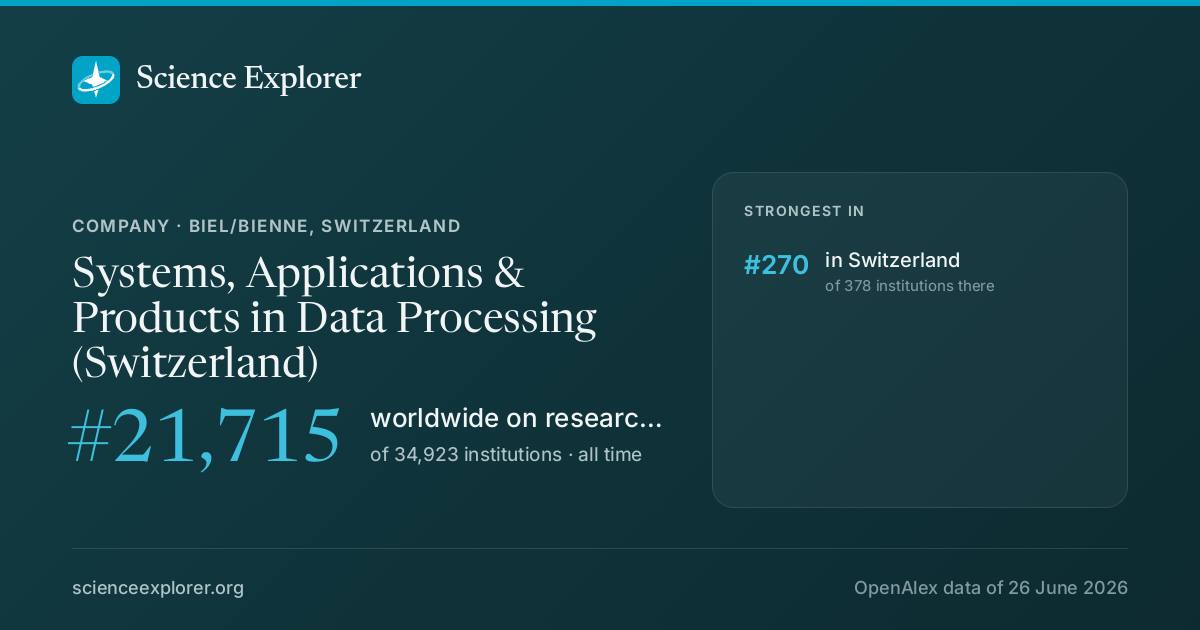
Systems, Applications & Products in Data Processing (Switzerland) on Science Explorer

A card with Systems, Applications & Products in Data Processing (Switzerland)'s standing and the fields it leads in, for a post or a slide. A link to this page previews as the same card.

Download the card

1200 × 630 PNG, sized for social posts, drawn from the latest snapshot.

Badges for a website1Each links back here and updates with every snapshot

Research measures only: rankings here say nothing about teaching, admissions or student experience. Comparable institutions and collaboration partners have tabs of their own, above.

Discussion

Ask a question or share a note about Systems, Applications & Products in Data Processing (Switzerland). Keep it to the research: no personal attacks, advertising or links. Any reader can report a post, which collapses it for everyone until it is opened.
